Author: Burt Webb

  • Geiger Readings for October 25, 2023

    Geiger Readings for October 25, 2023

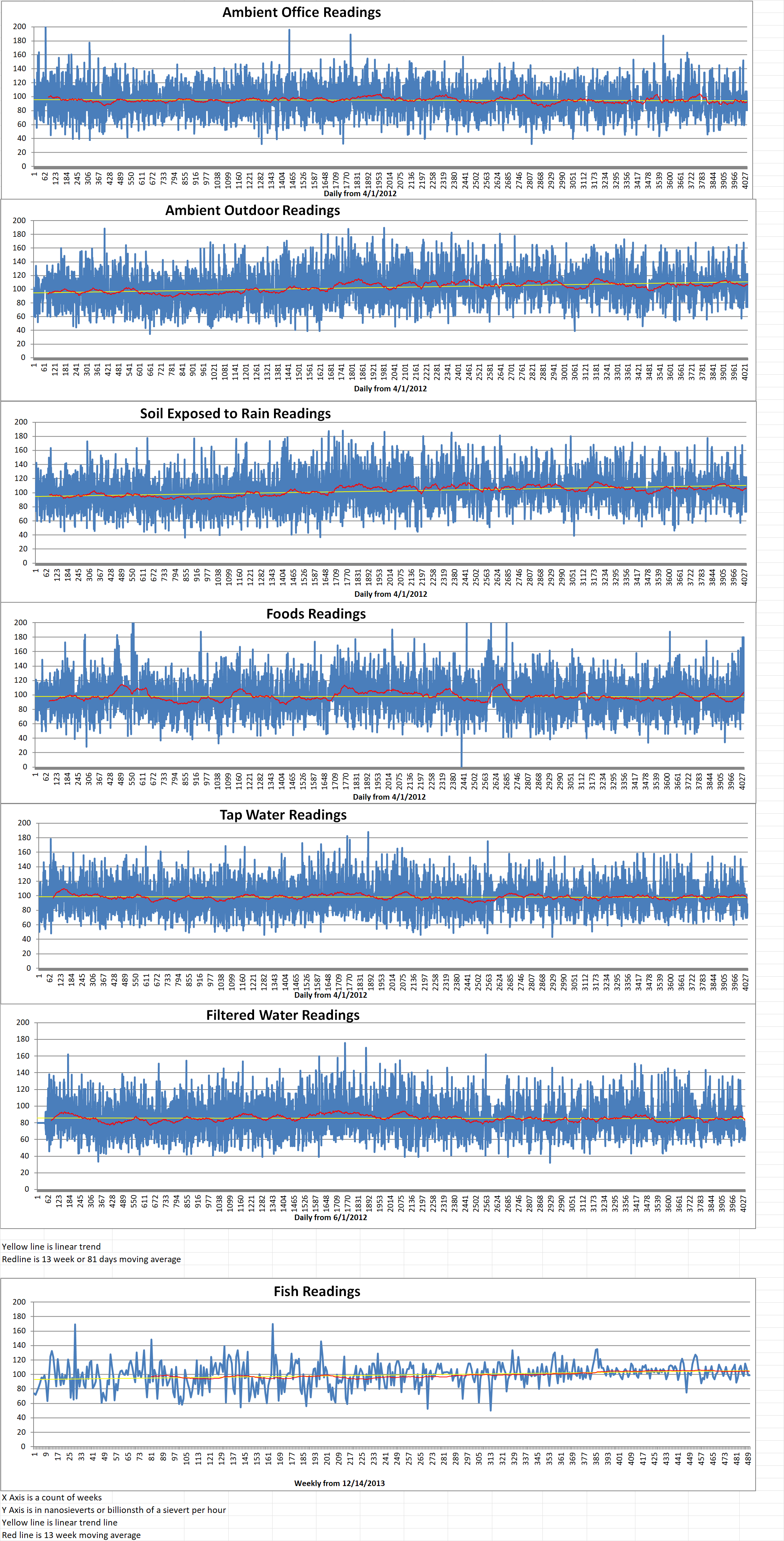
    Ambient office = 86 nanosieverts per hour

    Ambient outside = 165 nanosieverts per hour

    Soil exposed to rain water = 165 nanosieverts per hour

    Red bell pepper from Central Market = 126 nanosieverts per hour

    Tap water = 84 nanosieverts per hour

    Filter water = 79 nanosieverts per hour

  • Nuclear Weapons 837 – Does Israel Have An Effective Nuclear Arsenal – Part 2 of 2 Parts

    Nuclear Weapons 837 – Does Israel Have An Effective Nuclear Arsenal – Part 2 of 2 Parts

    Part 2 of 2 Parts (Please read Part 1 first)
         In the U.S., maintaining and “modernizing” the nuclear weapon stockpile has been possible in part because of the extensive data acquired through earlier tests.
         Sanders-Zarke noted that Israel was suspected of conducting a joint nuclear weapon test with South Africa in 1979. A flash of light picked up by the U.S. satellite Vela near South Africa was the basis of the assessment. Israel is not known to have conducted any other tests. However, Israel did not create its nuclear program without outside assistance.
         In the 1960s, France helped Israel establish the Negev Nuclear Research Centre near the city of Dimona. The Centre is capable of producing nuclear weapons. The U.S. only discovered the facility after construction began.
         Israel has U.S.-made aircraft able to deliver nuclear bombs and German-made submarines able to carry nuclear warheads. Israel has Jericho ballistic missiles able to deliver nuclear warheads over a thousand miles to nearby nations. The exact details of Israel’s nuclear warheads and delivery methods are not known. Its U.S. and German-made vehicles could act as reliable delivery methods if fitted for nuclear warheads.
         In August, the IAEA’s director General wrote in a report that there was a “long-standing and fundamental difference of views” between Israel and other Middle Eastern countries with respect to the regulation of nuclear activity.
         Kimball noted that Israel only has agreements to allow the IAEA to inspect specific facilities and does not have a comprehensive safeguard agreement “to ensure that civilian nuclear activities and materials are not being diverted for nuclear weapons use.” He went on to say that while Israel had a nuclear arsenal, the country had “no justification nor any military need to employ nuclear weapons”.
         Kimball said that the ACA is “deeply concerned about a further escalation of violence against civilian populations. But we are not concerned that this might involve the use of nuclear weapons.”
         Israel has insisted that it has no interest in “introducing” nuclear weapons to the Middle East. However, it has continued to avoid signing comprehensive safeguard agreements with the IAEA.
         In a vote at the U.N. General Assembly last year, a vast majority of member states called on Israel to place all of its nuclear sites under IAEA supervision and to get rid of any nuclear weapons it possessed. The IAEA has not commented on whether Israel has taken any actions in line with this call.
         The civilian death toll in the war between Israel and Hamas since October 7th has already exceeded the death toll of the fifty-day conflict in Gaza in 2014. The bombing of the Al-Ahli Arab hospital in Gaza ignited a world-wide wave of protests. Although there is still uncertainty about the source of the explosion, there were hundreds of civilian deaths.
         Shifting tides among nuclear nations and those feared to join their ranks have made the future of international cooperation on nuclear proliferation uncertain.
         Last week, Russia announced it would begin to revoke its ratification of the comprehensive nuclear test ban treaty. However, they will remain a signatory. The treaty is not in force because it has not been ratified by all necessary parties. When in force, it would ban nuclear explosions for any reason.
         Iran’s U.N. Security Council-imposed ban on ballistic missiles was also lifted on last Wednesday. It banned Iran from acquiring and selling missile technology capable of delivering nuclear weapons. The U.S., Australia and the E.U. have maintained their own sanctions and restrictions against Iran in order to continue limiting Iran’s nuclear potential.

  • Geiger Readings for October 24, 2023

    Geiger Readings for October 24, 2023

    Ambient office = 59 nanosieverts per hour

    Ambient outside = 100 nanosieverts per hour

    Soil exposed to rain water = 96 nanosieverts per hour

    Jalapeno from Central Market = 94 nanosieverts per hour

    Tap water = 79 nanosieverts per hour

    Filter water = 70 nanosieverts per hour

  • Nuclear Weapons 836 – Does Israel Have An Effective Nuclear Arsenal – Part 1 of 2 Parts

    Nuclear Weapons 836 – Does Israel Have An Effective Nuclear Arsenal – Part 1 of 2 Parts

    Part 1 of 2 Parts
         As the war between Israel and Hamas rages on in Gaza, international organizations have expressed their concern over a widening of the conflict because it has the potential to involve nuclear weapons.
         In October, the surprise Hamas attack on Israel started a war that has taken the lives of thousands of civilians. Israel continues to carry out what the head of the U.N. called “collective punishment” against Palestinians civilians. The attack on Israel also exposed a weakness in its military defense. Many question whether Israel could still defend itself with conventional weapons.
         In an October 9th post on X, Israeli lawmaker Revital Gotliv urged his government to unleash a “doomsday weapon” carried by Israel’s Jerico ballistic missiles. However, the extent of Israel’s nuclear capabilities and whether they would be effective in battle is an open question.
         Many international organizations and countries believe that Israel has nuclear weapons. However, Israel has conducted few, if any, tests of such weapons. The mystery that surrounds its nuclear program has raised questions among military experts about the nation’s actual deterrence capabilities. Israel has long maintained a policy of “nuclear ambiguity”. It has never directly confirmed or denied the existence of a nuclear arsenal.
         Daryl Kimball is executive director of the Arms Control Association (ACA). He said, “Israel is universally believed to possess nuclear arms stored in a partially disassembled state”. The nation is believed to have about ninety nuclear war heads as well as the ability to build a hundred more with its fissile materials stockpiles.
         Kimball stated that the use of nuclear weapons or even the threat of their use would make Israel “an international pariah and a target of foreign, conventional military attack”. The International Campaign to Abolish Nuclear Weapons (ICAN) issued a statement recently that “Israel is a nuclear-armed state, the only such state in the Middle East”.
         Alicia Sanders-Zakre is ICAN’s policy and research coordinator. She said, “Israel’s possession of nuclear weapons significantly increases the risks associated with the conflict and contributes to regional tensions. Escalation is a real danger”.
         The International Atomic Energy Agency (IAEA) said that it was “following with concern” developments in the Middle East where it performs activities aimed at preventing the spread of nuclear weapons.
         The Treaty on the Non-Proliferation of Nuclear Weapons (TNPNW) considers the U.S., Britain, China, France and Russia to be “nuclear states”. They have this designation because they built and tested nuclear explosives before 1967. North Korea, Israel, Pakistan and India have nuclear weapons but have never signed the treaty.
         The China Aerospace Science and Industry Corporation Limited is an aerospace defense contractor for the People’s Liberation Army. They recently published a paper in their journal. The paper said that the five treaty-recognized nuclear powers “all have land, sea and air-based nuclear strike capabilities and maintain a high level of nuclear combat readiness”. However, it is believed that Israel only has land-based capabilities. The effectiveness of nuclear strikes based solely on land-based capabilities is “questionable”.
         The nuclear nations that have not signed on to the non-proliferation treaty have conducted less than ten nuclear tests each. The U.S. has conducted more than a thousand nuclear tests. North Korea is the only nation that has conducted any nuclear tests since the end of the 1990s. Although other countries are no longer testing their nuclear weapons, they have been able to maintain their nuclear arsenals through scientific assessments such as computer simulations of nuclear processes.
    Please read Part 2 next

  • Geiger Readings for October 23, 2023

    Geiger Readings for October 23, 2023

    Ambient office = 77 nanosieverts per hour

    Ambient outside = 115 nanosieverts per hour

    Soil exposed to rain water = 116 nanosieverts per hour

    English cucumber from Central Market = 68 nanosieverts per hour

    Tap water = 84 nanosieverts per hour

    Filter water = 70 nanosieverts per hour

  • Geiger Readings for October 22, 2023

    Geiger Readings for October 22, 2023

    Ambient office = 82 nanosieverts per hour

    Ambient outside = 113 nanosieverts per hour

    Soil exposed to rain water = 114 nanosieverts per hour

    Corn from Central Market = 29 nanosieverts per hour

    Tap water = 87 nanosieverts per hour

    Filter water = 73 nanosieverts per hour