Author: Burt Webb
-
Geiger Readings for May 27, 2017
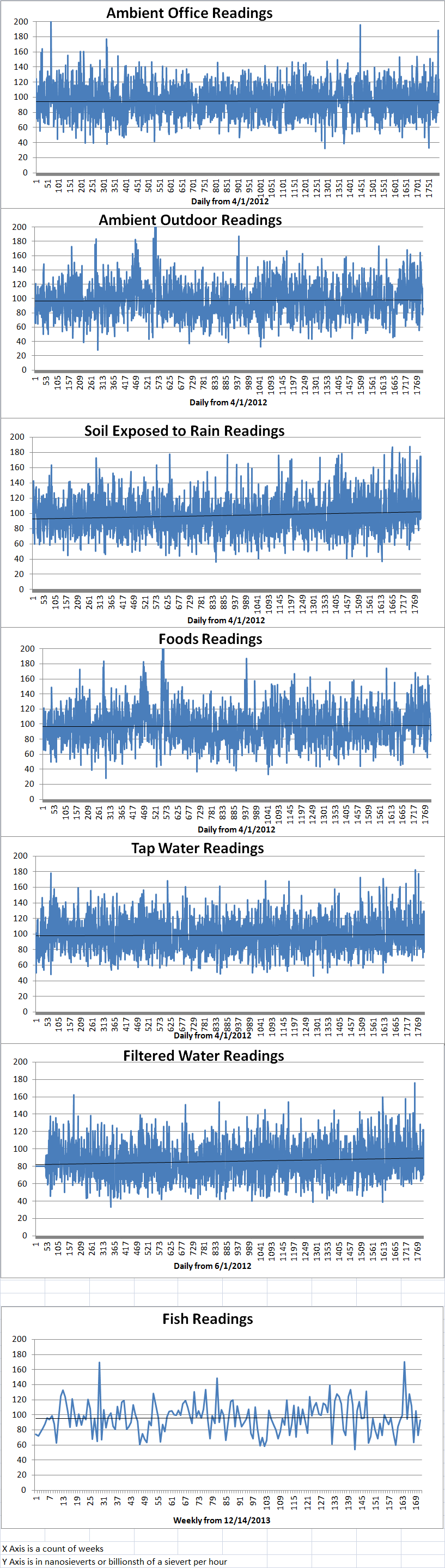
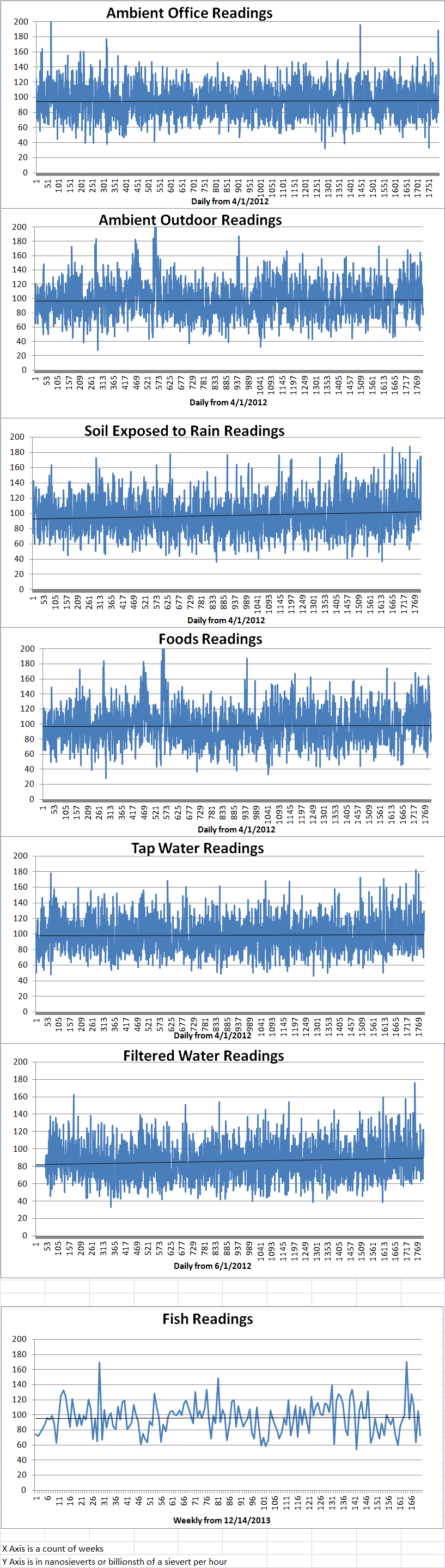
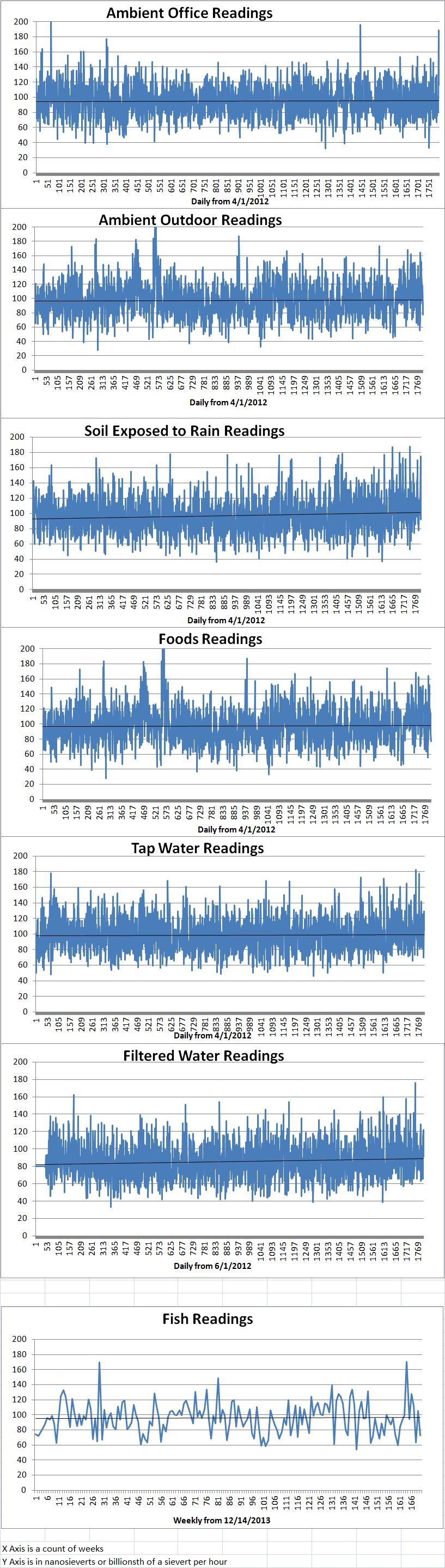
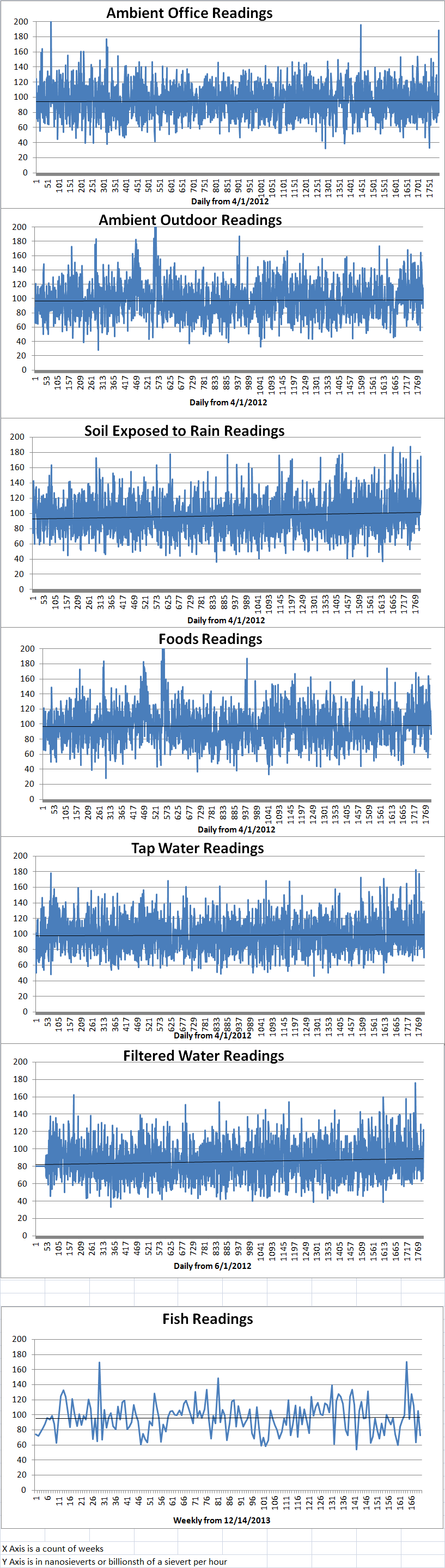
Ambient office = 93 nanosieverts per hourAmbient outside = 109 nanosieverts per hourSoil exposed to rain water = 93 nanosieverts per hourRomaine lettuce from Central Market = 86 nanosieverts per hourTap water = 77 nanosieverts per hourFilter water = 70 nanosieverts per hourDover sole – Caught in USA = 93 nanosieverts per hour -
Nuclear Reactors 283 – Scientists Publish Article That Claims That The Nuclear Regulator Commission Is Underestimating Dangers Of Nuclear Power
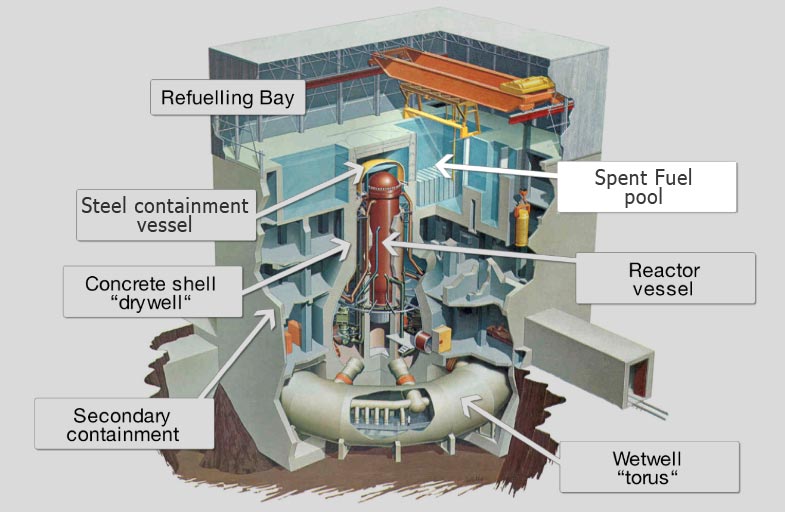
One of the big problems with nuclear reactor safety is the fact that a common design for reactors from General Electric put the cooling pool for the spent fuel rods four stories above the ground in the reactor building. If the cooling systems fail and water drains from the cooling pool exposing the spent fuel rods, they will spontaneously burst into flame. This was one of the main concerns at Fukushima when the emergency generators failed due to flooding and there was no power to keep the pumps going to supply water to the spent fuel pools. There are twenty commercial power reactors in the U.S. that have the old G.E. design.
Following the Fukushima disaster in 2011, national governments including the U.S. reviewed the design of reactors and safety procedures to see if they needed to be revised in light of what happened at Fukushima. Now the U.S. Nuclear Regulatory Commission (NRC) has been challenged with respect to its assessment of the dangers posed by fires in spent nuclear fuel cooling pools.
An article written by researchers from Princeton University and the Union of Concerned Scientists just published in the journal Science claims that the NRC “relied on faulty analysis to justify its refusal to adopt a critical measure for protecting Americans from the occurrence of a catastrophic nuclear-waste fire at any one of dozens of reactor sites around the country.” The article goes on to say that the fallout from an accident that was the result of failing to adopt the measure could be even greater than the fallout from the Fukushima disaster.
U.S. spent fuel pools are overcrowded because there is no permanent spent fuel repository in the U.S. Some of the spent fuel is being transferred to dry cask storage but much more needs to be move out of the pools. It is estimated that if much of the spent fuel is not removed from U.S. reactor cooling pools within five years, some reactors may have to be shut down because there is no place to put more spent fuel.
The current density of the spent fuel rods in U.S. reactor cooling pools is so great that a fire at one of them could release enough radioactive particles into the atmosphere to seriously contaminate an area twice the size of New Jersey. That would be over seventeen thousand square miles. It is estimated that as many as eight million people might have to be relocated and the cost could rise to two trillion dollars.
The article in Science magazine points out that a terrorist attack could lead to a fire at a nuclear power reactor but the NRC refused to consider terrorist attacks when reviewing risks at nuclear power plants. In addition, the NRC also refused to consider any damage caused by a fire at a nuclear power plant that was more than fifty miles away for the site of the plant and the fire. Failing to take these and other dangers into account caused the NRC to seriously underestimate the dangers posed by nuclear power plants.
One of the authors of the article suggested that pressure on the NRC from the nuclear industry and nuclear industry-friendly Congressmen was one of the reasons for the underestimation of risks. The nuclear industry is in serious trouble in the U.S. due to cheap oil and natural gas as well as dropping price for wind and solar. If the full risks of nuclear power were properly assessed by the NRC, the result might be the closure of more nuclear power plants in the U.S.
Diagram of Fukushima Nuclear Reactor:
-
Geiger Readings for May 26, 2017
Ambient office = 105 nanosieverts per hourAmbient outside = 111 nanosieverts per hourSoil exposed to rain water = 105 nanosieverts per hourRedleaf lettuce from Central Market = 102 nanosieverts per hourTap water = 106 nanosieverts per hourFilter water = 100 nanosieverts per hour -
Nuclear Weapons 281 – U.S. Department Of Energy Presents Nuclear Modernization Budget To Congress
I have often mentioned that the U.S. and Russia are both spending huge amounts of money in the near future to modernize their nuclear arsenals. Members of the U.S. defense establishment are currently testifying to Congress about the need for funds to be appropriated for this modernization.
The U.S. stockpiling of nuclear warheads began in the 1950s, during the early days of the Cold War. They have been maintained by the “Enduring Stockpile” program. The weapons are distributed among the three legs of our nuclear triad; land launched nuclear missiles, air launched nuclear bombs and missiles, and sea-launched missiles. Even if an enemy managed to destroy some of our nuclear weapons, those remaining would be able to totally destroy the enemy. The U.S. maintains its nuclear deterrence against the only two nations on Earth that have both the antagonism and the nuclear arsenals to consider striking the U.S.; Russia and China.
This Thursday, Frank Klotz, the head of the National Nuclear Security Administration was on Capitol Hill testifying before the House Armed Services Strategic Forces Subcommittee. He told the committee that half of the budget for the Department of Energy, thirteen billion nine hundred million dollars, would be used for modernizing nuclear weapons in fiscal year 2018. Most of the money will go to the Navy and Air Force. The DoE spent about thirteen billion dollars on such modernization in fiscal year 2017.
Klotz said in his testimony, “We’re very grateful for the level of spending that has been proposed in the president’s [fiscal 2018] budget. It will allow us to tackle some of our very important infrastructure recapitalization projects, such as the uranium processing facility at Y-12 in Oak Ridge, Tennessee. We expect to complete design this year and actually start construction next year We didn’t get into the situation we face with aging and in some cases crumbling infrastructure overnight, and we’re not going to get out of it in a day.”
The nuclear budget will be increased ten point eight percent to ten point two billion dollars. The Naval nuclear reactor program will go up by four point two percent to one point five billion dollars. There will be an increase of salaries for federal employees who staff these programs by eight point one percent to four hundred and eighteen billion dollars. The nuclear nonproliferation programs will remain at their 2017 levels of one point eight billion dollars.
Dr. Rob Soofer, Deputy Secretary of Defense, also testified to the House Armed Services Strategic Forces Subcommittee on Thursday. He pointed out that the only serious deterrent that the U.S. has against a massive nuclear attack is the threat of massive retaliation posed by a modern nuclear arsenal. He said that “strategy, forces and posture also must be flexible enough to maintain stability while adjusting to gradual and rapid technological and geopolitical changes.”
It is estimated that the recapitalization of the U.S. military nuclear program could run between two hundred and thirty billion dollars and two hundred and ninety billion dollars over the next several decades.
General Robin Rand, of the Air Force Global Strike Command, told the committee that “Fiscal constraints, while posing planning challenges, do not alter the national security landscape or the intent of competitors and adversaries. Nor do they diminish the enduring value of long-range strategic forces to our nation.”

-
Geiger Readings for May 25, 2017
Ambient office = 116 nanosieverts per hourAmbient outside = 93 nanosieverts per hourSoil exposed to rain water = 92 nanosieverts per hourIceberg lettuce from Central Market = 77 nanosieverts per hourTap water = 104 nanosieverts per hourFilter water = 91 nanosieverts per hour -
Nuclear Weapons 280 – Six Suggestions For Ways For U.S. To Put Pressure On North Korea – Part Two of Two Parts
Part Two of Two Parts (Please read Part One first)
Impose tougher U.N. sanctions
N.K. currently makes about five hundred million a year by supplying cheap labor to other nations. The U.S. is seeking tougher sanctions for all trade with N.K. to cut off the flow of revenue from international contracts. Some analysts believe that the U.S. should seek explicit sanctions on N.K. “slave” labor to deprive the N.K. regime of money that could be used for their weapons programs. It would be very difficult to impose sanctions tougher than those already imposed. In addition, many of the sanctions imposed have not been honored by other nations who trade with N.K. Having sanction in place that are not actually applied in practice would make the U.S. and the U.N. look weak. Increase failing sanctions may be difficult of not impossible.
Impose U.S.-coalition sanctions
There are calls for the U.S. to form a coalition of nations with the express purpose of applying harsher sanctions to N.K. that have been or could be approved by the U.N. Security Council. This could include issuing warrants for individuals and companies in China who are known to have broken sanctions by trading with N.K. The problem with this approach is that it could offend China to the point where we would lose their cooperation in trying to reign in N.K. weapons development. How would the U.S. respond to another nation issuing warrants for prominent U.S. businessmen?
Cut Access to U.S. banks
The U.S. could cut off access to U.S. banks for any company or individual anywhere in the world that does business with N.K. companies. This would cripple the N.K. weapons sales which represent forty percent of the N.K. economy. While this might seem to be an attractive move against N.K., the unanswered question is what sort of impact such a ban would have on world trade? Such an action by the U.S. against many international companies could result in a tsunami of lawsuits and diplomatic turbulence. Cutting off bank access for a company that only did a small part of their business with N.K. might cause economic and political turbulence that could cause problems for the U.S. far beyond the Korean Peninsula.
While some of the ideas on this list may be useful in our struggle with N.K., a great deal of study would be required to insure that the U.S. does not cause more problems than it is solving. As the severity of sanction mounts, international resistance to sanctions increases. There is a term from chess, “zugzwang” which means that a player has to make a more but no move that he can make will improve his position on the chessboard. We must be very careful in crafting our policy toward N.K. to insure that we do not make the international situation any worse than it already is.
Emblem of North Korea:
:
-
Nuclear News Roundup May 24, 2017
A false alarm that went out to some people’s television sets Tuesday might have scared some in New Jersey. Nbcnewyork.com
President Donald Trump told Philippine President Rodrigo Duterte in a phone call last month that two nuclear submarines were somewhere in the waters near North Korea. Businessinsider.com
-
Geiger Readings for May 24, 2017
Ambient office = 123 nanosieverts per hourAmbient outside = 176 nanosieverts per hourSoil exposed to rain water = 175 nanosieverts per hourAvocado from Central Market = 87 nanosieverts per hourTap water = 129 nanosieverts per hourFilter water = 122 nanosieverts per hour