So far, TEPCO and Japanese government officials have been unable to develop a clear plan of action for decommissioning Fukushima. theantimedia.org
BBC Wrong on Fukushima, Again youtube.com
Five years after a natural disaster and nuclear meltdown, a once fertile landscape is abandoned. nationalgeographic.com
Documentary director says that is ‘Shocking how many people died in Fukushima.’ rt.com
Five years after the nuclear plant meltdown at Fukushima, Japan has begun the controversial process of restarting its other reactors. oregonlive.com
China General Nuclear and the Chinese Academy of Sciences have just signed a strategic cooperation agreement to collaborate in the development of accelerator-driven systems which could be used to transmute spent nuclear fuel. The system could also be used to operate subcritical thorium nuclear reactors. The agreement was signed in Beijing on the 9th of March following a forum featuring both of these organizations. These two organizations have worked together for many years. An agreement on scientific and technical cooperation was signed in the fall of 2006.
CGN stated that the agreement would be based on “complementary advantages, win-win cooperation and common development in the research and development of accelerator-driven systems. By signing this agreement, the two sides will further establish long-term strategic alliances and partnerships to accelerate the development of advanced nuclear energy systems.”
Accelerator-driven systems are called that because they are based on the acceleration of subatomic particles such as protons. The protons hit a spallation target such as liquid lead-bismuth which generates neutrons. The accelerated neutrons are directed at a target called a blanket that contains some sort of fissionable materials. Long lived radionuclides can be extracted from spent nuclear fuel, mixed with fresh fuel and subjected to bombardment by an accelerator. This causes the long-lived isotopes to fission and transmute into short-lived isotopes which means that the radioactive waste is “hot” for a much shorter period of time. Such a process can also produce useful energy.
In a regular power reactor with neutrons supplied by the fuel in the rods, the only way to shut it down is to insert control rods which absorb the neutrons and lower the neutron flux below the point required for sustaining a fission reaction. One of the benefits of an accelerator driven system lies in the fact that the neutrons that cause the fission are coming from the outside and not being generated from within the fissionable material. In order to shut down an accelerator-driven system, it is only necessary to turn of the accelerator which supplying the neutrons. Without the neutrons to keep the reactions going, the reactor shuts down. This is much simpler, easier and faster than the shut down procedure in a standard reactor. This also makes operation of an accelerator-driven system much safer than a conventional reactor.
Research on thorium reactors has been carried out by different nations since the dawn of the atomic age in the 1950s. Thorium alone is not capable of generating sufficient neutrons to cause fission and generate power. Some other material like U235 or plutonium must supply the needed neutrons. One of the big problems with thorium reactors to date has been coping with the higher heat and pressure that is required for their operation. Some designs employ a bath of molten sodium which is highly flammable when it encounters water or air. This makes it very dangerous to deal with. An accelerator-driven system solves both of these problems. In an accelerator-driven system, the neutrons supplied by the accelerator can cause the thorium to fission and provide power. India, in particular, is starving for energy and has huge reserves of thorium. The development of a practical commercial thorium reactor based on an accelerator would be a great boon to India.
Thought it was time for an update on the big Hinkley Point C project in Britain. This is a real circus. The project is huge with a budget over twenty billion dollars for the construction of two nuclear power reactors. The contract for construction is held by the French government owned company, EDF.
EDF is in serious financial trouble because of a couple of major nuclear projects in France that are behind schedule and over budget. Also, the steel reactor vessels that were going to be used turned out to have too much carbon in the alloy which reduced their strength below acceptable standards.
Looking for investors, EDF set up an arrangement last October with a Chinese nuclear company named China General Nuclear Power Corporation, a state owned entity. The CGNPC is going to take a one third stake in the project. In order to get the Chinese involved, the British had to promise to let them build a Chinese designed reactor in Britain with Chinese labor. This upset the British labor unions as well as the British security forces. Then Britain got hit with a legal challenge because of European Union rules about outside investors in major projects.
The British government has promised to pay about twice as much for the electricity generated by the new reactors than the current price for electricity in Britain. Consumers fear that the price of electricity from other sources will stay low and those being supplied by the new Hinkley Point C reactors will wind up pay too high a price. This also caused another lawsuit claiming that Britain was violating EU rules about government support for private projects.
Now for the update.
The problem with too much carbon in the reactor vessels has been solved. EDF claims that they are going to use a different manufacturing process with different size chunks of steel that will produce reactor vessels that are sufficiently strong to meet regulatory standards.
The project was supposed to start construction within weeks of the deal set last October but EDF has been holding off making a final decision on the financing for the project because of their internal problems. Now they say that they will deliver final approval by the first of April even though there is strong resistance on the EDF board from the labor representatives. The Finance Director of EDF just resigned because he said that he cannot personally support the project proceeding for at least three years while EDF sorts out its financial problems.
Another reason for the delay is that in spite of the announcement of a deal with the Chinese last October, EDF says that they still do not have a signed contract for the Chinese participation because the due diligence of the CGNPC company was taking longer than expected due to the extraordinary complexity of the project. When the lack of a signed contract with CGNPC was made public recently, EDF faced a storm of criticism.
The Hinkley Point C project is a fascinating spectacle as promoter of nuclear power try desperately to move the project forward as problem after problem blocks their progress. Hopefully, this giant mess will collapse soon and save the ratepayers of Britain a huge hike in their electric bills.
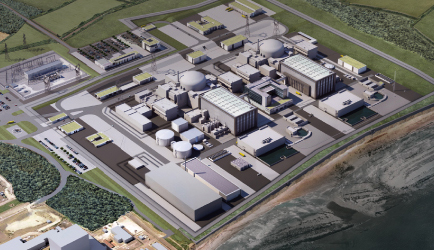
Artist’s concept of new Hinkley Point C power station: