I have blogged recently about the left-over radioactive pollution from the Cold War and the development of nuclear weapons. There are a number of famous sites where the weapons work was carried out that are horribly polluted to this day such as the Hanford Nuclear Reservation in Washington State. But in addition to the actual sites where the work was done, there are other places where the pollution generated by weapons work has leaked and migrated to ordinary neighborhoods. Currently, there are residential areas around St. Louis where radioactive pollution from the Cold War is a serious concern.
A great deal of nuclear weapons work was carried out in the St. Louis area during the Cold War. The U.S. Army Corp of Engineers (ACE) has been cleaning up contamination in industrial and commercial sections of the St. Louis area for years. Coldwater Creek runs through an area in St. Louis where waste from the nuclear weapons work was stored. The creek continues on through residential areas and ultimately runs into the Missouri River. Federal authorities has acknowledged that the creek contains radioactive contamination and have included it in their cleanup work. One major ongoing question is just how far the nuclear contamination was spread by the creek.
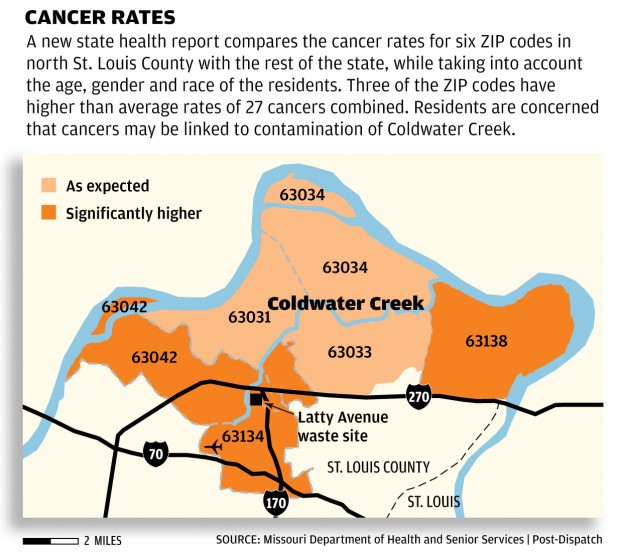
Past and present residents of the area claim that contamination from the creek spread into their neighborhoods during periods when the creek flooded. They have argued for broad sampling of houses and yards for contamination. They also claim that there an are unusually large number of cancer cases and other health problems that may be linked to radioactive exposure. Last fall, the Missouri Department of Health and Senior Services sent a letter to federal officials stating that a significantly higher occurrence of leukemia in areas around Coldwater Creek had been found. The MDHS said that it had not determined whether or not the leukemia cluster had been caused by contaminants from the nuclear weapons work. It requested federal assistance for further research on the subject.
Thorium, the radioactive isotope of hydrogen, is the primary pollutant being discussed. The ACE has, for the first time, admitted that thorium has been discovered in the ground of three neighborhoods around the creek. The federal authorities say that the thorium is at least six inched below the ground and is not a threat. The ACE says that it intends to include thorium found in residents yards in its cleanup. They are going to be doing more sampling in the general area where the thorium has been found and expect to find more.
The ACE has also found lower levels of thorium contamination in three other places along the creek including two public parks. The contaminated areas of the parks have been fenced off according to the city manager of Hazelwood. The non-contaminated areas of the parks have remained open for public use. However, the city manager is considering closing the rest of the parks because of public protests.
A citizens group has reacted to the admission from the ACE by saying, ” “We have proof from the federal government that thorium is in people’s backyards.” The existence of these sites is a sad reflection on environmental priorities versus military priorities in our country. Some of the hundreds of billions of dollars that the federal government spends each year on defense should be shifted to cleaning up the radioactive contamination from the production of nuclear weapons during the Cold War.