Blog
-
Geiger Readings for May 28, 2015
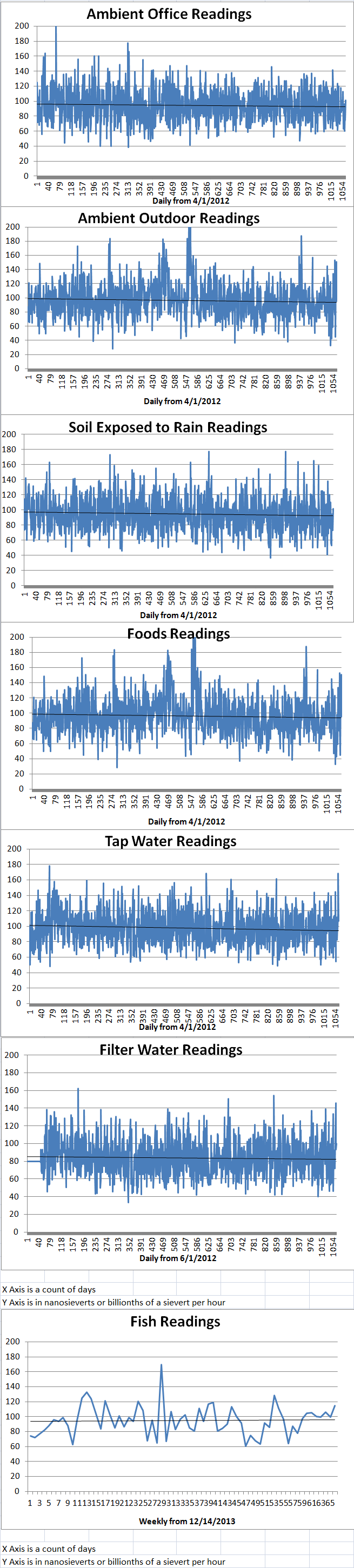
Ambient office = 120 nanosieverts per hourAmbient outside = 107 nanosieverts per hourSoil exposed to rain water = 106 nanosieverts per hourMango from Central Market = 111 nanosieverts per hourTap water = 67 nanosieverts per hourFiltered water = 60 nanosieverts per hour -
Nuclear Reactors 246 – Chinas Questionable Nuclear Power Ambitions
China has the most ambitious plans for nuclear reactor construction in the world today. They intend to spend tens of billions of dollars on the construction of dozens of nuclear power reactors by 2020. This would raise the share of Chinese electricity from nuclear from three percent to six percent. Considering the cost and possible problems with such ambitions, that does not seem like much of a benefit.
Following the 2011 disaster at Fukushima, China declared a moratorium on new reactor construction for a review of reactor siting and safety measures. A few months ago, the moratorium was lifted and the construction of two new reactors was approved. It would appear that it is full speed ahead for their reactor construction boom.
The U.S. has signed a deal with China to facilitate purchase of U.S. designed reactors and to possibly provide technology to allow China to process plutonium from spent fuel. (This seems rather odd as the Pentagon is getting worked up about the military threat posed by China.)
Now a Chinese nuclear physicist named He Zuoxiu is speaking out publicly against the wisdom of the aggressive Chinese reactor program. He says that the plans for construction of so many reactors in such a short time is dangerous. He insists that there is not sufficient time being allocated to put in place the safety and monitoring expertise that will be necessary to prevent major accidents.
As would be expected, there are two competing voices on the Chinese reactors ambitions. One of the groups is stressing the need for safety and the other is stressing the need for fast development. He is concerned about the dangers of corruption, poor management, poor oversight and bad decision making with respect to the development push. He says that the plan to build fifty eight gigawatts of nuclear generation capacity by 2020 is “insane.”
He is calling for China to halt new reactor approval and just finish the reactors now under construction. Most of China’s currently operating reactors were started after 2000. He points out that China just does not have sufficient experience in reactor construction and operation to embark on such an ambitious building program. A few decades of successfully operating existing reactors and those under construction would provide a base of experience to build more in the future.
Chinese authorities claim that they have taken the lessons of Fukushima into account but He counters that the Chinese experts did not pay sufficient attention to the role that the failure of human institutions played in the disaster. China had considered instituting stronger safety standards after Fukushima but the pressure for rapid nuclear expansion partly driven by profit-seeking companies caused rejection of those stronger standards. There is no independent watchdog agency for nuclear regulation in China and it is risky to go against official government policy which discourages whistle blowers.
He is especially worried about plans to build a lot of power reactors inland. The government has been claiming that they could build reactors in desert areas but there is no water for cooling in deserts. Any inland area of China with sufficient water to cool a reactor and sufficient demand to take the electricity is densely populated. An accident inland could contaminate rivers that supply water for hundreds of millions of people as well as pollute groundwater that is needed for huge areas of farmland.
A uranium processing plant project in Guangdong has already been cancelled because of public resistance. One major accident at a Chinese nuclear power plant would mobilize huge masses of people against the construction of any new reactors. I think that it is highly unlikely that China will complete construction of dozens of new power reactors by 2020.

-
Geiger Readings for May 27, 2015
Ambient office = 59 nanosieverts per hourAmbient outside = 119 nanosieverts per hourSoil exposed to rain water = 124 nanosieverts per hourCarrot from Central Market = 114 nanosieverts per hourTap water = 87 nanosieverts per hourFiltered water = 73 nanosieverts per hour -
Nuclear Reactors 245 – France’s Areva is Having Financial Problems
My last three posts were about the Russian state owned nuclear technology company Rosatom and their issues with participation in the nuclear technology market. Today I am going to discuss some difficulties that France’s nuclear technology company Areva is having. Areva is one of the major nuclear reactor construction companies in the world and the only such company in Europe.
The Hinkley Point C project in Great Britain is the current high profile project for Areva and its cost is about twenty six billion dollars. The project calls for the construction of two reactors based on the European Pressurized Reactors (EPR) design. The two reactors to be built in Somerset area of southwest England will be the first reactors to be constructed in many years in Great Britain. The project was approved by the British government and a fixed purchase price for the electricity from the reactors was guaranteed. Although there was a problem with the legality of state price guarantees in the European Union, the European Commission eventually ruled in favor of the project. Austria was not satisfied with the ruling of the Commission and intends to challenge it in court.
Despite the approval of the various governing agencies and the guaranteed price, investors have been slow to put money into the project. Although companies from Kuwait, Qatar, Saudi Arabia, and Great Britain have been mentioned as potential investors, none of them have invested yet. China’s National Nuclear Corporation has been also been suggested as an investor but their involvement was contingent on China being granted ownership of a new nuclear power plant at the Bradwell site in Essex in the southeast part of England. National security concerns have been raised in England over granting China access to the national power grid.
Another reason for investor reluctance, is based on the requirement that Areva has to come up with at least ten percent of the total cost of the project. In the fall of 2014, Areva admitted that it was having problems raising the ten percent share and might not be able to satisfy that requirement.
Areva’s current financial problems are a result of its involvement in another reactor construction project in Finland at the Olkiluoto site. Areva lost about five and a half billion dollars on the Olkiluoto project in 2014. The project was originally scheduled for 2009 but was recently pushed out to 2019.
Areva has announced that it is planning on investing around a billion dollars in a turn-around plan. To raise that money, they may have to lay off as many as one thousand people and sell some of the company’s assets. EDF, the French national energy utility is expect to assist in the recovery plan.
India is working on a deal with Areva for an EPR in Jaitapur and Areva has ambitions to sell EPR reactors to Saudi Arabia and other Arab countries. The cost overruns and schedule delays in Finland and on domestic reactor projects in France will not be good selling points for such exports.
Soon the French government will have to contract for the decommissioning of French reactors reaching the end of their life spans. The estimated cost of decommissioning is over three hundred billion dollars. It is probable that this cost (which could easily rise) will reduce the money available to assist Areva in its ambitions to export the EPR technology.
-
Radiation News Roundup May 26, 2115
The final report expected from the United Nations’ International Atomic Energy Agency on the Fukushima Daiichi nuclear power plant accident that occurred in March 2011, says the three-reactor meltdown was due, in part, to the lack of a response to concerns that a tsunami event could hit the plant, Japanese media are reporting. nuclearstreet.com
The Cigar Lake uranium project in northern Saskatchewan is now officially in commercial operation, Cameco has announced. world-nuclear-news.org
-
Geiger Readings for May 26, 2015
Ambient office = 102 nanosieverts per hourAmbient outside = 87 nanosieverts per hourSoil exposed to rain water = 101 nanosieverts per hourBartlett pear from Central Market = 95 nanosieverts per hourTap water = 115 nanosieverts per hourFiltered water = 100 nanosieverts per hour -
Nuclear Reactors 244 – Problems in the Russian Nuclear Export Industry – Part Three of Three Parts
Part Three of Three Parts (Please read Part One and Two first)
At the end of last year, Rosatom claimed that it had over one hundred billion dollars in contracts for the construction of twenty seven nuclear reactors. However, these are not really signed contracts for construction. They are general agreements to proceed with planning and the drafting of actual contracts. They are often referred to as “strategic partnerships for the development of nuclear power.”
At the end of 2014, Rosatom publicized a deal with South Africa in the Russian media. The claim was that this was an order for eight new power reactors and related nuclear infrastructure worth about forty billion dollars. However there was wide-spread criticism after details of the deal leaked out. The agreement does not call for any Russian liability in case of a nuclear accident, it provides for tax exemptions and includes the requirement that South Africa must get permission from Russia before dealing with any other nuclear technology supplier. The South African government which had tried to keep the details secret claimed that it had not selected a nuclear contractor yet and that it had signed agreements with several other countries for possible nuclear technology imports.
Rosatom is only currently constructing two new reactors inside Russia and a few outside Russia even though it had promised more. Any new construction Rosatom is engaged in is suffering cost overruns and is behind schedule. It is unlikely that Rosatom has the resources to construct twenty or more new reactors in the next decade despite questionable claims of many orders.
In the next decade, Rosatom will be called on to decommission old reactors that have reached the end of their lifespan. This work will be extremely costly and Rosatom will expect the government to provide funds. It is unknown whether the Russian economy will have recovered from soft fossil fuel prices and Western sanctions by the time these reactors need to be decommissioned. Even though money for loans extended to counties purchasing Russian nuclear technology will make their way back to Russia, it may take decades under the generous terms of the loans being discussed. There may be calls for issuing renewals of licenses for the old reactors but they are breaking down and this would most likely lead to serious accidents.
In 2014, Rosatom promised to build dozens of new reactors for many other countries including India, China, Iran, Algeria, Jordan and Saudi Arabia. Rosatom hoped to sign deals with South Africa, Egypt and Kazakhstan. If new reactors are ordered, Rosatom may be forced to stall for time by “slow-walking” the order process in order to give fossil fuel prices and the Russian economy a chance to recover.
Arguments for government assistance for Rosatom include a concern that Rosatom will lose market share if they are unable to compete in the international nuclear export market. considering problems facing other nuclear contractors such as France’s Areva and companies in Japan, South Korea and China, there may not be much competition for a shrinking global nuclear market.
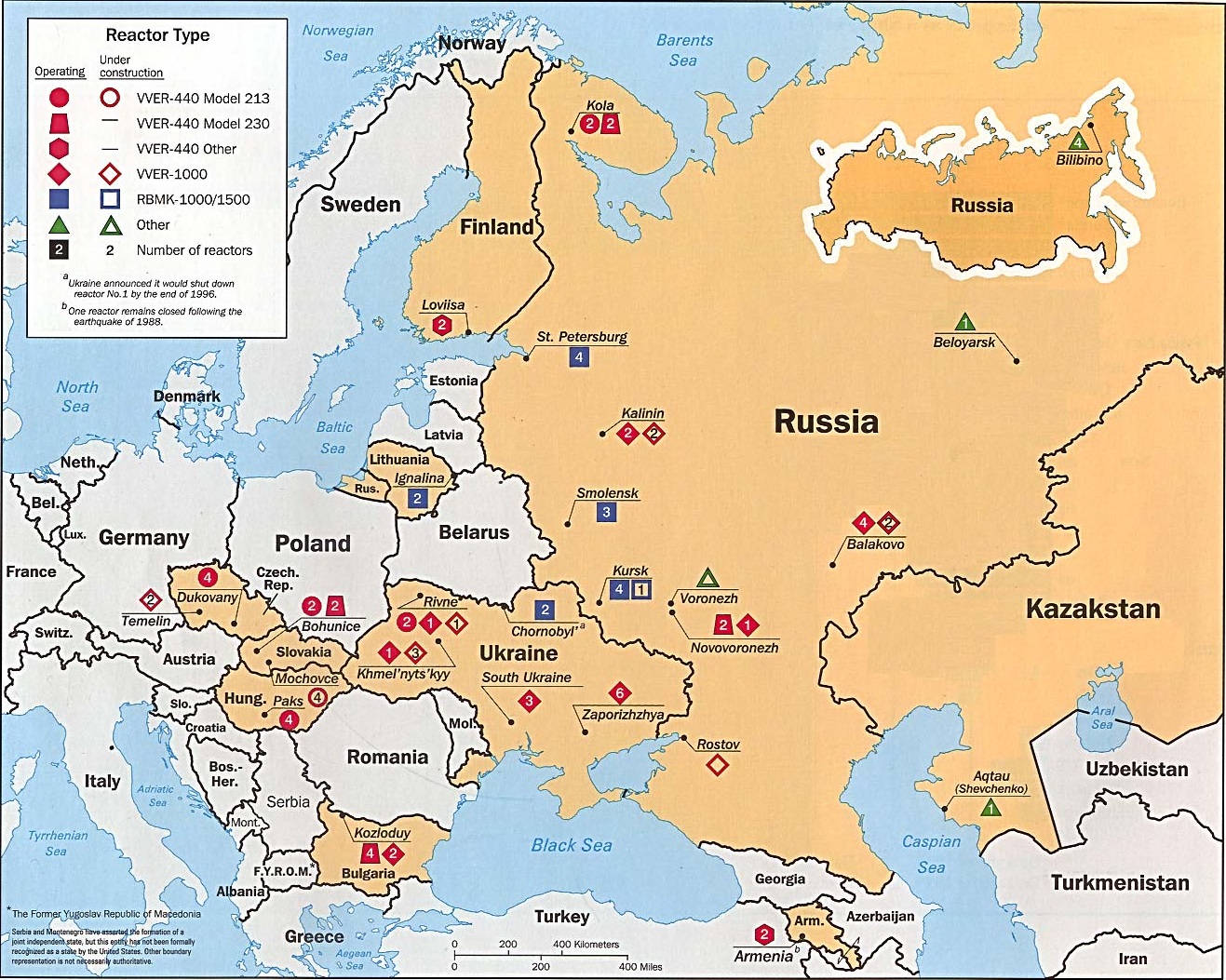
Soviet Designed Nuclear Reactors:
-
Geiger Readings for May 25, 2015
Ambient office = 74 nanosieverts per hourAmbient outside = 81 nanosieverts per hourSoil exposed to rain water = 73 nanosieverts per hourVine ripened tomato from Central Market = 153 nanosieverts per hourTap water = 197 nanosieverts per hourFiltered water = 93 nanosieverts per hour