Blog
-
Geiger Readings for March 08, 2014
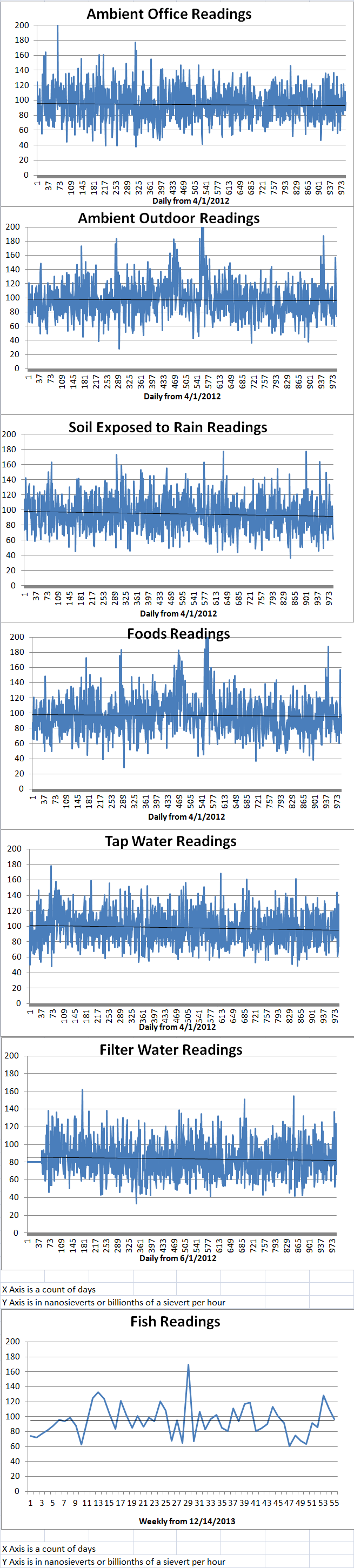
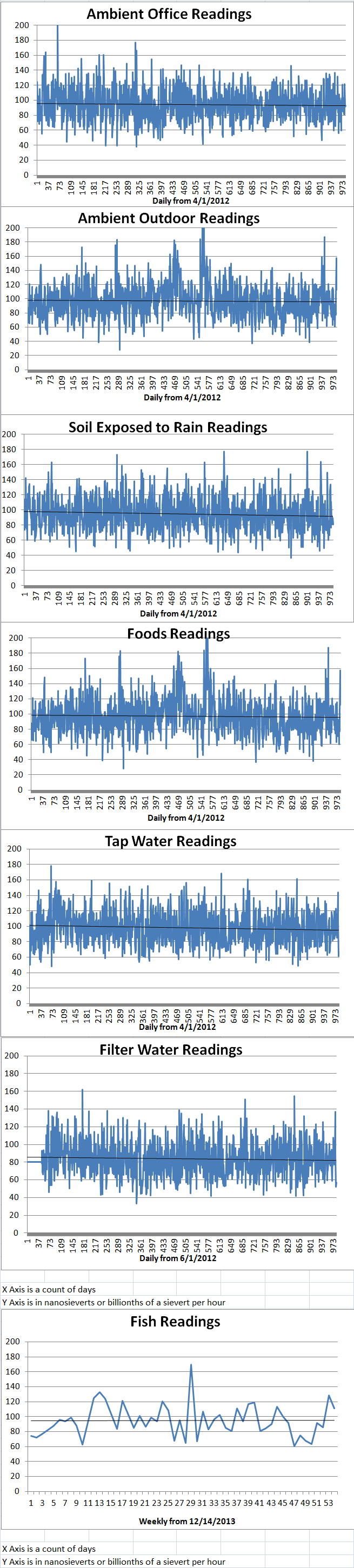
Ambient office = 97 nanosieverts per hourAmbient outside = 48 nanosieverts per hourSoil exposed to rain water = 62 nanosieverts per hourCrimini mushroom from Central Market = 978 nanosieverts per hourTap water = 74 nanosieverts per hourFiltered water = 66 nanosieverts per hour -
Radiation News Roundup March 07, 2014
A rise in contaminated water in the “C” drainage channel at Fukushima was detected around Thursday. fukuleaks.org
They are burning the contaminated rubble and soil from Fukushima and turning the ash into “Eco Cement” and using it to build publicly, including construction for the Olympic games. zengardner.com
-
Geiger Readings for March 07, 2014
Ambient office = 86 nanosieverts per hourAmbient outside = 82 nanosieverts per hourSoil exposed to rain water = 72 nanosieverts per hourCrimini mushroom from Central Market = 74 nanosieverts per hourTap water = 128 nanosieverts per hourFiltered water = 123 nanosieverts per hour -
Nuclear Reactors 217 – Assessing the Risk of Nuclear Reactors
Assessing the risks associated with different actions is something that we do every day. Whether it has to do with taking an umbrella because it might rain or taking a medication that has nasty side effects, we are always weighing the risks against benefits, pros and cons. Our lives are full of tradeoffs. Scientists have worked to created procedures for evaluating risk and reward in a formal framework. This is very important because leaders are always trying to decide the best course of action with respect to serious social, environmental and economic issues. Nuclear power is major source of electrical generation in the U.S. and it has a lot of attendant risks. How does the U.S. Nuclear Regulatory Commission assess the risk of a nuclear power plant?
The NRC has three primary questions that it asks when assessing risk.
1. What can go wrong?
2. How likely is it to go wrong?
3. What at the consequences if something goes wrong.
They refer to this set of questions as the “risk triplet.” The most important issues to consider are those that have a high likelihood and a serious consequence. After such considerations, analysis moves on to low likelihood and serious consequences. Finally, some thought can be given to low likelihood with low consequences.
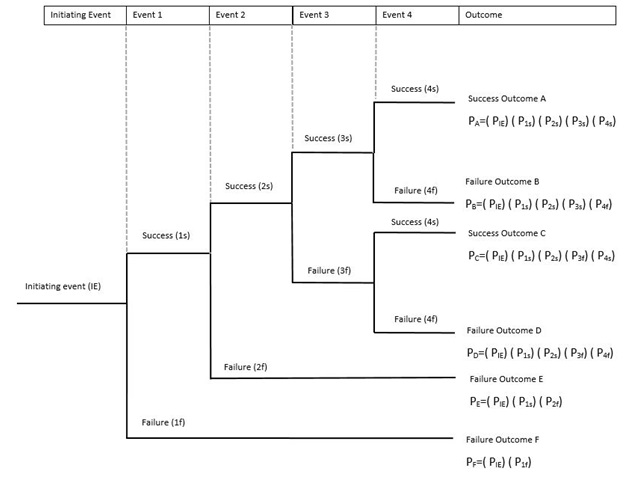
The primary tool for risk analysis at nuclear power plants is something called probabilistic risk assessment (PRA). Engineers use mathematical techniques to work out probabilities for the risk triplets. From the outcome of this analysis, an “event tree” and a “fault tree” are created. These “trees” map out sequences of possible occurrences and consequences in a systematic way. An event tree starts with an initiating event and then shows the different ways that subsequent events play out with either a positive or negative outcome. Fault trees are used to consider what the probability is for each of the different event sequences in the event tree.
When a chain of events results in the failure of a system, the fault tree allows the engineers to work through what went wrong at what stage in order for the system to crash. In some cases one of two things might go wrong. In other cases, several things can go wrong together. When working on system design, special attention is given to those possible event sequences that lead to system failure with serious consequences. The most dangerous possibilities receive the most attention in designing a system that is unlikely to fail in those ways.
One problem with the risk assessment process is that sometimes the engineers are simply not aware of some things that could go wrong. Some system failures are a surprise. A second problem is the fact that estimations of the probability of a particular event can be very wrong. Unfortunately, this is a place where politics can enter what should be an engineering question. Sometimes, parties involved in the promotion of a nuclear power plant will deliberately play down dangers in order to gain public support. And, finally, with respect to the third member of the risk triplet, projections of the consequences of system failure at a nuclear power plant are minimized in the name of profits. Risk assessment is a very important part of engineering and should be executed without respect to political or economic consideration.
Event tree example:

-
Radiation News Roundup March 06, 2014
-
Geiger Readings for March 06, 2014
Ambient office = 111 nanosieverts per hourAmbient outside = 101 nanosieverts per hourSoil exposed to rain water = 105 nanosieverts per hourCrimini mushroom from Central Market = 95 nanosieverts per hourTap water = 84 nanosieverts per hourFiltered water = 62 nanosieverts per hour -
Nuclear Weapons 125 – Breakout Time Is Not A Valid Criterion For Judging Iranian Nuclear Weapons Potential – Part 2
Part 2 of Iranian Breakout Time Misperceptions (Please read Part 1 first):
3. Proponents of the breakout time criterion claim that this process is the most likely way that Iran would create nuclear weapons at known Iranian nuclear facilities. This is contradicted by the fact that other nations such as Libya, Syria, Iraq, Romania and North Korea have all built clandestine sites to secretly work towards nuclear weapons. Two of Iran’s nuclear facilities had been secret until uncovered by U.S. intelligence. If Iran does decide to work on creating a nuclear arsenal, it is most likely that it will be at secret sites that would not be open to inspection. This could be called “sneakout” as opposed to “breakout.”
4. Proponents of the breakout time criterion claim that the shorter the estimated breakout time, the more the U.S.’s ability to prevent an Iran bomb is reduced. The truth is that any detection by current inspections of weapons grade uranium at any Iranian nuclear facility would trigger alarms that would result in immediate attention by the U.S. and other countries involved in the negotiations with Iran. Contingency plans for military intervention could be drafted and implemented in days which means that estimates of breakout in months are not the determining factors for a response.
5. Proponents of the breakout time criterion claim that the shorter the estimated breakout time, the more likely it is that Iran will attempt it. On the other hand, Iran has had an estimated breakout time of a few months for four years and they have not made an attempt to build a bomb yet. Currently Iran is negotiating for monitoring and inspections that would expand the estimated breakout time to a year. U.S intelligence says that Iran has had the scientific, technical and industrial capacity to produce nuclear weapons since 2007 but has not chosen to do so.
Breakout time is a simple way of assessing nuclear weapons activity but it is not sufficient to really answer the question of how long it would take a particular nation to actually design, build, test and manufacture an nuclear arsenal that could serve as a real deterrent to hostile neighbors. Iran’s leaders are very shrewd at negotiating. They are balancing external threats against international sanctions. They are working hard to drive the best bargain that they can.
Some factions in the U.S. Congress have advocated an attack on Iran for years. Israel has hinted that if the U.S. does not participate in military action against Iran soon, Israel will unilaterally attack Iranian nuclear sites. This would be a very dangerous move for Israel and could destabilize the Middle East even further. Negotiations are rapidly approaching a deadline for a nuclear deal with Iran. Negotiators are afraid that the hawks in the U.S. Congress will ram through legislation that would impose much harsher sanctions on Iran if a deal cannot be finalized by the deadline. Critics say that this action by the U.S. could make future negotiations much more difficult.
Iranian nuclear facilities:
-
Radiation News Roundup March 05, 2014
Fukushima is Japan’s and the world’s radiation nightmare that will not go away in our lifetimes nor our children’s or grandchildren’s. sorendreier.com
After more than a decade of extra-stringent oversight, Nuclear Fuel Services will soon return to normal levels of Nuclear Regulatory Commission involvement. johnsoncitypress.com
-
Geiger Readings for March 05, 2014
Ambient office = 92 nanosieverts per hourAmbient outside = 72 nanosieverts per hourSoil exposed to rain water = 81 nanosieverts per hourRed bell pepper from Central Market = 112 nanosieverts per hourTap water = 67 nanosieverts per hourFiltered water = 57 nanosieverts per hour -
Nuclear Weapons 124 – Breakout Time Is Not A Valid Criterion For Judging Iranian Nuclear Weapons Potential – Part 1
Part 1 of Iranian Breakout Time Misperceptions:
I have posts many links to articles dealing with the efforts of major nuclear powers to negotiate regulation of Iran’s nuclear program. The exact details of the negotiations have been kept secret so I have not posted my own comments on these efforts. The Prime Minister of Israel just gave a speech to the U.S. Congress about the dangers of a Iranian nuclear weapons program. The PM has been accusing Iran of developing nuclear weapons for years but even the Mossad, the Israeli intelligence service disagrees with his arguments that Iran is on the verge of creating nuclear weapons. Today I am going to post the first of two articles reviewing some misperceptions about the Iranian nuclear program.
One of the big arguments between the U.S. and Israel with respect to the Iranian nuclear program is the fact that some of the technology being discussed could, in theory, be repurposed to the creation of nuclear weapons. The U.S. is willing to allow Iran to keep their uranium enrichment equipment as long as there is a strict international program for inspecting Iran’s nuclear facilities. The PM of Israel has said that it is unacceptable for Iran to even have the technology that could be used to enrich uranium to weapons grade. One of the key measures that the U.S. Congress will be using to weigh any agreement with Iran will be something called the “breakout time” which is defined as the minimum time Iran would need to create fifty five pounds of weapons grade uranium. This is the amount of fissile material needed to create a single atomic bomb. Critics of this criterion say that the breakout time is a misleading and inadequate criterion for judging agreements with Iran for the following reasons.
1. Proponents of the breakout time criterion say that it is a good indicator of the time that would be required to build an nuclear bomb. Obtaining fifty five pounds of weapons grade uranium would only be the first step. Converting the enriched uranium fluoride gas into a powder, turning the power into a metallic core, surrounding the core with explosives and integrating the whole assembly into a miniaturized warhead would then follow. It is estimated that it might take from six months to eighteen months for this additional processing. Then the bomb would need to be tested.
2. Proponents of the breakout time criterion say that it can be measured accurately. Actually, only estimates are possible and they can vary widely depending on some underlying assumptions with respect to centrifuge efficiency, chemical conversion of uranium to feed the centrifuges, setting up centrifuge cascades and recycling waste. Often breakout time estimates are also assuming that Iran has none of the technical problems that have plagued its nuclear program in the past. Realistically, Iran would need two bomb to start in order to test one. This doubles breakout estimates. Simply proving that it could make a bomb would not serve as a nuclear deterrent. Even a small arsenal would multiply the breakout time again.
(Continued in Part Two tomorrow)
Iranian nuclear sites: