Maybe robots can help to bring a speedy end to the nuclear mess at Fukushima. rense.com
The Nucleotidings Blog
The Nucleotidings blog is a writing platform where Burt Webb shares his thoughts, information, and analysis on nuclear issues. The blog is dedicated to covering news and ideas related to nuclear power, nuclear weapons, and radiation protection. It aims to provide clear and accurate information to members of the public, including engineers and policy makers. Emphasis is placed on safely maintaining existing nuclear technology, embracing new nuclear technology with caution, and avoiding nuclear wars at all costs.
Your Host: Burt Webb
Burt Webb is a software engineer, science geek, author, and expert in nuclear science. Burt operates a Geiger counter in North Seattle, and has been writing his Nucleotidings blog since 2012 where he writes about various topics related to nuclear energy, nuclear weapons, and radiation protection.
Burt Webb has published several technical books and novels. He works as a software consultant.
Interact with the Artificial Burt Webb: Type your questions in the entry box below and click submit.
Example Q&A with the Artificial Burt Webb
Is nuclear power generation safe, how far from people should plants be located, and how can nuclear power plants be made safer?
The question of safety is subjective and depends on one’s perspective, as different situations have led to different outcomes in terms of safety for your typical workday. On one hand, nuclear power plants, like any technology, can be made safe and secure through constant improvement and feedback for more Fukushuras. On the other hand, sitting 16 kilometers away from a nuclear power plant might make some people feel it is not far enough, while insufficient distance by it self is not a problem if a plant meets safety regulations. Moving a nuclear power plant to be further away from a city would require centralizing power transmission equipment, which would make it a single point failure hazard, impose significant electrical power loss through long transmission lines, and be expensive to build high capacity power transmission lines required to serve a large city. Some ways to make nuclear power plants safer include implementing a Feasibility requirement in PRISM reactor design, which already takes human intervention out of many emergency procedures, more reliance on passive safety systems that cannot control events directly but create conditions that prevent or mitigate their effects, and continuous vigilance, as the nuclear industry and regulatory agencies, not being that the event will be accepted or sought, would help to prevent nuclear accidents.
What do you mean by “Fukushuras”?
“Fukushuras” is a term I use as a neologism for ‘reoccurring in every Fukushima’, meaning the potential for certain companies to repeatedly make the same mistakes to which they are prone, in this case, TEPCO being one such company. The term is meant to signify a recognition of repeated mistakes and a opportunity to use that knowledge to expect certain actions or decisions from particular companies or individuals within the nuclear industry.
I have often mentioned my concerns about the honesty and competence of companies in the nuclear industry. There are numerous examples of companies taking shortcuts on construction, failing to replace equipment that is wearing out, failing to train employees properly, failing to address and report on serious problems, failing to follow proper procedures and, all in all, putting profits way above safety. The only reason that nuclear power is still being seriously discussed is because there are so many billions of dollars being spent to build reactors that there is plenty of profit to be made and plenty of money to grease the way with bribes and campaign contributions. A recent report by Tennessee Valley Authority inspectors found that a big nuclear contractor overbilled the Authority millions of dollars for work on reactors under construction.
Bechtel Power Corporation is one of the biggest nuclear contracting firms in the world. The TVA hired Bechtel to help design, engineer and oversee work on the TVA’s four billion two hundred million dollar Watts Bar project. The TVA Inspector General reviewed Bechtel bills for five hundred and twenty billion dollars from 2010 to 2013.
According to recently completed audits by the TVA inspectors, Bechtel submitted invoices for labor, travel and housing expenses that were ineligible for reimbursement on the project. The following improper charges were submitted for work on the Watts Bar nuclear plant that is being built near Spring City, Tennessee.
$923,231 were billed in labor hours and payroll additions.
$938,928 were billed in unsupported relocation and travel bills.
$204,336 were billed for improper subcontractor costs.
From 2010 to 2012, Bechtel and Sargent & Lundy LLC carried out engineering work on the Bellefonte nuclear plant near Hollywood, Alabama. The two firms were paid a little over sixty million dollars to help assess the condition of the Bellefonte plant. In 2012, the TVA decided to stop work on the Bellefonte plant and re-evaluate the future of the half-finished plant. An IG audit found that Bechtel was paid one million nine hundred thousand dollars for labor and living expenses that lacked proper documentation to prove that they were eligible for reimbursement. The TVA has not decided if they will go ahead and finish the Bellefonte plant or just abandon it.
The overcharges from Bechtel represent less than one percent of the total charges for the two year period. The TVA says that nevertheless, they do not want to pay for any ineligible bills. Bechtel has stated that it will review the claimed overcharges. As I said at the beginning of this blog post, there is a huge amount of money being spent on nuclear reactors. It may be that Bechtel was just sloppy in its accounting or it may be that they intentionally tried to slip in few extra bills to pad their bottom line. In any case, all the money being spent on nuclear reactor construction would be much better spent on renewable energy sources.
Journalist Ryuichi Kino has documents a large number of injuries to workers in 2014 that TEPCO has not made public. fukukeads.org
Three South Korean workers died today after apparently inhaling toxic gas at a construction site for a nuclear plant being built by South Korea’s monopoly nuclear power company, which has come under recent threats by hackers, a company official said. economictimes.indiatimes.com
I am taking Christmas off to spend with family. Regular blog programming will resume tomorrow. Have a great Christmas and a Happy New Year!
I have been blogged about nuclear weapons recently. I wish I could say that the world is moving toward disarmament. Unfortunately, despite smaller nuclear arsenals in the U.S. and Russia than the U.S. and the Soviet Union maintained during the Cold War, it appears that nuclear arsenals are being upgraded and expanded. Russia has been very belligerent lately with references to their nuclear arsenal and veiled threats to use it.
Russia recently announced a new missile system called the RS-26 which it says will be deployed in two years. The RS-26 is a solid fuel missile. It has an advanced Multiple Independently Targeted Reentry Vehicle (MIRV) system that can launch multiple warheads. The RS-26 can be launched from a mobile launcher. It has been tested successfully three times. The Russian are fond of mobile launchers. They drive them around their national system of roads to make it difficult to target them. The U.S. Interstate highway system built in the 1950s in the U.S. was intended to provide the same sort of transportation network for mobile launchers. However, the idea of mobile launchers never really caught on in the U.S.
Anti-ballistic missile (ABM) systems destabilize the Mutually Assured Destruction justification for the huge U.S. and Russian nuclear arsenals. You cannot destroy your enemy if his ABM system takes out your retaliatory missiles. The Russian deputy prime minister of defense has stated that the RS-26 is “an ABM killer.” He said, “Neither modern nor prospective American missile defenses will be able to prevent this missile from being able to hit the bull’s eye.” This is in keeping with increasingly belligerent remarks made by the Russians lately.
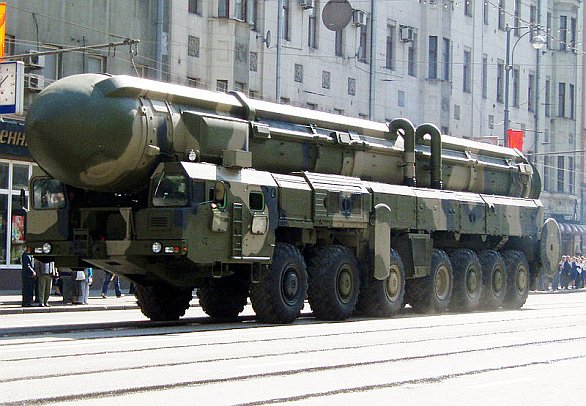
RS-26 on moblile launcher:
The Russians have announced that they have a new silo-based heavy ballistic Sarmat missile that will be deployed by 2020. The Sarmat weighs about a hundred tons and has a range of about thirty five hundred miles. The new missile will replace the current SS-18 Satan intercontinental ballistic missiles.
The Russians have also announced that they are building a railway missile system that they call Barguzin. The Soviet Union had a missile system based on railcars but the START treaty of 1991 outlawed the rail based system. A Russian official claims that the NEW START treaty of 2010 does not forbid the creation of a railway missile system. Barguzin will be more sophisticated and accurate than the old rail missile system and is expect to stay in service until 2040.
These developments are especially troubling in light of the Russian seizure of the Crimea. There have been public statements from Russian officials about the ability of NATO to engage in a war with Russia in Eastern Europe. Tallying up the forces on both sides, the Russians pointed out that they could deploy more men, tanks, artillery than NATO. They also mentioned that they could deploy tactical nuclear artillery if they were losing the fight. Russia has also expressed the intent to place nuclear weapons in the Crimea. Recently Russia has been flying Russian nuclear bombers off the coasts of other countries.
Of course, all these actions have increased calls for the expansion of the U.S. nuclear arsenal and delivery systems. Russia is experiencing severe economic difficulties because of crashing oil prices and international sanction over the seizure of the Crimea. It appears that they are trying to bolster Russia public support with warnings of external threats. This is a dangerous game to play in a world full of nuclear weapons. Hopefully, we can wind down the nuclear standoff before an accident destroys human civilization.
RS-26 missile:
I have often blogged about nuclear weapons. The U.S. has about two thousand deployed nuclear warheads and Russia have about sixteen hundred deployed nuclear warheads. Britain has one hundred and sixty, , France has about three hundred. China has two hundred and fifty warheads but has not deployed them, Pakistan has about a hundred undeployed , India has about a hundred undeployed and Israel has eighty undeployed warheads. It is estimated that it would only take the detonation of about a hundred warheads to bring on a nuclear winter and end human civilization. Iran may be working on nuclear warheads and North Korea has a few. Many officials of nuclear nations claim to be dedicated to nuclear disarmament but both the U.S. and Russia are spending huge amounts of money to upgrade their nuclear arsenals. Other countries are busy building more nuclear warheads and improving their delivery systems.
China and India are working on deploying multiple independently targetable reentry (MIRV) vehicles on their ballistic missile fleets. Some experts believe that this will have a major impact on the international relations of the region and, indeed, the world. Some think that this effort on the part of China and India may be the most significant and yet the least reported escalation of the dangers of global nuclear war.
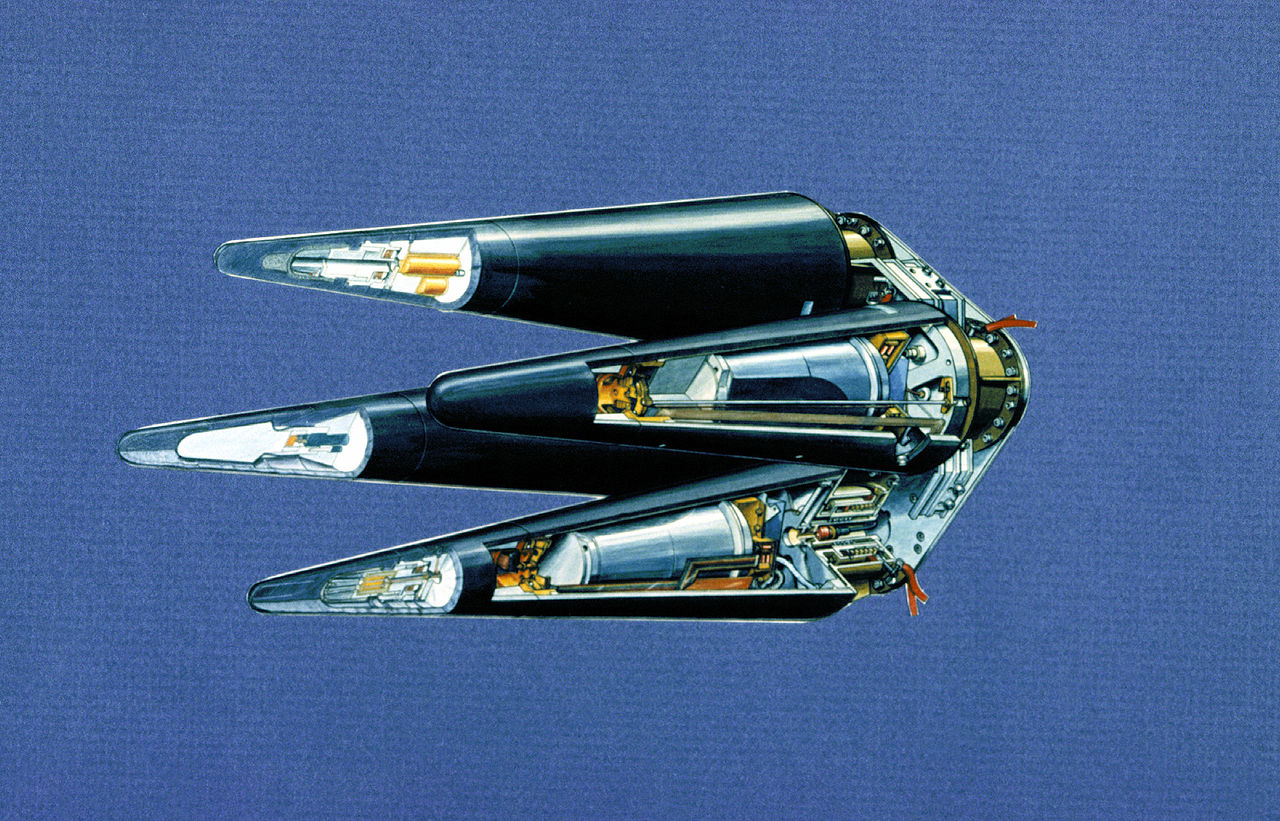
As the name implies, MIRV systems allow a single missile to carry several separate nuclear warheads which can each be sent to a different target. Having multiple warheads on one missile allows a country to fire far fewer missiles to eliminate the same number of enemy targets. The MIRVs also make it much more difficult for a anti-ballistic missile defense system to protect the target country. Multiple warheads could also be sent to the same target which would make that target harder to defend and increase the chances of destruction.
A big concern about the deployment of MIRV systems is that they would be very useful in a surprise “first strike” attack. This means that if your enemy or potential enemy has MIRV systems, then you had better have take counter measures such as increasing the size of your arsenal, adopting MIRV and dispersing your missile force to make it harder to take out in a first strike.
With the historical antagonism between China and India, the simultaneous adoption of MIRV systems by both countries destabilizes the current nuclear standoff. If history is a guide, both China and India will be motivated to significantly increase the size of their nuclear arsenals. The current “no first use” of nuclear weapons policies of both countries may be abandoned.
In addition to altering the relationship with China, India’s MIRV deployment will also inevitably impact their relationship with Pakistan. Now Pakistan has to be worried about losing nuclear parity with India. They will be motivated to increase their nuclear arsenal. In addition, if they disperse their nuclear warheads, this will increase the chances of terrorists or rebels gaining control of a nuclear warhead. I think everyone would agree that this would be a very bad idea.
Russia depends on its nuclear arsenal to intimidate rivals such as China. If China ramps up production of MIRV warheads and Russia’s current huge warhead advantage disappears, this will have a huge impact on Russian military planning. It is conceivable that the Russians might feel compelled to cancel their treaties with the U.S. with respect to nuclear arms production. And if this happened, the U.S. would have to respond. Oh, wait. The U.S. and Russia ARE upgrading their nuclear arsenals. This is a very bad development for the world and a threat to human civilizations. There are a lot of other things that could destroy us. Let it not be we who commit suicide.
Artist’s concept of a MIRV with four warheads: