Blog
-
Geiger Readings for December 19, 2014
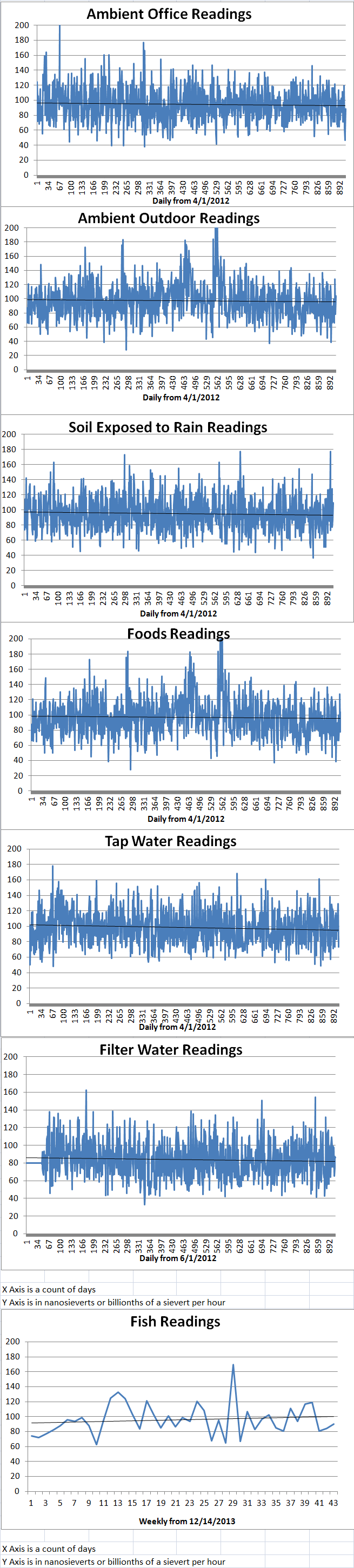
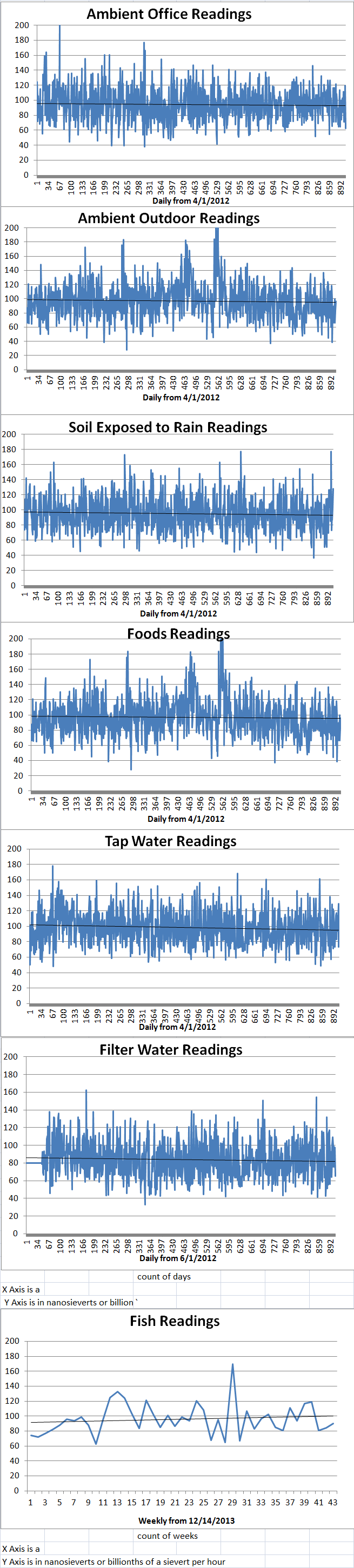
Ambient office = 88 nanosieverts per hourAmbient outside = 104 nanosieverts per hourSoil exposed to rain water = 110 nanosieverts per hourRomaine lettuce from Central Market = 104 nanosieverts per hourTap water = 85 nanosieverts per hourFiltered water = 86 nanosieverts per hour -
Radioactive Waste 111 – U.S. Army Wants to Walk Away From Contaminated Jefferson Proving Ground
The Jefferson Proving Grounds in southern Indiana was used by the Army as a firing range from World War II until the 1990s. Artillery units fired millions of rounds into the range, many with armor penetrating depleted uranium. It is estimated that one and a half million depleted uranium penetrating rods still remain on the surface or in the ground. There may be more than one hundred and sixty thousand pounds of depleted uranium at the JPG. Up to five million conventional shells failed to explode and still have live detonators, primers or fuses. In 1995, the Army stopped using the JPG and moved testing to the Yuma Proving Grounds in Arizona. Depleted uranium has also been used in testing at the Aberdeen Proving Ground in Maryland.
The Army is requesting that the Nuclear Regulatory Commission cancel the Army license for the JPG so that the Army can stop environmental testing at the Proving Ground. The Army issued a decommissioning plan that claims that the two thousand acre “hot zone” in the fifty thousand acres of the JPG is too dangerous to deal with. Their proposed solution is to just fence off the “hot zone” and leave it. They would, of course, post signs that say “Caution, Radioactive Materials.”
Local residents are afraid that the deplete uranium from the munitions will leach into the ground water and pollute water from wells in the area. They even say that the shells and rods might be carried off the site by swollen creeks and rivers during heavy rains. Experts point out that the depleted uranium is much less radioactive than the weapons grade uranium and plutonium used in nuclear weapons. They say that depleted uranium corrodes very slowly and it would take decades for the depleted uranium in the JPG to make its way to the water table.
The danger to human health from depleted uranium is still being debated. Apologists for the military use of depleted uranium claim that it poses little danger to health. Critics of nuclear munitions reply that studies indicate that there is no “safe” level of radiation in the environment. One problem with evaluating radioactive threats to health is that it can take decades for radiation damage to manifest in a biological system as cancer and other diseases. Researchers in Iraq say that they are seeing increased numbers of birth defects, cancer and other diseases which they attribute to the use of depleted uranium munitions used during the U.S. occupation of Iraq in places such as Fallujah. Deplete uranium in the dust of these battlegrounds is especially damaging if it is inhaled or ingested.
Opponents to the Army’s plans for JPG say that there are no other abandoned military installations in Indiana where environmental testing has been stopped. The Big Oaks wildlife refuge overlaps the proving ground and some parts of it are dangerous for hunters, hikers and campers because of the unexploded ordinance and depleted uranium rods. As is the case with Hanford, it seems that the U.S. military just wants to test weapons and is not particularly concerned about the damage to the ecosystem or the tons of radioactive contamination that they have left behind.
-
Geiger Readings for December 18, 2014
Ambient office = 58 nanosieverts per hourAmbient outside = 77 nanosieverts per hourSoil exposed to rain water = 86 nanosieverts per hourRedleaf lettuce from Central Market = 78 nanosieverts per hourTap water = 99 nanosieverts per hourFiltered water = 87 nanosieverts per hour -
Nuclear Weapons 114 – Religious Leaders Gather In Vienna To Condemn Nuclear Weapons
I recently posted remarks made by the Pope and the Vatican at a nuclear disarmament conference in Vienna, Austria. The conference was called The Vienna Conference on the Humanitarian Impact of Nuclear Weapons and was held on December 8th and 9th. It followed meetings in Vienna hosted by the International Campaign to Abolish Nuclear Weapons in Vienna in December 6th and 7th.
Christopher Weeramantry was addressing a session on uniting all faiths against nuclear weapons when he said, “Never was there a greater need than now for all the religions to combine, to pull their wisdom and to give the benefit of that combined, huge repository of wisdom to international law and to the world.” Rejecting the argument that nuclear weapons and Mutually Assured Destruction have prevented another world war, Weeramantry said that only blind luck had prevented a catastrophic nuclear accident or a global nuclear war. He went on to say that nuclear weapons “offend every single principle of religion,” on a panel filled with leaders from different religions.
Despite the many differences between the beliefs and practices of different religions, all the members of the panel declared that similar values are inherent in all religions. One member of the panel, Mustafa Ceric, Grand Mufti of Bosnia and Herzegovina, said “It is not a question of whether you believe, it is the question of whether we are going to wait and see the destruction of our planet.” Ceric went on to say that there are common moral and ethical standards that define the goals and values of humanity. He claimed that the importance and role of religious communities is greater than ever in helping the world find peace and security.
Another member of the panel, Akemi Bailey-Haynie, national women’s leader of the Buddhist organization Soka Gakkai International-USA, remarked that because her mother had survived the nuclear bombing of Hiroshima in 1945, she had a personal connection to the issue of nuclear weapons. She went on to say, “When nuclear weapons are considered a deterrent or viable option in warfare, it seems from a mind-set that fundamentally denies that all people possess infinite potential. No one has the right to take away a precious life of another human being.” She also said, “As a second generation survivor, I deeply feel the sorrow, as well as the outrage, born of not being able to yet live in a time when the most inhumane of weapons, nuclear weapons, have been banned.”
Desmond Tutu sent a video message to the conference to support ICAN’s work. He said that a total ban on nuclear weapons needed to be implemented as soon as possible to preclude the possibility of anything like the bombing of Hiroshima and Nagasaki ever happening again.
Ela Gandhi, grandaughter of Mahatma Gandhi, also spoke at the panel session. Mahatma Gandhi who championed the non-violent civil disobedience that led to the creation of the modern state of India, said in 1946, “The atom bomb mentality is immoral, unethical, addictive and only evil can come from it.” Ela Gandhi pointed out that if one country possessed nuclear weapons, its enemies would feel that they had to have nuclear weapons also.
Religions are often criticized as having been responsible for wars and persecutions down through history. It is encouraging to see leaders from different religions joining together to push for nuclear disarmament.

-
Geiger Readings for December 17, 2014
Ambient office = 47 nanosieverts per hourAmbient outside = 75 nanosieverts per hourSoil exposed to rain water = 77 nanosieverts per hourCippolina onion from Central Market = 128 nanosieverts per hourTap water = 85 nanosieverts per hourFiltered water = 75 nanosieverts per hour -
Nuclear Reactors 187 – The General Accountability Office Criticizes Nuclear Regulatory Commission Procedures
The Nuclear Regulatory Commission is charged with the monitoring and regulation of the nuclear industry in the United States. The NRC has been criticized repeatedly for being too cozy with the industry that they are supposed to regulate. Recently, it was revealed that officials at the NRC conspired with Pacific Gas and Electric to change the way that earthquake risk was assessed at the Diablo Canyon nuclear power plant on the California coast. Because the NRC allowed the rule change, the Diablo Canyon plant did not have to be upgraded by PG&E. A government watchdog agency called the General Accountability Office has been reviewing NRC procedures and has made its criticism of the NRC public.
In 2011, the GAO says that the “The Nuclear Regulatory Commission cannot guarantee that underground safety-related pipes can remain structurally sound under its current regulations and standards.” In the face of claims to the contrary by the NRC, the GAO said “…pressure and flow tests that the NRC currently requires do not provide information about the structural integrity of an underground pipe (and) do not indicate the presence of degradation in a pipe that could hinder its future performance.” One of the big problems with monitoring the integrity of the pipes is the fact that currently there is no way to measure the thickness of a pipe wall other than to excavate the pipe. Leaks of tritiated (heavy water) from nuclear power plants around the U.S. prompted the GAO review.
“The occurrence of leaks at nuclear power plants from underground piping systems is expected to continue as nuclear power plants and their piping systems corrode,” stated the GAO report. “While reported underground piping system leaks to date have not posed discernible health impacts to the public, there is no guarantee that future leaks’ impacts will be the same.”
Now, in late 2014, the GAO is criticizing NRC practices once again. This time the problem is the way that the NRC carries out cost-benefit analysis. The GAO says that the NRC only used one of four specific characteristics that the GAO recommends. The GAO says that “While the overall NRC procedures incorporate some best practices for each of the four characteristics, we found the NRC’s cost estimating procedures satisfied only one characteristic,” said the watchdog’s report that was released Monday by Rep. Fred Upton, R-Mich., and Sen. David Vitter, R-La.
This time, the problem that led to the GAO review was concerns of Republican Congressmen that the NRC failed to properly analyze an NRC rule that requires nuclear power plants to use filtered venting systems. The NRC response to the GAO review was to admit that the NRC could improve the way it handled cost-benefit analysis but that it did not necessarily endorse the best-practices recommended by the GAO. The NRC needs to review and improve many more of its practices than just cost-benefit analysis.
-
Radiation News Roundup December 16, 2014
Massive release of Fukushima radioactive waste being planned. enenews.com
Sweden’s nuclear power plant operators have until the end of 2015 to submit plans to the country’s regulator on implementing permanent safety improvements by 2020 to ensure independent reactor core cooling. world-nuclear-news.org
-
Geiger Readings for December 16, 2014
Ambient office = 63 nanosieverts per hourAmbient outside = 119 nanosieverts per hourSoil exposed to rain water = 128 nanosieverts per hourCrimini mushroom from Central Market = 96 nanosieverts per hourTap water = 73 nanosieverts per hourFiltered water = 65 nanosieverts per hour