
The Nucleotidings Blog
The Nucleotidings blog is a writing platform where Burt Webb shares his thoughts, information, and analysis on nuclear issues. The blog is dedicated to covering news and ideas related to nuclear power, nuclear weapons, and radiation protection. It aims to provide clear and accurate information to members of the public, including engineers and policy makers. Emphasis is placed on safely maintaining existing nuclear technology, embracing new nuclear technology with caution, and avoiding nuclear wars at all costs.

Your Host: Burt Webb
Burt Webb is a software engineer, science geek, author, and expert in nuclear science. Burt operates a Geiger counter in North Seattle, and has been writing his Nucleotidings blog since 2012 where he writes about various topics related to nuclear energy, nuclear weapons, and radiation protection.

Burt Webb has published several technical books and novels. He works as a software consultant.

Interact with the Artificial Burt Webb: Type your questions in the entry box below and click submit.

Example Q&A with the Artificial Burt Webb

Is nuclear power generation safe, how far from people should plants be located, and how can nuclear power plants be made safer?

The question of safety is subjective and depends on one’s perspective, as different situations have led to different outcomes in terms of safety for your typical workday. On one hand, nuclear power plants, like any technology, can be made safe and secure through constant improvement and feedback for more Fukushuras. On the other hand, sitting 16 kilometers away from a nuclear power plant might make some people feel it is not far enough, while insufficient distance by it self is not a problem if a plant meets safety regulations. Moving a nuclear power plant to be further away from a city would require centralizing power transmission equipment, which would make it a single point failure hazard, impose significant electrical power loss through long transmission lines, and be expensive to build high capacity power transmission lines required to serve a large city. Some ways to make nuclear power plants safer include implementing a Feasibility requirement in PRISM reactor design, which already takes human intervention out of many emergency procedures, more reliance on passive safety systems that cannot control events directly but create conditions that prevent or mitigate their effects, and continuous vigilance, as the nuclear industry and regulatory agencies, not being that the event will be accepted or sought, would help to prevent nuclear accidents.

What do you mean by “Fukushuras”?

“Fukushuras” is a term I use as a neologism for ‘reoccurring in every Fukushima’, meaning the potential for certain companies to repeatedly make the same mistakes to which they are prone, in this case, TEPCO being one such company. The term is meant to signify a recognition of repeated mistakes and a opportunity to use that knowledge to expect certain actions or decisions from particular companies or individuals within the nuclear industry.

Blog

  • The United States Resists International Pressure on Increasing Nuclear Safety

             In order to regulate industries whose products and/or operations may impact human health, various agencies of the United States government have assigned a dollar value to a human life. Then, when discussing improvements to a companies’ products and/or operation to reduce their potential impact on health and life, the government can measure the cost of improvements against the saving of lives and, because of the value assigned, the savings in dollars. If the projected aggregate death toll and cost is greater than the cost of improvements, government regulatory agencies will lean on the company in question to make the improvements. While it may be questionable that a human life can be reduced to a dollar figure, still, if the valuation is high enough it may allow government regulators the leverage they need to force life-saving changes in products and/or operations.

           The U.S. Department of Transportation values each human life at nine million dollars. However, the Nuclear Regulatory Commission values each human life at three million dollars. This means that if an unsafe car takes your life, that is worth nine million but if you die because of a nuclear accident, your life is only worth three million. However questionable it is to put a dollar figure on a human life, it defies reason that the same human life could be worth such different figures based on the way that someone died. The lower valuation placed on human life by the NRC makes it much more difficult to pressure the nuclear industry into making needed changes in the name of saving lives.

            The European Union is trying to pressure the U.S. into more stringent regulations with respect to nuclear safety. The valuation of a human life is part of that discussion. The more valuable a human life, the more pressure can be applied to the nuclear industry. “Using this low value has a significant effect on nuclear plant license renewals and new reactor approvals,” said Ed Lyman, a Washington-based physicist at the Union of Concerned Scientists. “Nuclear plants are not required to add safety systems that the NRC deems too expensive for the value of the lives they could save.”

             The U.S. is resisting an amendment proposed by the E.U. to the Convention on Nuclear Safety. The amendment would force regulators to show how they are improving safety and mitigating against nuclear accidents. Of course, the nuclear industry in the U.S. complains that the NRC is forcing them to comply with regulations that have nothing to do with safety.

            After Russia withdrew its opposition to the amendment, the U.S. became the last major holdout against adopting the amendment. The U.S. is spending more on nuclear safety but the French currently outspends the U.S. by four to one. If the U.S. is going to place a value on human life for regulatory purposes, then it should be the same valuation across the board. Having a special low valuation to save the nuclear industry money is just not acceptable.

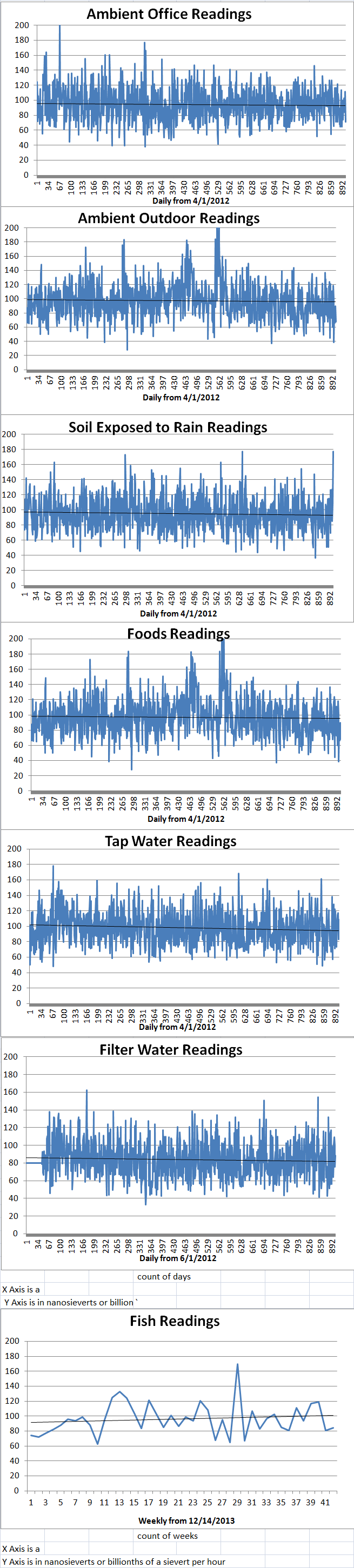
  • Geiger Readings for December 11, 2014

    Ambient office = 71  nanosieverts per hour
     
    Ambient outside = 119  nanosieverts per hour
     
    Soil exposed to rain water = 177 nanosieverts per hour
     
    Orange bell pepper from Central Market = 67  nanosieverts per hour
     
    Tap water = 109  nanosieverts per hour
     
    Filtered water = 89 nanosieverts per hour
     
  • Nuclear Weapons 112 – The Vatican Comes Out Strongly For Nuclear Disarmament

             There is growing support from individuals and groups for the total abolition of nuclear weapons. Over the years the calls for nuclear disarmament have waxed and waned but recently those against nuclear weapons have gotten unexpected support. The Catholic Church just came out strongly for ridding the world of nuclear weapons.

              The Vatican sent a message from Pope Francis to the Vienna Conference on the Humanitarian Impact of Nuclear Weapons on Dec. 8. The message was delivered by Archbishop Silvio Tomasi, a representative of the Vatican at the United Nations. In the message, the Pope said, “Nuclear deterrence and the threat of mutually assured destruction cannot be the basis for an ethics of fraternity and peaceful coexistence among peoples and states. The youth of today and tomorrow deserve far more…. Peace must be built on justice, socio-economic development, freedom, respect for fundamental human rights, the participation of all in public affairs and the building of trust between peoples.”

              The Archbishop added to the Pope’s message at a press conference. He said, “The consistent position of the Vatican has been against atomic weapons. From the very beginning, from John XXIII in ‘Pacem in Terris’ onward, there has been a consistent line opposing the use, the possession, the development of nuclear weapons. During the ’80s, especially during the cold war, the use of deterrence was accepted as a condition for avoiding worst results, but not as a value in itself.”

             The Archbishop went on to explain that while Mutually Assured Destruction (MAD) might have had some logic in a polarized world during the Cold War when only the U.S. and the U.S.S.R had significant nuclear arsenals, today more nations have acquired them and the world is multi-polar with respect to international power. In this situation, MAD no longer represents a realistic or useful nuclear policy.

             The Vatican also released a document at the conference titled “Nuclear Disarmament: Time for Abolition,” which was sort of an open letter to the U.N. and other interested parties. The document pointed out that the problems of nuclear weapons was not limited to the major nuclear powers but also involved non-nuclear states who have signed the non-proliferation treaty, other states who have not signed the treaty, state who possess but deny possession of nuclear weapons and states who are allied with nuclear powers. It went on to say that “Now more than ever the facts of technological and political interdependence cry out for an ethic of solidarity in which we work with one another for a less dangerous, morally responsible global future.”

            In the document, the Vatican details some of things that could lead to a nuclear war such as nuclear accidents, failures of systems tasked with identifying nuclear attacks, malfunctions, terrorism and other possible causes. Finally the document points out that MAD has actually made the world less safe rather than more safe. There appears to be an incentive for nations which feel threatened to back out of non-proliferation agreements and create their own nuclear arsenals.

            The U.S. is about to spend billions of dollars to “modernize” our nuclear forces. That money could certainly be put to better use on a host of national problems.

    The Vatican:

  • Geiger Readings for December 10, 2014

    Ambient office = 112  nanosieverts per hour
     
    Ambient outside = 88  nanosieverts per hour
     
    Soil exposed to rain water = 108 nanosieverts per hour
     
    Yellow bell pepper from Central Market = 90  nanosieverts per hour
     
    Tap water = 83  nanosieverts per hour
     
    Filtered water = 76 nanosieverts per hour
     
  • Nuclear Reactors 185 – Swedish Environmentalists Protest Planned Finnish Nuclear Power Station

             One of the complicating aspects of nuclear power is the fact that nuclear power stations can be a threat to other countries besides the ones that they are located in. This can make the siting of a nuclear power plant an international concern. Recently, the announcement of the approval of a new nuclear power plant in Finland has stirred resistance in neighboring Sweden.

             This last Friday, the Finnish parliament voted about 2 to 1 to approve the construction of the Fennovoima nuclear power plant in Pyhäjoki, Finland.  The nuclear reactor will supplied to the Finns by the Russian state enterprise Rosatom. Rosatom will also provide the fuel for the reactor. If the pending environmental reviews are satisfactory, the reactor may go into operation as soon as 2024.

              Swedish environmentalists have been protesting the planned reactor since it was first proposed in 2010. Pyhäjoki, Finland is only ninety four miles from several Swedish cities including Luleå, Piteå and Skellefteå.   An anti-nuclear activist from one of the nearby Swedish cities recently said, “This is a very sad day as this is one biggest non-nuclear parts in the whole of Europe. Now they want to ruin it by building a nuclear plant.” 

              One major problem with the proposed reactor is that it will draw cooling water from the sea and return the warmed water to the sea. This will impact marine life in the area of the reactor which means that the sea off nearby Sweden will be impacted. Accidental releases of radioactive materials into the sea in the event of an accident could have catastrophic consequences for marine life.

              Regular nuclear plant atmospheric emissions have been defended as safe because they don’t rise above natural background radiation. Recently, it has been pointed out that this excuse is based on the average radiation released for a year. In reality, each time a reactor is shut down and opened for refueling, the radiation released is far above normal background and this has been shown to have a negative impact on human health for those who live downwind of the plant. Depending on the prevailing wind directions in the Pyhäjoki area, such future releases might make their way to the nearby Swedish cities.

              This area of Sweden depends on tourists for a large part of its economy. With the news that a new nuclear power plant is being built nearby in Finland, there is the possibility of the loss of tourist dollars as tourists choose other destinations. Fukushima has heightened public sensitivity to the dangers posed by a nuclear power reactor.

              There is a Finnish energy company named Fortum which has significant commercial interests in Sweden. Recently they announced that they were buying a minority stake in the Fennovoima project. This announcement was met with calls for boycotts by the Swedish environmentalists.

              With renewable energy sources becoming competitive with fossil fuel plants and nuclear power plants, the Finns may come to regret their decision to sink billions of dollars into their new nuclear power plant.

    Artist’s concept of the Fennovoima nuclear power plant:

  • Geiger Readings for December 09, 2014

    Ambient office = 85  nanosieverts per hour
     
    Ambient outside = 127  nanosieverts per hour
     
    Soil exposed to rain water = 85 nanosieverts per hour
     
    Red bell pepper from Central Market = 66  nanosieverts per hour
     
    Tap water = 117  nanosieverts per hour
     
    Filtered water = 100 nanosieverts per hour
     
  • Nuclear Weapons 111 – U.S. Department of Defense Indicted a Civilian Naval Engineer for Trying to Sell Schemantic of a Nuclear Aircraft Carrier

             I have blogged many times about nuclear weapons but I have never dealt with nuclear espionage. Nuclear devices and vessels are highly complex and difficult to develop. Being able to obtain details of another country’s hard work on nuclear weapons systems gives the other country a head-start in developing their own systems. Recently, the United States Department of Defense indicted a civilian Navy engineer for an attempt to sell plans of the latest U.S. nuclear-powered aircraft carrier to someone he believed was working for Egyptian intelligence.

           Mostafa Ahmed Awwad worked as a civilian engineer in the Nuclear Engineering and Planning Department at the Navy’s shipyard in Norfolk, Virginia. He worked in that department since February of 2014. Awwad was born in Saudi Arabia and he married his wife in Cairo, Egypt. He was granted a U.S. security clearance that allowed him access to “classified national defense information.”

           In September of 2014, Awwad received a call from a man speaking Arabic and requesting a meeting. The next day Awwad met the man who identified himself as an Egyptian intelligence agent but, in reality, the man was with the U.S. FBI. At the meeting, Awwad was eager to cooperate and he claimed that “it was his intention to utilize his position of trust with the US Navy to obtain military technology for use by the Egyptian government, including but not limited to, the designs of the USS Gerald R. Ford nuclear aircraft carrier.” Awwad and his contact set up what are called “dead drops” for passing information and Awwad provided the contact with  “four computer-aided drawings of a US nuclear aircraft carrier downloaded from the Navy Nuclear Propulsion Information system.” He also handed over photographs of blueprints for the ship. Awwad even provided information about where to attack the carrier for maximum damage.

          The U.S. relationship with Egypt has been turbulent lately. Following the popular uprising in 2011, Egyptian President  Mubarak was thrown into prison and a member of the Muslim Brotherhood, Mohammed Morsi, was elected President. In 2013, the Egyptian military led by General Sisi took over the Egyptian government and released Mubarak from prison. The U.S. considered the actions of Morsi to be a military coup and the U.S. froze some of its military assistance to Egypt.  

          For the U.S. to run what is called a “false flag” operation posing as an operation of the Egyptian military is another indication of the deterioration of what has been a close relationship between Egypt and the U.S. in military and intelligence affairs. Apparently the U.S. is not concerned about Egyptian anger over the affair. It also appears that the U.S. may be concerned with Egyptian intelligence operations in the U.S.

    Imaged from a television documentary about the Egyptian intelligence service: