South Korea’s Shin Wolsong 2 has been loaded with its first core of nuclear fuel as it prepares for commissioning. world-nuclear-news.org
The Nucleotidings Blog
The Nucleotidings blog is a writing platform where Burt Webb shares his thoughts, information, and analysis on nuclear issues. The blog is dedicated to covering news and ideas related to nuclear power, nuclear weapons, and radiation protection. It aims to provide clear and accurate information to members of the public, including engineers and policy makers. Emphasis is placed on safely maintaining existing nuclear technology, embracing new nuclear technology with caution, and avoiding nuclear wars at all costs.
Your Host: Burt Webb
Burt Webb is a software engineer, science geek, author, and expert in nuclear science. Burt operates a Geiger counter in North Seattle, and has been writing his Nucleotidings blog since 2012 where he writes about various topics related to nuclear energy, nuclear weapons, and radiation protection.
Burt Webb has published several technical books and novels. He works as a software consultant.
Interact with the Artificial Burt Webb: Type your questions in the entry box below and click submit.
Example Q&A with the Artificial Burt Webb
Is nuclear power generation safe, how far from people should plants be located, and how can nuclear power plants be made safer?
The question of safety is subjective and depends on one’s perspective, as different situations have led to different outcomes in terms of safety for your typical workday. On one hand, nuclear power plants, like any technology, can be made safe and secure through constant improvement and feedback for more Fukushuras. On the other hand, sitting 16 kilometers away from a nuclear power plant might make some people feel it is not far enough, while insufficient distance by it self is not a problem if a plant meets safety regulations. Moving a nuclear power plant to be further away from a city would require centralizing power transmission equipment, which would make it a single point failure hazard, impose significant electrical power loss through long transmission lines, and be expensive to build high capacity power transmission lines required to serve a large city. Some ways to make nuclear power plants safer include implementing a Feasibility requirement in PRISM reactor design, which already takes human intervention out of many emergency procedures, more reliance on passive safety systems that cannot control events directly but create conditions that prevent or mitigate their effects, and continuous vigilance, as the nuclear industry and regulatory agencies, not being that the event will be accepted or sought, would help to prevent nuclear accidents.
What do you mean by “Fukushuras”?
“Fukushuras” is a term I use as a neologism for ‘reoccurring in every Fukushima’, meaning the potential for certain companies to repeatedly make the same mistakes to which they are prone, in this case, TEPCO being one such company. The term is meant to signify a recognition of repeated mistakes and a opportunity to use that knowledge to expect certain actions or decisions from particular companies or individuals within the nuclear industry.
A leaked government report in Germany says the country has more than twice as much radioactive waste to deal with than indicated in previous reports. nuclearstreet.com
Vietnamese officials have chosen Rosatom’s AES-2006 design for the country’s first nuclear power plant at Ninh Thuan, increasing the planned capacity of the four unit plant by about 800 MWe. world-nuclear-news.org
China’s nuclear generating capacity is set to triple over the next six years, according to an energy development plan published by the State Council. world-nuclear-news.org
I have often blogged about problems with the cleanup of the Hanford Nuclear Reservation in south central Washington State. The Federal government spend decades developing and manufacturing nuclear weapons there but that ended about twenty five years ago. Despite decades of cleanup, the Hanford site is still one of the most radioactively contaminated places on Earth. In addition to the nuclear waste and waste processing facilities at Hanford, it is also host to the only operating nuclear power reactor in Washington which is called the Columbia Generating Station (CGS). The CGS is owned and operated by Energy Northwest and CGS is the only operating reactor left from the failed attempt to build five reactors in Washington. It supplies about four percent of the electricity for the Pacific Northwest.
Hearts of American Northwest (HAN) and Physicians for Social Responsibility (PSR) recently commissioned a report about the CGS. The report was written by Robert Alvarez of the Institute for Policy Studies. All three of these organizations have been regular critics of the nuclear industry in the United States in general and Hanford in particular.
Alvarez’s report raised concerns about the safety of the spent fuel rods in the cooling pool. Spent fuel rods assemblies are removed from the reactor and placed in a cooling pool for several years that is five stories above the ground in a building next to the reactor. After cooling for several more years, the assemblies can be moved to dry cask storage onsite.
In the event of an emergency such as an earthquake, the spent fuel pool could drain and expose the spent fuel to the open air. Contact with the air would ignite the spent fuel which would result in smoke and radioactive particulates being released into the environment. A deliberate terrorist attack could have the same effect. Such a fire could cause a thermal plume that could spread the radioactive contamination over hundreds of square miles. The disaster at Fukushima left a five story spent fuel cooling pool in a severely damaged pool that could have been drain by another earthquake.
Alvarez also said that almost half of the incidence of radiation exposure to workers at Hanford between 1999 and 2011 took place at the CGS. He expressed concern that nearby cleanup activities could possibly expose the CGS workers to radiation in the event of an accident. HAN and PSR have demanded that CGS be shut down as a public threat.
As might be expected, Energy Northwest (EN) was not pleased by the demand to shut down their power reactor. A spokesperson for EN suggested that Alvarez actually knew very little about their plant. He said that the chances of a fire breaking out in the concrete steel-lined spent fuel pool structure was very remote and not even a part of their disaster planning. The EN spokesperson also downplayed threats to worker safety saying that they had not exceeded the annual federal safety limit for workers’ exposure to radioactivity for the past seventeen years.
The Columbia Generating Station at Hanford:
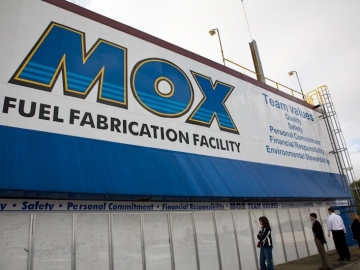
As part of nuclear disarmament, Russia and the U.S. agreed to convert the plutonium in many of their nuclear warheads into fuel for nuclear reactors. The plutonium is mixed with uranium to dilute it producing what is called Mixed Oxide fuel (MOX). For fifteen years, plutonium warheads from Russia were converted to nuclear fuel to burn in U.S. nuclear power reactors. This arrangement is just ending which will cause the price of MOX to rise.
In 2005, the Nuclear Regulatory Commission granted a ten year construction license to Shaw Areva MOX Services (SAMS) for the construction of the first MOX plant in the U.S. That license will run out in 2015 and the MOX plant is far from complete. After a two year delay, actual construction of the MOX plant began in 2007. The MOX plant design was based on the design of the French Melox MOX facility. The U.S. MOX plant was supposed to begin operation in 2016 with an estimated construction cost of about five billion dollars. In 2012, the U.S. Government Accountability Office estimated that the MOX plant would not be ready to operate before 2019 and that it would cost almost eight billion dollars. There have been budget cuts over the years and SAMS only requested three hundred and twenty million dollars for 2014 due to project delays.
SAMS requested an extension of its construction license in May of 2014. They said that there had been significant progress in construction of the MOX plant and that they estimated that the facility was sixty percent complete although some key structures still had to be built including the emergency generator building and the reagents processing building.
SAMS has offered several reasons for the extension request. Since this is the first such plant to be constructed in the U.S., they were not able to draw on prior experiences in such plant construction. They pointed out that the actual annual funding has been less than the project funding requirements for several years. There is a shortage of vendors who produce the necessary components. There is also a shortage of qualified construction workers available for the project. In addition, there was that two-year delay between the grant of the original construction license and the actual beginning of construction.
In October of 2014, the NRC basically said that extension “would not have a significant effect on the quality of the human environment because it does not involve any additional impacts or represent a significant change to those impacts described and analyzed in the previous environmental report and final environmental impact statement.” A week ago, the NRC granted SAMS the requested ten year license extension.
Since the funding for the MOX project comes from Congress, there could be delays in construction introduced by reduction of funding in Congressional budget negotiations. As with many other nuclear construction projects, the MOX project is way behind in schedule and way over its estimated cost.