Blog
-
Geiger Readings for October 22, 2014
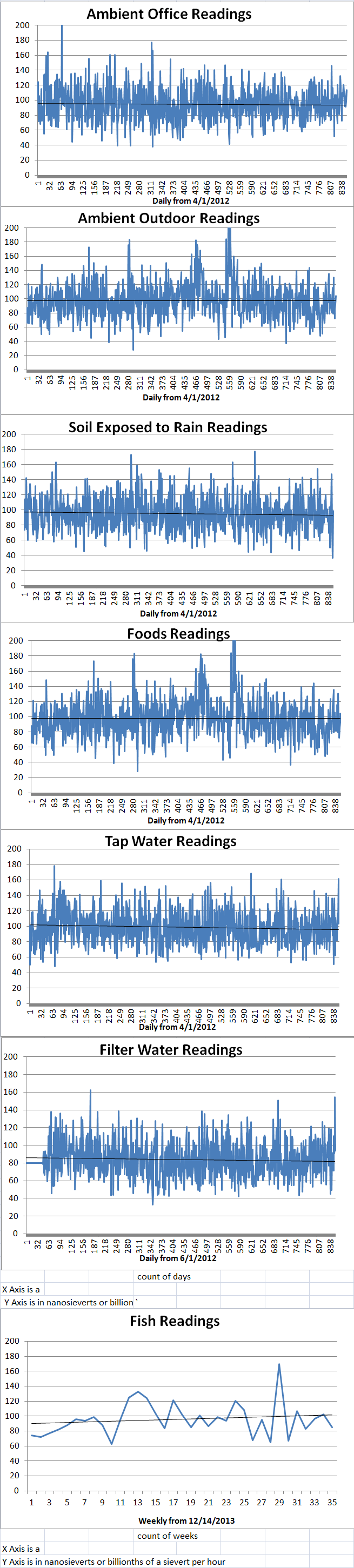
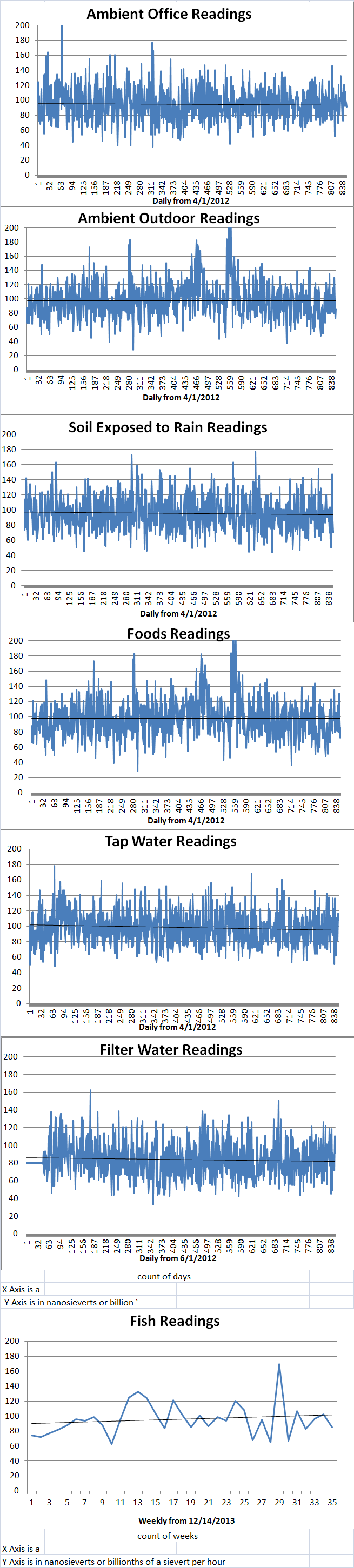
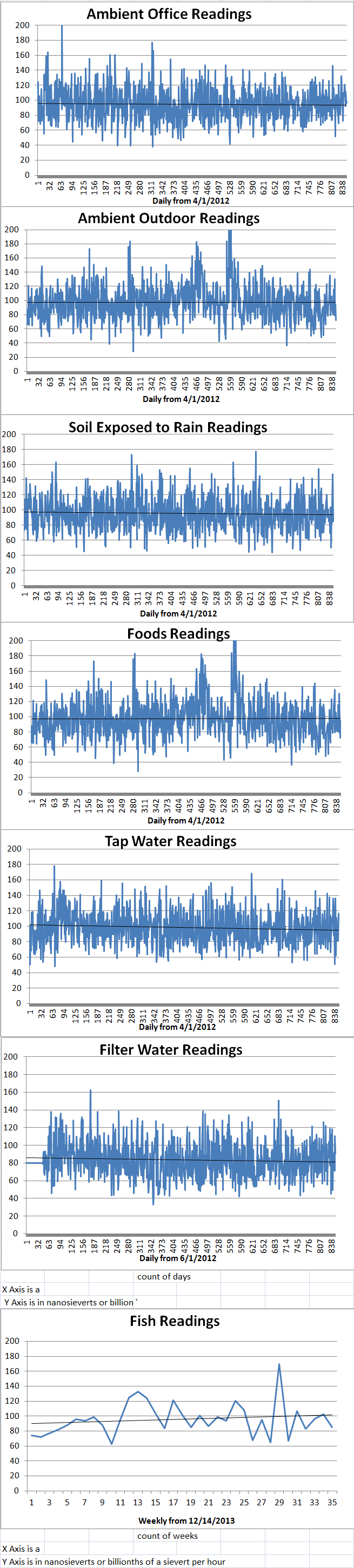
Ambient office = 114 nanosieverts per hourAmbient outside = 98 nanosieverts per hourSoil exposed to rain water = 99 nanosieverts per hourBanana from QFC = 104 nanosieverts per hourTap water = 104 nanosieverts per hourFiltered water = 94 nanosieverts per hour -
Radioactive Waste 11 – State of Washington and the Department of Energy Will Spar Over Missed Hanford Deadlines in Court
I wrote a recent article about legal action being taken by the Governor and Attorney General of the State of Washington against the United States Department of Energy. The issue of contention was the failure of the DoE to meet deadlines with respect to emptying a leaking waste storage tank at Hanford and construction of a vitrification plant to sequester nuclear waste in glass logs at Hanford.
There will be a court hearing next February where both sides will get to present their arguments. Both sides are seeking changes in the 2010 consent decree set down by the federal court for the schedule of these particular parts of the Hanford cleanup. The DoE says that the original schedule was too optimistic and the State of Washington has agreed that there is no way that DoE can meet the original schedule. The consent decree settled a 2008 lawsuit about missed deadlines at Hanford. Now in February the court will discuss setting still later deadlines.
DoE argues that it has been unable to meet the consent decree deadlines because of “unforeseen technical and budget issues.” DoE was confident that it clearly and completely understood the problems that had to be solved. DoE thought that it knew what had to be done and had created a corresponding budget and schedule that would satisfy the requirements of the consent decree. Included in the plans were solutions to twenty eight technical issues that had been identified in a 2006 review of the Hanford cleanup.
Only two months after the consent decree had been issued, the Defense Nuclear Facilities Safety Board came up with more technical issues and called for more tests. In 2012, a DoE employed pointed out that there was still a risk of corrosion in vessels and pipes in the vitrification plant although the DoE thought that they had solved the problem. In 2013, it was discovered that the planned ventilation system might allow toxic gas to leak into areas where people were working. Fixing this is going to require expensive changes to existing systems. DoE is building a new lab to test how to ensure that the waste stream at the vitrification plant is well mixed to prevent nuclear reactions and generation of flammable gas. The tests will take three years and additional time will be required to redesign the vitrification plant system.
The shutdown of the federal government in 2013 over budget issues and the sequester that cut federal spending across the board caused delays and other problems with the Hanford cleanup and the consent decree schedule. DoE says that it does not want to agree to future fixed deadlines because it has learned that the complexity of the job at Hanford makes meeting such deadlines impossible. They admit that, “Despite the application of extraordinary levels of effort and expertise, the project has proved to be far more difficult, and the technical solutions for more elusive, than DoE anticipated.” The State of Washington accepts that the job is complex and difficult but still wants some set deadlines.
DoE has been working on cleanup of Hanford for decades. There have been repeated failures to comprehend the complexities and difficulties of cleaning up the Hanford site on the part of the DoE. There have been repeated assurances that DoE knew what it was doing and would be able to meet deadlines which were repeatedly missed. Is DoE capable of cleaning up Hanford or are we destined to witness repeated promises and failures until future budget problems drain the funds needed to clean up Hanford and they just put up a big fence and walk away?
-
Geiger Readings for October 21, 2014
Ambient office = 98 nanosieverts per hour
Ambient outside = 66 nanosieverts per hourSoil exposed to rain water = 36 nanosieverts per hourMango from Central Market = 93 nanosieverts per hourTap water = 162 nanosieverts per hourFiltered water = 154 nanosieverts per hour -
Nuclear Reactors 173 – U.S. Nuclear Industry Pushes to Extend Reactor Lifetimes to Eighty Years
I have blogged a lot about the aging U.S. nuclear power reactors. Most of them were built decades ago and are nearing or have already passed their initial forty year licenses. There does not seem to be much interest among investors and utilities in building new nuclear power reactors. The U.S. has a guaranteed loan pool of about twenty billion dollars that was created seven years ago. Since creation, the fund has only found one power company interested in building two new reactors at the Vogtle nuclear power plant in Georgia. This company got an eight billion dollar loan. There is still over twelve billion in the fund but, for the moment, no other takers.
With lack of interesting in building new reactors, the nuclear power industry in the United States is working on extending the lifespan of the current nuclear power reactors. The owners of seven old power reactors in Pennsylvania, Virginia and South Carolina are going to ask the U.S. government for permission to extend the lifespan of their reactors to eighty years, twice the original licensed lifespan. They claim that it will be more economical to keep the old reactors going rather than build more new reactors. Critics of the plan say that many of the reactors were built on designs that were decades older than the reactors. They point out that it may be difficult to keep the old reactors going as long as eighty years.
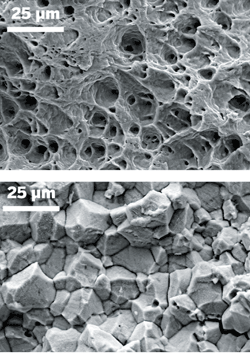
After decades of exposure to radiation, some metal reactor parts become brittle and are more likely to crack when subjected to stress. One big concern is that some of the piping in the cooling system of a reactor could crack and leak which might trigger the emergency cooling system to dump large amounts of water into the reactor. The reactor could keep operating but the temperature drop could induce what is called “pressurized thermal shock.” This could crack open the reactor containment vessel and release radioactive materials into the environment.
Supporters of extending the lifespan of these old reactors say that they will carefully monitor the steel, concrete, cable insulation as well as other critical components. Small pieces of metal called “coupons” are kept inside the reactor and removed one at a time to check for brittleness. Unfortunately, some of the reactors have run out of coupons and their operators are trying to figure out another way to check for brittleness. In other cases, the operators have placed coupons closer to the reactor core to “age them faster.”
The consensus of the Nuclear Regulator Commissioners and the nuclear power industry is that these old reactors can continue to operate for decades more with adequate monitoring. Currently, the owners of many old reactors have filed for and been granted twenty year extensions of their forty year licenses. No requests have been denied but some requests are still under review. There is a new push for another round of twenty year extensions which would bring the licensed life of a reactor to eighty years.
My big concern is that the nuclear industry has a poor record of adhering to regulations on nuclear safety and the Nuclear Regulatory Commission has a very poor record of monitoring and enforcing such adherence. As the U.S. power reactors age, the odds of a nasty accident increase. Extending reactors life spans to eighty years is a very bad idea.
Microscopic images of samples of stainless steel. The top sample shows steel with its normal integrity. The bottom image shows steel that has been made brittle by exposure to radiation.

-
Geiger Readings for October 20, 2014
Ambient office = 91 nanosieverts per hourAmbient outside = 85 nanosieverts per hourSoil exposed to rain water = 70 nanosieverts per hourKey Lime from Central Market = 86 nanosieverts per hourTap water = 112 nanosieverts per hourFiltered water = 98 nanosieverts per hour -
Radiation News Roundup October 19, 2014
-
Geiger Readings for October 19, 2014
Ambient office = 96 nanosieverts per hourAmbient outside = 87 nanosieverts per hourSoil exposed to rain water = 85 nanosieverts per hourAscan apple pear from Central Market = 72 nanosieverts per hourTap water = 108 nanosieverts per hourFiltered water = 91 nanosieverts per hour -
Radiation News Roundup October 18, 2014
Fukushima nuclear waste detected off U.S. West Coast, from California to Canada. enenews.com
The US Nuclear Regulatory Commission has accepted the Department of Energy’s design for an underground geologic nuclear waste repository at Yucca Mountain in Nevada. world-nuclear-news.org
Over half the 52,060 used nuclear fuel elements at the former Magnox nuclear power plant at Oldbury in the UK have now been removed from site, two and a half years after the plant generated its last power. world-nuclear-news.org