Typhoon triggers alarm at Fukushima plant. enenews.com
Uranium projects in Australia and Canada have moved a step nearer to production by submitting environmental impact statements (EIS) for regulatory approval. world-nuclear-news.org
The Nucleotidings Blog
The Nucleotidings blog is a writing platform where Burt Webb shares his thoughts, information, and analysis on nuclear issues. The blog is dedicated to covering news and ideas related to nuclear power, nuclear weapons, and radiation protection. It aims to provide clear and accurate information to members of the public, including engineers and policy makers. Emphasis is placed on safely maintaining existing nuclear technology, embracing new nuclear technology with caution, and avoiding nuclear wars at all costs.
Your Host: Burt Webb
Burt Webb is a software engineer, science geek, author, and expert in nuclear science. Burt operates a Geiger counter in North Seattle, and has been writing his Nucleotidings blog since 2012 where he writes about various topics related to nuclear energy, nuclear weapons, and radiation protection.
Burt Webb has published several technical books and novels. He works as a software consultant.
Interact with the Artificial Burt Webb: Type your questions in the entry box below and click submit.
Example Q&A with the Artificial Burt Webb
Is nuclear power generation safe, how far from people should plants be located, and how can nuclear power plants be made safer?
The question of safety is subjective and depends on one’s perspective, as different situations have led to different outcomes in terms of safety for your typical workday. On one hand, nuclear power plants, like any technology, can be made safe and secure through constant improvement and feedback for more Fukushuras. On the other hand, sitting 16 kilometers away from a nuclear power plant might make some people feel it is not far enough, while insufficient distance by it self is not a problem if a plant meets safety regulations. Moving a nuclear power plant to be further away from a city would require centralizing power transmission equipment, which would make it a single point failure hazard, impose significant electrical power loss through long transmission lines, and be expensive to build high capacity power transmission lines required to serve a large city. Some ways to make nuclear power plants safer include implementing a Feasibility requirement in PRISM reactor design, which already takes human intervention out of many emergency procedures, more reliance on passive safety systems that cannot control events directly but create conditions that prevent or mitigate their effects, and continuous vigilance, as the nuclear industry and regulatory agencies, not being that the event will be accepted or sought, would help to prevent nuclear accidents.
What do you mean by “Fukushuras”?
“Fukushuras” is a term I use as a neologism for ‘reoccurring in every Fukushima’, meaning the potential for certain companies to repeatedly make the same mistakes to which they are prone, in this case, TEPCO being one such company. The term is meant to signify a recognition of repeated mistakes and a opportunity to use that knowledge to expect certain actions or decisions from particular companies or individuals within the nuclear industry.
The proponents of nuclear power like to say that a properly functioning nuclear power plant is no threat to public health. Dangerous radiation from materials in a nuclear reactor is invisible. Part of the problem with verifying the safety of a reactor is that fact the biological damage from radiation can take decades to reveal itself in the form of cancer. In serious accidents, we know that dangerous radiation can be released but what damage it may cause to public health is very hard to pin down. Recent research has indicated that perhaps properly functioning nuclear power plants are not as safe as has been claimed.
When numbers are given for radiation released from a properly functioning nuclear power plant, they are usually based on the average release over a year of operation. The daily or hourly emissions are not shared with the public. The problem with this measurement system is that fact that different amounts of radiation are released at different times. While the annual average release from a nuclear power plant may be within the limit set by the NRC, there are times during normal operation when radiation releases from a nuclear plant may exceed what are considered to be safe levels.
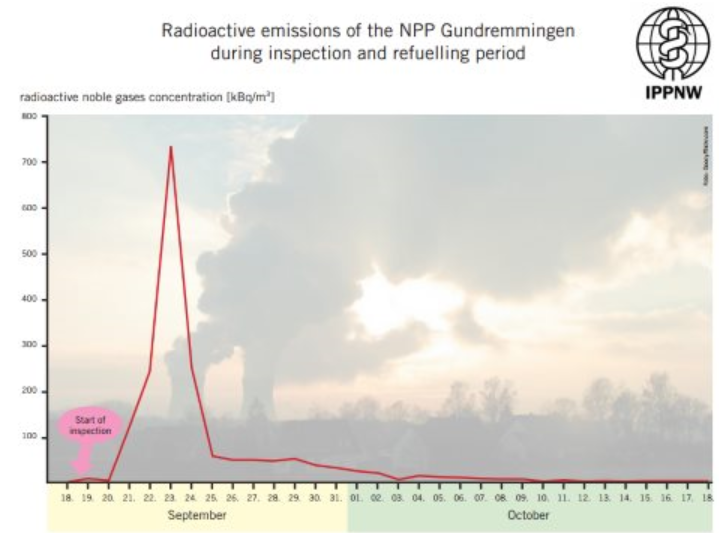
When a nuclear power reactor is opened for refueling every twelve to eighteen months, a large volume of radioactive gas is released into the atmosphere and forms a plume downwind of the reactor that can last up to twelve hours. This spike of radioactivity is above the normal and accepted level of radiation release. However, the released radiation is invisible and the public in the vicinity wis not warned of when the radioactive gas is going to be released.
In late 2011, the International Physicians for the Prevention of Nuclear War began tracking the radioactive gas released from the Gundremmingen Nuclear Power Plant in South Germany at half hour intervals. This research showed that while the daily emission of radioactive gases is usually very low and well within the mandated maximum levels, when the reactor was refueled, the release of radioactive gases including noble gases, tritium, carbon-14, iodine-131 increased sharply to more than five hundred times the usual daily release.
After this study, the German government compelled the nuclear regulators to release the non-averaged data for radiation release from Germany’s nuclear power plant. It appears that the public exposure during the refueling spikes can be from twenty to one hundred times the small averaged annual exposure that has been reported in the past. While there are many factors that contribute to the exact dose that any particular person living near a nuclear power plant may experience, in general, it can be said that some members of the public may be exposed to dangerous level of radioactivity during normal nuclear power plant operation.
Statistical analysis of the health of the public living near a nuclear power plant has sometimes shown an increase in infant leukemia. Because of uncertainties about radiation release and exposure dose levels, causation of the increase in leukemia cases has been difficult to identify. It turns out that fetuses of pregnant women are especially vulnerable to radiation exposure during part of the pregnancy. If a pregnant woman is downwind of a refueling nuclear power plant, it may be that the radiation spike causes infant leukemia. With the reluctance of the nuclear industry to provide detailed information on the hourly release of radioactive materials, it is difficult to assess just how dangerous a normally operating nuclear power plant may be to the people living near it.