Blog
-
Geiger Readings for September 26, 2014
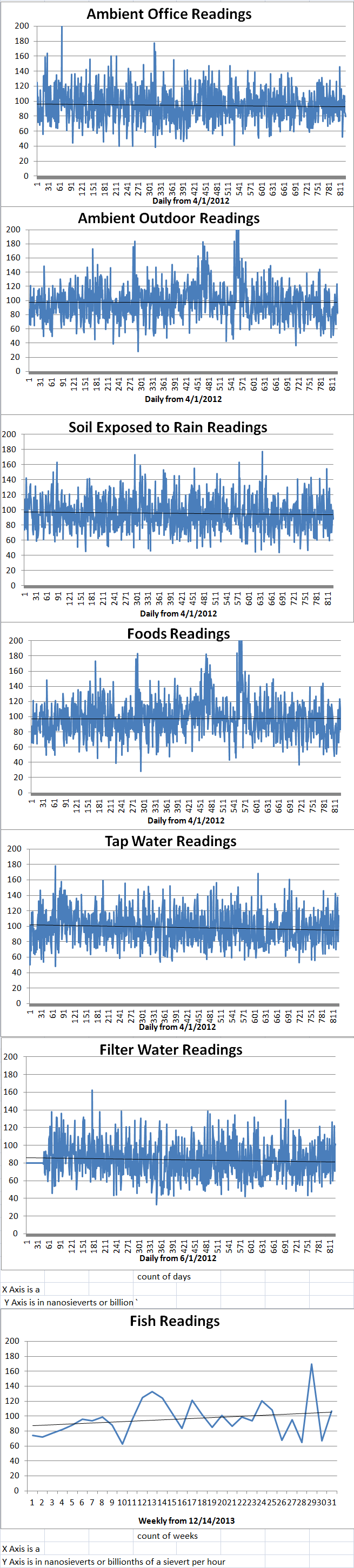
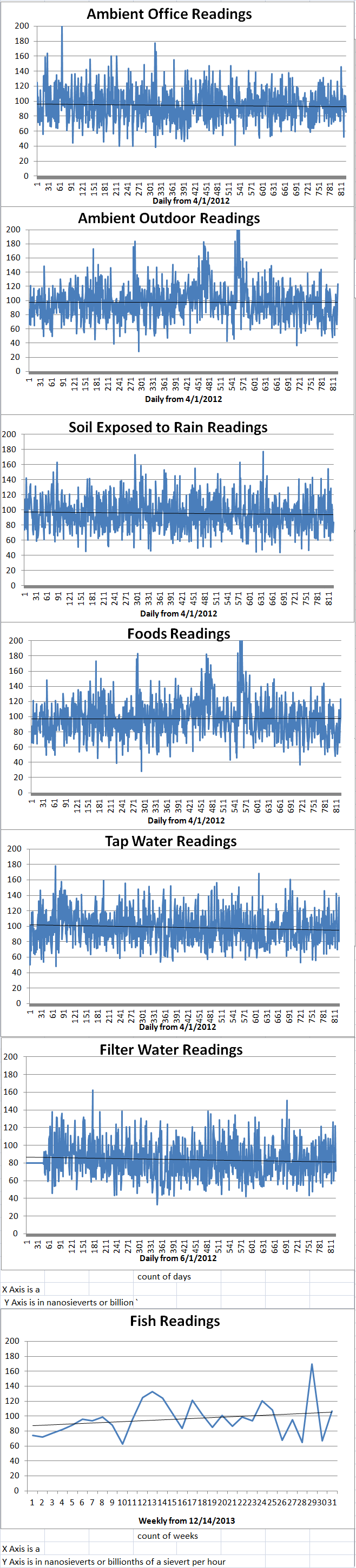
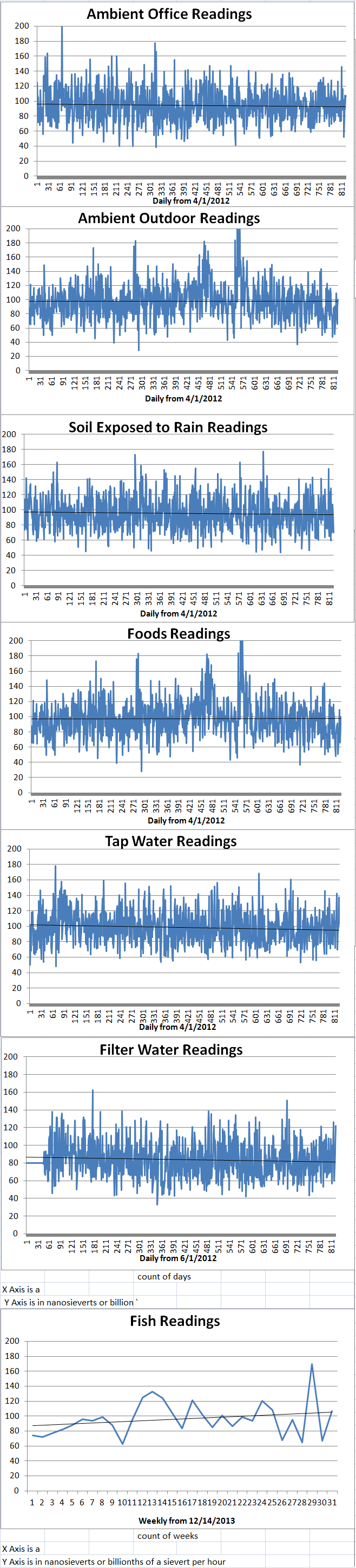
Ambient office = 80 nanosieverts per hourAmbient outside = 105 nanosieverts per hourSoil exposed to rain water = 88 nanosieverts per hourYellow bell pepper from Top Foods = 83 nanosieverts per hourTap water = 114 nanosieverts per hourFiltered water = 101 nanosieverts per hour -
Radioactive Waste 99 – Update on the Recent Accident at the Waste Isolation Pilot Plant 11
It has now been seven months since there was a release of radioactive particles from the Waste Isolation Pilot Plant (WIPP) near Carlsbad, New Mexico. A drum containing waste generated by nuclear weapons production at Los Alamos National Laboratory (LANL) burst in the underground facility. The air filtration system was not functioning correctly and the released radioactive materials including plutonium and americium escaped from the WIPP and were detected in Carlsbad over twenty miles away.
The exact contents of the drum that exploded are not well documented. The scientists at LANL have conducted over three thousand experiments with chemicals that might have been in the drum but have failed to duplicate the event that ruptured the drum. A recent report from Reuters claimed that a source at WIPP told them that a second drum may have ruptured and released radioactive materials at WIPP. Just a few days ago, the Department of Energy denied that there was any evidence of a second drum exploding at the WIPP. Apparently LANL announced that there was a second drum of their waste at the WIPP that contained much the same type of wastes and additives in the drum that did explode.
Six hundred and seventy eight other drums containing waste from LANL are now considered to be at high risk for heating and bursting. Of these drums, six hundred are stored at the WIPP, fifty seven drums are still at LANL and one hundred and thirteen drums are at a temporary storage in Texas.
LANL has been producing about ten plutonium pit triggers for nuclear warheads per year for the past few decades. With the call to renovate the U.S. nuclear arsenal, LANL will have to increase its pit trigger production to eighty a year. This will cause a huge increase in nuclear waste from LANL. With WIPP closed and no good estimation of when it may reopen, the question of what to do with all this new waste cannot be answered at this time. The pit triggers will be produced in the Plutonium Facility 4 (PF4) at LANL which is thirty six years old and located over an active seismic fault. Problems with the PF4 caused LANL to close it over a year ago.
The U.S. Defence Nuclear Facilities Safety Board (DNFSB) issued a report on a three year review of emergency preparedness at U.S. nuclear weapons facilities. In the report, the DNFSB stated that the problems that it found with the response to the accident at WIPP are also relevant to other U.S. nuclear weapon facilities. The report concluded that the underlying causes of the problems included “ineffective implementation of existing requirements, inadequate revision of requirements to address lessons learned and needed improvements to site programs, and weaknesses in DOE verification and validation of readiness of its sites with defence nuclear facilities….” In light of these findings, the DNFSB report found that the “DOE has not comprehensively and consistently demonstrated its ability to adequately protect workers and the public in the event of an emergency.” Given that the U.S. is embarking on a major upgrade to its nuclear arsenal, the conclusion of the DNFSB report is cause for great concern and needs to be addressed by the U.S. Department of Defence.
-
Radiation News Roundup September 25, 2014
The Japanese NHK television channel changed their scheduled TV program about Fukushima radioactive particles to a show about dinosaurs with no explanation. fukushima-diary.com
The Navy has shut down almost all nuclear propulsion-related work at the Norfolk Naval Shipyard after two incidents involving potentially contaminated material. nuclearstreet.com
-
Geiger Readings for September 25, 2014
Ambient office = 84 nanosieverts per hourAmbient outside = 90 nanosieverts per hourSoil exposed to rain water = 100 nanosieverts per hourOrange bell pepper from Top Foods = 111 nanosieverts per hourTap water = 111 nanosieverts per hourFiltered water = 99 nanosieverts per hour -
Nulcear Weapons 94 – U.S. – Russia – China – Pakistan Are All Upgrading Their Nuclear Arsenals
My last post discussed the work being done in North Korea on the development of tactical nuclear weapons. While North Korea is a wild card in the international nuclear weapons arena, there are other more important players who are working on their arsenals.
President Obama has been a strong advocate for global nuclear disarmament since before he was elected. In 2009, he signed an agreement with the then president of Russia to cut strategic nuclear arms. Unfortunately, when the current Russian president seized the Crimea in Ukraine this year, the momentum toward nuclear disarmament slowed. The Russian President recently mentioned nuclear weapons in discussing possible conflict in Eastern Europe. In the past month, Russian fighters and Russian nuclear bombers entered the identification zone off the West Coast of the U.S. and Canadian.
Last month, the Kansas City National Security Campus was dedicated in Kansas by the U.S. government to assist in the revitalization the aging nuclear warheads in the U.S. arsenal. The plant is part of a nationwide program which includes creating a new generation of nuclear weapon delivery systems. The projected cost of these new programs is three trillion dollars over the next three decades. With new Russian and Chinese belligerence, it would be politically impossible for Obama to pursue significant cuts in U.S. nuclear weapons.
Russia had announced recently intentions to renew its strategic nuclear forces by seventy percent by 2020. Now Russia has just announced that the renewal will be one hundred percent by 2020. The Defense Minister of Russia also said that thirty percent of the army and navy weapons would be switch to “cutting edge” technologies in 2015. He hinted that there were some secret weapons projects going on as well.
Last month, China admitted the existence of the rumored Dongfeng-41A, a “next generation” intercontinental ballistic missile which can carry ten nuclear warheads and travel up to twelve thousand miles. International treaties have forged that banned the creation of such multiple-warhead missiles between Russia and the U.S. Unfortunately, Russia backed out of the treaty.
Pakistan recently announced that it would be creating a fleet of submarines to carry sea launched nuclear tipped missiles. This expansion of capability is obviously aimed at India which has a new right-wing government that has been ratcheting up belligerent rhetoric toward Pakistan since it was elected. The idea behind the new submarine fleet is to warn potential attackers (India) that even if Pakistan was decimated with an unexpected nuclear attack, the submarines would be able to launch a devastating retaliatory nuclear strike against the attacker. Unfortunately, if either Pakistan or India launched a nuclear strike on the other, within months, the prevailing winds would carry the nuclear fallout back over the attacker. It would be suicidal.
With Russia, the U.S. and China announcing major nuclear upgrades, it appears that we are entering a new nuclear arms race that might return us to the instability of the Cold War period. As dangerous as the possibility of intentional nuclear war may be, the possibility of an accidental nuclear war breaking out is even more worrisome.
Architect’s model of the new National Security Campus in Kansas City:

-
Geiger Readings for September 24, 2014
Ambient office = 85 nanosieverts per hourAmbient outside = 78 nanosieverts per hourSoil exposed to rain water = 84 nanosieverts per hourCelery from Top Foods = 123 nanosieverts per hourTap water = 80 nanosieverts per hourFiltered water = 71 nanosieverts per hour -
Nuclear Weapons 93 – North Korea Working on Tactical Nuclear Warheads and Delivery Systems
I have written previous posts about the nuclear aspirations and efforts of North Korea. They have tested intermediate range rockets and have been working hard on miniaturizing nuclear warheads so that they can be carried by their missiles. Even though they have a huge army, it is poorly equipped and would not be effecting in conventional warfare against a well armed foe such as South Korea. N.K. is developing nuclear weapons because they would give N.K. an edge in a conflict with South Korea.
The strategic nuclear missiles in the arsenals of nations with nuclear weapons are intended to carry big nuclear warheads on intercontinental flights. These warheads are designed to do major damage to large areas such as cities, factory complexes or military bases. N.K would not like to devastate huge areas of South Korea with strategic nuclear bombs because they want to invade and hold South Korea. There is also the probability that there would be major fallout in N.K. if they dropped big nuclear warheads on the South.
In the last decade, N.K. developed their “transporter erector launchers” or mobile artillery rocket launchers with the assistance of the Chinese. These launchers can fire three hundred millimeter diameter artillery rockets that can carry about two hundred pounds of explosives.
Since 2010, N.K has produced a new version of the three hundred millimeter mobile rocket launchers with the assistance of the Russians. The new launcher was made public in May of 2013. N.K. has also been working on the KN-10, a three hundred millimeter rocket based on the Russian SS-21 ground-to-ground missile. This rocket will be able to carry over a thousand pounds of explosives up to one hundred and twenty four miles. It was announced publicly in August of this year.
It is believed that N.K. is also working on miniature tactical nuclear warheads for the KN-10 missile. Tactical nuclear warheads are much smaller than strategic nuclear warheads and are intended for use on battlefields against military targets. Their use in a conflict with South Korea would give the North Koreans an advantage on the battlefield and would leave most of South Korea undamaged.
Even without tactical nuclear warheads, the new KN-10 missiles are much more powerful and would cause much more damage than the old generation of three hundred millimeter artillery missiles. The United States has troops on edge of the Demilitarized Zone between North and South Korea. They are there so that an attempt to invade South Korea by North Korea would encounter these U.S. troops and trigger war with the U.S. With tactical nuclear weapons in the mix, a war on the Korean peninsula would be more complex. South Korea does not have nuclear weapons and the U.S. would have to decide whether to answer North Korean aggression with U.S. tactical nuclear weapons.
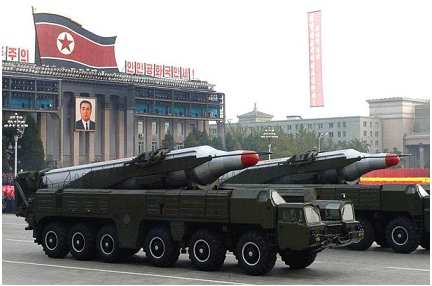
Example of a North Korean missile and mobile launcher:
-
Radiation News Roundup September 23, 2014
An extremely radioactive used car was almost to be imported from Japan to Russia. fukushima-diary.com
Russia expects that within two years it will receive a contract to construct Jordan’s first nuclear power plant following the signing of a project development agreement. world-nuclear-news.org
Statements by a European Commission spokesman indicate the UK’s Hinkley Point C nuclear power plant project will be approved under state aid rules. world-nuclear-news.org
-
Geiger Readings for September 23, 2014
Ambient office = 107 nanosieverts per hourAmbient outside = 73 nanosieverts per hourSoil exposed to rain water = 70 nanosieverts per hourIceberg lettuce from Top Foods = 100 nanosieverts per hourTap water = 137 nanosieverts per hourFiltered water = 122 nanosieverts per hour