Blog
-
Geiger Readings for September 15, 2014
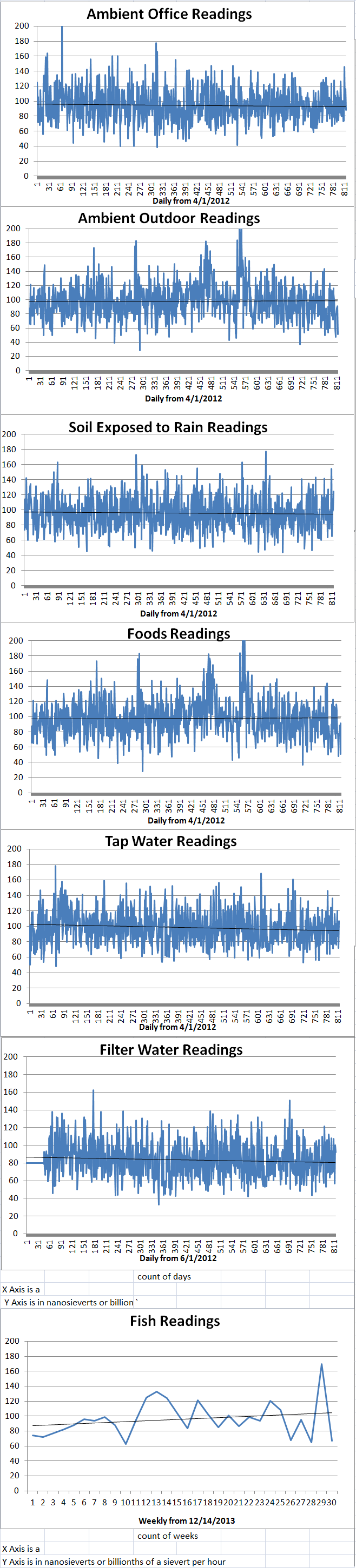
Ambient office = 88 nanosieverts per hourAmbient outside = 119 nanosieverts per hourSoil exposed to rain water = 125 nanosieverts per hourBartlett pear from Top Foods = 51 nanosieverts per hourTap water = 104 nanosieverts per hourFiltered water = 92 nanosieverts per hour -
Radiation News Roundup September 14, 2014
The Asahi Shimbun, Japan’s second-largest daily newspaper, retracted an influential news report on the Fukushima nuclear disaster on Thursday after weeks of criticism from other news organizations. rallyagainstomalley.com
Plutonium found in Carlsbad, New Mexico nearly 30 miles from US WIPP nuclear site. enenews.com
-
Geiger Readings for September 14, 2014
Ambient office = 116 nanosieverts per hourAmbient outside = 91 nanosieverts per hourSoil exposed to rain water = 100 nanosieverts per hourYellow bell pepper from Top Foods = 91 nanosieverts per hourTap water = 107 nanosieverts per hourFiltered water = 100 nanosieverts per hour -
Radiation News Roundup September 13, 2014
The Asahi Shimbun, Japan’s second-largest daily newspaper, retracted an influential news report on the Fukushima nuclear disaster on Thursday after weeks of criticism from other news organizations. rallyagainstomalley.com
Plutonium found in Carlsbad, New Mexico nearly 30 miles from US WIPP nuclear site. enenews.com
-
Geiger Readings for September 13, 2014
Ambient office = 100 nanosieverts per hourAmbient outside = 120 nanosieverts per hourSoil exposed to rain water = 98 nanosieverts per hourCrimini mushroom from Top Foods = 81 nanosieverts per hourTap water = 72 nanosieverts per hourFiltered water = 57 nanosieverts per hourPetrale sole – Caught in USA = 67 nanosieverts per hour -
Radioactive Waste 98 – TEPCO is Being Sued By Workers Over Hazard Pay for Fukushima Clean-up
I have blogged in the past about the employment situation at Fukushima. Layers and layers of subcontractors exist between the nuclear companies and the people hired to work at nuclear plants. Organized crime in Japan is involved in contracting staffing at nuclear power reactors. There are no background checks for people working at nuclear power plants and desperate people from the margins of society wind up working a nuclear power plants. There have been reports that these desperate people form a sort of second class of workers at nuclear power plants who are poorly equipped, poorly trained and financially exploited by subcontractors. There have also been reports highly skilled workers are leaving the dangerous jobs at Fukushima for other less hazardous positions in the nuclear industry. Now there are lawsuits from workers at Fukushima saying that they are not being paid what they are entitled to.
Four Fukushima workers are suing TEPCO because they say that they were not paid promised hazard pay above and beyond their regular salaries. This is the first such law suit against TEPCO. The workers wore masks in court because they are afraid of retaliation from their employers. Six hundred thousand dollars in unpaid wages is being sought from TEPCO and some of their partner firms. The lawyer for the four who brought the suit said that it was possible that there would be more laws suits from workers among the six thousand employed in the estimated forty year clean-up of the Fukushima disaster site. The lawyer stated that TEPCO has promised but not delivered hazard pay and that skilled workers were leaving the clean-up project which is now being handled by the less skilled.
TEPCO announced last year that it would double daily danger pay to two hundred dollars per worker because of the danger involved in dealing with the uncontrolled flow of radioactive water and the decommissioning of the reactors that experienced core meltdowns at Fukushima. However, the promised hazard pay is being held up by some of the eight hundred subcontractors who sent workers to Fukushima. The subcontractors claim that their businesses will fail if they are not allowed to divert the hazardous pay. TEPCO is already expected to pay over forty eight billion dollars as compensation to the people around Fukushima whose lives were impacted by the Fukushima disaster. Additional billions of dollars will be required to complete the forty year decontamination and decommissioning at Fukushima. A citizens’ judicial panel recently decided that three former executives of TEPCO should face criminal charges because of their actions leading up to, during and following the Fukushima disaster.
Considering the costs that are piling up, it is obvious that TEPCO will be under serious economic stress in the coming years. I wonder how long it will be until TEPCO declares bankruptcy. I expect that if and when they do, the burden of the continuing clean up will fall on the Japanese government and the Japanese taxpayers. And, should the government decide that it does not have the funds to continue the clean-up, the Fukushima site may become a permanent threat to human health and the environment in Japan.
Fukushima workers:
-
Geiger Readings for September 12, 2014
Ambient office = 91 nanosieverts per hourAmbient outside = 61 nanosieverts per hourSoil exposed to rain water = 65 nanosieverts per hourBanana from Top Foods = 88 nanosieverts per hourTap water = 102 nanosieverts per hourFiltered water = 87 nanosieverts per hour -
Radiation News Roundup September 12, 2014
TEPCO announced the completion of the installation of an 80 meter wide underground zeolite wall at Fukushima Daiichi. fukuleaks.org
Educating the public on the risks of radiation should be a long-term process and not just take place in the aftermath of a major nuclear accident, a panel of radiation protection experts agreed. world-nuclear-news.org
-
Radioactive Waste 97 – Japan Seeking Demonstration Projects to Remove Tritium from Fukushima Water
My last blog was about tritium, the dangerous radioactive isotope of hydrogen. Tritium is being released worldwide by operating nuclear reactors. Nuclear accidents such as Fukushima can release huge amounts of tritium. There is no existing nuclear technology for the removal of tritium from water. Japan is now seeking bids for demonstration projects for tritium removal. Three companies have been selected to construct the demonstration projects.
The Japanese Ministry of Economy, Trade and Industry (METI) sent out a request for proposals in September of 2013 to remove tritium from contaminated water at Fukushima which is filling up emergency tanks and leaking into the Pacific Ocean. After the official submission period ended in late October of 2013, a review panel from the International Research Institute for Nuclear Disarmament went over all the proposals. Unfortunately, none of the many proposals that were submitted could be immediately applied to decontaminating Fukushima waste water.
A Japanese government committee charged with finding treatments for the contaminated waste water said that “Since technologies that have a quick effect in separating tritium have not been found after collecting technical proposals from both inside and outside of Japan, it will be necessary in the future to assess measures proposed in response to our requests for information.” The committee called for proposals in mid-May that could demonstrate a method for tritium removal. The deadline for the new proposals was July 17, 2014. In late August, METI stated that Kurion from the U.S., GE Hitachi Nuclear Energy of Canada (GENEC) and FSUE Radioactive Waste Management Enterprise (RosRAO) from Russia will build demonstration projects to show how their technology can remove tritium from water.
The demonstration projects have to show that the propose tritium removal technologies actually work as promised. Additionally, the demonstration projects will provide a basis for estimating the cost of constructing and operating tritium removal at the Fukushima nuclear plant where the disaster occurred. The demos will have to show that they can remove tritium from water where the tritium concentration is between six tenths of a million Becquerels and four million Becquerels per quart. The processes demonstrated have to be expandable to treating more than four hundred cubic yards of water a day. The Mitsubishi Research Institute will be handling the funding on behalf of METI’s Agency for Natural Resource and Energy. Funding of up to nine million four hundred thousand dollars will be made available to each of the companies for the construction and operation of the demonstration projects.
Tritium is a threat to human health and it is a growing problem around Fukushima. Development of a technology that can remove tritium from water is an important step toward mitigating the environmental pollution from the Fukushima disaster. Hopefully, at least one of the demonstration projects will be successful and there will be a new technology to assist in decontamination of water released from nuclear power plants.

-
Radiation News Roundup September 11, 2014
Firefighters quickly doused a fire reported in an auxiliary building at North Carolina’s Harris nuclear plant Wednesday. nuclearstreet.com
Meeting the energy needs of a growing global population while tackling climate change is the “biggest diplomatic challenge of the era,” according to leading climate change expert Professor Sir David King. world-nuclear-news.org