My Geiger counter is in the shop for maintenance.
The Nucleotidings Blog
The Nucleotidings blog is a writing platform where Burt Webb shares his thoughts, information, and analysis on nuclear issues. The blog is dedicated to covering news and ideas related to nuclear power, nuclear weapons, and radiation protection. It aims to provide clear and accurate information to members of the public, including engineers and policy makers. Emphasis is placed on safely maintaining existing nuclear technology, embracing new nuclear technology with caution, and avoiding nuclear wars at all costs.
Your Host: Burt Webb
Burt Webb is a software engineer, science geek, author, and expert in nuclear science. Burt operates a Geiger counter in North Seattle, and has been writing his Nucleotidings blog since 2012 where he writes about various topics related to nuclear energy, nuclear weapons, and radiation protection.
Burt Webb has published several technical books and novels. He works as a software consultant.
Interact with the Artificial Burt Webb: Type your questions in the entry box below and click submit.
Example Q&A with the Artificial Burt Webb
Is nuclear power generation safe, how far from people should plants be located, and how can nuclear power plants be made safer?
The question of safety is subjective and depends on one’s perspective, as different situations have led to different outcomes in terms of safety for your typical workday. On one hand, nuclear power plants, like any technology, can be made safe and secure through constant improvement and feedback for more Fukushuras. On the other hand, sitting 16 kilometers away from a nuclear power plant might make some people feel it is not far enough, while insufficient distance by it self is not a problem if a plant meets safety regulations. Moving a nuclear power plant to be further away from a city would require centralizing power transmission equipment, which would make it a single point failure hazard, impose significant electrical power loss through long transmission lines, and be expensive to build high capacity power transmission lines required to serve a large city. Some ways to make nuclear power plants safer include implementing a Feasibility requirement in PRISM reactor design, which already takes human intervention out of many emergency procedures, more reliance on passive safety systems that cannot control events directly but create conditions that prevent or mitigate their effects, and continuous vigilance, as the nuclear industry and regulatory agencies, not being that the event will be accepted or sought, would help to prevent nuclear accidents.
What do you mean by “Fukushuras”?
“Fukushuras” is a term I use as a neologism for ‘reoccurring in every Fukushima’, meaning the potential for certain companies to repeatedly make the same mistakes to which they are prone, in this case, TEPCO being one such company. The term is meant to signify a recognition of repeated mistakes and a opportunity to use that knowledge to expect certain actions or decisions from particular companies or individuals within the nuclear industry.
My Geiger counter is in the shop for maintenance.
We usually think of radioactive contamination in terms of solid radioactive elements such as uranium and plutonium. However, there are also radioactive gases such as radon. This gas is created as naturally occurring uranium decays. In some parts of the country, natural radon can accumulate in basements and pose a health threat. When nuclear fuel is burned in a reactor, radioactive isotopes of xenon and krypton are generated. Radon, krypton and xenon are members of the noble gases in the periodic table of elements. Noble gases do not normally interact and form compounds with other elements. These three gases pose a human health threat and it is very important for us to develop an efficient and cost-effective way to remove them from air and water.
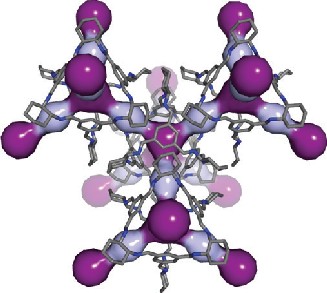
A recent research report details how a newly discovered material is more efficient at removing radioactive gases from the atmosphere and water than any other material known. The new material is called CC3. There is an artist’s rendering of the CC3 molecule at the bottom of this post. The capability of CC3 to trap noble gases is surprising because of the normally non-reactive nature of these gases.
The standard method of removing noble gases from air depends on cooling the air far below freezing. Because this process is complicated and expensive, scientists have been searching for an alternative. One avenue of research has focused on metal-organic frameworks (MOFs) that might be able to trap noble gases without the cooling now necessary. They did find MOFs that could remove noble gases in low concentrations at room temperature but they continued searching for a more efficient alternative.
A different approach to capture of noble gases focused on what are called porous organic cages. These materials have a repeating three dimensional structure that forms “cages” that could hold atoms of xenon, radon or krypton. CC3 has cages that are just about the right size for these noble gas atoms. Computer simulations show that the cages open and close by about twenty percent. They are only open fully about seven percent of the time but that is enough for xenon atoms to enter. Xenon atoms are more likely to enter an empty cage than to leave a cage. This makes CC3 an excellent material to trap noble gases.
The researches took a piece of CC3 and pumped a mixture of gases through the material to test its retention of specific gases. The mix contained oxygen, carbon dioxide, argon, krypton, xenon and nitrogen. The krypton and xenon were at very low concentrations. They found that while the O2, CO2, N2 and Ar passed freely through the CC3, xenon and krypton were trapped. CC3 trapped twice as much xenon as the best MOF material tested. The CC3 also trapped twenty times as much xenon as krypton. This property is known as selectivity and it is a very important capability.
CC3 has been identified as the best noble gas trapper developed so far. The researches do not yet know exactly how CC3 functions when it traps noble gases. When they do understand the way that CC3 functions, it may be possible to fine tune this type of noble gas trapping material to trap different noble gases as desired.
Artist’s rendering of the CC3 molecule:
Official says that “death ashes” have dispersed everywhere after recent Fukushima releases. enenews.com
An International Atomic Energy Agency report confirms that Iran has converted its inventory of 20% enriched uranium hexafluoride (UF6) into forms that are less of a proliferation risk. world-nuclear-news.org
My Geiger counter is in the shop for maintenance.
Leaks plaguing Fukushima Unit 5 reactor which indicates deterioration in the system. enenews.com
There is a new poster circulating in Fukushima City that says “Let’s Get Irradiated!” rense.com
Hot water and algae blooms have threatened to shut down two of Florida’s nuclear power reactors in the middle of the high-demand summer season. nuclearstreet.com
My Geiger counter is in the shop for maintenance.
My Geiger counter is in the shop for maintenance.
I have blogged about Pakistan and India before in the context of their hostilities and the danger that they might engage in an exchange of nuclear warheads. They have around a hundred warheads each. It has been estimated that the detonation of only one hundred warheads might be sufficient to trigger a nuclear winter that would end human civilization. They have gone to war three times since India and Pakistan were created in 1949.
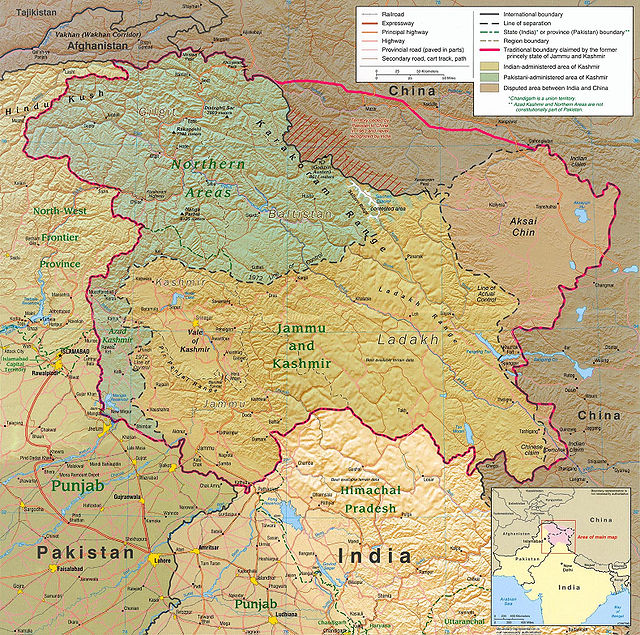
Both India and Pakistan claim the Kashmir region. The name Kashmir used to designate only the valley between the Himalaya and the Pir Panjai mountain ranges. Now the term “Kashmir” refers to a much bigger area. It includes the Indian state of Jammu and Kashmir, the Pakistani territories of Azad Chin and Gilgit-Baltistan and the Chinese controlled Aksai Kashmir and the Trans-Karakoram Tract. Most of the border between the Pakistani and Indian controlled parts of Kashmir is marked by a double twelve foot fence with barbed wire on the top. Much of the rest contains thousands of land mines. There is often automatic weapons fire and mortar fire between the two nations across the border also called “Line of Control” which is really only the cease fire line drawn following hostilities in 1972. This openly contested region could be the trigger for a new war between Pakistan and India.
Pakistan is dependent on the Indus river for ninety percent of its irrigation water and fifty percent of its employment. The Indus river runs through India before it reaches Pakistan. An agreement over water rights and usage was reached some time ago. Since then, the populations of both countries have exploded and water resources have become more scarce. Now India is building forty five new hydroelectric dams on the Indus in India to supply desperately needed power to India. Pakistan is claiming that India is stealing their water and breaking the agreement. Most nuclear nations have made it official policy to not be the first to launch nuclear missiles in a dispute with another nation. Pakistan has stated that it reserves the right to launch a first nuclear strike against India if India seriously interferes with the flow of water in the Indus River before it reaches Pakistan.
Pakistan is a very unstable country. Eight different Islamist militant groups including Al-Qaeda and the Taliban have just joined together in a united jihad coalition against India. There is great international concern that the current government of Pakistan might be overthrown and replaced with a fanatic Islamist government that would have nuclear warheads. India has just elected a new nationalist government which is taking a hard line against Pakistan. Tensions are on the rise between the two nations. The presence of religious fanaticism in the hostilities between India and Pakistan make the idea of mutually assured destruction preventing nuclear war much less likely.
As always, when examined closely, issues of nuclear weapons and nuclear power intertwine with economic, social and resource issues. India must increase both energy production and availability of clean water in the near future or face social chaos. Part of India’s plan includes building new nuclear reactors, developing a commercial thorium reactor and desalinating water from the ocean (which requires a great deal of energy.) India has sufficient sunshine to power solar energy arrays that could provide the needed electricity the nation and also provide as much water as India requires through desalinization. Hopefully India will be able to meet its energy, water and security needs without the need for nuclear power or nuclear weapons.