Blog
-
Geiger Readings for June 2, 2014
Latitude 47.704656 Longitude -122.318745Ambient office = 67 nanosieverts per hourAmbient outside = 102 nanosieverts per hourSoil exposed to rain water = 101 nanosieverts per hourRaw peanuts in shell from Top Foods = 79 nanosieverts per hourTap water = 111 nanosieverts per hourFiltered water = 87 nanosieverts per hour -
Radiation News Roundup June 1, 2014
Official in Fukushima says that hot particles of melted fuel are inhaled by children every day. enenews.com
Matsudo city government tell people not to go close to the river because the radiation level is dangerously high. fukushima-diary.com
Protestors interrupted a public meeting with the Nuclear Regulatory Commission in Brattleboro, Vermont Wednesday night. digital.vpr.net
-
Geiger Readings for June 1, 2014
Ambient office = 102 nanosieverts per hourAmbient outside = 71 nanosieverts per hourSoil exposed to rain water = 63 nanosieverts per hourBanana from QFC = 71 nanosieverts per hourTap water = 107 nanosieverts per hourFiltered water = 77 nanosieverts per hour -
Geiger Readings for May 31, 2014
Ambient office = 123 nanosieverts per hourAmbient outside = 54 nanosieverts per hourSoil exposed to rain water = 64 nanosieverts per hourFiber One dry cereral from Safeway = 80 nanosieverts per hourTap water = 95 nanosieverts per hourFiltered water = 83 nanosieverts per hourHalibut – Caught in Canada = 108 nanosieverts per hour -
Nuclear Reactors 127 – Nuclear Regulatory Commission Votes to Ignore Need to Move Spent Fuel to Dry Casks
I have mentioned before that the spent fuel pools at U.S. nuclear reactors are rapidly filling up and will all be full within five years if none of the spent fuel assemblies are removed. Currently, the spent fuel pools hold about five times as many fuel assemblies as the cores of operating reactors. Unless some of the spent fuel assemblies are removed soon, it will not be possible to refuel reactors and they will need to be shut down.
The U.S. government promised that there would be a permanent geological repository for spent fuel assemblies by 1999. Yucca Mountain in Nevada had been selected for such a repository and much preliminary work had been done when the project was cancelled in 2009. There is no current project to site and build a permanent repository. The best estimates are that there will be no permanent repository until 2050 at the earliest.
Spent fuel pools are especially vulnerable to accidents or terrorist attacks. A recent NRC study that evaluated the possible consequences of a fire at a nuclear power plant in Pennsylvania where spent fuel rods burned concluded that such a fire would lead to forty thousand additional cancer deaths, almost a thousand square miles of evacuated territory and more than four million people being displaced.
There has been a push in the nuclear industry and the U.S. government to move some of the spent fuel assemblies from the spent fuel pool to steel and concrete dry casks on site. The study mentioned above found that if the spent fuel assemblies older than five years in the pools were moved to dry cask, the repercussions of such a fire would be greatly reduced.
Aside from the considerable cost of this alternative, there are problems with the current dry cask designs. Chemical reactions can produce gas in the casks which could lead to explosions and fires. New cask designs are being developed but prototypes will not be available until 2017 at the earliest. So storage is filling up and time is running out to find alternatives.
The Nuclear Regulatory Commission just met and voted on whether or not to mandate on site dry cask storage. The vote was four to one against accelerating the transfer of spent fuel assemblies to dry cask storage. The Commission also voted that “no further generic assessments be pursued related to possible regulatory actions to require the expedited transfer of spent fuel to dry cask storage.”
Given that the spent fuel pools are filling up and there is no permanent geological repository, this would seem to be strange policy vote on the part of the NRC. The reason for the decision was apparently that although such a fire would be catastrophic, the probability of such a fire was very small so no action needed to be taken. Unfortunately, the NRC study did not include the possibility of a terrorist attack. Given that an terrorist attack on a spent fuel pool could be devastating, spent fuel pools would be a prime target for terrorists. In Ukraine, there have already concerns that an escalating military confrontation could lead to deliberate attacks on Ukraine nuclear power plants.
Deliberately disregarding terrorist attacks in consideration of moving spent fuel assemblies to dry casks is a glaring omission in the NRC study and decision. The NRC has not taken important action to insure the safety of U.S. citizens from the disastrous releases of radioactive materials from nuclear power plants.
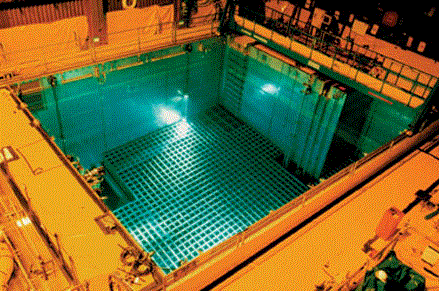
Spent Fuel Pool:

-
Geiger Readings for May 30, 2014
Ambient office = 84 nanosieverts per hourAmbient outside = 109 nanosieverts per hourSoil exposed to rain water = 94 nanosieverts per hourMango from Top Foods = 140 nanosieverts per hourTap water = 80 nanosieverts per hourFiltered water = 70 nanosieverts per hour -
Nuclear Accidents 28 – Ice Wall Being Constructed Around Damaged Reactors at Fukushima
I post a lot links about the repercussions of the disaster there in March of 2011. One of the reasons that I post so many of these links is that I want people to understand just how profound the effects are of such a major nuclear accident on a society. I have been following the various problems and efforts to control them since the accident and I decided that today I would return to Fukushima to discuss how they are trying to deal with the leakage of contaminated water into the Pacific Ocean.
TEPCO has just begun dumping ground water into the Pacific Ocean that has been routed around the melted reactors cores at Fukushima. The water is not completely free from radioactive contamination but TEPCO claims that it does not represent a threat to humans or life in the ocean. Critics of the way that the repercussion of the Fukushima disaster are being handled are debating that claim.
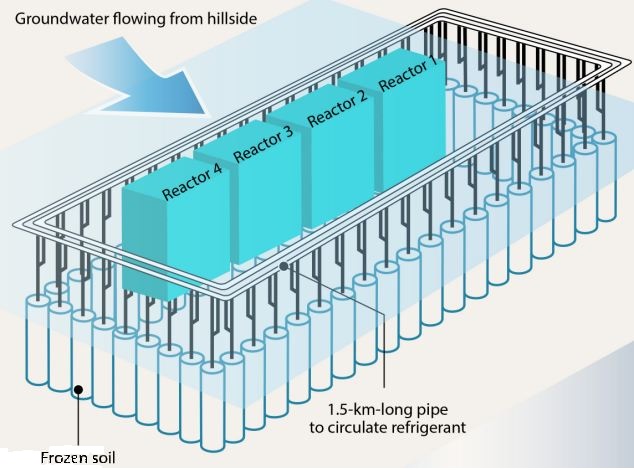
The Nuclear Regulatory Agency (NRA) of Japan was created after the Fukushima disaster to act as an government oversight agency for nuclear affairs. The NRA has just authorized the “construction of a network of pipes, pumps and compressors designed to freeze the ground and create a mile-long ice wall to block the path of water flowing between surrounding mountains and the Pacific Ocean.” This technique has been used to dig tunnels near water but has never been attempted on this scale.
The ice wall will be constructed around the four reactors at Fukushima that sustained damage. The cores of reactors for Units 1,2 and 3 have melted down into the Earth. The building housing the Unit 4 reactor and spent fuel pool was heavily damaged when Unit 3 exploded. The ice wall will be almost a mile long and will penetrate one hundred feet into the ground. Holes will be drilled and pipes will be inserted into the holes. Coolant as cold as minus forty degrees Celcius or forty degrees below zero Fahrenheit will be pumped into the holes and will freeze the soil around the hole. The intention is to form a water tight rectangle around the four damaged reactors.
If the plan works, the water that is flowing underground from the mountains behind the Fukushima power plant will be diverted around the ice wall and flow into the ocean without being contaminated. In addition, heavily contaminated water which is inside the rectangle will be trapped and unable to flow into the ocean. Construction of the ice wall is expected to be completed by March of 2015. A new ground water drainage system is being created around the damaged reactors as a backup for the ice wall. Critics are not convinced that the ice wall will be as effective as TEPCO claims. Considering the incompetence and dishonesty displayed by TEPCO in the past, the critics may well be right.
-
Radiation News Roundup May 29, 2014
The future of three Exelon nuclear power plants is in question after they failed to secure a capacity payment that would have supported their operation in a difficult power market. world-nuclear-news.org
Unnamed security violations at the Zion nuclear plant in Illinois are likely to result in a civil penalty of $17,500 for a subsidiary of EnergySolutions. nuclearstreet.com