Blog
-
Geiger Readings for February 19, 2013
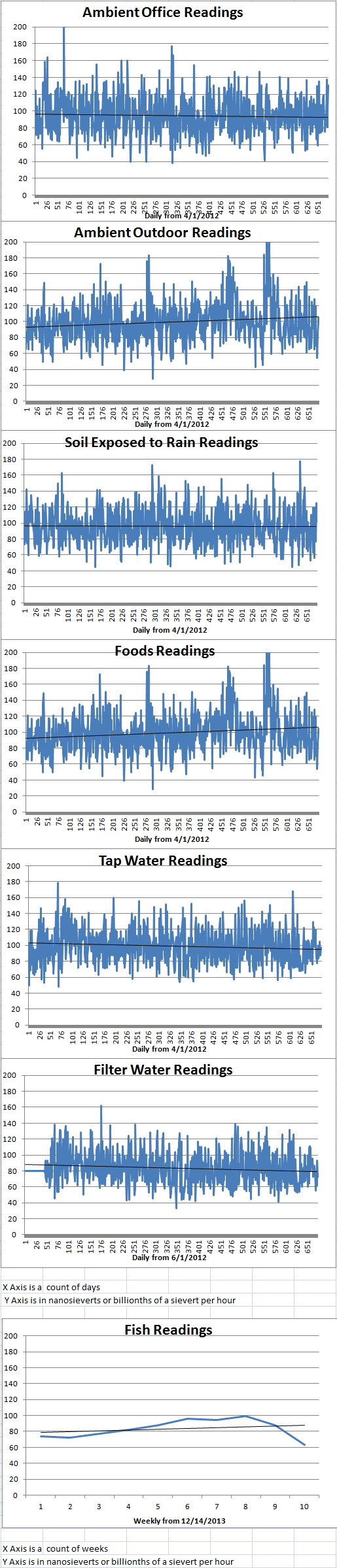
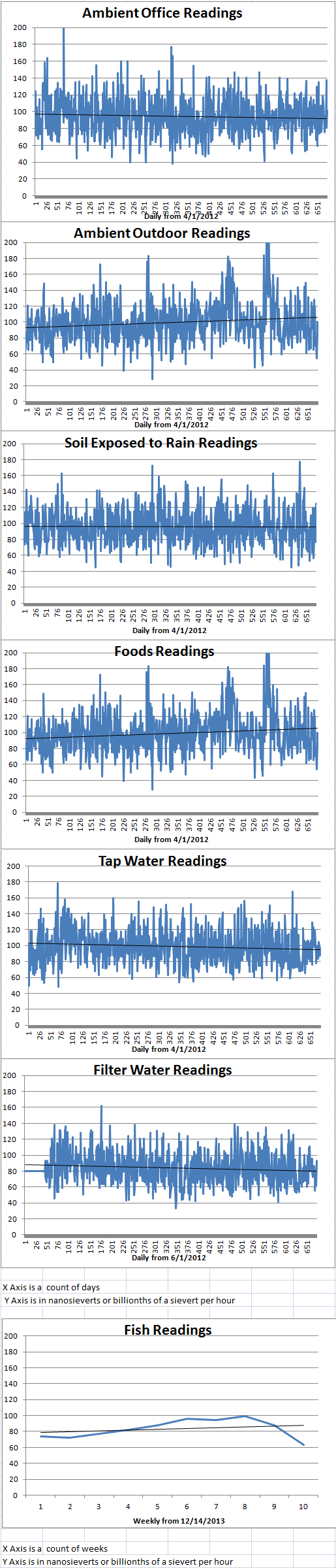
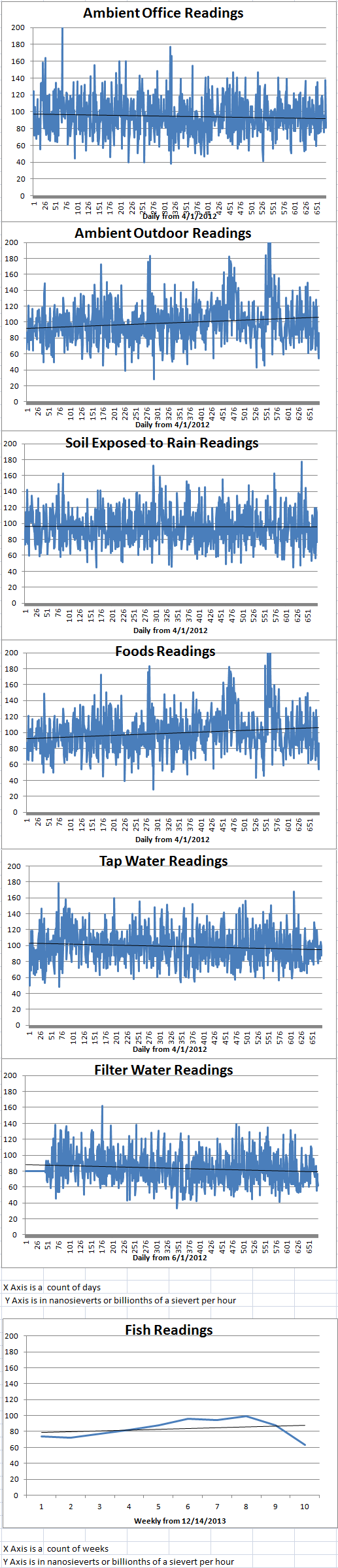
Ambient office = 130 nanosieverts per hourAmbient outside = 118 nanosieverts per hourSoil exposed to rain water = 102 nanosieverts per hourAsparagus from Top Foods = 105 nanosieverts per hourTap water = 96 nanosieverts per hourFiltered water = 73 nanosieverts per hour -
Radioactive Waste 61 – Illegal Nuclear Waste Dumping in Russia 4
In December of 2005, Greenpeace activists occupied a loading dock and 2 loading cranes at the port of Le Havre, France. They were protesting the loading of four hundred and fifty containers of radioactive waste on a ship bound for Russia. They were protesting the thirty year arrangement between European nations and the Russian Federation to ship nuclear waste to Russia for disposal.
Over the decades more than one hundred thousand tons of radioactive waste have been shipped to Russia. National and international laws and regulations were broken at every stage of the journey posing a threat to all the people living along the route taken by the waste ships.
There are two main types of nuclear wastes being shipped to Russia. Uranium waste generated by nuclear fuel reprocessing taking place at the Cogema/Areav facility at la Hague in Normandy, France and depleted uranium created by the enrichment of nuclear fuel at the France Eurodif/Areva de Pierrelatte facilities in France and the Urenco facilities in Germany (Gronau), the Netherlands (Almelo) and the UK (Capenhurst). These facilities provide fuel for the one hundred and thirty five nuclear reactors operating in Europe.
The containers being used to ship the nuclear waste to Russia do not meet the standards set by the International Atomic Energy Agency. They pose a major hazard during their trip to Russia that covers thousands of miles. Crystals of uranium hexafluoride compose much of the waste being shipped. This substance reacts violently to water, generating lethal gas.
“The nuclear industry is opting for the cheapest, dirtiest and most dangerous option – dumping in Russia,” said Vladimir Tchuprov of Greenpeace Russia in la Havre. “Russia already has a nuclear waste crisis, and yet EDF, EoN, and all other European nuclear utilities are making the situation worse. Disposal and even storage of foreign nuclear waste in Russia is illegal,” said Tchuprov.
“European utilities dumping uranium wastes in Russia include: OKG – Finland, Vattenfall – Sweden/Europe, EoN and RWE – Germany, Electrabel – Belgium, EPZ – the Netherlands, British Energy – the UK, EDF – France, Iberdola – Spain, and NOK/Swissnuclear – Switzerland.”
Greenpeace has filed a lawsuit in Russia against this practice, citing Russian law that states that importation of nuclear waste from foreign sources for disposal in Russia is illegal. Their complaint was against Tekhsnabexport, a Russian company, for signing contracts with Eurodif, Urenco, Internexco and GKN to accept nuclear waste for disposal in Russia. Even the Russian Ministry of Atomic Energy (Minatom) signed a contract with the French company Cogema for disposal of nuclear waste.
While the illegal dumping of nuclear waste by the Mafia in Italy is an arrangement between companies and organized crime, the dumping in Russia appears to be an arrangement between European companies, Russian companies and even the Russian government. Such blatant disregard for Russian law on the part of Russia companies and Russian government agencies reveals amazing greed and cynicism that ill severs the Russian people.
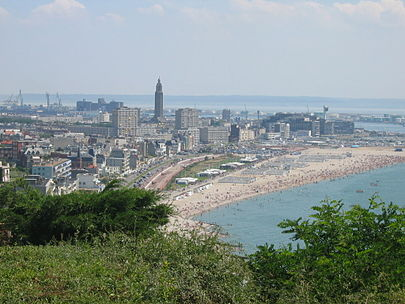
Port of La Havre, France:

-
Geiger Readings for February 18, 2013
Ambient office =101 nanosieverts per hourAmbient outside = 82 nanosieverts per hourSoil exposed to rain water = 100 nanosieverts per hourAsparagus from Top Foods = 100 nanosieverts per hourTap water = 97 nanosieverts per hourFiltered water = 93 nanosieverts per hour -
Radioactive Waste 60 – Illegal Nuclear Waste Dumping in Russia 3
Yesterday, I blogged about illegal dumping of nuclear waste in the Arctic Sea by the Soviet Union and Russia. The Soviet Union and Russia also dumped nuclear waste in the Sea of Japan.
In 1993, after the fall of the Soviet Union, Greenpeace announced that they had received reports that a Russia freighter was on its way to the Sea of Japan to dump nine hundred tons of nuclear waste. Greenpeace filmed the dumping operation and Japanese television broadcast it repeatedly. Japan lodged a complaint with the Russian government with respect to the dumping which was thought to be illegal under international law. It was confirmed later that such Russian dumping had been going on since at least 1959.
The London Convention of 1972 outlawed dumping of nuclear waste in the world’s oceans. The Russians claimed that under the treaty they were allowed to dump “low-level nuclear waste.” The Russian government said that it had given the Russia Navy permission to dump seventeen hundred tons of radioactive waste into the Sea of Japan in October and November of 1993. Other nations disagreed with the Russia interpretation of the treaty.
The Japanese government had agreed to a one billion and eight hundred million dollar aid package for Russia earlier in 1993. One hundred million of that aid package was intended to help Russia dismantle nuclear weapons. The Russian President arrived in Japan about a week before Greenpeace publicized the Russian nuclear waste dumping to sign an agreement with regard to nuclear waste dumping in the Sea of Japan. The agreement called for joint monitoring of the level of radioactivity in the Sea of Japan.
The Japanese public, government agencies, and various Japanese organizations including unions of fishermen demanded an immediate halt to the Russian dumping of nuclear waste into the Sea of Japan. Critical letters flooded the Russian Consulates in Japan and telegrams were sent directly to the Russian President. In late October of 1993, Russia announced that it would suspend the dumping of nuclear wastes into the Sea of Japan. However, Russia said that it might be forced to resume such dumping if it was unable to build a new waste processing plant within the next eighteen months.
Japan had opposed the prohibition of low level radioactive waste dumping in the world’s oceans during the 1980s. Apparently they thought that they might want to dispose of their own waste in that way. After the Russia dumping was publicized in late 1993, signatories of the original London Convention met to discuss policy toward nuclear waste dumping. The outcome was an explicit and detailed ban on the dumping of any nuclear wastes into the ocean.
Nuclear waste continues to be dumped into the world’s oceans by unscrupulous nuclear companies and organized crime syndicates such as the Mafia. In disregard of the London Convention, even government agencies in nuclear nations have continued to dump nuclear wastes into the ocean and seas of the planet or they have looked the other way while other organizations did the dumping. The world has been very concerned about the radioactive materials leaking from Fukushima into the Pacific Ocean. Unfortunately, Fukushima is not the first incident of radioactive materials being discharged into the world’s oceans. Illegal ocean nuclear waste dumping has been going on for decades and it continues today, totally apart from Fukushima.
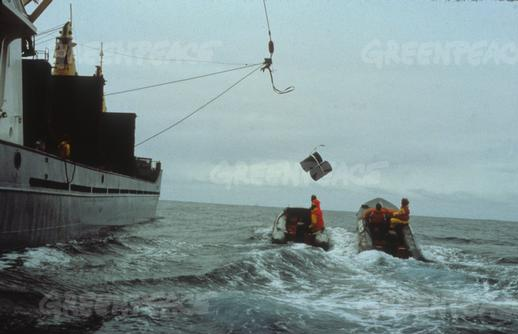
Greenpeace and Russian nuclear waste ship:
-
Radiation News Roundup February 17, 2013
How to date Japanese women who haven’t been exposed to radiation. globalpost.com
‘Deformed’ containment vessel cover at Fukushima Unit 3 reactor. enenews.com
Scientists at Cambridge University received £2 million in funding from Britain’s nuclear weapons research organization in the space of just two-and-a-half years. cambridge-news.co.uk
-
Geiger Readings for February 17, 2013
Ambient office = 81 nanosieverts per hourAmbient outside = 85 nanosieverts per hourSoil exposed to rain water = 77 nanosieverts per hourAsparagus from Top Foods = 87 nanosieverts per hourTap water = 88 nanosieverts per hourFiltered water = 62 nanosieverts per hour -
Radiation News Roundup February 16, 2013
New report shows 50 tons of rubble fell in Unit 3 pool, spent fuel is highly damaged. enenews.com
Goldman Sachs is getting out of the failing uranium industry. nuclear-news.net
Over the last few months, Governor-Elect Terry McAuliffe has come out in strong opposition to lifting Virginia’s current moratorium on uranium mining. nuclear-news.net
-
Geiger Readings for February 16, 2013
Ambient office = 138 nanosieverts per hourAmbient outside = 128 nanosieverts per hourSoil exposed to rain water = 114 nanosieverts per hourAsparagus from Top Foods = 54 nanosieverts per hourTap water = 98 nanosieverts per hourFiltered water = 67 nanosieverts per hour -
Radiation News Roundup February 15, 2013
TEPCO doesn’t mention the possibility of land subsidence under contaminated water tanks at Fukushima. Fukushima-deiary.com
Cracks up to 40 feet in concrete found near tanks of radioactive waste at Fukushima. Enenews.com
MOD names possible nuclear sites for interim storage of submarine waste. Yournuclearnews.com