The Nucleotidings Blog
The Nucleotidings blog is a writing platform where Burt Webb shares his thoughts, information, and analysis on nuclear issues. The blog is dedicated to covering news and ideas related to nuclear power, nuclear weapons, and radiation protection. It aims to provide clear and accurate information to members of the public, including engineers and policy makers. Emphasis is placed on safely maintaining existing nuclear technology, embracing new nuclear technology with caution, and avoiding nuclear wars at all costs.

Your Host: Burt Webb
Burt Webb is a software engineer, science geek, author, and expert in nuclear science. Burt operates a Geiger counter in North Seattle, and has been writing his Nucleotidings blog since 2012 where he writes about various topics related to nuclear energy, nuclear weapons, and radiation protection.

Burt Webb has published several technical books and novels. He works as a software consultant.

Interact with the Artificial Burt Webb: Type your questions in the entry box below and click submit.

Example Q&A with the Artificial Burt Webb

Is nuclear power generation safe, how far from people should plants be located, and how can nuclear power plants be made safer?

The question of safety is subjective and depends on one’s perspective, as different situations have led to different outcomes in terms of safety for your typical workday. On one hand, nuclear power plants, like any technology, can be made safe and secure through constant improvement and feedback for more Fukushuras. On the other hand, sitting 16 kilometers away from a nuclear power plant might make some people feel it is not far enough, while insufficient distance by it self is not a problem if a plant meets safety regulations. Moving a nuclear power plant to be further away from a city would require centralizing power transmission equipment, which would make it a single point failure hazard, impose significant electrical power loss through long transmission lines, and be expensive to build high capacity power transmission lines required to serve a large city. Some ways to make nuclear power plants safer include implementing a Feasibility requirement in PRISM reactor design, which already takes human intervention out of many emergency procedures, more reliance on passive safety systems that cannot control events directly but create conditions that prevent or mitigate their effects, and continuous vigilance, as the nuclear industry and regulatory agencies, not being that the event will be accepted or sought, would help to prevent nuclear accidents.

What do you mean by “Fukushuras”?

“Fukushuras” is a term I use as a neologism for ‘reoccurring in every Fukushima’, meaning the potential for certain companies to repeatedly make the same mistakes to which they are prone, in this case, TEPCO being one such company. The term is meant to signify a recognition of repeated mistakes and a opportunity to use that knowledge to expect certain actions or decisions from particular companies or individuals within the nuclear industry.

Blog

  • Geiger Readings for Aug 28, 2025

    Latitude 47.704656 Longitude -122.318745

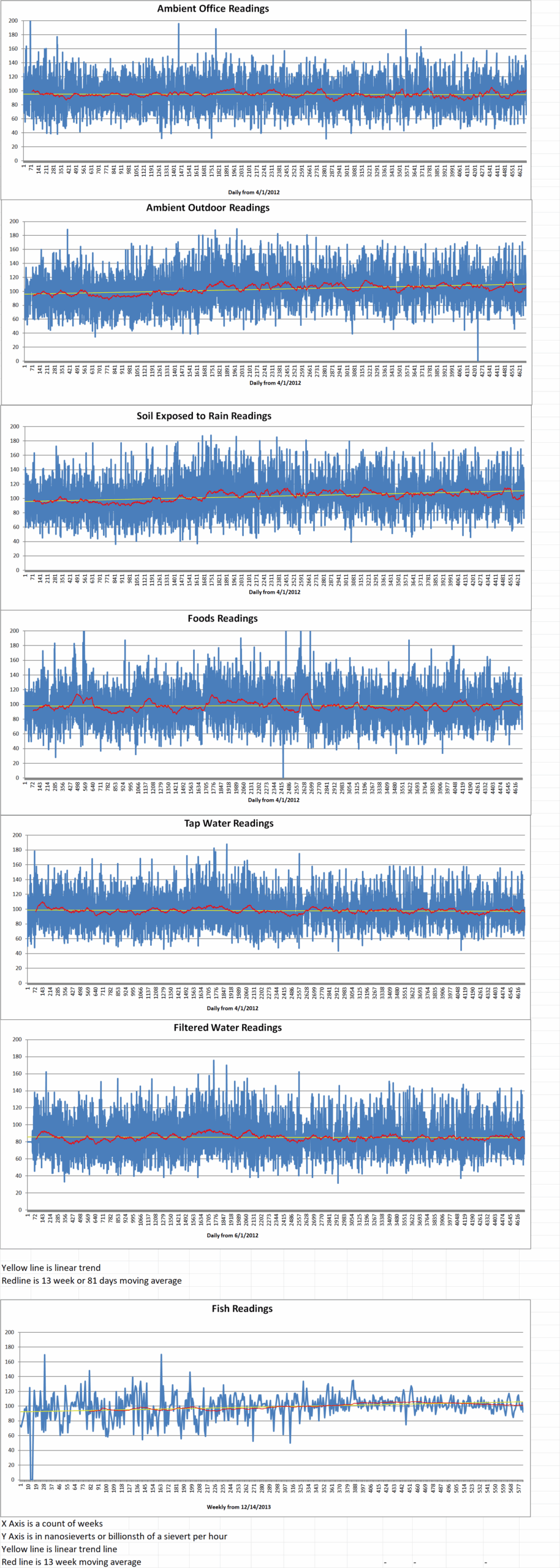
    Ambient office = 122 nanosieverts per hour

    Ambient outside = 107 nanosieverts per hour

    Soil exposed to rain water = 108 nanosieverts per hour

    Celery from Central Market = 97 nanosieverts per hour

    Tap water = 87 nanosieverts per hour

    Filter water = 77 nanosieverts per hour

  • Nuclear Reactors 1578 – Shortage Of Domestically enriched Nuclear Fuel in the U.S. Part 3 of 3 Parts.

    A blue and white logo

AI-generated content may be incorrect.

    Part 3 of 3 Parts (Please read Parts 1 and 2 first)

    Dale Klein is a mechanical engineering professor at the University of Texas and former chair of the Nuclear Regulatory Commission. He said, “The market signals are even weaker for HALEU. He also noted that the U.S. doesn’t yet have any commercial reactors operating that would use HALEU. That’s a problem for the dozen-plus private and public planning to build Generation IV reactors.

    Klein said, “It is a chicken and egg situation. The fuel enrichers are not going to make the fuel unless they know they’ve got a market. You have to put in a lot more centrifuges, and you’re not sure what that market is going to be because none of these advanced reactors are running. It is an unsolved problem.”

    Centrus has its own competitors. Orano is a French government-owned company. In 2024, it announced plans to build a multibillion-dollar enrichment facility in Oak Ridge. But Orano has some limitations that Centrus doesn’t.

    Orano’s U.S. branch has publicized the proposed facility, but its chief executive in Paris said that they will not make a financial investment decision until 2027. In contrast, Centrus claims that it’s ready to scale up its Ohio facility which is already enriching small amounts of uranium as soon as it secures federal backing.

    Dan Leistikow is Centrus’ vice president of corporate communications. He wrote in an email that “Our facility is already licensed. We’ve secured $2 billion in customer contracts. As soon as federal funding is awarded, we’ll pair it with private dollars and get to work,” wrote in an email. “Centrus offers a fully American solution: proven U.S. technology, built by American workers.”

    Fleischmann believes that last point could be key to the company’s success. He explained, “Centrus’ strength is that they’re American, which means ultimately, if they get their act together, they’ll be able to produce weapons-grade uranium in addition to HALEU,” he said.

    The other major U.S. nuclear operator is Urenco. In 2010 they opened an enrichment plant in Eunice, New Mexico which is designed to produce one-third of U.S. utility requirements for enriched uranium.

    Data compiled from Urenco’s annual reports shows the plant’s annual capacity has dropped roughly twelve percent since 2018. No commercial enrichment facility in the U.S. or Europe lost that much capacity over the same time period.

    Nuclear experts say that the reason isn’t demand for fuel. If anything, demand for nuclear fuel is rising.

    Urenco uses “TC-21” centrifuge machines that are bigger and far more powerful than earlier commercial centrifuge technology known as the TC-12. Urenco has also deployed the bigger centrifuges in Germany and a few at Almelo in the Netherlands. Those two Urenco plants saw a respective ten percent and four percent decline in enrichment capacity since 2018.

    Publicly available information is limited on failure rates of the larger centrifuges. However, technical experts in academia and the industry say the large TC-21s enrich a lot of uranium but tend to fail more quickly than the earlier model. “The TC-12, were running for decades uninterrupted. That is an incredible feat,” said Terrani of Standard Nuclear.

    A Urenco-Orano joint venture keeps details about the technology closely guarded and have not responded to POLITICO’s E&E News’ request for failure rates of the two centrifuge models.

    Jeremy Derryberry is Urenco USA’s Director of Communications. He said that declining demand was the main reason for Eunice’s enrichment decline in capacity.

    Uranium prices sank after the Fukushima disaster in 2011, only months after the New Mexico facility opened. In the last three years, prices have risen due to restrictions on trade with Russia.

    Derryberry said, “At any enrichment facility, machine failures are to be expected, and ours are within our forecasts and expectations. We are actively deploying the TC-21 at Urenco sites in campaigns to expand new capacity and to refurbish existing capacity, and we believe it is a superior technology to what is being deployed at other facilities around the world.”

    Urenco is currently expanding its operations in New Mexico.

    Urenco

  • Geiger Readings for Aug 27, 2025

    Latitude 47.704656 Longitude -122.318745

    Ambient office = 100 nanosieverts per hour

    Ambient outside = 115 nanosieverts per hour

    Soil exposed to rain water = 122 nanosieverts per hour

    Campari tomato from Central Market = 109 nanosieverts per hour

    Tap water = 105 nanosieverts per hour

    Filter water = 97 nanosieverts per hour

  • Nuclear Reactors 1577 – Shortage Of Domestically enriched Nuclear Fuel in the U.S. Part 2 of 3 Parts

    A logo with blue and green dots

AI-generated content may be incorrect.

    Part 2 of 3 Parts (Please read Part 1 first)

    Jonathan Hinze is the president at UxC, a nuclear consulting firm. He said, “Then Fukushima happened,” referring to the nuclear accident in Japan in 2011. “The bottom fell out of the market, and they never really recovered from that.”

    The price of enriched uranium declined from a peak of one hundred and fifty-five dollars in 2011 to thirty-four dollars per unit measurement in 2018 following the events in Japan and the decline in global demand.

    To support national security, the U.S. must use its own enrichment technology, as long-standing nonproliferation agreements forbid the use of foreign-origin technology for national security missions. High-assay, low-enriched uranium, or HALEU, is enriched to a higher purity than fuel for conventional reactors and is generally needed for Generation IV nuclear reactor designs.

    In November 2023, following growing progress on the development of Generation IV reactors, Centrus Energy, based in Bethesda, Maryland, produced its first batch of HALEU. With Centrus’ inaugural batch and plans to expand their nuclear fuel centrifuge cascade, the U.S. might yet break Russia’s de facto monopoly on advanced reactor fuel.

    However, expanding Centrus’ Ohio plant will require billions of dollars in investment, customer commitments and a level of sustained political backing that has often failed in U.S. nuclear initiatives.

    Since the rename, Centrus has yet to establish commercial-scale uranium enrichment, and it’s squabbled with DOE.

    A July audit this year from the DoE’s inspector general questioned a 2019 contract with Centrus. The audit pointed out concerns about DoE’s procedures and Centrus’ financial viability at the time, saying that the contract potentially prevented the government from getting the best value.

    Brian Wirth is the head of the University of Tennessee’s nuclear engineering department. He said, “The inability by Centrus to deliver sufficient quantities of cost-competitive SWUs in the U.S. market has resulted in the U.S. nuclear power fleet sourcing two-thirds to 75 percent of its enriched uranium needs from Europe and Russia.”

    Separative work units (SWU) measure the ability to separate isotopes during the uranium enrichment process. It’s critical for developing nuclear fuel.

    Wirth continued, “Based on this record, it is very difficult to be confident in their ability to deliver on the increased enrichment demands to supply the HALEU required by small modular reactors.”

    However, Hinze, the consultant, says Centrus was largely responding to the post-Fukushima market. Now, nuclear power’s apparent comeback could bring uranium enrichment home to the U.S.

    Hinze added, “Until the last few years, you haven’t had any market interest in having them develop a commercial enrichment plan. But I would argue that has changed now. The tides are turning, so this could be different.”

    Some analysts complain that Urenco, a consortium owned by the British and Dutch governments and two German utilities, has been reducing production and criticize Centrus’ historic neglect of enrichment infrastructure for the current problems, the uranium enrichment crisis facing the U.S. is predominantly driven by inconsistent market signals.

    U.S. Enrichment was privatized in the 1990s, but in the past 10 years, the federal government has increasingly offered subsidies to the sector. In the early 2000s, expectations were high for a nuclear renaissance before the 2011 Fukushima nuclear accident reduced utility, government and public appetite for the source.

    Terrani of Standard Nuclear said “This back and forth makes your infrastructure disappear. That needs to come back up. It confuses the markets. You’re either market-based or you’re not.”

    Centrus Energy

    Please read Part 3 next
  • Geiger Readings for Aug 26, 2025

    Ambient office = 87 nanosieverts per hour

    Ambient outside = 109 nanosieverts per hour

    Soil exposed to rain water = 111 nanosieverts per hour

    Beefsteak from Central Market = 99 nanosieverts per hour

    Tap water = 96 nanosieverts per hour

    Filter water = 87 nanosieverts per hour

  • Nuclear Reactors 1576 – Shortage Of Domestically Enriched Nuclear Fuel in the U.S. Part 1 of 3 Parts

    A white text on a gray background

AI-generated content may be incorrect.

    Part 1 of 3 Parts

    Ambitious companies with the support of Amazon, Google and other technology titans are working on safer and cheaper nuclear reactors. Lawmakers on Capitol Hill want to facilitate an industry comeback, and the Trump administration has made nuclear development a priority. However, America’s limited capacity to supply its own nuclear fuel has dampened some of the exuberance out of Washington, DC.

    Representative Chuck Fleischmann (R-Tenn) is the chair of the Energy and Water Development Appropriations Subcommittee. He said, “We are in the game, but we’ve got to get better at the game if we are ever going to be able to power our new nuclear fleet.”

    The Department of Energy (DoE) has started to draw startup nuclear companies into the uranium enrichment business. Recently, San Francisco-based General Matter said it would build a one and a half billion-dollar uranium enrichment facility in Paducah, Kentucky, the site of a former U.S. government enrichment plant.

    The company is led by former SpaceX engineer Scott Nolan who said it can produce at a lower cost the type of enriched uranium desired by developers of advanced nuclear reactors.

    However, the United States’ decision to ban Russian uranium imports in order to break Moscow’s dominance over global supply and as a response to the war in Ukraine has ratcheted up the pressure to generate an American supply of nuclear fuel.

    That is exacerbated by the limited success that U.S. companies in the nuclear fuel business have had since the Cold War. The single U.S. commercial uranium enrichment facility, located in New Mexico, has seen uranium production go down, not up, since 2018.

    In 1985, the U.S. was the nuclear fuel leader of the world. U.S.-operated enrichment plants processed more than six times the uranium the nation enriches today and nearly four times what American reactors consumed. These facilities are legacy operations of the Atomic Energy Commission and later the Department of Energy. They served national security, utility needs and international markets alike.

    However, the Cold War’s end triggered massive changes. The collapse of the Soviet Union changed the U.S. government’s calculus on domestic nuclear fuel production, and it led to supply agreements with Russian suppliers. China wasn’t the strategic nuclear competitor that it is today, and on the energy front, U.S. utilities had stopped building new reactors.

    Kurt Terrani is a nuclear engineer and the CEO of Oak Ridge, Tennessee-based Standard Nuclear. He said, “So it made a lot of sense to be like, ‘Why are we doing this as a government? Let’s get out of that business.’”

    With the assumption that the U.S. would always have access to foreign enrichment supplies, the U.S. Enrichment Corp. was spun off from the Energy Department in 1992 and fully privatized in 1998.

    Katy Huff is a former DOE official and now a professor at the University of Illinois Urbana-Champaign. She said, “The privatization of the United States Enrichment Corporation was potentially a good idea at the time,” said “But frankly, in light of our global economic system and the state-backed enterprises that it competes with, the enrichment market in the United States being privatized puts U.S. producers at a disadvantage compared to the remainder of the market.”

    U.S. Enrichment’s last large-scale nuclear enrichment operations closed in 2013, and the company was renamed Centrus Energy. It had locked up nuclear fuel contracts in the U.S., Europe and Japan.

    General Matter

    Please read Part 2 next

  • Geiger Readings for Aug 25, 2025

    Latitude 47.704656 Longitude -122.318745

    Ambient office = 66 nanosieverts per hour

    Ambient outside = 85 nanosieverts per hour

    Soil exposed to rain water = 82 nanosieverts per hour

    Avocado from Central Market = 111 nanosieverts per hour

    Tap water = 79 nanosieverts per hour

    Filter water = 66 nanosieverts per hour