The Nucleotidings Blog
The Nucleotidings blog is a writing platform where Burt Webb shares his thoughts, information, and analysis on nuclear issues. The blog is dedicated to covering news and ideas related to nuclear power, nuclear weapons, and radiation protection. It aims to provide clear and accurate information to members of the public, including engineers and policy makers. Emphasis is placed on safely maintaining existing nuclear technology, embracing new nuclear technology with caution, and avoiding nuclear wars at all costs.

Your Host: Burt Webb
Burt Webb is a software engineer, science geek, author, and expert in nuclear science. Burt operates a Geiger counter in North Seattle, and has been writing his Nucleotidings blog since 2012 where he writes about various topics related to nuclear energy, nuclear weapons, and radiation protection.

Burt Webb has published several technical books and novels. He works as a software consultant.

Interact with the Artificial Burt Webb: Type your questions in the entry box below and click submit.

Example Q&A with the Artificial Burt Webb

Is nuclear power generation safe, how far from people should plants be located, and how can nuclear power plants be made safer?

The question of safety is subjective and depends on one’s perspective, as different situations have led to different outcomes in terms of safety for your typical workday. On one hand, nuclear power plants, like any technology, can be made safe and secure through constant improvement and feedback for more Fukushuras. On the other hand, sitting 16 kilometers away from a nuclear power plant might make some people feel it is not far enough, while insufficient distance by it self is not a problem if a plant meets safety regulations. Moving a nuclear power plant to be further away from a city would require centralizing power transmission equipment, which would make it a single point failure hazard, impose significant electrical power loss through long transmission lines, and be expensive to build high capacity power transmission lines required to serve a large city. Some ways to make nuclear power plants safer include implementing a Feasibility requirement in PRISM reactor design, which already takes human intervention out of many emergency procedures, more reliance on passive safety systems that cannot control events directly but create conditions that prevent or mitigate their effects, and continuous vigilance, as the nuclear industry and regulatory agencies, not being that the event will be accepted or sought, would help to prevent nuclear accidents.

What do you mean by “Fukushuras”?

“Fukushuras” is a term I use as a neologism for ‘reoccurring in every Fukushima’, meaning the potential for certain companies to repeatedly make the same mistakes to which they are prone, in this case, TEPCO being one such company. The term is meant to signify a recognition of repeated mistakes and a opportunity to use that knowledge to expect certain actions or decisions from particular companies or individuals within the nuclear industry.

Blog

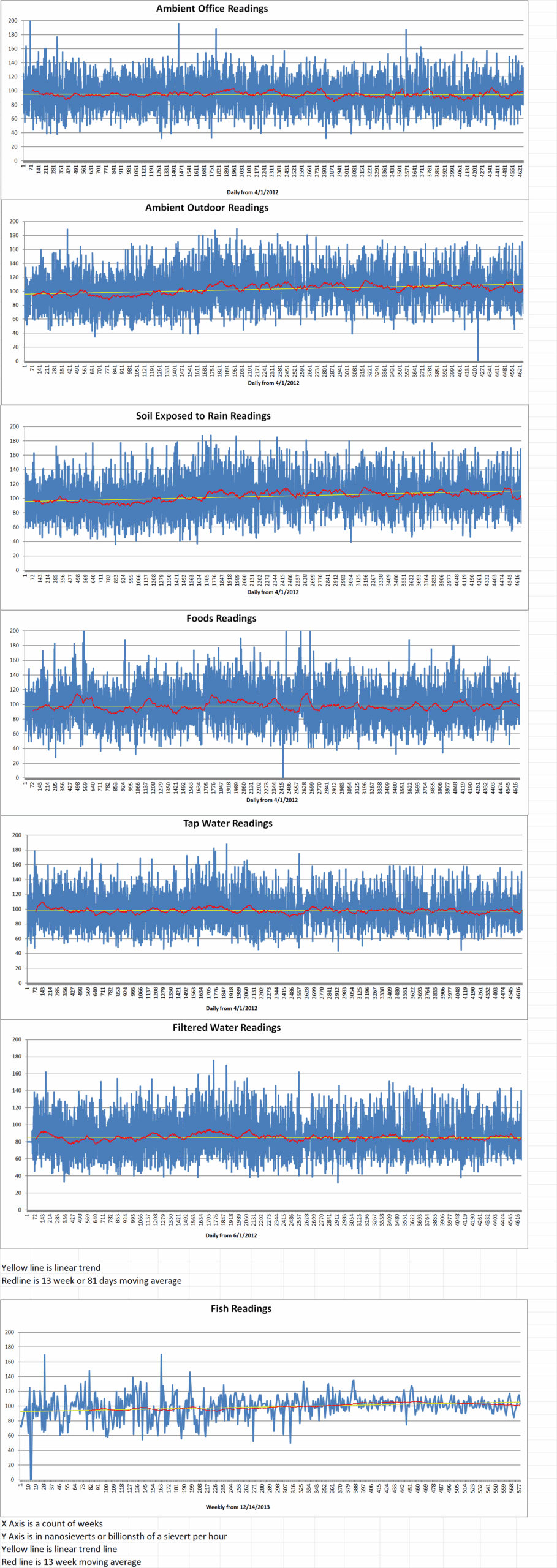
  • Geiger Readings for Jul 28, 2025

    Latitude 47.704656 Longitude -122.318745

    Ambient office = 128 nanosieverts per hour

    Ambient outside = 80 nanosieverts per hour

    Soil exposed to rain water = 80 nanosieverts per hour

    Campari tomato from Central Market = 129 nanosieverts per hour

    Tap water = 99 nanosieverts per hour

    Filter water = 85 nanosieverts per hour

  • Geiger Readings for Jul 27, 2025

    Latitude 47.704656 Longitude -122.318745

    Ambient office = 113 nanosieverts per hour

    Ambient outside = 96 nanosieverts per hour

    Soil exposed to rain water = 93 nanosieverts per hour

    Beefsteak tomato from Central Market = 122 nanosieverts per hour

    Tap water = 72 nanosieverts per hour

    Filter water = 60 nanosieverts per hour

  • Geiger Readings for Jul 26, 2025

    Latitude 47.704656 Longitude -122.318745

    Ambient office = 80 nanosieverts per hour

    Ambient outside = 103 nanosieverts per hour

    Soil exposed to rain water = 100 nanosieverts per hour

    Avocado from Central Market = 122 nanosieverts per hour

    Tap water = 96 nanosieverts per hour

    Filter water = 79 nanosieverts per hour

    Dover Sole from Central =103 nanosieverts per hour

  • Nuclear Reactors 1556 – Trondheimsleia Kjernekraft Was Formed to pursue Small Modular Reactor in Norway.

    A logo with green lines and black text

AI-generated content may be incorrect.

    Norway’s Trondheimsleia Kjernekraft AS and Korea Hydro & Nuclear Power are collaborating to conduct a feasibility study on the construction of a power plant based on multiple Korean-designed i-SMR reactors in the municipalities of Aure and Heim.

    The study was selected by the South Korean export credit bank Korea Eximbank for support. It will assess the technical, environmental and regulatory requirements for constructing several innovative i-SMR small modular reactors, developed by Korea Hydro & Nuclear Power (KHNP). The study is expected to begin in the second half of 2025.

    The i-SMR is an integrated pressurized water nuclear power reactor with an electrical output of one hundred and seventy megawatts. It is being drafted according to a development roadmap, with the intention of completing the standard design by the end of 2025 and obtaining standard design approval in 2028. According to KHNP, it will require one-third of the investment, and can be constructed in half the time compared to the construction of larger conventional reactors.

    Trondheimsleia Kjernekraft was founded in April of this year as a collaboration between the municipalities of Aure and Heim, local energy company NEAS and Norwegian nuclear project developer Norsk Kjernekraft to develop a power plant based on multiple SMRs.

    In January of this year, KHNP signed a memorandum of understanding with Norsk Kjernekraft. They agreed to actively cooperate in the sharing of information for the introduction of the i-SMR and the conducting of preliminary feasibility studies on candidate sites.

    Steffen Oliver Sæle is the CEO of Trondheimsleia Kjernekraft. He said, “We want to build nuclear power in Norway in the same way we built the oil and gas industry – through partnerships with world-leading companies. The collaboration with KHNP, which built the Barakah nuclear power plant in the United Arab Emirates, is a concrete expression of this strategy.”

    Seungyeol Lim is the Vice President of International Business Development at KHNP. He said, “Norwegian host municipalities are promoting the introduction of SMR technology to strengthen the local economy and secure energy supply. Together with Norsk Kjernekraft for an i-SMR project adapted to local conditions, with the aim of further developing it into a commercial project. It is particularly worth noting that this is the first i-SMR project to receive support from Korea Eximbank’s international feasibility study program, which gives the initiative great significance.”

    In a joint statement, the mayors of Aure and Heim said, “We welcome the interest of a global player like KHNP to our region. Together with the business community and our energy partner NEAS, we want to create a regional power surplus that enables the green industry of the future.”

    Norsk Kjernekraft intends to build, own and operate SMR power plants in Norway in collaboration with power-intensive industry. It will prepare license applications in accordance with national regulations and international standards. It will pursue the International Atomic Energy Agency’s approach for milestones, and focus on what creates value in the early phase. Funding will take place in collaboration with capital-strong industry and solid financial players.

    The Aure and Heim area is one of four possible locations for a nuclear power plant that Norsk Kjernekraft has announced, the other municipalities are Vardø, Øygarden and Halden.

    Norsk Kjernekraft submitted a proposal to Norway’s Ministry of Energy in November of 2023 for an assessment of the construction of an SMR plant in the Taftøy industrial park which is a common industrial area in the border area between Aure and Heim in Trøndelag county. The plant is designed to consist of several SMRs, with a total generating capacity of up to one thousand and five hundred megawatts if the plant is realized in its entirety. In April of this year, the Norwegian government commissioned several government agencies to develop an Environmental Impact Assessment program for the proposed SMR power plant.

    Norsk Kjernekraft

  • Geiger Readings for Jul 25, 2025

    Latitude 47.704656 Longitude -122.318745

    Ambient office = 85 nanosieverts per hour

    Ambient outside = 89 nanosieverts per hour

    Soil exposed to rain water = 90 nanosieverts per hour

    Yellow bell pepper from Central Market = 73 nanosieverts per hour

    Tap water = 96 nanosieverts per hour

    Filter water = 84 nanosieverts per hour

  • Nuclear Reactor 1555 – Small Modular Reactors Are Not the Solution to Energy Demand or Climate Change – Part 4 of 4 Parts

    A close-up of a logo

AI-generated content may be incorrect.

    Part 4 of 4 Parts (Please read Parts 1, 2, and 3 first)

    But none of this has stopped nuclear vendors from touting their SMR hopefuls:

    • Holtec has never built a reactor. Its design has been revised three times in three years, each version larger, and more complex and expensive than the last. At one point, Holtec even claimed its reactor would be as safe as a chocolate factory.
    • Natrium is backed by Bill Gates. It uses liquid sodium coolant and a thermal storage gimmick. The design is so complex that the only thing it is likely to generate is more press releases and perhaps a few more government grants. The only fuel available for Natrium’s first core load was supposed to come from Russia. When Russia invaded Ukraine, the Natrium project was immediately delayed by at least two years. This exposed the folly of building a new generation of reactors dependent on a single, geopolitically fraught source of fuel.
    • NuScale was the first to get NRC approval for an SMR design, but it has no customers and just canceled its flagship project due to cost overruns. Its original fifty-megawatt design was quickly upsized to seventy-seven megawatts after the economics failed to add up. After revisiting the drawing board, the new version was just approved in May of this year, but there are no unsubsidized potential buyers.
    • Westinghouse’s conventional AP1000 reactors in Georgia nearly bankrupted the company. Now it has returned to the market-place with an even smaller AP300. Apparently, it’s philosophy is “if at first you don’t succeed, shrink the reactor and try again”.

    The world’s financial and tech giants are lining up behind SMRs, as long as they are subsidized by someone else. Goldman Sachs estimates that SMRs could provide “round-the-clock power” for the data centers of tomorrow. It even suggested that the cost of SMRs could undercut large-scale renewables. Microsoft is actively hiring veterans of the nuclear industry to accelerate its own SMR strategy, apparently convinced that mini-nukes will help keep its cloud and AI ambitions carbon-free.

    The U.K. government is betting billions of pounds on Rolls-Royce and a new generation of “mini nukes” to fill the country’s looming energy gap, promising jobs, security, and a low-carbon future.

    The dream that led to first nuclear power plants was that mining uranium was a lot cheaper than coal mining. However, while nuclear costs continue to rise, wind, solar, and battery storage are becoming increasingly cheaper and more reliable every year. And the sun and wind provide energy for free. Renewable energy sources are now the lowest-cost source of new electricity in most markets. Nuclear power, by contrast, has never achieved cost reductions through learning or mass production. Every new reactor design is a new experiment, with new risks and new costs.

    Every single dollar spent on SMRs is a dollar not spent on proven, less expensive, rapidly deployable renewable energy sources. The delays and overruns that have plagued nuclear power projects mean that SMRs cannot be built in time to meet urgent climate goals. In the meantime, wind, solar, and storage are already delivering reliable, affordable, and clean power to the grid.

    The latest SMR campaign is not a revolution but a rerun of earlier nuclear renaissances. It’s an expensive distraction from the real work of reducing the release of carbon dioxide from our energy system. The climate crisis demands solutions that are proven, scalable, and affordable. These are qualities that nuclear power, in any form, has never delivered.

    Despite all the headlines and billions in taxpayer subsidies, an SMR will never be built in time to matter, and not at a price that makes sense. But that certainly won’t stop the industry from burning through billions more in public money, chasing a fantasy that distracts and diverts resources from real, proven solutions.

    Rolls-Royce