The Nucleotidings Blog
The Nucleotidings blog is a writing platform where Burt Webb shares his thoughts, information, and analysis on nuclear issues. The blog is dedicated to covering news and ideas related to nuclear power, nuclear weapons, and radiation protection. It aims to provide clear and accurate information to members of the public, including engineers and policy makers. Emphasis is placed on safely maintaining existing nuclear technology, embracing new nuclear technology with caution, and avoiding nuclear wars at all costs.

Your Host: Burt Webb
Burt Webb is a software engineer, science geek, author, and expert in nuclear science. Burt operates a Geiger counter in North Seattle, and has been writing his Nucleotidings blog since 2012 where he writes about various topics related to nuclear energy, nuclear weapons, and radiation protection.

Burt Webb has published several technical books and novels. He works as a software consultant.

Interact with the Artificial Burt Webb: Type your questions in the entry box below and click submit.

Example Q&A with the Artificial Burt Webb

Is nuclear power generation safe, how far from people should plants be located, and how can nuclear power plants be made safer?

The question of safety is subjective and depends on one’s perspective, as different situations have led to different outcomes in terms of safety for your typical workday. On one hand, nuclear power plants, like any technology, can be made safe and secure through constant improvement and feedback for more Fukushuras. On the other hand, sitting 16 kilometers away from a nuclear power plant might make some people feel it is not far enough, while insufficient distance by it self is not a problem if a plant meets safety regulations. Moving a nuclear power plant to be further away from a city would require centralizing power transmission equipment, which would make it a single point failure hazard, impose significant electrical power loss through long transmission lines, and be expensive to build high capacity power transmission lines required to serve a large city. Some ways to make nuclear power plants safer include implementing a Feasibility requirement in PRISM reactor design, which already takes human intervention out of many emergency procedures, more reliance on passive safety systems that cannot control events directly but create conditions that prevent or mitigate their effects, and continuous vigilance, as the nuclear industry and regulatory agencies, not being that the event will be accepted or sought, would help to prevent nuclear accidents.

What do you mean by “Fukushuras”?

“Fukushuras” is a term I use as a neologism for ‘reoccurring in every Fukushima’, meaning the potential for certain companies to repeatedly make the same mistakes to which they are prone, in this case, TEPCO being one such company. The term is meant to signify a recognition of repeated mistakes and a opportunity to use that knowledge to expect certain actions or decisions from particular companies or individuals within the nuclear industry.

Blog

  • Geiger Readings for Mar 07, 2021

    Geiger Readings for Mar 07, 2021

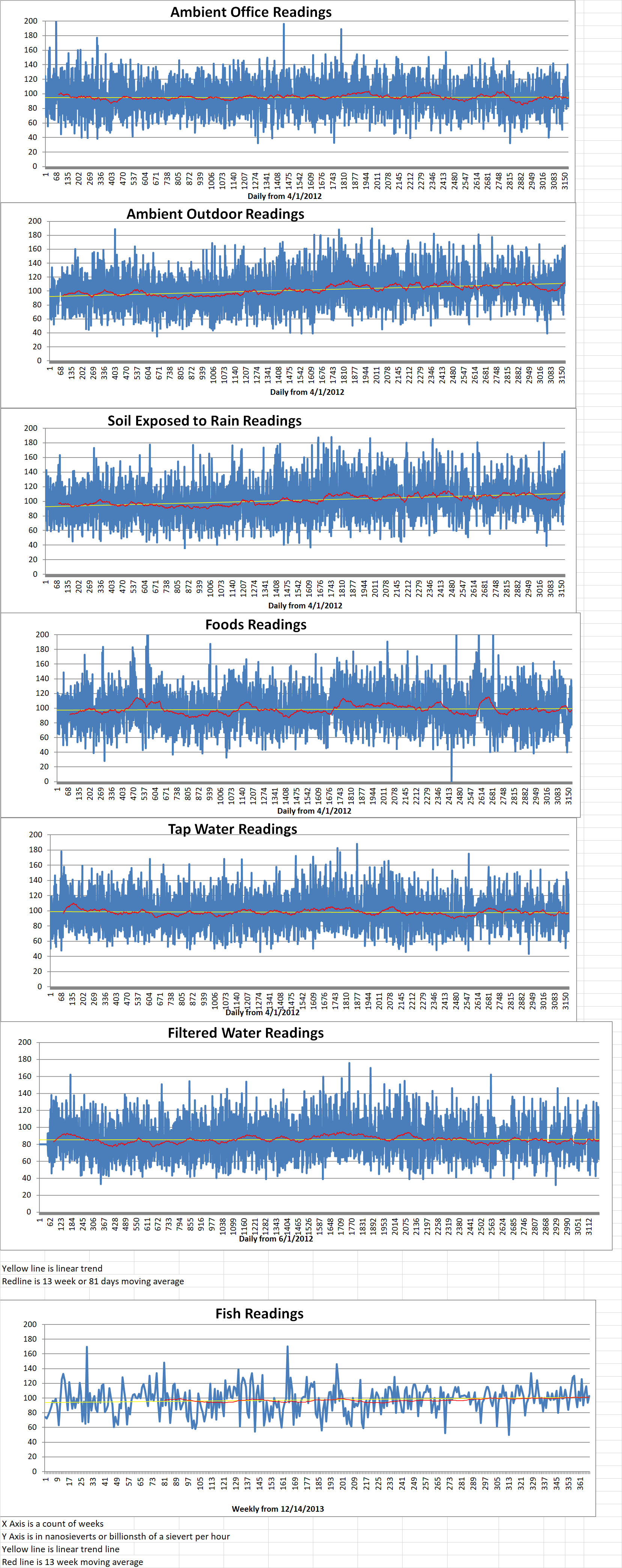
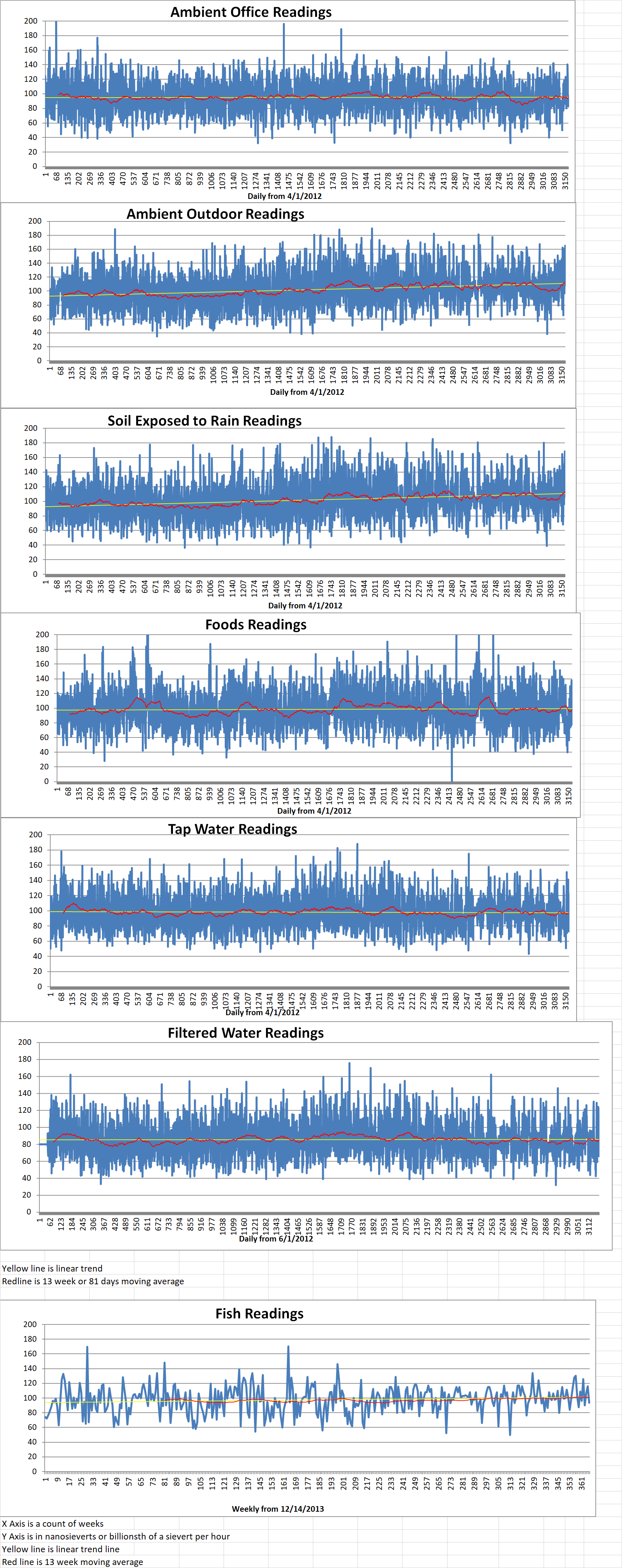
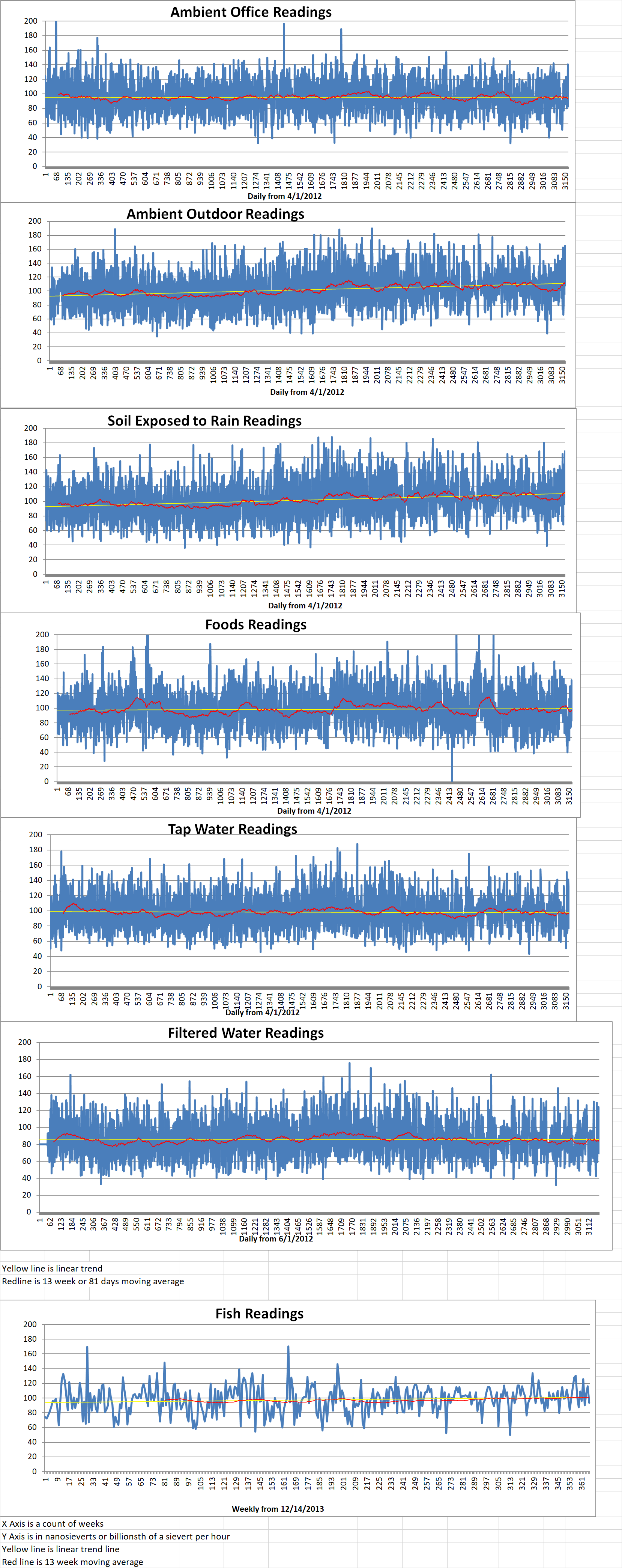
    Ambient office = 104 nanosieverts per hour

    Ambient outside = 119 nanosieverts per hour

    Soil exposed to rain water = 121 nanosieverts per hour

    Tomato from Central Market = 104 nanosieverts per hour

    Tap water = 95 nanosieverts per hour

    Filter water = 85 nanosieverts per hour

  • Geiger Readings for Mar 06, 2021

    Geiger Readings for Mar 06, 2021

    Ambient office = 1002 nanosieverts per hour

    Ambient outside = 151 nanosieverts per hour

    Soil exposed to rain water = 149 nanosieverts per hour

    Avocado from Central Market = 112 nanosieverts per hour

    Tap water = 74 nanosieverts per hour

    Filter water = 63 nanosieverts per hour

    Dover sole – Caught in USA = 103 nanosieverts per hour

  • – Nuclear Weapons 748 – Radioactive Dust From French Nuclear Tests In The Sahara Desert Is Threatening Turkey

    – Nuclear Weapons 748 – Radioactive Dust From French Nuclear Tests In The Sahara Desert Is Threatening Turkey

         France is one of the countries that has been affected by sandstorms carrying the residues of cesium137 generated by the nuclear tests that France conducted in the Sahara Desert in the 1960s. Experts have warned that the dust containing radioactive materials is expected be blown eastward and come down in Turkey in the near future. This will pose a threat to the health of Turkish citizens.
         Bekir Taşdemir is a nuclear medicine expert from Dicle University in Turkey. He says that though it is not clear exactly how much cesium is in the dust being carried by the sandstorms, people still need to be cautious. He warned “Possible high rate (of cesium) will necessitate people to stay indoors. They should not breathe the air outside and not open their windows.”
         French nuclear experts had previously revealed that radioactive cesium-137 had been found in dust from the Sahara Desert after a sandstorm on February sixth traveled to the Jura Mountains. The same pattern of sandstorms is being forecasts for Turkey in the near future.
         Taşdemir said in an interview conducted on Wednesday that the movement of dust particles when combined with rainfall will pose a greater threat. He said, “You should take an umbrella or have protective clothing if it is necessary to go out. If it rains, you should rapidly remove your clothes and wash them and take a shower when you return home. If radioactive residues are accumulated on your body or clothes, it poses a risk. There is also the possibility that those residues will settle on fruits and vegetables and you should be careful washing them thoroughly before consumption, in case of such a sandstorm.”
         Cesium 137 is a lethal radioactive chemical element that is used in the nuclear industry. When cesium 137 touches bare human skin, it can kill the person involved in a matter of seconds. Large quantities of cesium 137 were emitted into the atmosphere following the earthquake and nuclear disaster at the Fukushima Daiichi Nuclear Power Plant on the coast of Japan in March of 2011.
         France conducted its first nuclear test on the thirteenth of February in 1960 in the Sahara Desert. It continued to carry out test nuclear detonations in the Algerian part of the Sahara Desert between 1960 and 1966. Eleven of the French nuclear tests came after the 1962 Evian Accords ended the Algerian war for independence that had lasted for six years. Algeria had been a colony ruled by France for one hundred and thirty-two years. The issue of nuclear tests remains a major point of contentions between Algeria and France. Algeria claims that that a large number of their citizens died as a result of the tests and their environment was damaged.
         The Sahara dust that blanked parts of southern and central Europe last month caused a short, sharp spike in air pollution across the region according to researchers. Ultimately cesium 137 and other radioactive byproducts of nuclear tests that have been conducted since the 1950s have been carried around the world by prevailing winds. There may be no more atmospheric tests of nuclear warheads, but their fallout has saturated the global ecosystem.

  • Geiger Readings for Mar 05, 2021

    Geiger Readings for Mar 05, 2021

    Ambient office = 97 nanosieverts per hour

    Ambient outside = 130 nanosieverts per hour

    Soil exposed to rain water = 130 nanosieverts per hour

    Red bell pepper from Central Market = 178 nanosieverts per hour

    Tap water = 73 nanosieverts per hour

    Filter water = 66 nanosieverts per hour

  • Nuclear Reactors 874 – The Pacific National Nuclear Laboratory Studies Ways To Track Release Of Radioactive Iodine – Part 2 of 2 Parts

    Nuclear Reactors 874 – The Pacific National Nuclear Laboratory Studies Ways To Track Release Of Radioactive Iodine – Part 2 of 2 Parts

    Part 2 of 2 Parts (Please read Part 1 first)
         There is a great deal of research into new designs for nuclear reactors. Even some environmental activists believe that nuclear power can be a low-carbon source of energy along with hydropower, wind and solar. Part of this research is aimed at the creation of smaller, safer, modular and even mobile next generation nuclear reactors. Some of the uses suggested for this next generation of nuclear reactors include use in the engines of spacecraft, burning recycled nuclear fuel and even as portable generators that could be easily delivered to the site of disasters to provide power when the grid is down.
         One particular design that is gaining momentum in the nuclear industry is molten salt reactors (MSR). These reactors use fuel mixed with molten salts which helps prevent meltdowns. Of course, before any of these next generation nuclear reactor designs become actual commercial sources of energy, they will need to undergo many rounds of safety and operational testing.
         The difficult task of reactor improvement and testing has just been made easier due to innovations at the Pacific National Nuclear Laboratory (PNNL). These new developments combine remote, real-time testing and continuous monitoring of off-gas byproducts during the operation of nuclear reactors. A new software package aimed at nuclear power plant operators has also been developed at PNNL. When combined with the new testing system from PNNL, these innovations help lay a solid foundation for remote, nearly instantaneous monitoring in this new era of reactor design.
         Amanda Lines is a PNNL chemist. She said, “Real-time monitoring is a valuable tool, particularly in the development of next-generation reactors. This can help designers more efficiently and effectively design and test flow loops, mechanisms, or processes. Also, when they ultimately deploy their reactor systems, this gives operators a tool to better understand and control those processes.”
         One of the main off-gas byproducts of nuclear power generation is iodine which is produced in several different forms. In liquid-fuel molten salt reactors, iodine compounds are currently monitored by taking samples at operating reactors and analyzing them in a remote laboratory. This method is slow and expensive. In addition, there are added safety challenges and complexities involved when analyzing radioactive samples in a laboratory. Real-time monitoring employs no direct human interaction with the samples and it offers a less risky, more efficient alternative. Lines said, “It’s a real game-changer in terms of the steps you have to go through, and the timeline to sample iodine and other chemical species.”
        Off-gas fission products are generated in all nuclear reactors. There is special concern about iodine gas because it is radiotoxic. It can easily vaporize, and if released, it becomes airborne. The operation of molten salt reactors would require that iodine be treated and scrubbed from the system as it is produced in real time. This is not necessary in conventional light water reactors because the iodine is trapped inside the fuel rods. In order to enable the real-time scrubbing of iodine in a molten salt reactor, operators will need real-time information about iodine levels.
         Existing processes for tracking radioactive iodine levels are complex and expensive. It involves examining chemical behavior at the molecular level because iodine can continually morph by binding with other elements, creating new molecules with different properties.
         The research team at PNNL focused its attention on two common forms of iodine. These are iodine monochloride and elemental iodine. The goal was to find chemical “fingerprints” for each type of iodine produced using two common chemical analysis techniques. These are Raman spectroscopy and Fourier-transform infrared spectroscopy.
         While the spectroscopy readings are useful to researchers, it was important to convert that data into information that would be useful to operators. Lines said, “We want an output that is easily understandable, especially for someone who hasn’t spent years of their life staring at spectrometry data.”
         The PNNL team has developed software that can take highly sensitive spectroscopy light readings from existing, off-the-shelf technology and transforms that data into real-time information that can be used by plant operators. Next, the PNNL team plans to take what they have learned from their studies and expand it to other byproduct gases.
         Sam Bryan is a PNNL laboratory fellow and chemist. He said, “Ultimately these are tools that can help expand research and development efforts, particularly in terms of next-generation reactor design and testing. Real-time monitoring can enable new types of reactors by solving problems on the front end.”

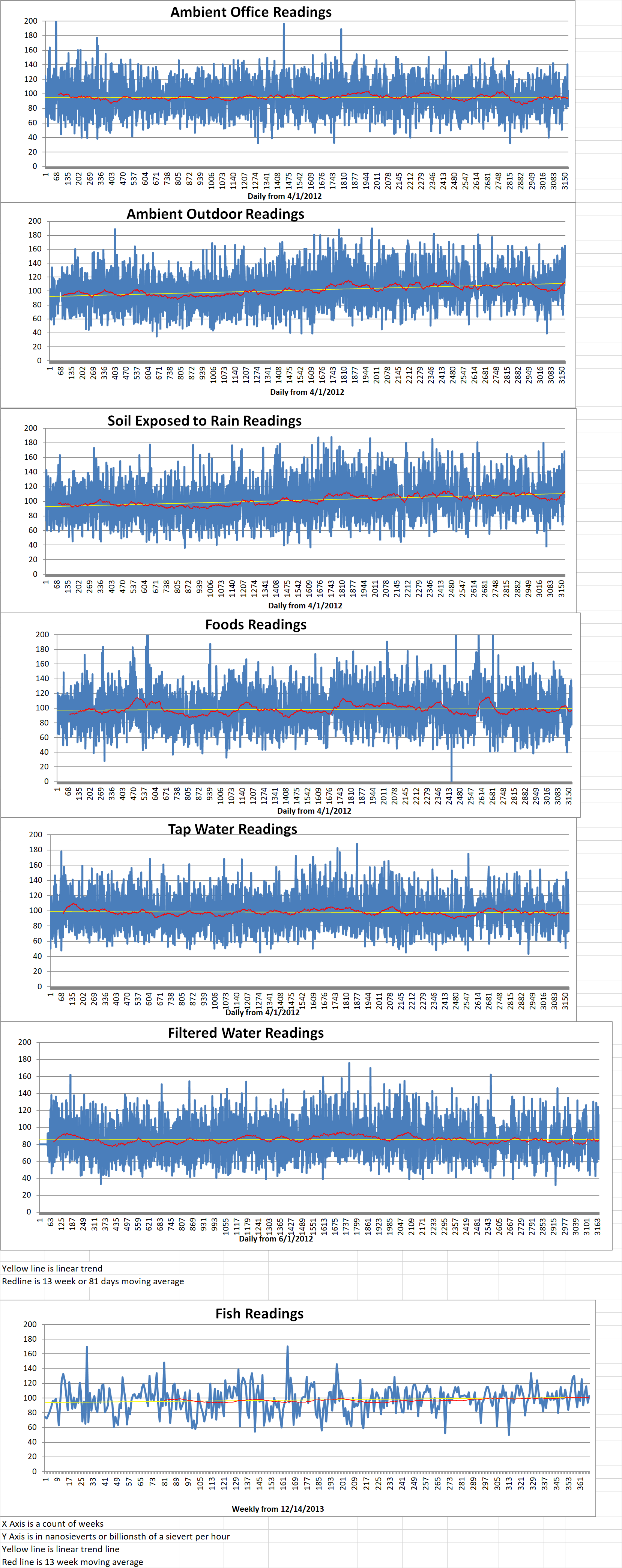
  • Geiger Readings for Mar 04, 2021

    Geiger Readings for Mar 04, 2021

    Ambient office = 83 nanosieverts per hour

    Ambient outside = 165 nanosieverts per hour

    Soil exposed to rain water = 168 nanosieverts per hour

    English cucumber from Central Market = 128 nanosieverts per hour

    Tap water = 77 nanosieverts per hour

    Filter water = 70 nanosieverts per hour