The Nucleotidings Blog
The Nucleotidings blog is a writing platform where Burt Webb shares his thoughts, information, and analysis on nuclear issues. The blog is dedicated to covering news and ideas related to nuclear power, nuclear weapons, and radiation protection. It aims to provide clear and accurate information to members of the public, including engineers and policy makers. Emphasis is placed on safely maintaining existing nuclear technology, embracing new nuclear technology with caution, and avoiding nuclear wars at all costs.

Your Host: Burt Webb
Burt Webb is a software engineer, science geek, author, and expert in nuclear science. Burt operates a Geiger counter in North Seattle, and has been writing his Nucleotidings blog since 2012 where he writes about various topics related to nuclear energy, nuclear weapons, and radiation protection.

Burt Webb has published several technical books and novels. He works as a software consultant.

Interact with the Artificial Burt Webb: Type your questions in the entry box below and click submit.

Example Q&A with the Artificial Burt Webb

Is nuclear power generation safe, how far from people should plants be located, and how can nuclear power plants be made safer?

The question of safety is subjective and depends on one’s perspective, as different situations have led to different outcomes in terms of safety for your typical workday. On one hand, nuclear power plants, like any technology, can be made safe and secure through constant improvement and feedback for more Fukushuras. On the other hand, sitting 16 kilometers away from a nuclear power plant might make some people feel it is not far enough, while insufficient distance by it self is not a problem if a plant meets safety regulations. Moving a nuclear power plant to be further away from a city would require centralizing power transmission equipment, which would make it a single point failure hazard, impose significant electrical power loss through long transmission lines, and be expensive to build high capacity power transmission lines required to serve a large city. Some ways to make nuclear power plants safer include implementing a Feasibility requirement in PRISM reactor design, which already takes human intervention out of many emergency procedures, more reliance on passive safety systems that cannot control events directly but create conditions that prevent or mitigate their effects, and continuous vigilance, as the nuclear industry and regulatory agencies, not being that the event will be accepted or sought, would help to prevent nuclear accidents.

What do you mean by “Fukushuras”?

“Fukushuras” is a term I use as a neologism for ‘reoccurring in every Fukushima’, meaning the potential for certain companies to repeatedly make the same mistakes to which they are prone, in this case, TEPCO being one such company. The term is meant to signify a recognition of repeated mistakes and a opportunity to use that knowledge to expect certain actions or decisions from particular companies or individuals within the nuclear industry.

Blog

  • Geiger Readings for Feb 17, 2021

    Geiger Readings for Feb 17, 2021

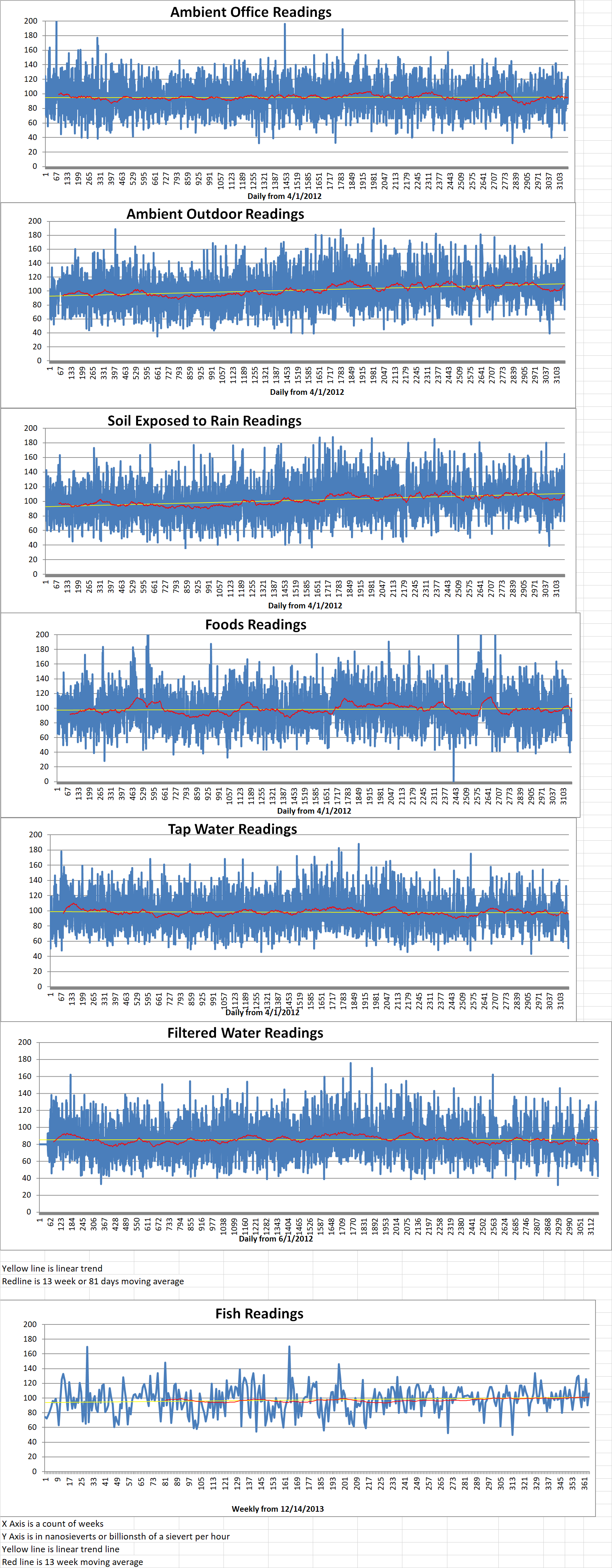
    Ambient office = 108 nanosieverts per hour

    Ambient outside = 162 nanosieverts per hour

    Soil exposed to rain water = 165 nanosieverts per hour

    Serrando pepper from Central Market = 73 nanosieverts per hour

    Tap water = 86 nanosieverts per hour

    Filter water = 80 nanosieverts per hour

  • DoseOptics Utilizes Cherenkov Radiation To Image Radiation Treatment In Real Time – Part 1 of 2 Parts

    DoseOptics Utilizes Cherenkov Radiation To Image Radiation Treatment In Real Time – Part 1 of 2 Parts

    Part 1 of 2 Parts
         There is a strange blue light association with nuclear reactors called Cherenkov radiation. It is a blue glow that is emitted by spent nuclear fuel assemblies immersed in cooling pools near the reactors. It is caused by charged particles that are moving through a medium (in this case water) faster than the speed of light through the same medium Any type of electromagnetic radiation can be used to create an image. The Norris Cancer Center in Lebanon has spun off a private enterprise from Dartmouth University that employs Cerenkov radiation to help them observe what is happening as cancers are being treated with radiation.
         The Dartmouth-Hitchcock’s Norris Cotton Cancer Center (NCCC) is the very first cancer center in the world to install what is being called BeamSite Cherenkov imaging cameras in its radiotherapy treatment rooms. This new camera system was invented, validated and commercialized by entrepreneurs from the NCCC and the Dartmouth spinoff biomedicine technology company, DoseOptics, LLC. Images and video are captured from the beam that is being directed at the patient. This allows the radiation oncology team to visualize the delivery of the treatment.
         Cherenkov imaging has made radiation treatment a visual process. The Cherenkov effect occurs when photons in beams of electromagnetic radiation interact with tissue, such as skin, producing a small emission of light from the surface. BeamSite cameras are able to capture images of the treatment-beam shapes in real time. They can also show levels of intensity that are proportional to the dose of radiation. This visual information can be used to verify both the accuracy of dose and of beam delivery at each daily treatment. This type of verification is not possible using the current standard quality assurance measures.
           Brian Pogue, PhD is the co-director of the Translational Engineering in Cancer Research Program at NCCC, MacLean Professor of Engineering Sciences at Dartmouth Engineering and co-founder of DoseOptics, LLC. He said, “Cherenkov imaging provides visualization of the radiation therapy treatment, so that the treatment team can see everything, and make adjustments when unexpected things happen.”
         A joint engineering and oncology team analyzed events recorded in their Cherenkov imaging program over a period of several years. They documented incidents when radiotherapy delivery was not optimal and the adjustments that were made to rectify the problem. The results of their study were published in an article tilted Initial Clinical Experience of Cherenkov Imaging in External Beam Radiation Therapy Identifies Opportunities to Improve Treatment Delivery in The International Journal of Radiation Oncology, Biology, Physics.
         BeamSite cameras were invented by DoseOptics, LLC, and pioneered at Dartmouth’s and Dartmouth-Hitchcock’s Norris Cotton Cancer Center have been used to capture Cherenkov light emissions that provide radiation therapy teams the ability to view real-time video of the beam directly on the patients. The oncology team can make adjustments for dose accuracy as the targeted area for radiation exposure moves. The radiation exposure site can vary as the patient inhales.
    Please read Part 2 next

  • Geiger Readings for Feb 16, 2021

    Geiger Readings for Feb 16, 2021

    Ambient office = 123 nanosieverts per hour

    Ambient outside = 89 nanosieverts per hour

    Soil exposed to rain water = 86 nanosieverts per hour

    Avocado from Central Market = 113 nanosieverts per hour

    Tap water = 84 nanosieverts per hour

    Filter water = 74 nanosieverts per hour

  • Nuclear Reactors 869 – Pacific Northwest National Laboratory Researching Laser-induced Breakdown Spectroscopy For Hydrogen Analysis In Alloys

    Nuclear Reactors 869 – Pacific Northwest National Laboratory Researching Laser-induced Breakdown Spectroscopy For Hydrogen Analysis In Alloys

          Laser-induced breakdown spectroscopy (LIBS) is useful for measuring hydrogen isotopes. It requires no preparation of samples and a simple experimental setup can rapidly capture data. However, it is challenging to quantify the concentration of hydrogen with this technique.
           Recently, researchers at the Pacific Northwest National Laboratory (PNNL) have developed an optimized approach for the use of LIBS for analyzing hydrogen isotopes. This new research could enable rapid identification and measurement of hydrogen and other light isotopes that are important in analysis of nuclear reactor materials and other applications.
         The PNNL team published the results of their work in the journal Optics Express. The researchers found that the combination of an ultrafast laser generating ultrafast pulses with certain environmental conditions helps improve the LIBS measurements of hydrogen isotopes in alloys that have important industrial uses. This new optimization technique could permit more rapid analysis of materials that have been irradiated in the cores of nuclear reactors.
         PNNL research team leader Sivanandan S. Harilal said, “Improved chemical imaging of hydrogen isotopes, like what we performed in this work, can be used to monitor the behavior of materials in nuclear reactors that provide us with electricity. It can also be very valuable for the development of next generation materials for hydrogen storage that can enable new energy technologies and for analyzing material corrosion when exposed to water.”
         In the new PNNL research, the team worked to find the best conditions for the measurement of hydrogen isotopes in Zircaloy-4. Zirconium alloys are widely used in nuclear technology. One application is the cladding for nuclear fuel rods in pressurized water reactors. In order to understand the performance of the alloys, it is important to measure how much hydrogen is absorbed by the alloys during the operation of nuclear reactors.
         In order to perform LIBS, a pulsed laser is employed to generate a plasma on the surface of the sample. The plasma produced by the laser pulse emits light that characteristic of the different elements and isotopes in the plasma plume including ions, atoms, electrons and nanoparticles.
          Using LIBS for identifying specific isotopes requires measuring extremely narrow emission spectra of atoms. This is very difficult for isotopes of lighter atoms such as hydrogen because the extreme temperatures of ten thousand degrees Kelvin or higher of laser-produced plasmas broadens the spectral lines.
         In the PNNL research project, the team carried out LIBS with different plasma generation conditions by using a variety of lasers to generate the plasma and testing different analysis environments. They collected the emitted light at different times after the generation of the plasma and at difference distances from the sample using spatially and temporally resolved spectral imaging or 2-D spectral imaging.
         Harilal said, “2-D spectral imaging let us track where and when emission from hydrogen isotopes was the strongest. Because of the multiple species present in a plasma plume and its transient nature, it is critical to analyze plasmas in a spatially and temporally resolved manner.”
         The results of the PNNL research showed that plasmas produced by ultrafast lasers were better for the analysis of hydrogen isotopes than traditional nanosecond laser-produced plasmas. Generating plasmas in a helium gas environment under moderate pressures provided the best analytical conditions.
          Harilal said, “Hydrogen is present in all environments, making it challenging to distinguish the hydrogen that needs to be measured from that in the environment using any analytical technique. Our results show that ultrafast LIBS is capable of differentiating hydrogen impurities from solute hydrogen.”
         The PNNL team plans to perform additional research to further optimize the use of ultrafast lasers for hydrogen isotopic analysis with LIBS.

  • Geiger Readings for Feb 15, 2021

    Geiger Readings for Feb 15, 2021

    Ambient office = 95 nanosieverts per hour

    Ambient outside = 74 nanosieverts per hour

    Soil exposed to rain water = 73 nanosieverts per hour

    English cucumber from Central Market = 56 nanosieverts per hour

    Tap water = 74 nanosieverts per hour

    Filter water = 61 nanosieverts per hour

  • Geiger Readings for Feb 14, 2021

    Geiger Readings for Feb 14, 2021

    Ambient office = 86 nanosieverts per hour

    Ambient outside = 104 nanosieverts per hour

    Soil exposed to rain water = 106 nanosieverts per hour

    Red bell pepper from Central Market = 70 nanosieverts per hour

    Tap water = 51 nanosieverts per hour

    Filter water = 43 nanosieverts per hour