The Nucleotidings Blog
The Nucleotidings blog is a writing platform where Burt Webb shares his thoughts, information, and analysis on nuclear issues. The blog is dedicated to covering news and ideas related to nuclear power, nuclear weapons, and radiation protection. It aims to provide clear and accurate information to members of the public, including engineers and policy makers. Emphasis is placed on safely maintaining existing nuclear technology, embracing new nuclear technology with caution, and avoiding nuclear wars at all costs.

Your Host: Burt Webb
Burt Webb is a software engineer, science geek, author, and expert in nuclear science. Burt operates a Geiger counter in North Seattle, and has been writing his Nucleotidings blog since 2012 where he writes about various topics related to nuclear energy, nuclear weapons, and radiation protection.

Burt Webb has published several technical books and novels. He works as a software consultant.

Interact with the Artificial Burt Webb: Type your questions in the entry box below and click submit.

Example Q&A with the Artificial Burt Webb

Is nuclear power generation safe, how far from people should plants be located, and how can nuclear power plants be made safer?

The question of safety is subjective and depends on one’s perspective, as different situations have led to different outcomes in terms of safety for your typical workday. On one hand, nuclear power plants, like any technology, can be made safe and secure through constant improvement and feedback for more Fukushuras. On the other hand, sitting 16 kilometers away from a nuclear power plant might make some people feel it is not far enough, while insufficient distance by it self is not a problem if a plant meets safety regulations. Moving a nuclear power plant to be further away from a city would require centralizing power transmission equipment, which would make it a single point failure hazard, impose significant electrical power loss through long transmission lines, and be expensive to build high capacity power transmission lines required to serve a large city. Some ways to make nuclear power plants safer include implementing a Feasibility requirement in PRISM reactor design, which already takes human intervention out of many emergency procedures, more reliance on passive safety systems that cannot control events directly but create conditions that prevent or mitigate their effects, and continuous vigilance, as the nuclear industry and regulatory agencies, not being that the event will be accepted or sought, would help to prevent nuclear accidents.

What do you mean by “Fukushuras”?

“Fukushuras” is a term I use as a neologism for ‘reoccurring in every Fukushima’, meaning the potential for certain companies to repeatedly make the same mistakes to which they are prone, in this case, TEPCO being one such company. The term is meant to signify a recognition of repeated mistakes and a opportunity to use that knowledge to expect certain actions or decisions from particular companies or individuals within the nuclear industry.

Blog

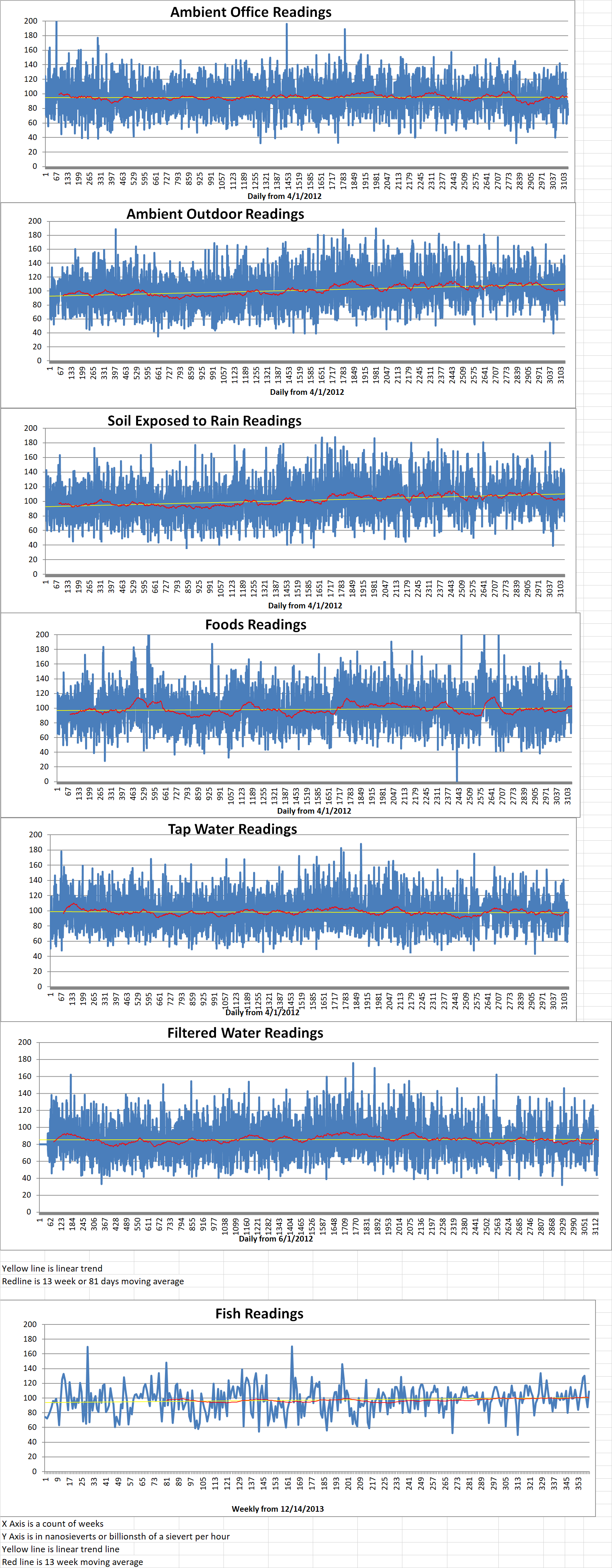
  • Geiger Readings for Jan 26, 2021

    Geiger Readings for Jan 26, 2021

    Ambient office = 51 nanosieverts per hour

    Ambient outside = 109 nanosieverts per hour

    Soil exposed to rain water = 111 nanosieverts per hour

    Blueberry from Central Market = 65 nanosieverts per hour

    Tap water = 97 nanosieverts per hour

    Filter water = 92 nanosieverts per hour

  • Nuclear Batteries Are An Intense Area Of Research – Part 1 of 3 Part

    Nuclear Batteries Are An Intense Area Of Research – Part 1 of 3 Part

    Part 1 of 3 Parts
         I have briefly mentioned batteries based on nuclear materials before in this blog. Currently there is a movement to build on past technologies to upgrade existing nuclear battery designs and develop new nuclear batteries.
          Big centralized power generation systems like nuclear power plants with huge physical grids for distributing electricity are inefficient. Early in the Atomic Age, the world was able to take advantage of economies of scale.
          Generally, only about a third of the primary energy content in most sources is converted into useable energy by our current energy generation technology. The amount of energy that can be derived from sunlight falling on the Earth is limited by the physics of light and the chemical efficiency of solar cells. Wind energy is limited by geography, weather, the physics of wind flow and the mechanical efficiency of the windmills.
          In fossil fuels and nuclear power, most of the loss occurs because we use the energy for a single purpose such as generating electricity or producing thrust. The remaining two thirds of the energy is dissipated as waste heat. Only Combined-Cycle or Combined Heat & Power natural gas technologies use more than forty percent of their heat. Over thirty percent of all kilowatt hours stored are lost. Another five percent is lost during transmission through the national power grid from the power plant to the point of use.
          A centralized power system is required to account for the highest demand anywhere and anytime so only up to half of the generating capacity is regularly in use. The rest of the generated energy is reserved in case there is temporarily a high demand such as in a very hot summer or very cold winter. This means that there is significant underused capacity resulting in unamortized debt.  Any intermittency in generation only makes the problem worse.
         In other fields, the very concept of centralization is obsolete. For instance, the old phone system contained phones wired over hundreds of miles to a central exchange. The exchange was staffed by thousands of switch operators. This old system has been replace by an autonomous hand-held device connected by flexible networks to distributed servers, routers and autonomous satellites in orbit around the Earth. This allows the new system to dynamically allocate network resources and handle major fluctuations in data sharing requirements.
         This decentralization trend has led to the development of new markets, new opportunities and new industries. Analysts believe that the same factors and motivations that drove the digital revolution in communications and media should be capable of driving energy generation and distribution. Power generation can be made smaller, more mobile, safer, cleaner and cheaper. Such changes in energy and industrial system and markets should soon be able to reflect the scale of change that has been seen in wireless data transmission and the media.
         Other systems that could benefit from decentralization include the growth and distribution of food and the cleaning and distribution of water. If these systems could be localized, then the time, cost and waste involved in long distance distribution of food and water could be eliminated.
    Please read Part 2

  • Geiger Readings for Jan 25, 2021

    Geiger Readings for Jan 25, 2021

    Ambient office = 60 nanosieverts per hour

    Ambient outside = 85 nanosieverts per hour

    Soil exposed to rain water = 82 nanosieverts per hour

    Tomato from Central Market = 128 nanosieverts per hour

    Tap water = 79 nanosieverts per hour

    Filter water = 66 nanosieverts per hour

  • Geiger Readings for Jan 24, 2021

    Geiger Readings for Jan 24, 2021

    Ambient office = 61 nanosieverts per hour

    Ambient outside = 108 nanosieverts per hour

    Soil exposed to rain water = 106 nanosieverts per hour

    Broccoli from Central Market =132 nanosieverts per hour

    Tap water = 85 nanosieverts per hour

    Filter water = 66 nanosieverts per hour

  • Geiger Readings for Jan 23, 2021

    Geiger Readings for Jan 23, 2021

    Ambient office = 79 nanosieverts per hour

    Ambient outside = 99 nanosieverts per hour

    Soil exposed to rain water = 106 nanosieverts per hour

    Cauliflower from Central Market = 92 nanosieverts per hour

    Tap water = 102 nanosieverts per hour

    Filter water = 96 nanosieverts per hour

    Dover sole – Caught in USA = 97 nanosieverts per hour

  • Nuclear Weapons 743 – The New Biden Administration Has Important Decisions To Make With Respect To U.S. Nuclear Policy – Part 2 of 2 Part

    Nuclear Weapons 743 – The New Biden Administration Has Important Decisions To Make With Respect To U.S. Nuclear Policy – Part 2 of 2 Part

    Part 1 of 2 Parts (Please read Part 1)
         Rob Soofer served as deputy assistant secretary of defense for nuclear and missile defense policy since the early part of the Trump administration.  Looking at the programmatic level of U.S. nuclear defense projects, he said that administration planners have to decide what to include in and what to exclude from the FY22 budget request for nuclear weapons spending.
         One specific decision that must be made in the near future is whether or not to approve Milestone B on the Department of Defense’s replacement for the nuclear cruise missile known as the Long-Range Standoff weapon or LRSO. This decision must be made by May of this year.
         The LRSO has received mixed reactions among Democrats in Congress. In 2015 and 2016, there were efforts to just cancel the program. Hillary Clinton was the Democratic nominee for President in 2016. She expressed skepticism about the LRSO program and there were predictions that if she had been elected, the program might have been cancelled.
         Soofer emphasized that the policy questions surrounding the LRSO are something that the new Biden administration will have to wrestle with. He urged decisions makers not to let that discussion delay the Milestone B decision. If that were to occur, there could be major ramifications for the ability of the DoE to successfully execute that program.
         Soofer said, “If they wait until they’re done thinking about this in a formal [Nuclear Posture Review] construct, which could take a year, they will not be able to make that [engineering and manufacturing development] EMD decision. So I would hope that there’s enough information amongst senior leadership to at least make an EMD decision.”
          With respect to missile defense, the largest near-term question facing the new Biden administration is exactly how to carry out the Next Generation Interceptor (NGI) program. In the FY21 National Defense Authorization Act, Congress commanded the Pentagon to build an interim homeland intercontinental ballistic missile defense interceptor. This interim interceptor was to be delivered by 2026 which is just a few years before the NGI is scheduled to go into operation.
         Congress allowed the Pentagon a waiver to skip that interim capability if the DoE decided that it was unrealistic.
    That decision will have to come early in the new Biden administration’s term.
          More generally, Soofer said that he considered the “key question” on missile defense for the Biden administration is the question of whether or not to move ahead with the Trump administration plan to put twenty new Ground-based Interceptors in the ground.
         Soofer said, “They’re going have to make the key decision whether they’re going to continue with the 20 GBIs. If they do, then they’ll find out fairly quickly that the difference between an interim capability, maybe like a heavy [life-extension program] — the difference between that and the objective system, in terms of time, is maybe one or two years. And you have to weigh that against a significant enhancement in capability that NGI gets you primarily through the fielding of multiple kill vehicles. All this is going to be very, very politicized. And the strategy and the technology behind it is going to be weighed.”