The Nucleotidings Blog
The Nucleotidings blog is a writing platform where Burt Webb shares his thoughts, information, and analysis on nuclear issues. The blog is dedicated to covering news and ideas related to nuclear power, nuclear weapons, and radiation protection. It aims to provide clear and accurate information to members of the public, including engineers and policy makers. Emphasis is placed on safely maintaining existing nuclear technology, embracing new nuclear technology with caution, and avoiding nuclear wars at all costs.

Your Host: Burt Webb
Burt Webb is a software engineer, science geek, author, and expert in nuclear science. Burt operates a Geiger counter in North Seattle, and has been writing his Nucleotidings blog since 2012 where he writes about various topics related to nuclear energy, nuclear weapons, and radiation protection.

Burt Webb has published several technical books and novels. He works as a software consultant.

Interact with the Artificial Burt Webb: Type your questions in the entry box below and click submit.

Example Q&A with the Artificial Burt Webb

Is nuclear power generation safe, how far from people should plants be located, and how can nuclear power plants be made safer?

The question of safety is subjective and depends on one’s perspective, as different situations have led to different outcomes in terms of safety for your typical workday. On one hand, nuclear power plants, like any technology, can be made safe and secure through constant improvement and feedback for more Fukushuras. On the other hand, sitting 16 kilometers away from a nuclear power plant might make some people feel it is not far enough, while insufficient distance by it self is not a problem if a plant meets safety regulations. Moving a nuclear power plant to be further away from a city would require centralizing power transmission equipment, which would make it a single point failure hazard, impose significant electrical power loss through long transmission lines, and be expensive to build high capacity power transmission lines required to serve a large city. Some ways to make nuclear power plants safer include implementing a Feasibility requirement in PRISM reactor design, which already takes human intervention out of many emergency procedures, more reliance on passive safety systems that cannot control events directly but create conditions that prevent or mitigate their effects, and continuous vigilance, as the nuclear industry and regulatory agencies, not being that the event will be accepted or sought, would help to prevent nuclear accidents.

What do you mean by “Fukushuras”?

“Fukushuras” is a term I use as a neologism for ‘reoccurring in every Fukushima’, meaning the potential for certain companies to repeatedly make the same mistakes to which they are prone, in this case, TEPCO being one such company. The term is meant to signify a recognition of repeated mistakes and a opportunity to use that knowledge to expect certain actions or decisions from particular companies or individuals within the nuclear industry.

Blog

  • Geiger Readings for Jan 22, 2021

    Geiger Readings for Jan 22, 2021

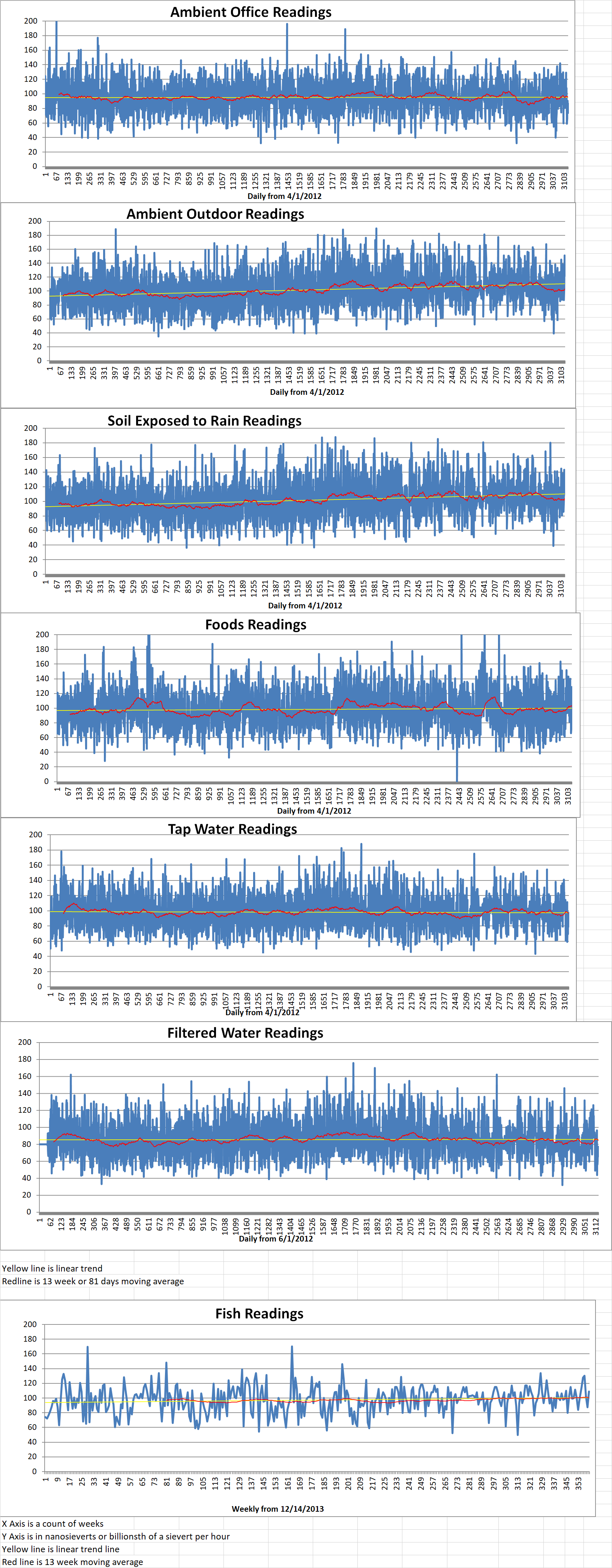
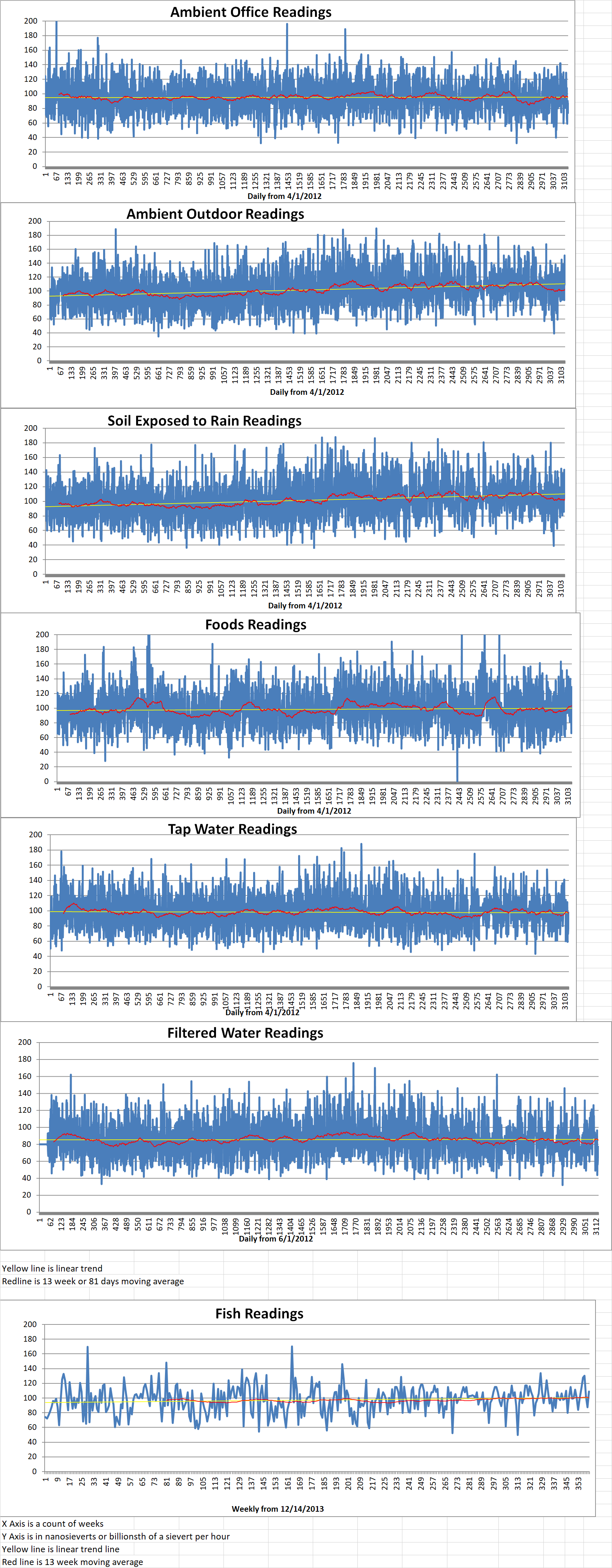
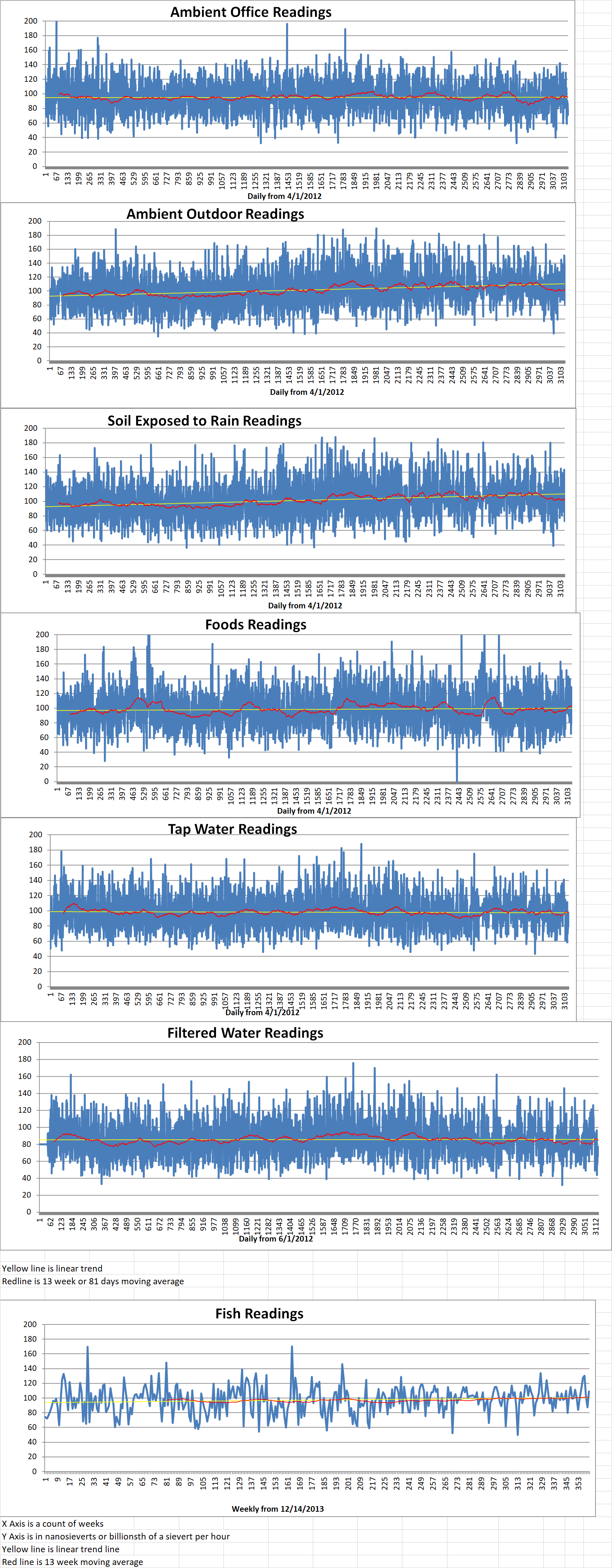
    Ambient office = 72 nanosieverts per hour

    Ambient outside = 80 nanosieverts per hour

    Soil exposed to rain water = 73 nanosieverts per hour

    Avocado from Central Market = 93 nanosieverts per hour

    Tap water = 84 nanosieverts per hour

    Filter water = 77 nanosieverts per hour

  • Nuclear Weapons 742 – The New Biden Administration Has Important Decisions To Make With Respect To U.S. Nuclear Policy – Part 1 of 2 Parts

    Nuclear Weapons 742 – The New Biden Administration Has Important Decisions To Make With Respect To U.S. Nuclear Policy – Part 1 of 2 Parts

    Part 1 of 2 Parts    
         Joe Biden has been inaugurated as the 46th President of the United States. His national security team is under pressure to quickly make calls on a variety of key nuclear and missile defense decisions, according to a top outgoing Pentagon official.
         Rob Soofer served as deputy assistant secretary of defense for nuclear and missile defense policy since the early part of the Trump administration. He expects that there will be a wide-ranging review of nuclear and missile defense issues by the new Biden administration. However, he hopes that the technical reviews that are needed to keep existing programs on track will not be delayed by the policy review.
        Soofer said that there is only a short time before the defense budget must be produced. The budget could be due by mid-March. He said, “They will likely alter President [Donald] Trump’s budget request for fiscal 2022 in some fashion. And I would hope that that they would wait until they conducted their Nuclear Posture Review and their Missile Defense Review before they took any precipitous steps with respect to the big modernization programs. I think anything that reflects dollars and cents for the FY22 budget is going to have to have near-term consideration. Funding for the Ground Based Strategic Deterrent and the nuclear certification of the F-35 — all these nuclear decisions are reflected in the budget request, and so in a sense they have to make a decision within months.”
         Some policy issues such as questions about the no-first-use policy can certainly wait according to Soofer, but there is a near-term policy decision that has to be made. This involves the U.S. strategy for the New START nuclear treaty which expires early next month. The Biden administration has two options to discuss with Russia. These are a one-year extension and a five-year extension.
         Soofer himself participated in negotiations with Russia over the past year. Based on those talks, he believes that there is a real opportunity to bring Russian tactical nuclear weapons into a new version of the New START agreement. He said, “In order to take advantage of that opportunity, the Biden administration should not extend the New START treaty for five years. If they do that, Russia will pocket that extension, walk away, and you’re never going to see [the Russians] again.”
         Soofer’s views are not shared by some members of the arms control community. The Arms Control Association (ACA) issued a report on January 19 that focused on arms control priorities for the new Biden administration. Their report called for a five-year “unconditional” extension of the New START treaty.
         The authors of the report said that “There is no evidence that Russia is desperate to extend the treaty or that a shorter-term extension of New START would make Russia more likely to negotiate a follow-on agreement. Nor is a one-year or two-year extension likely to be enough time to negotiate a new agreement. New START took ten months to negotiate and then about as long to bring into force. And that was at a time when the U.S.-Russia relationship was far less tense.”
    Please read Part 2 next

  • Geiger Readings for Jan 21, 2021

    Geiger Readings for Jan 21, 2021

    Ambient office = 74 nanosieverts per hour

    Ambient outside = 122 nanosieverts per hour

    Soil exposed to rain water = 122 nanosieverts per hour

    English cucumber from Central Market = 88 nanosieverts per hour

    Tap water = 84 nanosieverts per hour

    Filter water = 74 nanosieverts per hour

  • Nuclear Reactors 861 – The Moltex Energy Approach To Recycling Spent Nuclear Fuel Is Questionable – Part 2 of 2 Parts

    Nuclear Reactors 861 – The Moltex Energy Approach To Recycling Spent Nuclear Fuel Is Questionable – Part 2 of 2 Parts

    Part 2 of 2 Parts (Please read Part 1 first)
          Moltex Energy Canada has opened an office in Saint John. Their estimates for storing spent nuclear fuel after they extract fuel for their SMRs would be from a hundred times to a thousand times lower than current estimates for storage. Rory O’Sullivan is the CEO of Moltex Energy Canada.  He said, “It’s very different in cost, complexity, depth underground. … That’s obviously a very big, very appealing factor.” He was referring to the difference between storing the spent nuclear fuel after their extraction process versus storing un-reprocessed spent nuclear fuel.
         There is currently no permanent geological repository for storing spent nuclear fuel in Canada. The Canadian Nuclear Waste Management Organization is researching sites in Ontario for a repository but there has been no decision on a location yet.
         Allison Macfarlane was a former director of the U.S. Nuclear Regulatory Commission and is the current director of the School of Public Policy and Global Affairs at the University of British Columbia. She said that creating a shorter-term radioactivity life for spent nuclear fuel could actually complicate underground storage. This is because such a situation would result in a facility that has to be constantly funded and secured as opposed to just being sealed up and abandoned.  She said “That means that you believe that the institutions that exist to keep monitoring that … will exist for hundreds of years, and I think that is a ridiculous assumption. I’m looking at the United States, I’m seeing institutions crumbling in a matter of a few years. I have no faith that institutions can last that long and that there will be streams of money to maintain the safety and security of these facilities. That’s why you will need a deep geologic repository for this material.”
         Macfarlane said that Moltex is assuming that their technology will be able to successfully extract most of the highly radioactive part of the spent nuclear fuel. She said, “They are assuming that they remove one hundred per cent of the difficult, radionuclides, the difficult isotopes, that complicate the waste. My response is: prove it. Because if you leave five per cent, you have high-level waste that you’re going to be dealing with. If you leave one per cent, you’re going to have high-level waste that you’re going to be dealing with. So sorry, that one doesn’t fly with me.”
         Macfarlane is a geologist by training. She first raised concerns about molten-salt technology and waste issues in a 2018 paper that she co-authored for the Bulletin of Atomic Scientists. She questioned the plans for the construction of a permanent geological repository for spent nuclear fuel at Yucca Mountain, Nevada.
         The Coalition for Responsible Energy Development is a New Brunswick environmental group opposed to SMRs.
    They have been referencing Macfarlane’s research as another reason to doubt the validity of molten-salt SMRs. O’Sullivan said that he is “personally very baffled and frustrated” by public opposition to SMRs. He went on to say that anti-nuclear activists have been complaining about dealing with spent nuclear fuel for decades “and we think we’ve finally got a solution that’s cost effective to deal with it, and we’re still getting this backlash. … We’re environmentalists and we have this backlash.”
         ARC Nuclear is another company based in Saint John that is working on SMRs. Their plans also call for the use of some existing spent nuclear fuel to fuel their SMRs. They said in a press release that their technology “has successfully been demonstrated, therefore proven, at the engineering scale.”
         NB Power has estimated that thousands of jobs will be created by the production of SMRs and there will be a one-billion-dollar boost to the provincial economy. The previous liberal government in Canada has giving Moltex and ARC a total of ten million dollars to support research and development of SMRs. The Canadian federal government has stated that nuclear power is critical to Canada for the reduction of carbon emissions. However, they have not granted any money to the two Saint John companies.

  • Geiger Readings for Jan 20, 2021

    Geiger Readings for Jan 20, 2021

    Ambient office = 74 nanosieverts per hour

    Ambient outside = 136 nanosieverts per hour

    Soil exposed to rain water = 129 nanosieverts per hour

    Blueberry from Central Market = 129 nanosieverts per hour

    Tap water = 79 nanosieverts per hour

    Filter water = 66 nanosieverts per hour

  • Nuclear Reactors 860 – The Moltex Energy Approach To Recycling Spent Nuclear Fuel Is Questionable – Part 1 of 2 Parts

    Nuclear Reactors 860 – The Moltex Energy Approach To Recycling Spent Nuclear Fuel Is Questionable – Part 1 of 2 Parts

    Part 1 of 2 Parts
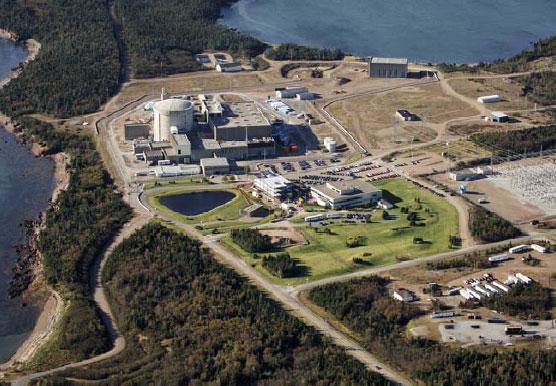
          Small modular reactors (SMR) are getting a lot of press recently. They are defined as fission reactors that produce three hundred megawatts or less of electricity. Allison Macfarlane is the Director of the School of Public Policy and Global Affairs at the University of British Columbia. She was a former head of the Nuclear Regulatory Commission in the U.S. She says that she has a lot of unanswered questions about the molten-salt technology that would be used to construct one type of SMR that would be made in New Brunswick, Canada.
          Moltex Energy is pitching the technology because it believes that it is key to its business case. This is because they are planning on using some of the nuclear waste from the Point Lepreau Generating Station and reducing the long-term cost and radioactivity of the waste that remains. However, Macfarlane said that no one has been able to prove that it is possible or viable to attempt to reprocess nuclear waste and achieve a lower cost and risk for spent nuclear fuel waste.
          Macfarlane said, “Nobody knows what the numbers are, and anybody who gives you numbers is selling you a bridge to nowhere because they don’t know. Nobody’s really doing this right now. … Nobody has ever set up a molten salt reactor and used it to produce electricity.” Macfarlane said that she could not comment specifically on the Moltex technology because the information that they have released so far is too “vague.” She added that she felt the general selling pitch for molten-salt technology is questionable. She said, “Nobody’s been able to answer my questions yet on what all these wastes are and how much of them there are, and how heat-producing they are and what their compositions are. My sense is that all of these reactor folks have not really paid a lot of attention to the back end of these fuel cycles,” in reference to the long-term risks and the costs of securely storing nuclear waste.
          The Point Lepreau nuclear power plant is New Brunswick’s most important generating station. It earns about fifty thousand dollars an hour when it is operating. Moltex is one of two companies in Saint John promoting SMRs as the next logical step for nuclear power generation in the province. They are also pitching SMRs as a low-carbon alternative to using fossil fuels to generate electricity.
         Moltex North Canada CEO Rory O’Sullivan said that Moltex’s molten-salt technology will allow it to economically extract the most radioactive portions of the existing spent nuclear fuel from the Point Lepreau Generation Station. Currently, the waste is stored in pellet form in silos near the power plant and is inspected on a regular basis. The Moltex process would remove under on per cent of the material in the spent nuclear fuel to power the Moltex reactor. O’Sullivan said that the remainder of the spent nuclear fuel after the extraction would be less radioactive for a shorter period of time.
         Existing plans for dealing with spent nuclear fuel in Canada are to build a permanent geological repository where the waste can be stored. The repository would have to be able to keep the spent nuclear fuel secure of hundreds of thousands of years. O’Sullivan said that extracting and removing the most radioactive parts of the spent nuclear fuel would reduce the storage time to a few hundred years which would significantly reduce the cost. He said, “The vast majority will have decayed within a couple of hundred years back down to regular natural levels.”
    Please read Part 2 next

  • Geiger Readings for Jan 19, 2021

    Geiger Readings for Jan 19, 2021

    Ambient office = 87 nanosieverts per hour

    Ambient outside = 129 nanosieverts per hour

    Soil exposed to rain water = 129 nanosieverts per hour

    Heirloom tomato from Central Market = 88 nanosieverts per hour

    Tap water = 98 nanosieverts per hour

    Filter water = 77 nanosieverts per hour