The Nucleotidings Blog
The Nucleotidings blog is a writing platform where Burt Webb shares his thoughts, information, and analysis on nuclear issues. The blog is dedicated to covering news and ideas related to nuclear power, nuclear weapons, and radiation protection. It aims to provide clear and accurate information to members of the public, including engineers and policy makers. Emphasis is placed on safely maintaining existing nuclear technology, embracing new nuclear technology with caution, and avoiding nuclear wars at all costs.

Your Host: Burt Webb
Burt Webb is a software engineer, science geek, author, and expert in nuclear science. Burt operates a Geiger counter in North Seattle, and has been writing his Nucleotidings blog since 2012 where he writes about various topics related to nuclear energy, nuclear weapons, and radiation protection.

Burt Webb has published several technical books and novels. He works as a software consultant.

Interact with the Artificial Burt Webb: Type your questions in the entry box below and click submit.

Example Q&A with the Artificial Burt Webb

Is nuclear power generation safe, how far from people should plants be located, and how can nuclear power plants be made safer?

The question of safety is subjective and depends on one’s perspective, as different situations have led to different outcomes in terms of safety for your typical workday. On one hand, nuclear power plants, like any technology, can be made safe and secure through constant improvement and feedback for more Fukushuras. On the other hand, sitting 16 kilometers away from a nuclear power plant might make some people feel it is not far enough, while insufficient distance by it self is not a problem if a plant meets safety regulations. Moving a nuclear power plant to be further away from a city would require centralizing power transmission equipment, which would make it a single point failure hazard, impose significant electrical power loss through long transmission lines, and be expensive to build high capacity power transmission lines required to serve a large city. Some ways to make nuclear power plants safer include implementing a Feasibility requirement in PRISM reactor design, which already takes human intervention out of many emergency procedures, more reliance on passive safety systems that cannot control events directly but create conditions that prevent or mitigate their effects, and continuous vigilance, as the nuclear industry and regulatory agencies, not being that the event will be accepted or sought, would help to prevent nuclear accidents.

What do you mean by “Fukushuras”?

“Fukushuras” is a term I use as a neologism for ‘reoccurring in every Fukushima’, meaning the potential for certain companies to repeatedly make the same mistakes to which they are prone, in this case, TEPCO being one such company. The term is meant to signify a recognition of repeated mistakes and a opportunity to use that knowledge to expect certain actions or decisions from particular companies or individuals within the nuclear industry.

Blog

  • Geiger Readings for Jan 18, 2021

    Geiger Readings for Jan 18, 2021

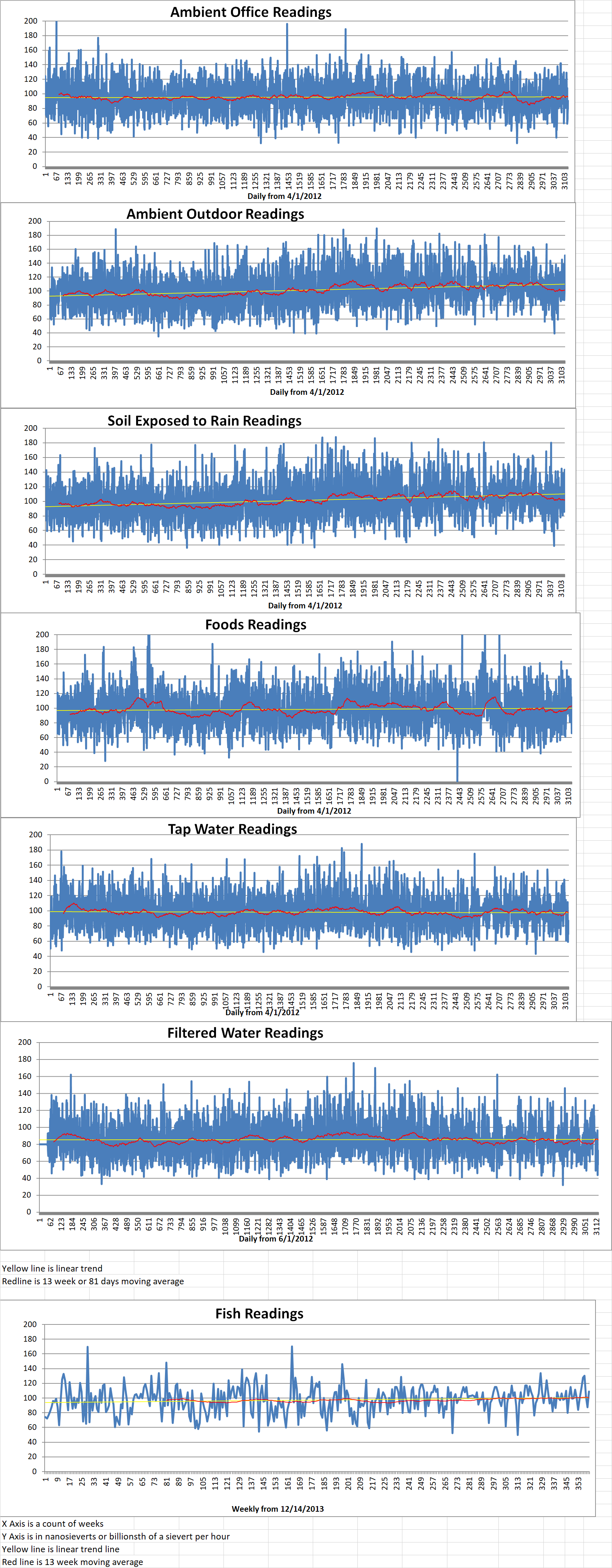
    Ambient office = 80 nanosieverts per hour

    Ambient outside = 151 nanosieverts per hour

    Soil exposed to rain water = 143 nanosieverts per hour

    Organic avocado from Central Market = 73 nanosieverts per hour

    Tap water = 87 nanosieverts per hour

    Filter water = 71 nanosieverts per hour

  • Geiger Readings for Jan 17, 2020

    Geiger Readings for Jan 17, 2020

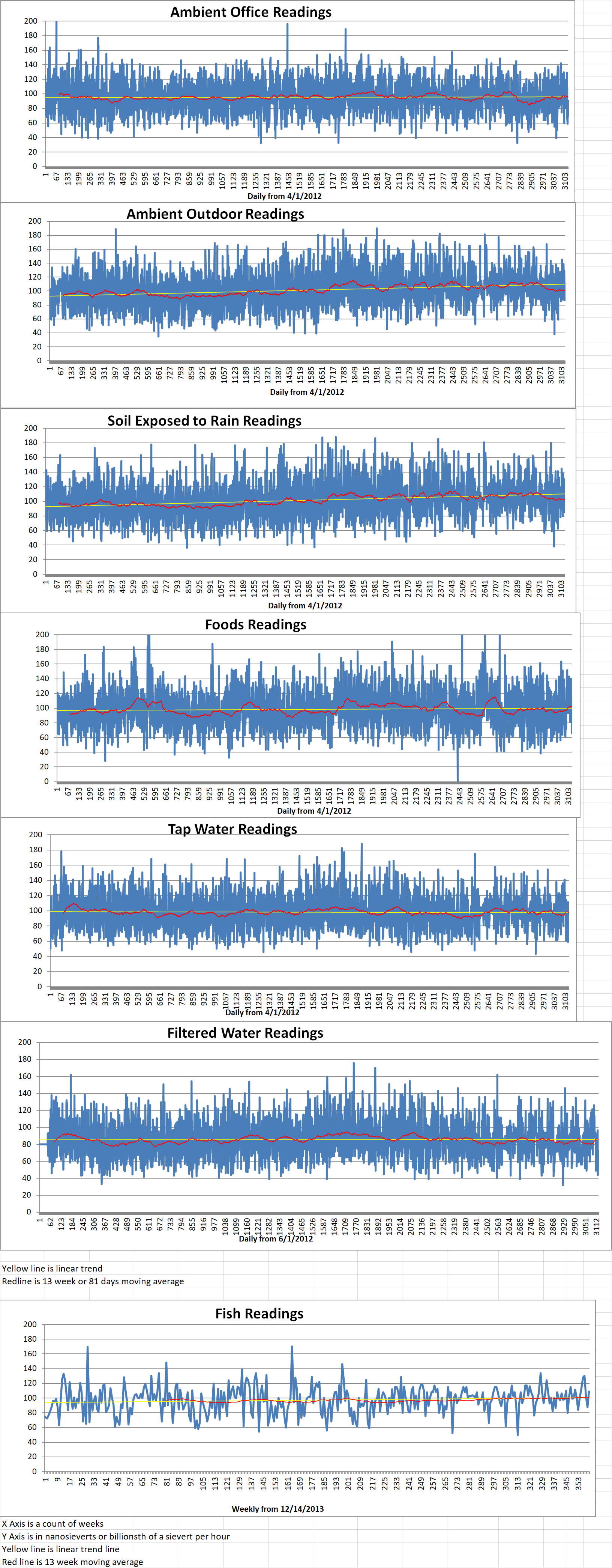
    Ambient office = 91 nanosieverts per hour

    Ambient outside = 110 nanosieverts per hour

    Soil exposed to rain water = 111 nanosieverts per hour

    English cucumber from Central Market = 66 nanosieverts per hour

    Tap water = 80 nanosieverts per hour

    Filter water = 72 nanosieverts per hour

  • Geiger Readings for Jan 16, 2021

    Geiger Readings for Jan 16, 2021

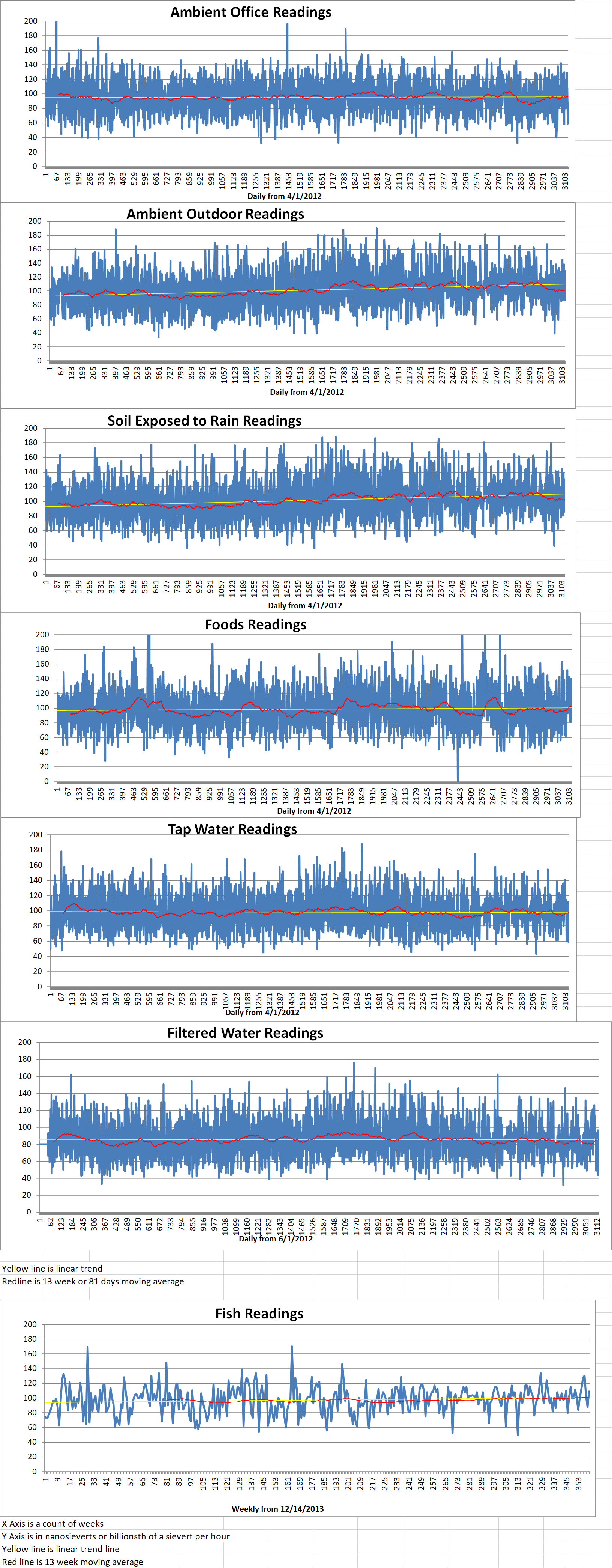
    Ambient office = 87 nanosieverts per hour

    Ambient outside = 107 nanosieverts per hour

    Soil exposed to rain water = 106 nanosieverts per hour

    Blueberry from Central Market = 109 nanosieverts per hour

    Tap water = 70 nanosieverts per hour

    Filter water = 60 nanosieverts per hour

    Dover sole – Caught in USA = 1o9 nanosieverts per hour

  • Nuclear Reactors 858 – The Dangers Of Overextending Licenses For Nuclear Power Plants – Part 3 of 4 Parts

    Nuclear Reactors 858 – The Dangers Of Overextending Licenses For Nuclear Power Plants – Part 3 of 4 Parts

    Part 3 of 4 Parts (Please read Parts 1 and 2 first)

         Beyond Nuclear captured and saved a copy of the original PNNL report for the NRC on extending licensing for nuclear power plants. Here is the revised version of the report now on the NRC websites.

          Gunther points out that the omissions from the revised report start with the Abstract section of the orginal report which states: “As U.S. nuclear power plants look to subsequent license renewal (SLR) to operate for a 20-year period beyond 60 years, the U.S. Nuclear Regulatory Commission and the industry will be addressing technical issues around the capability of long-lived passive components to meet their functionality objectives. A key challenge will be to better understand likely materials degradation mechanisms in these components and their impacts on component functionality and safety margins. Research addressing many of the remaining technical gaps in these areas for SLR may greatly benefit from materials sampled from plants (decommissioned or operating). Because of the cost and inefficiency of piecemeal sampling, there is a need for a strategic and systematic approach to sampling materials from structures, systems and components in both operating and decommissioned plants.” In the revised version of the report, this abstract is missing.

          The removal of the report from the websites and the appearance of the revised report missing important information highlights a major problem with the NRC. Too often, the NRC is a victim of regulatory capture which means that they are too strongly influenced by the industry they are charged with regulating. The NRC is too lenient with respect to failures of nuclear power plant operators to follow the regulations. The NRC has been caught working with nuclear power plant operators to loosen regulations in  order for power plant operators to stay in compliance and save money. Unfortunately, the current Trump administration has been too ready to abolish or alter regulations that companies say are too costly to implement.

         Gunther says that, with respect to current decommissioning practices for nuclear power plants, the U.S. nuclear industry “knocks these plants down and buries them as quickly as they can” and “ignores having critical post-mortem autopsies.” Components at the plants are not studied to determine the extent of wear including “how radiation affects concrete and impacts on what had been inaccessible areas of the plants.”  No analyses of the impacts of embrittlement of metals, especially on the reactor pressure vessel caused by radiation exposure as well as the extreme temperatures and vibrations. The industry resists carrying out such analyses because of the cost involve, says Gunther. In addition, there are about six hundred miles of electrical cables in a typical nuclear power plant which energize control monitors and other components. The insulation and jacketing of electrical cabling are also not being inspected but just buried with the plant. Ultimately, the real-world effects or aging are not being studied. The original PNNL report would have required that this be done.

         The first nuclear power plant to be granted an extension on its operating license to eighty years was the Florida Power & Light’s Turkey Point near Homestead, Florida, 25 miles south of Miami.

    Please read Part 4 next

  • Geiger Readings for Jan 15, 2021

    Geiger Readings for Jan 15, 2021

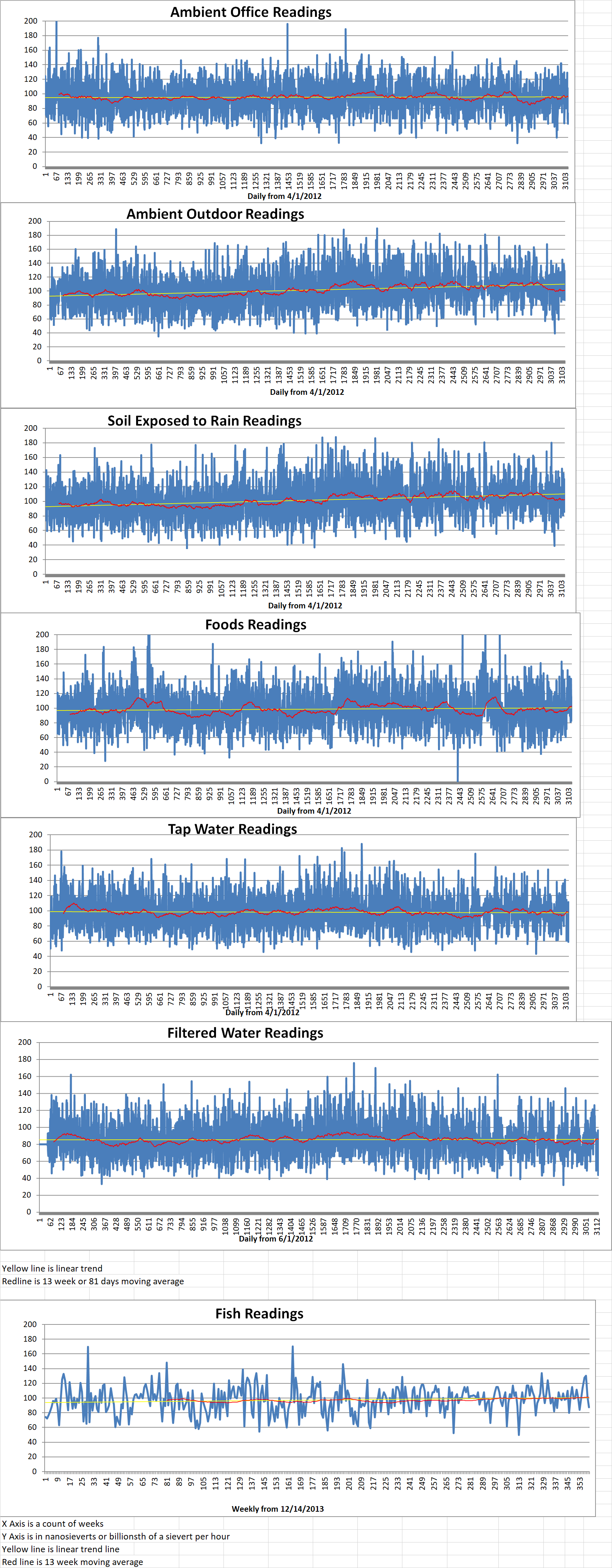
    Ambient office = 73 nanosieverts per hour

    Ambient outside = 104 nanosieverts per hour

    Soil exposed to rain water = 100 nanosieverts per hour

    Avocado from Central Market = 115 nanosieverts per hour

    Tap water = 73 nanosieverts per hour

    Filter water = 56 nanosieverts per hour

  • Nuclear Reactors 857 – The Dangers Of Overextending Licenses For Nuclear Power Plants – Part 2 of 4 Parts

    Nuclear Reactors 857 – The Dangers Of Overextending Licenses For Nuclear Power Plants – Part 2 of 4 Parts

    Part 2 of 4 Parts (Please read Part 1 first)
         Although part of the problem facing the nuclear industry has to do with the huge upfront price of nuclear power and the current preference for “green” energy such as solar and wind, the global nuclear industry is also suffering from public and governmental backlash over the nuclear power plant disasters at Three Mile Island, Chernobyl and Fukushima.
          Robert Alvarez says that there is no actual empirical evidence that nuclear power plants can operate safely and economically for a hundred years. There is no way to ignore the problems of aging at nuclear power plants that operate at extreme temperatures and pressures as well as experiencing radiation fatigue from bombardment of neutrons release by the nuclear fission. After all, as Alvarez said, “Who would want to ride in a one-hundred-year-old car?”
         Paul Gunther is the director of the Reactor Oversight Project of the organization Beyond Nuclear. He says, “The new construction of nuclear power plants is proving to be more expensive and more dubious than ever before. So, the nuclear industry and the NRC are in the process of developing a plan to get these existing aging and inherently dangerous machines to run for 100 years. This raises all kinds of problems that have never been addressed.” Apparently, there is little appetite at the NRC and the U.S. Department of Energy (DoE) to address them.
          The NRC commissioned the DoE’s Pacific Northwest National Laboratory (PNNL) to carry out a study and issue a report in 2017. The report was titled “Criteria and Planning Guidance for Ex-Plant Harvesting to Support Subsequent License Renewal.” Gunther said, “The federal laboratory was contracted by the NRC to develop the criteria and guidance document to address and close numerous ‘knowledge gaps’ in the license renewal safety review process to provide the ‘reasonable assurance’ that the reactors could be operated reliably and safely into the license extension period.” The report raised important questions regarding extending the operating licenses of nuclear power plants.
          Gunther said that the PNNL report was posted on its website in December of 2017. “It was also posted to the websites of the Department of Energy Office of Scientific and Technical Information and the International Atomic Energy Commission’s International Nuclear Information System.” Gunther attended a public meeting at the NRC headquarters in Rockville Maryland in September of 2018 on the topic of operating license extensions. He said that when he started asking questions based on the information in PNNL report, the NRC officials were surprised. Following that meeting, the NRC “wiped all three websites of the report.”
          The NRC eventually reposted the report on the websites, but it had been “scrubbed clean of dozens of references to safety-critical knowledge ‘gaps’ pertaining to many known age-related degradation mechanisms described in the original published report,” according to Gunther. “The NRC revision also scrubbed Pacific Northwest National Laboratory findings and recommendations to ‘require’ the harvesting of realistic and representative aged materials from decommissioning nuclear power stations—base metals, weld materials, electric cables, insulation and jacketing, reactor internals and safety-related concrete structures like the containment and spent fuel pool—for laboratory analyses of age degradation. The laboratory analyses are intended to provide ‘reasonable assurance’ of the license extension safety review process for the projected extension period.”
    Please read Part 3 next