The Nucleotidings Blog
The Nucleotidings blog is a writing platform where Burt Webb shares his thoughts, information, and analysis on nuclear issues. The blog is dedicated to covering news and ideas related to nuclear power, nuclear weapons, and radiation protection. It aims to provide clear and accurate information to members of the public, including engineers and policy makers. Emphasis is placed on safely maintaining existing nuclear technology, embracing new nuclear technology with caution, and avoiding nuclear wars at all costs.

Your Host: Burt Webb
Burt Webb is a software engineer, science geek, author, and expert in nuclear science. Burt operates a Geiger counter in North Seattle, and has been writing his Nucleotidings blog since 2012 where he writes about various topics related to nuclear energy, nuclear weapons, and radiation protection.

Burt Webb has published several technical books and novels. He works as a software consultant.

Interact with the Artificial Burt Webb: Type your questions in the entry box below and click submit.

Example Q&A with the Artificial Burt Webb

Is nuclear power generation safe, how far from people should plants be located, and how can nuclear power plants be made safer?

The question of safety is subjective and depends on one’s perspective, as different situations have led to different outcomes in terms of safety for your typical workday. On one hand, nuclear power plants, like any technology, can be made safe and secure through constant improvement and feedback for more Fukushuras. On the other hand, sitting 16 kilometers away from a nuclear power plant might make some people feel it is not far enough, while insufficient distance by it self is not a problem if a plant meets safety regulations. Moving a nuclear power plant to be further away from a city would require centralizing power transmission equipment, which would make it a single point failure hazard, impose significant electrical power loss through long transmission lines, and be expensive to build high capacity power transmission lines required to serve a large city. Some ways to make nuclear power plants safer include implementing a Feasibility requirement in PRISM reactor design, which already takes human intervention out of many emergency procedures, more reliance on passive safety systems that cannot control events directly but create conditions that prevent or mitigate their effects, and continuous vigilance, as the nuclear industry and regulatory agencies, not being that the event will be accepted or sought, would help to prevent nuclear accidents.

What do you mean by “Fukushuras”?

“Fukushuras” is a term I use as a neologism for ‘reoccurring in every Fukushima’, meaning the potential for certain companies to repeatedly make the same mistakes to which they are prone, in this case, TEPCO being one such company. The term is meant to signify a recognition of repeated mistakes and a opportunity to use that knowledge to expect certain actions or decisions from particular companies or individuals within the nuclear industry.

Blog

  • Geiger Readings for Jan 07, 2021

    Geiger Readings for Jan 07, 2021

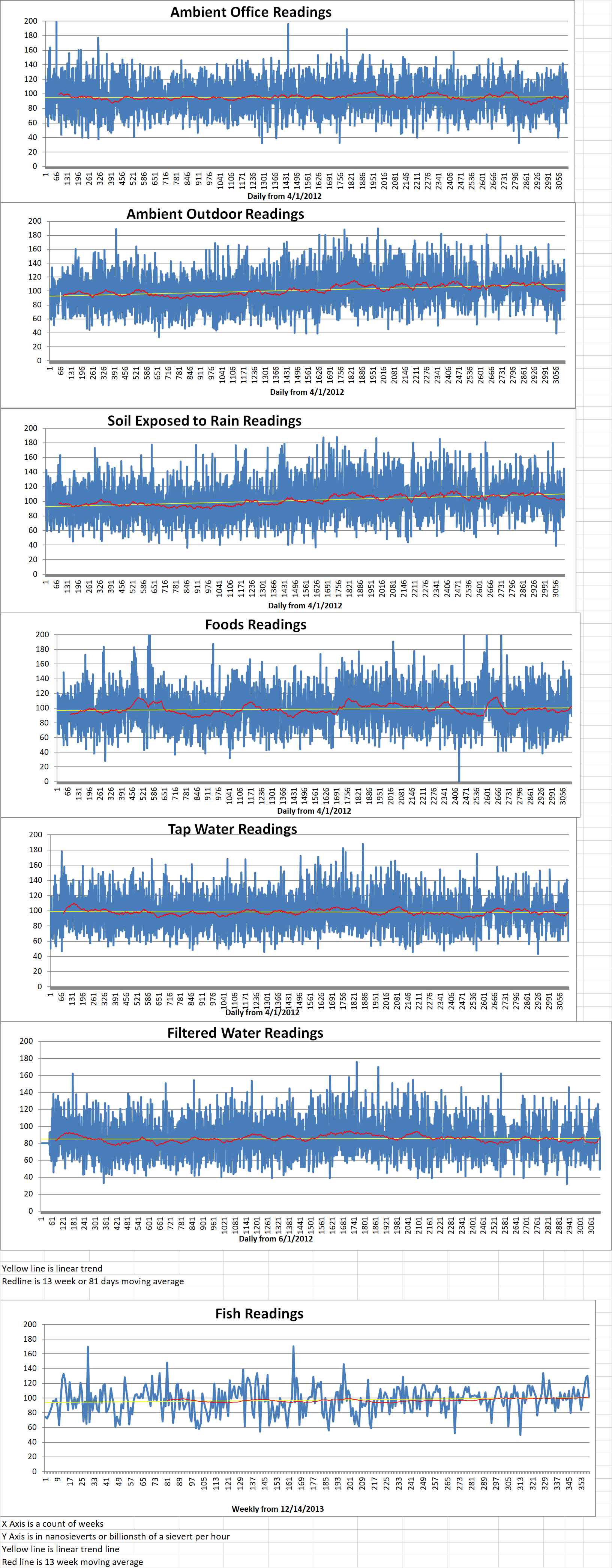
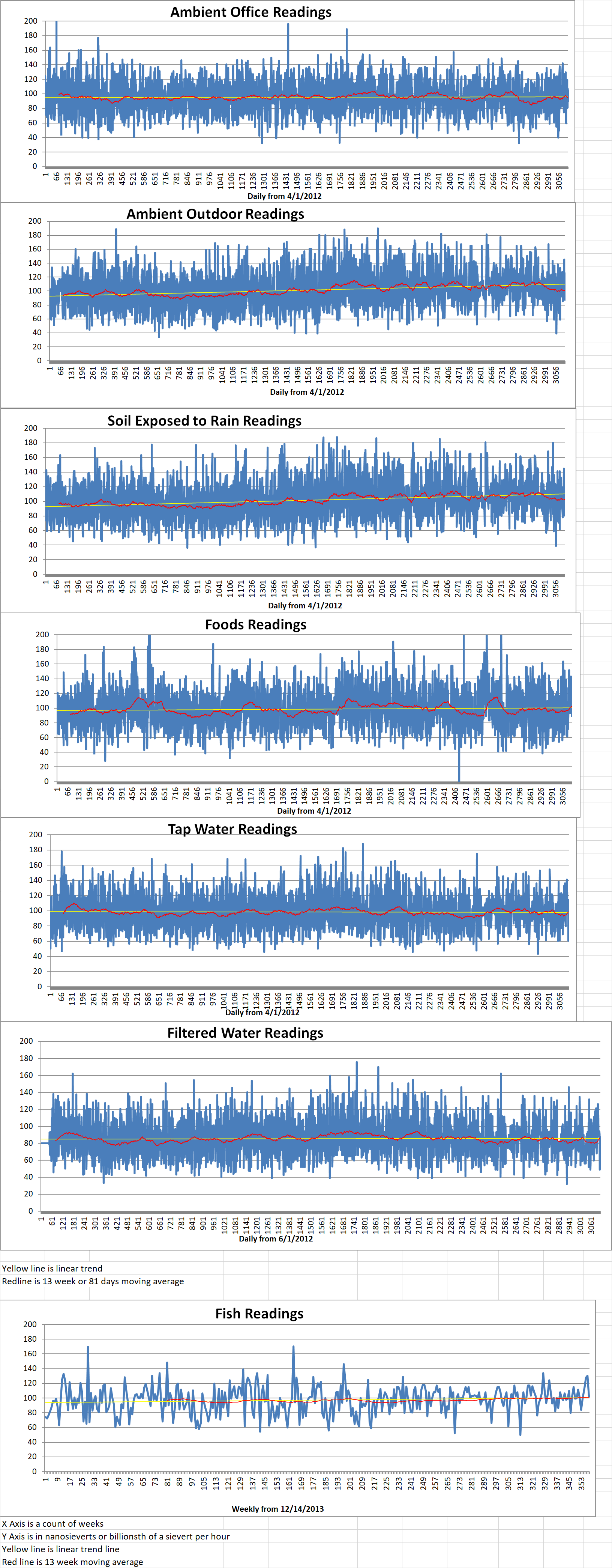
    Ambient office = 99 nanosieverts per hour

    Ambient outside = 104 nanosieverts per hour

    Soil exposed to rain water = 107 nanosieverts per hour

    English cucumber from Central Market = 81 nanosieverts per hour

    Tap water = 91 nanosieverts per hour

    Filter water = 82 nanosieverts per hour

  • Radioactive Waste 793 – Problems With Capsules Of Cesium And Strontium Stored At Hanford Nuclear Reservation – Part 3 of 5 Parts

    Radioactive Waste 793 – Problems With Capsules Of Cesium And Strontium Stored At Hanford Nuclear Reservation – Part 3 of 5 Parts

    Part 3 of 5 Parts (Please read Part 1 and 2 first)
          The cesium and strontium inside the capsules in the WESF at the Hanford Nuclear Reservation were once part of the mixture of toxic and radioactive materials in the one hundred and seventy-seven huge underground tanks. The heat generated by the radioactive isotopes of cesium and strontium decaying in the buried tanks was causing the high-level radioactive waste mixture in the tanks to start boiling. This forced the technicians to extract the cesium and strontium from the tanks and put them in capsules in the WESF for separate storage. This work was carried out between 1967 and 1985.
          At first, the DoE thought that the cesium and strontium could be used for a variety of purposes including thermoelectric power supplies, calibration of industrial instruments or to extend the shelf life of pork, wheat and spices. Unfortunately, consumers are generally concerned about the safety of irradiated foods. The DoE leased hundreds of the capsules to private U.S. companies for research.
          One of the companies that received Hanford cesium capsules was Radiation Sterilizers which utilized the cesium to sterilize mediate equipment at its facilities in Decatur, Georgia and Westerville, Ohio. In 1988, one of the DoE capsules being used in Decatur developed a tiny leak. Two one hundredths of one percent of the cesium escaped. This wound up taking the DoE four years to clean up and cost forty seven million dollars.
          Federal investigators discovered that when the capsules were moved in and out of cooling pools thousands of times, the temperature changes eventually damaged their steel. Radiation Sterilizers had removed temperature monitoring systems in its facilities. The company blamed the DoE, claiming that they were sent a damaged capsule. Whatever the truth was, the DoE immediately recalled all the capsules that it had distributed and returned them to the WESF.
          There are currently one thousand three hundred and thirty-five capsules of cesium chloride at the WESF. Most of the waste in those capsules consists of nonradioactive isotopes of cesium. Most of the radioactive isotopes are cesium-137 with a little cesium-135. Another six hundred and one capsules contain strontium fluoride with the main radioactive isotope being strontium-90.
          Cesium-137 has a half-life of thirty years and strontium-90 has a half-life of twenty-nine years. These are very short half-lives when compare to radioactive materials such as uranium and plutonium. However, the radioactivity in the capsules of strontium is so great that it will take over eight hundred years for the strontium capsules to decay enough to be classified as low-level waste. This was detailed in a 2003 report by the U.S. National Research Council. Although the radioactive isotope cesium-137 will fall to much lower levels in a few hundred years, the half-life of cesium-135 is two million three hundred thousand years. This means that that isotope will eventually become the dominant source of radioactivity in the cesium capsules.
          Workers at Hanford are continuing to monitor the condition of the capsules in the WESF. They periodically shake the capsules with a long metal gripping tool. If the result of the manipulation is a “clunk” sound, this means that the inner stainless-steel pipe is moving freely. This indicates that the capsule is still in good condition. If the inner pipe is damaged, rusty, or swollen, it will fail to move when the capsule is shaken. Around two dozen of these failed capsules have been sealed in a larger stainless-steel container and held apart from the other capsules. This is known as “overpacking.”
    Please read Part 4 next

  • Geiger Readings for Jan 06, 2021

    Geiger Readings for Jan 06, 2021

    Ambient office = 118 nanosieverts per hour

    Ambient outside = 116 nanosieverts per hour

    Soil exposed to rain water = 119 nanosieverts per hour

    Heirloom tomato from Central Market = 97 nanosieverts per hour

    Tap water = 94 nanosieverts per hour

    Filter water = 82 nanosieverts per hour

  • Radioactive Waste 792 – Problems With Capsules Of Cesium And Strontium Stored At Hanford Nuclear Reservation – Part 2 of 5 Parts

    Radioactive Waste 792 – Problems With Capsules Of Cesium And Strontium Stored At Hanford Nuclear Reservation – Part 2 of 5 Parts

    Part 2 of 5 Parts (Please read Part 1 first)
         To avoid the catastrophic failure of the cooling pools at the WESF, the DoE is working on transferring the capsules from the cooling pools to dry casks placed on an outdoor storage pad at Hanford. Sets of six capsules will be placed inside cylindrical metal sleeves. The air inside the cylinders will be exchanged for helium which will dissipate the heat generated by the capsules. The cylindrical sleeves will be inserted into a series of shielded canisters. The final vessel is an eleven-foot tall cylindrical cask made from a special steel alloy and reinforced concrete.
          A passive cooling system will pull cool air into the casks and expel warm air. No fans or cooling water will be needed. The casks will sit vertically on the concrete storage pad. Eventually, there will be a total of twenty casks. Similar systems are used to store spent nuclear fuel at commercial nuclear power plants all over the U.S. The DoE has until the 31st of August 2025 to complete the work of transferring the capsules to the storage casks based on a legal agreement between the DoE, the State of Washington and the U.S. Environmental Agency.
         When the transfer of the capsules is completed, the DoE projects that the new storage system for the capsules will save the U.S. over six million dollars annually in operating costs for the WESF. However, the new storage is only intended as a temporary measure. The capsules will remain in their dry storage casks for fifty years. When that time arrives, the capsules may be vitrified before they are buried in a deep geological repository that remains to be constructed.
          Some analysts believe that the timeline for dealing with the capsules may be too ambitious. Last March at a Congressional hearing, DoE officials stated that treatment of the waste in the underground tanks had the highest priority at Hanford. The DoE also proposed that the annual budget for Hanford cleanup should be cut by seven hundred million dollars in fiscal year 2021. The DoE Office of Environmental Management has published a strategic vision for 2020 to 2030. In the published vision statement, the DoE says that the agency “will continue to evaluate” the transfer of capsules that are currently stored at the WESF.
          The COVID-19 pandemic has caused further complications for the DoE plans at Hanford. The DoE now says that it “will be assessing potential impacts on all projects” that result from reduced operations at Hanford due to the pandemic. The FY2021 budget proposal calls for “safely” deferring work on the WESF capsule transfer project for one year. During that time, there will be “continued maintenance, monitoring, and assessment activities at WESF.”
         It is not surprising that community leaders and state policy makers are opposed to the potential slowdowns and budget cuts at Hanford. They complain that the cleanup at Hanford has been going on for three decades and it should not be delayed any further. David Reeploeg is a member of the Tri-City Development Council (TRIDEC). He said that the DoE strategic vision and proposed budget cuts just add to the “collective frustration” at “this pattern of kicking the can down the road.” TRIDEC advocates for Hanford-related priorities in the nearby communities of Richland, Kennewick, and Pasco, Wash.
    Please read Part 3 next

  • Geiger Readings for Jan 05, 2021

    Geiger Readings for Jan 05, 2021

    Ambient office = 90 nanosieverts per hour

    Ambient outside = 87 nanosieverts per hour

    Soil exposed to rain water = 81 nanosieverts per hour

    Red bell pepper from Central Market = 125 nanosieverts per hour

    Tap water = 76 nanosieverts per hour

    Filter water = 66 nanosieverts per hour

  • Radioactive Waste 791 – Problems With Capsules Of Cesium And Strontium Stored At Hanford Nuclear Reservation – Part 1 of 5 Parts

    Radioactive Waste 791 – Problems With Capsules Of Cesium And Strontium Stored At Hanford Nuclear Reservation – Part 1 of 5 Parts

    Part 1 of 5 Parts
         I have often blogged about the Hanford Nuclear Reservation in south central Washington State. It is one of the most radioactive sites on the whole planet. During World War II and the Cold War, plutonium was produced at Hanford for use in the creation of nuclear warheads. A great deal of radioactive liquids were just poured into trenches dug in the dirt. Over two hundred million gallons of toxic radioactive sludge was created while Hanford was making plutonium and a great deal of it is currently held in one hundred and seventy seven huge underground tanks, some of which are leaking. The U.S. Department of Energy (DoE) has been working on a giant glassification plant for years. They want to embed some of the tank waste into glass logs for permanent burial. The work being done at Hanford is the biggest environmental cleanup effort in the world.
         The tanks of sludge and the contaminated soil are not the only radioactive hazards at Hanford. There are also almost two thousand capsules of very radioactive cesium and strontium. The two radioactive isotopes are stored in cylindrical double-walled, stainless-steel capsules that weight about twenty-four pounds each. In total, the capsules contain about one third of the radioactivity at Hanford.
          The capsules have been stored in a building called the Waste Encapsulation and Storage Facility (WESF) for decades. They sit under about thirteen feet of cooling water in concrete basins lined with stainless-steel. The water around the capsules glows blue with Chrenkov radiation which is generated by particles traveling faster than light travels in water.
         The WESF was built in 1973 with an intended life span of thirty years. The facility is far beyond that time span now. In 2013, a team of nuclear specialists from neighboring Oregon warned Hanford officials that the concreate walls of the cooling pools had lost structural integrity because of the constant bombardment of gamma radiation from the capsules. Hanford is only thirty-five miles from the border between Washington and Oregon. The Columbia River runs right next to the Hanford Reservation. After it passes Hanford, the Columbia continues on past Oregon farms and fisheries and eventually runs through Portland which is the biggest city in Oregon.
         In 2014, the DoE’s Office of the Inspector General decided that the WESF posed the greatest risk of a serious accident for any DoE facility that is operating past its original design life time. If a severe earthquake occurred, the disintegrating concrete basins containing the capsules could collapse and allow the cooling water to drain away. In that eventuality, the capsules would overheat and break apart which would release radioactive materials. The ground and air around the WESF would be heavily contaminated and parts of Hanford might become too radioactive to enter. The radioactivity released could even find its way to nearby cities.
          Dirk Dunning is an engineer and retired Hanford expert for the Oregon Department of Energy. He was one of the team that expressed initial concerns about the integrity of the concrete cooling pools at the WESF. He said, “If it’s bad enough, it means all cleanup essentially stops. We can’t fix it, we can’t stop it. It just becomes a horrible, intractable problem.”
    Please read Part 2 next

  • Geiger Readings for Jan 04, 2021

    Geiger Readings for Jan 04, 2021

    Ambient office = 94 nanosieverts per hour

    Ambient outside = 89 nanosieverts per hour

    Soil exposed to rain water = 86 nanosieverts per hour

    English cucumber from Central Market = 89 nanosieverts per hour

    Tap water = 97 nanosieverts per hour

    Filter water = 88 nanosieverts per hour