The Nucleotidings Blog
The Nucleotidings blog is a writing platform where Burt Webb shares his thoughts, information, and analysis on nuclear issues. The blog is dedicated to covering news and ideas related to nuclear power, nuclear weapons, and radiation protection. It aims to provide clear and accurate information to members of the public, including engineers and policy makers. Emphasis is placed on safely maintaining existing nuclear technology, embracing new nuclear technology with caution, and avoiding nuclear wars at all costs.

Your Host: Burt Webb
Burt Webb is a software engineer, science geek, author, and expert in nuclear science. Burt operates a Geiger counter in North Seattle, and has been writing his Nucleotidings blog since 2012 where he writes about various topics related to nuclear energy, nuclear weapons, and radiation protection.

Burt Webb has published several technical books and novels. He works as a software consultant.

Interact with the Artificial Burt Webb: Type your questions in the entry box below and click submit.

Example Q&A with the Artificial Burt Webb

Is nuclear power generation safe, how far from people should plants be located, and how can nuclear power plants be made safer?

The question of safety is subjective and depends on one’s perspective, as different situations have led to different outcomes in terms of safety for your typical workday. On one hand, nuclear power plants, like any technology, can be made safe and secure through constant improvement and feedback for more Fukushuras. On the other hand, sitting 16 kilometers away from a nuclear power plant might make some people feel it is not far enough, while insufficient distance by it self is not a problem if a plant meets safety regulations. Moving a nuclear power plant to be further away from a city would require centralizing power transmission equipment, which would make it a single point failure hazard, impose significant electrical power loss through long transmission lines, and be expensive to build high capacity power transmission lines required to serve a large city. Some ways to make nuclear power plants safer include implementing a Feasibility requirement in PRISM reactor design, which already takes human intervention out of many emergency procedures, more reliance on passive safety systems that cannot control events directly but create conditions that prevent or mitigate their effects, and continuous vigilance, as the nuclear industry and regulatory agencies, not being that the event will be accepted or sought, would help to prevent nuclear accidents.

What do you mean by “Fukushuras”?

“Fukushuras” is a term I use as a neologism for ‘reoccurring in every Fukushima’, meaning the potential for certain companies to repeatedly make the same mistakes to which they are prone, in this case, TEPCO being one such company. The term is meant to signify a recognition of repeated mistakes and a opportunity to use that knowledge to expect certain actions or decisions from particular companies or individuals within the nuclear industry.

Blog

  • Geiger Readings for Nov 15, 2020

    Geiger Readings for Nov 15, 2020

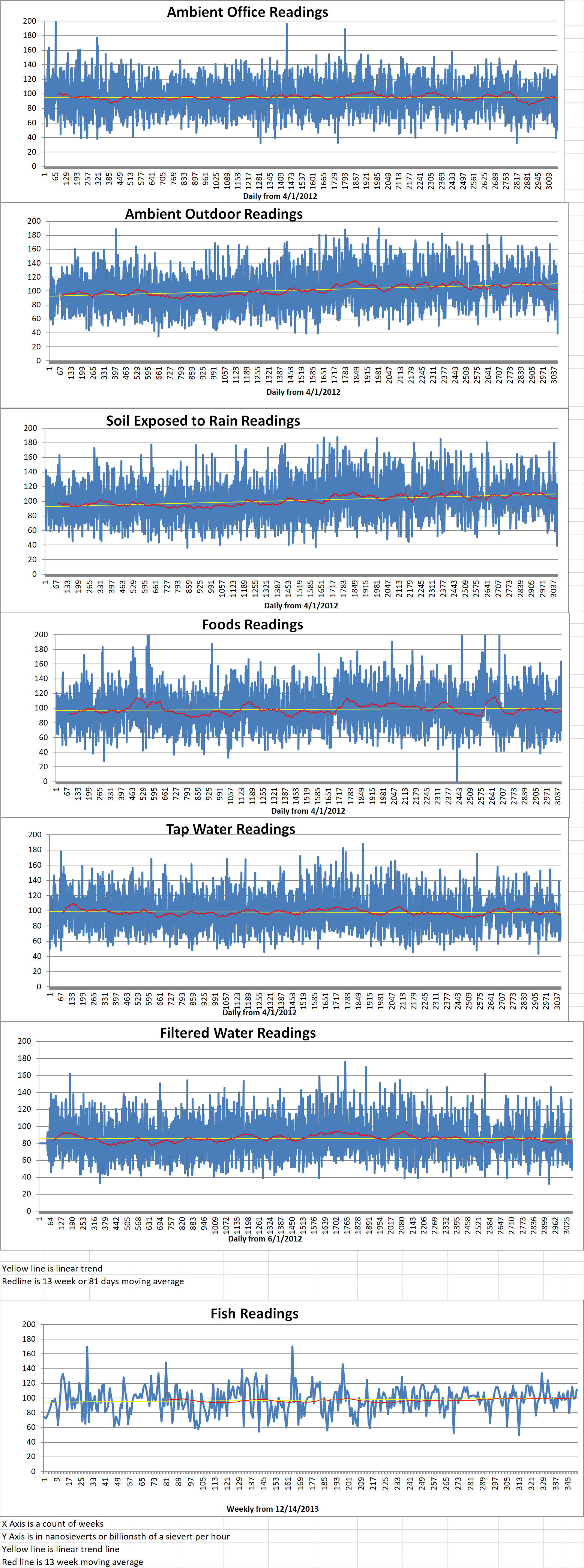
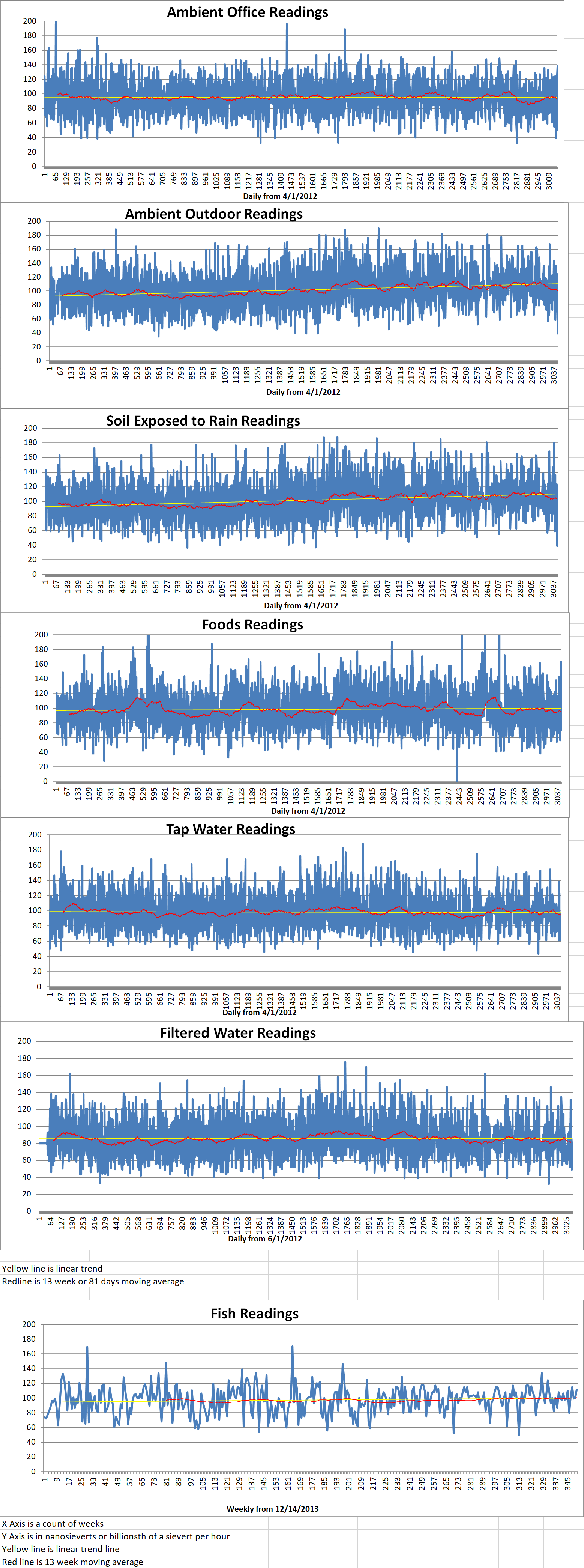
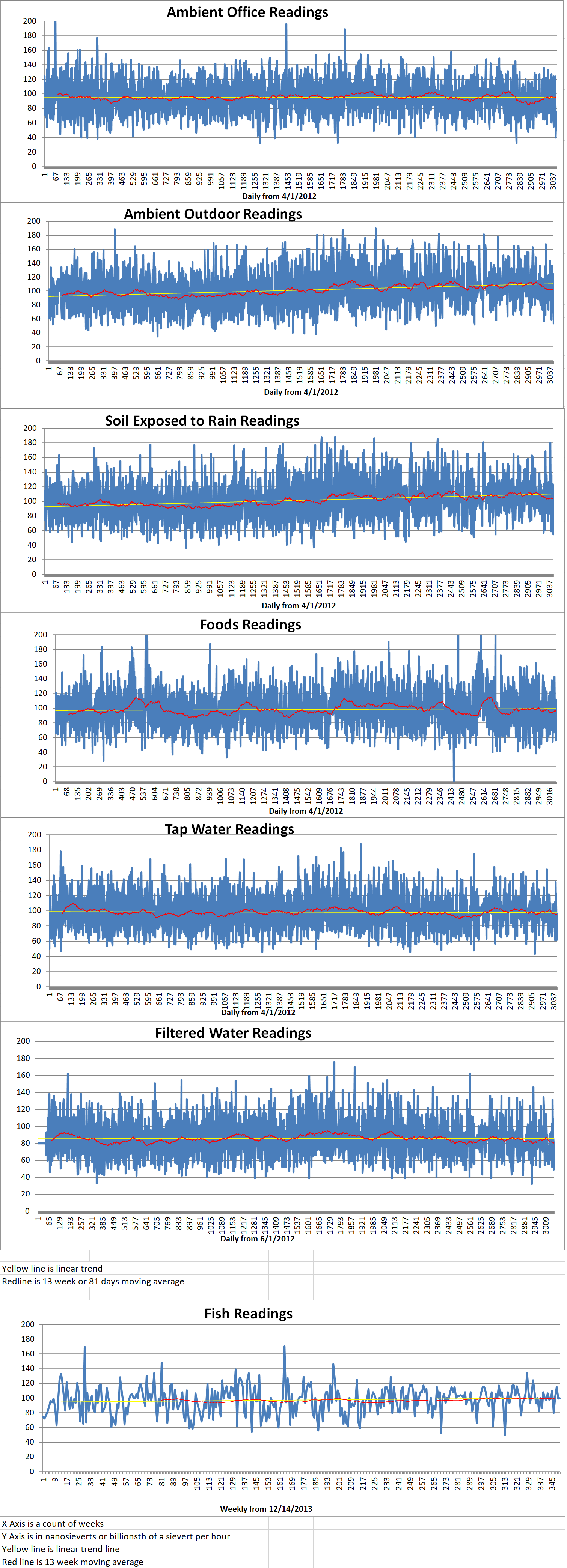
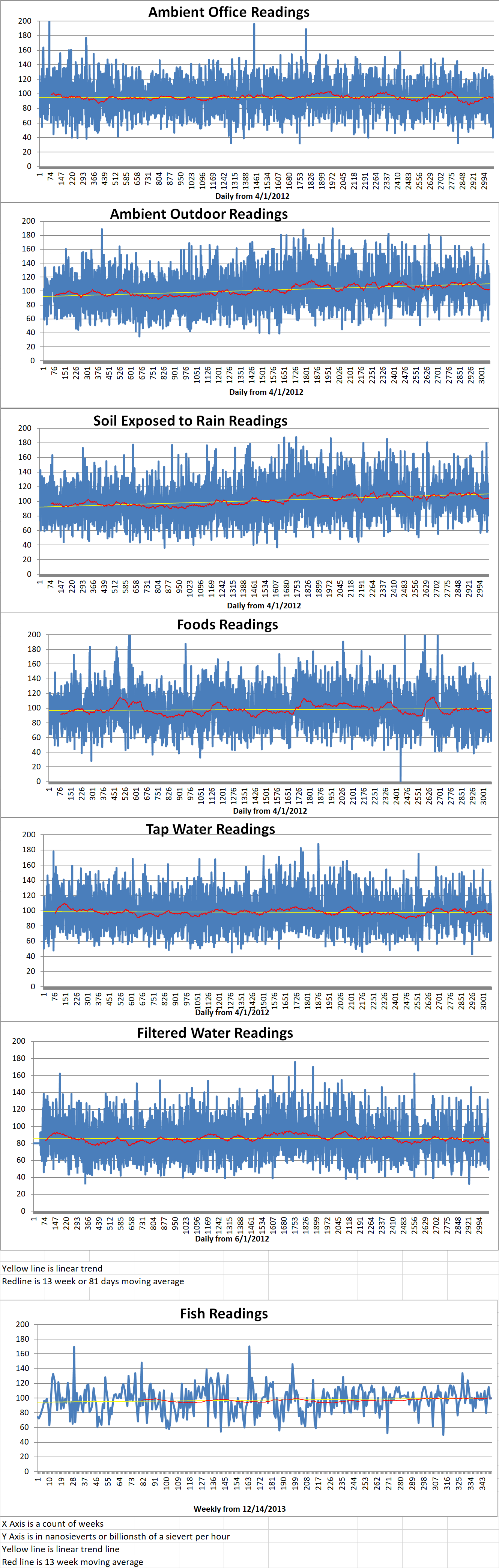
    Ambient office = 138 nanosieverts per hour

    Ambient outside = 86 nanosieverts per hour

    Soil exposed to rain water = 87 nanosieverts per hour

    Garlic from Central Market = 110 nanosieverts per hour

    Tap water = 90 nanosieverts per hour

    Filtered water = 72 nanosieverts per hour

  • Geiger Readings for Nov 14, 2020

    Geiger Readings for Nov 14, 2020

    Ambient office = 128 nanosieverts per hour

    Ambient outside = 39 nanosieverts per hour

    Soil exposed to rain water = 39 nanosieverts per hour

    Celery from Central Market = 164 nanosieverts per hour

    Tap water = 84 nanosieverts per hour

    Filtered water = 74 nanosieverts per hour

    Dover sole – Caught in USA = 111 nanosieverts per hour


  • Nuclear Reactors 837 – The United Kingdom Is Planning For The Construction Of Small Modular Reactors To Supply Electricity – Part 5 of 5 Parts

    Nuclear Reactors 837 – The United Kingdom Is Planning For The Construction Of Small Modular Reactors To Supply Electricity – Part 5 of 5 Parts

    Part 5 of 5 Parts (Please read Parts 1, 2, 3 and 4 first)
         Rolls Royce operates the Vulcan Naval Reactor Test Establishment at Dounreay under the Vulcan Trials Operation and Maintenance contract. Rolls Royce has already been a benefitiary of U.K. government money flowing into new nuclear projects. It has been lobbying the U.K. government to support its SMR research and development project. When the Office of the Prime Minister submitted its pitch document in 2017, it copied phrases right out of Rolls Royce statements to give to the Financial times.
          It appears that Rolls Royce is lobbying a Boris Johnson aide named Dominic Cummings who is reputed to oppose energy efficiency. His influence is obvious in the push for SMRs and BEIS is also pushing for government support for Sizewell C. The pandemic triggered crash in the aviation industry has caused Rolls Royce to fire up to eight thousand employees. This troubled company is a big example of Great Britain supporting huge unprofitable companies. Critics say that it would not be wise to pour more millions of dollars of public money into Rolls Royce.
          Analysts say that both Sizewell and the SMRs would be much too expensive for the public purse which is already absorbing the shock of the pandemic. Burke said that the pitch for SMR funding should be “Cummings fights back against the public pressure for Sizewell from EDF and (Tom) Greatrex”. Tom Greatrex is the Nuclear Industry Association’s chairman. In a recent Times article he called for “a strong and unambiguous statement of the need for new nuclear to be able to meet the net-zero target” and he also specifically requested backing for Sizewell C.
         There is a major PR battle in the U.K. media over new nuclear projects. Editors of publications seem to be in favor of giving pro-nuclear writers free reign and seldom question their unsupported claims that nuclear power is zero carbon. Dr. Lowry says that this is questionable proposition and not based on any emperical data. If the carbon footprint of the full uranium fuel cycle is considered from uranium mining, milling, enrichment, fuel fabrication, irradiation, radioactive waste conditioning, storage, packaging to final disposal then the carbon emissions of nuclear power plants are between ten and eighteen times greater than the carbon emissions from renewable energy technology. This was determined by a recent study conducted by Mark Jacobsdon who is a professor of civil and environmental engineering at Stanfod University in California.
         Another recent peer-reviewed article published in Nature Energy indicated that nations installing nuclear power do not have lower carbon emissions but those installing a lot of renewable energy systems do have lower carbon emissions. As a third recent study showed, investment in new nuclear power reactors tends to compete with investment in renewables. The two choices for power generation cannot peacefully co-exist.
          Renewables offer a more rapid and cost-effective means to reach zero carbon targets. The opportunity costs of nuclear power are extremely negative. The 2019 World Nuclear Industry Status Report comprehensively refutes any evidence-based arguments that the implementation of nuclear power will help address the problem of climate change. But, in the end, none of those arguments really reach the heart of the matter. Military nuclear programs require the support of the civilian nuclear power industry.

  • Geiger Readings for Nov 13, 2020

    Geiger Readings for Nov 13, 2020

    Ambient office = 75 nanosieverts per hour

    Ambient outside = 53 nanosieverts per hour

    Soil exposed to rain water = 55 nanosieverts per hour

    Blueberry from Central Market = 93 nanosieverts per hour

    Tap water = 87 nanosieverts per hour

    Filtered water = 80 nanosieverts per hour

  • Nuclear Reactors 836 – The United Kingdom Is Planning For The Construction Of Small Modular Reactors To Supply Electricity – Part 4 of 5 Parts

    Nuclear Reactors 836 – The United Kingdom Is Planning For The Construction Of Small Modular Reactors To Supply Electricity – Part 4 of 5 Parts

    Part 4 of 5 Parts (Please read Parts 1, 2 and 3 first)
         Despite criticism from multiple analysts, the U.K. government is still considering taking a direct stake in the Sizewell C project as recommended by BEIS. This action would employ a “Regulated Asset Base” (RAB) model in which costs are added to consumers’ bills during construction. One problem with this approach is the fact that some nuclear power projects have consumed millions of dollars from energy customers only to be abandoned without ever generating a single watt of electricity.
         The RAB approach would result in multibillion-dollar liabilities appearing on the U.K. governments balance sheet. The Treasury is studying the question of whether the U.K. government should receive equity stakes in EDF’s Sizewell plant to compensate.  The U.K. government had previously offered to purchase a one-third stake in a planned Wylfa nuclear power plant to be constructed on Anglesey. Hitachi, the Japanese company that was going to construct the Wylfa plant, ultimately pulled out of the project because it was still going to be too expensive for them even with the participation of the U.K. government.
         In any case, the RAB approach is already being challenged by the U.K. national nuclear regulator, the Office for Nuclear Regulation (ONR), because it could introduce a dual regulator for the industry. The ONR does not consider this to be reasonable or practical.
         Renewables are considered to be safer, cheaper, easier to install quickly and genuinely low carbon without the need for a dangerous fuel supply chain. The Sizewell reactor would not be able to supply any power until 2034 at the earlier. Wind and solar plants take about two years on average to construct. The ability of the U.K. national energy grid to absorb fluctuating renewable power sources is improving. Renewable deployment is also benefiting from the rapidly dropping cost of batteries, and investment in hydrogen and other forms of energy storage.
         The National Infrastructure Commission has testified that the absorption of sixty five percent renewables on the national grid by 2030 is more cost effective than nuclear power and more technically achievable.
          Robin Grimes is the Chief Scientific Adviser for the Ministry of Defense on nuclear science and technology. Apparently, he recognizes the attraction of renewables and has been developing other arguments against renewable energy sources. He is advocating for the potential of cogeneration for nuclear power plants. Cogeneration would entail use of the “waste” head from nuclear power plants for many purposes including district heating, seawater desalinization, synthetic fuel production and industrial process heat. Unfortunately, this is not likely to have much impact on the cost-benefit equation for nuclear power.
          Grimes was the author of a once classified report drafted in 2014 for the Ministry of Defense in which it was recommended that the U.K. nuclear submarine industry needed to forge links with the civil nuclear power program in order to offload some of the costs from its overburdened budget. This secret report also discussed possible solutions for the leak of radiation from the Vulcan Naval Reactor Test Establishment which is a military submarine reactor testing facility constructed in 1950 at the Dounreay submarine base in Scotland. Engineers with nuclear expertise are dying as the nuclear facilities that service the submarines are failing. New nuclear subs will require a new supply chain and new expertise.
    Please read Part 5

  • Geiger Readings for Nov 12, 2020

    Geiger Readings for Nov 12, 2020

    Ambient office = 66 nanosieverts per hour

    Ambient outside = 85 nanosieverts per hour

    Soil exposed to rain water = 81 nanosieverts per hour

    English cucumber from Central Market = 70 nanosieverts per hour

    Tap water = 71 nanosieverts per hour

    Filtered water = 56 nanosieverts per hour

  • Nuclear Reactors 835 – The United Kingdom Is Planning For The Construction Of Small Modular Reactors To Supply Electricity – Part 3 of 5 Parts

    Nuclear Reactors 835 – The United Kingdom Is Planning For The Construction Of Small Modular Reactors To Supply Electricity – Part 3 of 5 Parts

    Part 3 of 5 Parts (Please read Parts 1 and 2 first)
         Andrew Stirling talks about the “tragic relative popularity of (increasingly obsolescent) nuclear weapons”. Civil nuclear installations are crumbling and this provides a fortuitous opportunity to shift some of the costs for nuclear infrastructure that might be useful for the military over to the civilian nuclear program. The U.K. has copious stores of plutonium and the U.K. military has its own dedicated uranium enrichment logistics.
          Tom Burke is the Chairman of E3G which is a think tank. He said, “Clearly, the military need to maintain both reactor construction and operation skills and access to fissile materials will remain. I can well see the temptation for Defense Ministers to try to transfer this cost to civilian budgets.”
          Dr David Toke is a Reader in Energy Politics, Department of Politics and International Relations at the University of Aberdeen. He says that the global threat of nuclear proliferation is strongly linked to the spread of nuclear power. David Lowry agrees with Toke. He said that “India, Pakistan and above all Israel are obvious examples, each of which certainly has built nuclear weapons.”
         Stirling believes that we cannot separate the work of challenging civil nuclear power programs without also challenging military nuclear interests. He said, “The massive expense of increasingly ineffective military nuclear systems extends beyond the declared huge budgets. They are also propped up by large hidden subsidies from consumer and taxpayer payments for costly nuclear power.  Huge hidden military interests will likely continue to keep the civil nuclear monster growing new arms. Until critics reach out and engage the entire thing, we’ll never prevail in either struggle.” It is still unclear how the U.K. will pay for expensive new nuclear power plants.
         The Office of the Prime Minister is strongly backing the development and deployment of SMRs. In the meantime, BEIS has been trying to find a way to pay for the Sizewell C reactor which the French company, EDF, has been promoting for construction in Suffolk. Analysts think that this may be part of the reason that it did not want to take part in the financing of Rolls Royce’s expansion.
         BEIS has been considering and promoting the idea of the U.K. government taking equity stakes in future U.K. nuclear power plants such as Sizewell C. This has been confirmed by the U.K. energy minister.
         EDF is not able to continue with its plans to construct a new U.K. nuclear power setation unless it receives even more U.K. government support than it has already obtained. Jean-Bernard Lévy is the CEO of EDF. He recently met the Chancellor of the Exchequer Rishi Sunak to plead for more funding from the U.K. government. John Sauven is the head of Greenpeace in the U.K. He wrote a letter to the Chancellor in which he argued that while the requested support might be in the interests of EDF, it certainly would not be in the interests of the U.K.
    Please read Part 4 next