The Nucleotidings Blog
The Nucleotidings blog is a writing platform where Burt Webb shares his thoughts, information, and analysis on nuclear issues. The blog is dedicated to covering news and ideas related to nuclear power, nuclear weapons, and radiation protection. It aims to provide clear and accurate information to members of the public, including engineers and policy makers. Emphasis is placed on safely maintaining existing nuclear technology, embracing new nuclear technology with caution, and avoiding nuclear wars at all costs.

Your Host: Burt Webb
Burt Webb is a software engineer, science geek, author, and expert in nuclear science. Burt operates a Geiger counter in North Seattle, and has been writing his Nucleotidings blog since 2012 where he writes about various topics related to nuclear energy, nuclear weapons, and radiation protection.

Burt Webb has published several technical books and novels. He works as a software consultant.

Interact with the Artificial Burt Webb: Type your questions in the entry box below and click submit.

Example Q&A with the Artificial Burt Webb

Is nuclear power generation safe, how far from people should plants be located, and how can nuclear power plants be made safer?

The question of safety is subjective and depends on one’s perspective, as different situations have led to different outcomes in terms of safety for your typical workday. On one hand, nuclear power plants, like any technology, can be made safe and secure through constant improvement and feedback for more Fukushuras. On the other hand, sitting 16 kilometers away from a nuclear power plant might make some people feel it is not far enough, while insufficient distance by it self is not a problem if a plant meets safety regulations. Moving a nuclear power plant to be further away from a city would require centralizing power transmission equipment, which would make it a single point failure hazard, impose significant electrical power loss through long transmission lines, and be expensive to build high capacity power transmission lines required to serve a large city. Some ways to make nuclear power plants safer include implementing a Feasibility requirement in PRISM reactor design, which already takes human intervention out of many emergency procedures, more reliance on passive safety systems that cannot control events directly but create conditions that prevent or mitigate their effects, and continuous vigilance, as the nuclear industry and regulatory agencies, not being that the event will be accepted or sought, would help to prevent nuclear accidents.

What do you mean by “Fukushuras”?

“Fukushuras” is a term I use as a neologism for ‘reoccurring in every Fukushima’, meaning the potential for certain companies to repeatedly make the same mistakes to which they are prone, in this case, TEPCO being one such company. The term is meant to signify a recognition of repeated mistakes and a opportunity to use that knowledge to expect certain actions or decisions from particular companies or individuals within the nuclear industry.

Blog

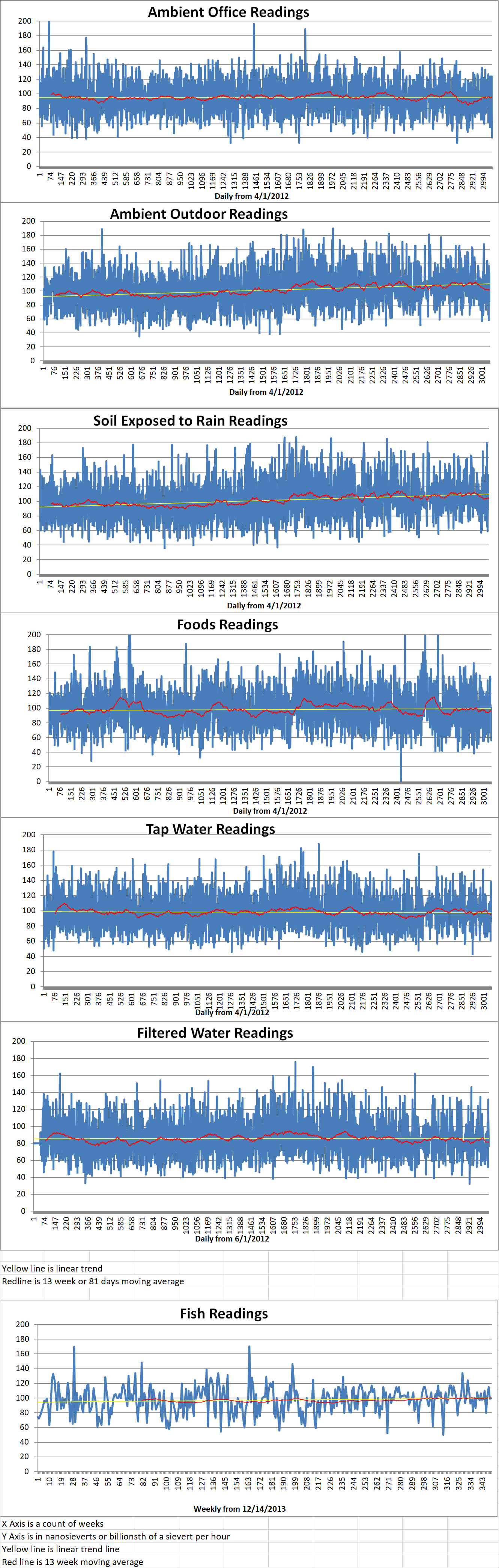
  • Geiger Readings for Nov 11, 2020

    Geiger Readings for Nov 11, 2020

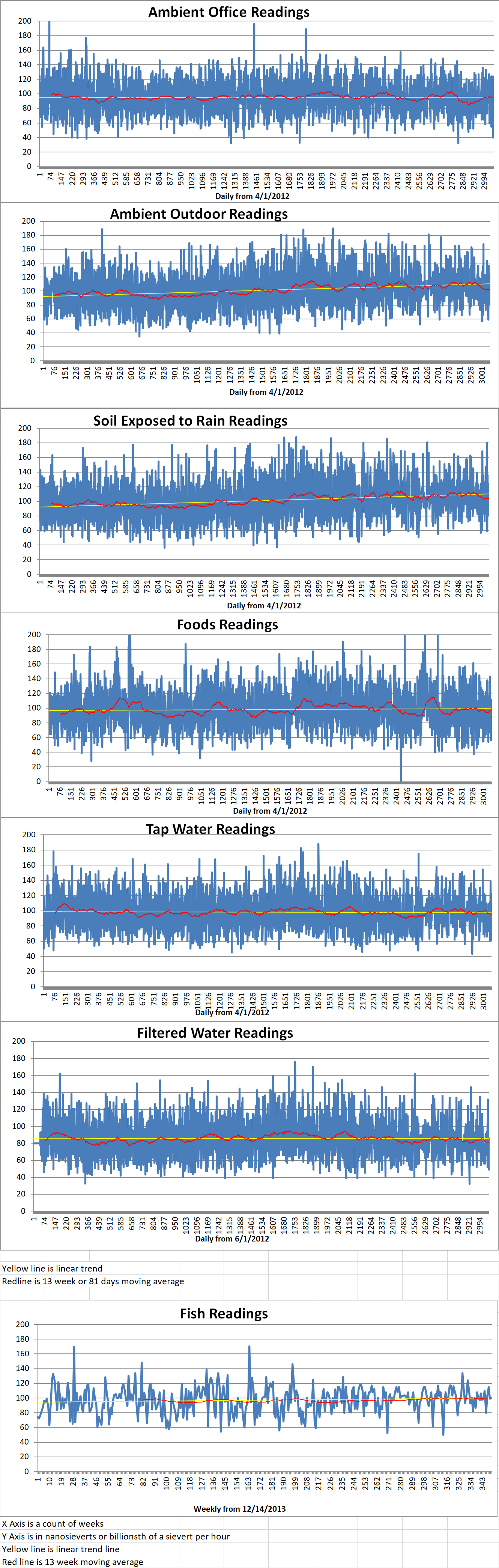
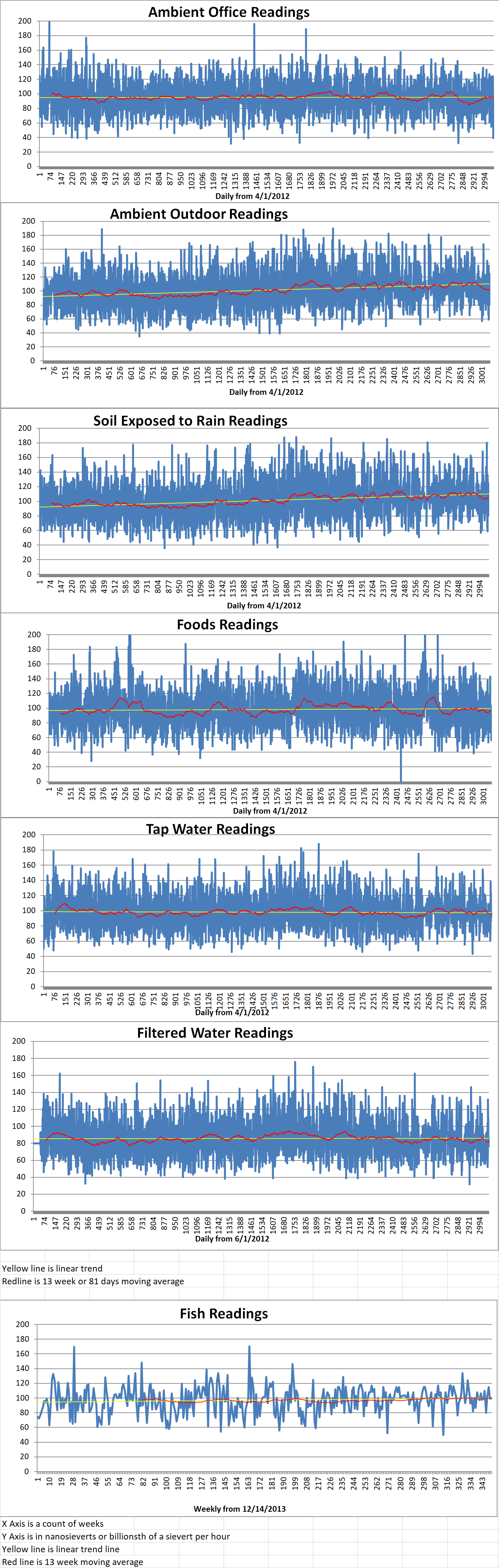
    Ambient office = 50 nanosieverts per hour

    Ambient outside = 120 nanosieverts per hour

    Soil exposed to rain water = 123 nanosieverts per hour

    Red bell pepper from Central Market = 111 nanosieverts per hour

    Tap water = 62 nanosieverts per hour

    Filtered water = 49 nanosieverts per hour

  • Nuclear Reactors 834 – The United Kingdom Is Planning For The Construction Of Small Modular Reactors To Supply Electricity – Part 2 of 5 Parts

    Nuclear Reactors 834 – The United Kingdom Is Planning For The Construction Of Small Modular Reactors To Supply Electricity – Part 2 of 5 Parts

    Part 2 of 5 Parts (Please read Part 1 first)
         The first thing to consider about the SMRs is that they are not particularly small. The nuclear power plant at Wylfa in north Wales generated about four hundred and sixty megawatts when it was operational. The four hundred and sixty megawatt SMRs would be bigger than all the Magnavox type nuclear reactors in the U.K. (except for Wylfa). They are comparable to Advanced Gas-cooled reactors. (I have a problem with even calling the reactors being developed by the U.K. SMRs because according to the common definition of SMRs, they are not supposed to generate over three hundred megawatts.)
          The question of where the SMRs will be manufactured is still open. Derby is the home of the Rolls Royce company which is involved in the development of the SMRs. The U.K. government is already using the funds of the Department of Housing and Communities (DHC) to finance the construction of a new advanced manufacturing center in Derby. The Department of Business and Energy (BEIS) was asked why their funds were not being used to construct the new center. A spokesperson replied that the current funding scheme was part of “levelling up regeneration money”, whatever that means.
         Maybe the BEIS was reluctant to commit its funds to such a project. Spending money on such a “risky prospect” betrays “an irrationally cavalier attitude” according to Andrew Sterling who is a Professor of Science & Technology Policy at the University of Sussex Business School. He also said that “implausibly short time” was being allocated for the development and construction of an untested nuclear reactor design.
         Stirling says that the only justification for this decision to proceed with SMRS is that it is supporting the U.K. nuclear weapons program. “Even in a worst case scenario, where this massive Rolls Royce production line and supply chain investment is badly delayed (or even a complete failure) with respect to civil reactor production, what will nonetheless have been gained is a tooled-up facility and a national skills infrastructure for producing perhaps two further generations of submarine propulsion reactors, right into the second half of the century. And the costs of this will have been borne not by the defense budget, but by consumers and citizens.”
         The U.K. defense policy is fulling committed to the use of nuclear power for military applications. The very roots of the U.K. civil nuclear power program are embedded in the Cold War rush to develop nuclear weapons even though the British public was told that the production of electricity via nuclear power would be “too cheap to meter.”
          The core of the post-Brexit mentality is the legacy of empire and the desire to continue to be perceived as having important world status. The English political elite cannot imagine that this status could be maintained without the U.K. being in the nuclear nations club and being able to maintain the threat of nuclear deterrence. Dr. Paul Dorfman works at the Energy Institute of the University College of London. He said, “The civil-military link is undisputable and should be openly discussed.”
    Please read Part 3 next

  • Geiger Readings for Nov 10, 2020

    Geiger Readings for Nov 10, 2020

    Ambient office = 57 nanosieverts per hour

    Ambient outside = 81 nanosieverts per hour

    Soil exposed to rain water = 81 nanosieverts per hour

    Avocado from Central Market = 89 nanosieverts per hour

    Tap water = 97 nanosieverts per hour

    Filtered water = 80 nanosieverts per hour

  • Nuclear Reactors 833 – The United Kingdom Is Planning For The Construction Of Small Modular Reactors To Supply Electricity – Part 1 of 5 Parts

    Nuclear Reactors 833 – The United Kingdom Is Planning For The Construction Of Small Modular Reactors To Supply Electricity – Part 1 of 5 Parts

    Part 1 of 5 Parts
         The government of the U.K. has pushed for more nuclear power reactors for the past fifteen years and has just renewed its commitment to nuclear power with public statements of support. Some observes may be puzzled about such support given many problems associated with nuclear power. Perhaps part of the answer is the fact that, since its inception, nuclear power has been supported by governments because of its connection to nuclear weapons. Any opposition to nuclear power must also oppose nuclear weapons to have any hope of succeeding.
          At a recent online Conservative Party conference, Prime Minister Boris Johnson said, “All of Britain’s household energy needs supplied by offshore wind by 2030.” If this is accomplished, it would represent about forty per cent of the total U.K. consumption of electricity. While this sounds like a win for renewable energy generation, there were also two announcements about nuclear power at the conference.
         The office of the Prime Minister told the Financial Times that it was considering dedicating about two billion six hundred thousand dollars to support the new small modular reactors (SMRs) currently under development. They are discussing the possibility of constructing as many as sixteen SMRs to “to help UK meet carbon emissions targets”. The announcement said that the first SMR to be constructed in the U.K. is estimated to cost as much as three billion dollars and be operational by 2029.
         The U.K. government is also considering commissioning the first mini nuclear power stations which would host the SMRs. This announcement was encouraging to nuclear suppliers and investors. Final decisions on funding these projects will depend on the multiyear review of spending by the U.K Treasury which is due later this year. A consortium would be formed to construct such a power station and it would include Rolls Royce and the National Nuclear Laboratory.
          Support for the development of this SMR technology is expected to be part of Boris Johnson’s “10-point plan for a green industrial revolution” and new Energy White Paper. These documents are expected to be released later this fall. It is probable that Johnson will also present these documents as his response to the English citizens assembly recommendations that were demanded by Extinction Rebellion in 2019.
          The new energy plan will also include provisions for carbon capture and storage and using hydrogen as a vehicle fuel. But it is the plan for the SMRs that is impressive. The intent is to manufacture them on production lines in central factories and transport them to their final sites for assembly. Each of the SMRs would operate for up to sixty years and provide four hundred and forty megawatts of electricity each year. This is estimated to be enough electricity to power a city the size of Leeds. The SMR design is supposed to be ready by April of 2021. The U.K. business and energy department has already pledged to provide over twenty-three million dollars for developing the consortium’s early-stage plans.
    Please read Part 2 next

  • Geiger Readings for Nov 09, 2020

    Geiger Readings for Nov 09, 2020

    Ambient office = 56 nanosieverts per hour

    Ambient outside = 125 nanosieverts per hour

    Soil exposed to rain water = 124 nanosieverts per hour

    Cauliflower from Central Market = 56 nanosieverts per hour

    Tap water = 95 nanosieverts per hour

    Filtered water = 86 nanosieverts per hour

  • Geiger Readings for Nov 08, 2020

    Geiger Readings for Nov 08, 2020

    Ambient office = 62 nanosieverts per hour

    Ambient outside = 100 nanosieverts per hour

    Soil exposed to rain water = 103 nanosieverts per hour

    Broccoli from Central Market = 99 nanosieverts per hour

    Tap water = 92 nanosieverts per hour

    Filtered water = 77 nanosieverts per hour