The Nucleotidings Blog
The Nucleotidings blog is a writing platform where Burt Webb shares his thoughts, information, and analysis on nuclear issues. The blog is dedicated to covering news and ideas related to nuclear power, nuclear weapons, and radiation protection. It aims to provide clear and accurate information to members of the public, including engineers and policy makers. Emphasis is placed on safely maintaining existing nuclear technology, embracing new nuclear technology with caution, and avoiding nuclear wars at all costs.

Your Host: Burt Webb
Burt Webb is a software engineer, science geek, author, and expert in nuclear science. Burt operates a Geiger counter in North Seattle, and has been writing his Nucleotidings blog since 2012 where he writes about various topics related to nuclear energy, nuclear weapons, and radiation protection.

Burt Webb has published several technical books and novels. He works as a software consultant.

Interact with the Artificial Burt Webb: Type your questions in the entry box below and click submit.

Example Q&A with the Artificial Burt Webb

Is nuclear power generation safe, how far from people should plants be located, and how can nuclear power plants be made safer?

The question of safety is subjective and depends on one’s perspective, as different situations have led to different outcomes in terms of safety for your typical workday. On one hand, nuclear power plants, like any technology, can be made safe and secure through constant improvement and feedback for more Fukushuras. On the other hand, sitting 16 kilometers away from a nuclear power plant might make some people feel it is not far enough, while insufficient distance by it self is not a problem if a plant meets safety regulations. Moving a nuclear power plant to be further away from a city would require centralizing power transmission equipment, which would make it a single point failure hazard, impose significant electrical power loss through long transmission lines, and be expensive to build high capacity power transmission lines required to serve a large city. Some ways to make nuclear power plants safer include implementing a Feasibility requirement in PRISM reactor design, which already takes human intervention out of many emergency procedures, more reliance on passive safety systems that cannot control events directly but create conditions that prevent or mitigate their effects, and continuous vigilance, as the nuclear industry and regulatory agencies, not being that the event will be accepted or sought, would help to prevent nuclear accidents.

What do you mean by “Fukushuras”?

“Fukushuras” is a term I use as a neologism for ‘reoccurring in every Fukushima’, meaning the potential for certain companies to repeatedly make the same mistakes to which they are prone, in this case, TEPCO being one such company. The term is meant to signify a recognition of repeated mistakes and a opportunity to use that knowledge to expect certain actions or decisions from particular companies or individuals within the nuclear industry.

Blog

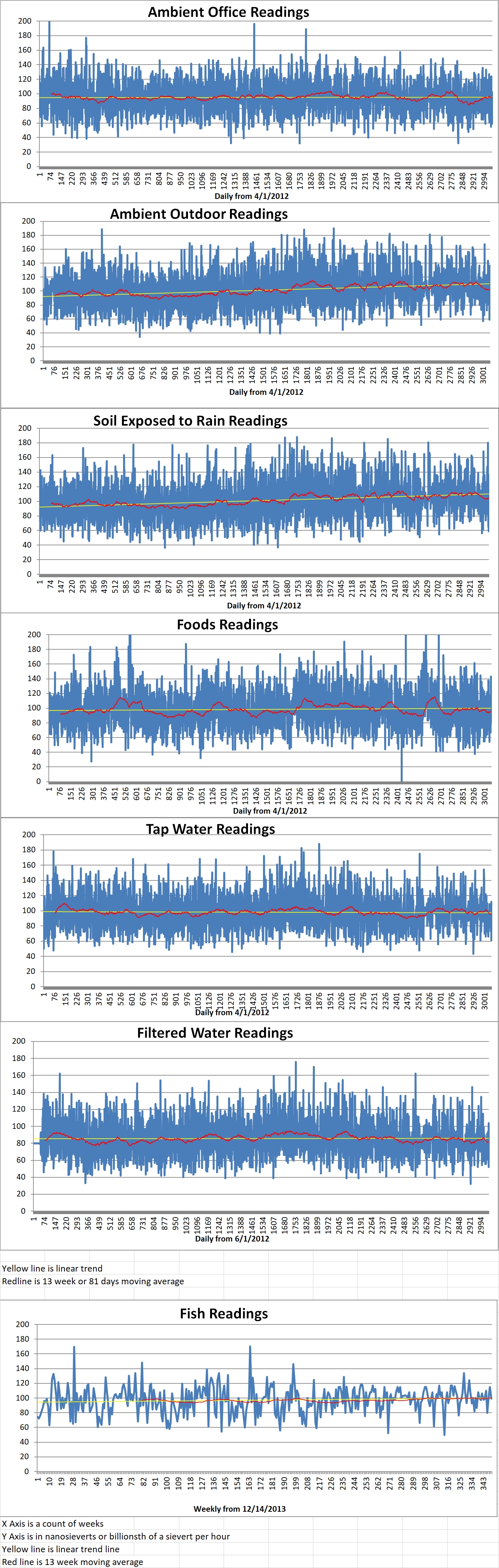
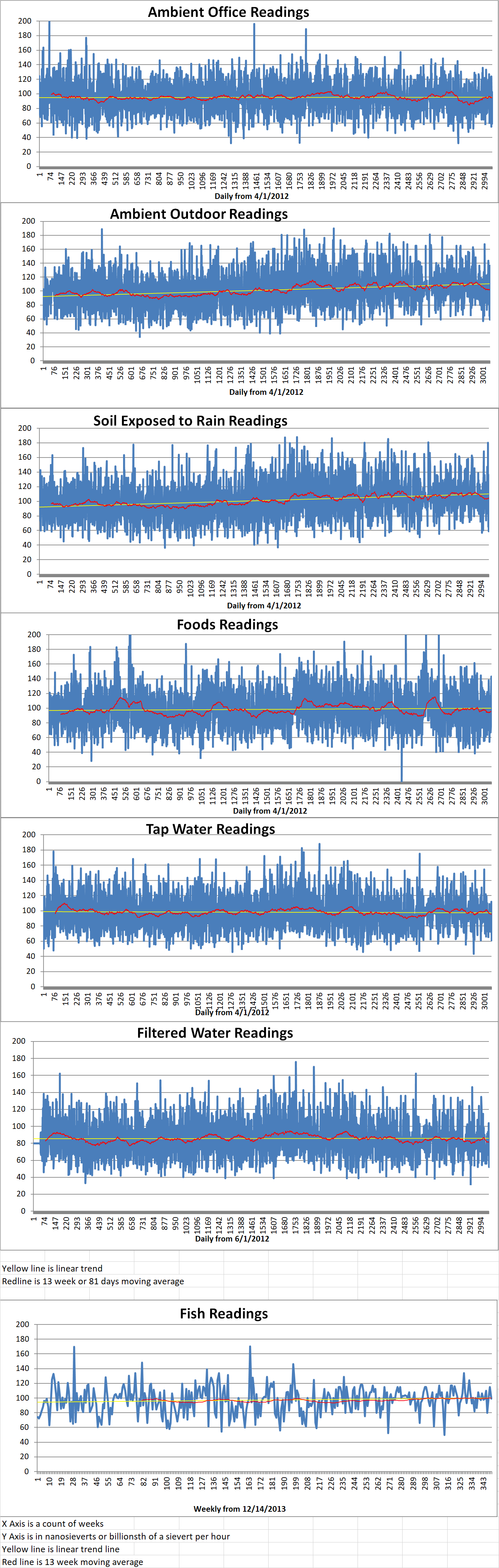
  • Geiger Readings for Nov 04, 2020

    Geiger Readings for Nov 04, 2020

    Ambient office = 115 nanosieverts per hour

    Ambient outside = 111 nanosieverts per hour

    Soil exposed to rain water = 118 nanosieverts per hour

    Heirloom tomato from Central Market = 104 nanosieverts per hour

    Tap water = 138 nanosieverts per hour

    Filtered water = 132 nanosieverts per hour

  • Radioactive Waste 781 – Korea Is Going To Test Radioactivity Decontamination Technologies At The Chernobyl Nuclear Power Plant In Ukraine

    Radioactive Waste 781 – Korea Is Going To Test Radioactivity Decontamination Technologies At The Chernobyl Nuclear Power Plant In Ukraine

         There was a massive nuclear accident at the Chernobyl Nuclear Power Plant, near the city of Pripyat in the north of Ukraine in April of 1986. A test was being conducted on the emergency backup systems for core cooling. The operators triggered a reactor shutdown, but a combination of unstable conditions and reactor design flaws caused an uncontrolled nuclear chain reaction instead. There was an explosion that ruptured the reactor core followed by a fire that release radioactive particles into the atmosphere which were carried across Europe.
         By December 1986, a protective Chernobyl Nuclear Power Plant sarcophagus was built to enclose the ruins of the plant and prevent the further spread of radioactive materials. Recently a new bigger sarcophagus was completed to cover the original sarcophagus.
        Now the Chernobyl Nuclear Power Plant has been chosen as a testing ground for new South Korean technologies for the treatment of radioactive materials. This announcement was made by Oleksandr Skomarokhov, ChNPP deputy director of radioactive waste management for Ukraine after the signing of a Memorandum of Understanding last month by Sergei Kalashnyk, the head of the State Agency of Ukraine on Exclusion Zone Management (SAUEZM), and Won Seok Park, the president of the Korea Atomic Energy Research Institute (KAERI).
          Skomarokhov made a statement on the SAUEZM website where he said that the agreement enables KAERI to carry out the decontamination of concrete and metal fragments of stainless steel and carbon steel. He went on to say “KAERI has technical developments aimed at the decontamination of radioactively contaminated surfaces, but it can’t test these technologies because there are no actual (non-artificially) contaminated surfaces in Korea today. At the same time, the Chernobyl nuclear power plant, which is being decommissioned, is constantly looking for the ways and means both to qualitatively perform decontamination of materials and to significantly reduce the amount of radioactive waste produced in this process. Thus, the ChNPP site is a kind of laboratory testing ground for KAERI technology specialists.”
         KAERI said that the MoU can be considered as an extension to its research on the practical use of nuclear dismantling core technologies that have been developed by the Nuclear Technology Development Project of South Korea’s Ministry of Science and Technology. KAERI and the Ministry are planning to demonstrate the technology at ChNPP and then develop practical models for its use in third countries. ChNPP has been closed down since the 1986. No full-scale dismantling and decommissioning work has been undertaken there. Such work is scheduled to begin in 2045 according to KAERI.
         The use of radioactive concrete processing technology separates and processes concrete waste produced by the dismantling of nuclear facilities by using high heat and physical force to separate aggregate and cement. This process can reduce the amount of radioactive waste left over by as much as fifty percent according to KAERI.
         Decontamination technology for radioactively contaminated metal equipment utilizes a foam decontamination agent applied to a large area of a building or to large equipment. The foam is then washed off to remove radioactive materials which reduces the contamination to about ten percent of its original level.
         In addition, KAERI plans to demonstrate radioactive waste disposal technology, field measurement technology and soil treatment technology for large-area contamination sites as well as “residential restoration” technology in a series of project.
          Won Seok Park said, “This agreement will be an opportunity to share technology and know-how with Ukrainian people with experience in the field of nuclear dismantling and to build future-oriented partnerships.”

  • Geiger Readings for Nov 03, 2020

    Geiger Readings for Nov 03, 2020

    Ambient office = 95 nanosieverts per hour

    Ambient outside = 120 nanosieverts per hour

    Soil exposed to rain water = 119 nanosieverts per hour

    Crimini mushroom from Central Market = 90 nanosieverts per hour

    Tap water = 80 nanosieverts per hour

    Filtered water = 73 nanosieverts per hour

  • Nuclear Fusion 114 – Culham Center for Fusion Energy In The U.K. Working On Spherical Tokamak

    Nuclear Fusion 114 – Culham Center for Fusion Energy In The U.K. Working On Spherical Tokamak

         The UK is working on their own approach to nuclear fusion for power production. Their Mega Amp Spherical Tokamak (Mast) Upgrade has taken seven years to construct at a cost of seventy-one million dollars to date. It utilizes an innovative design known as a spherical tokamak. The tokamak is a popular approach for fusion devices that use magnetic fields to confine the plasma inside a vessel. The plasma consists of a hot ionized gas in which nuclear fusion takes place. Most of them are shaped like a donut. However, in the Mast Upgrade, the size of the donut hole has been shrunk as much as possible leading to a more spherical shape.
         Prof Ian Chapman is the chief executive of the U.K. Atomic Energy Authority (UKAEA). When the Mast Upgrade was switched on for the first time recently, he said that it was “a really momentous occasion”.
         The occurrence of what is called “first plasma” signals the start of this pioneering effort to move the U.K. closer to building a commercial fusion power plant. While it is relatively easy to control a plasma and perform fusion, it is another matter to achieve the Lawson criterion where the amount of energy being pumped into the fusion reactor is less than the amount of energy generated by the reactor.
         The Culham Center for Fusion Energy is currently home to both the Mast Upgrade and another fusion reactor project called the Joint European Torus (JET). The JET is based on a more conventional fusion reactor design. It was the precursor for the international, multi-billion-euro being built in France called the ITER. It is hoped that the ITER project, which is one of the biggest science experiments in the world, will be able to demonstrate nuclear fusion at a scale that could be used for energy production.
          In addition to the JET, the Culham researchers have been pursuing a parallel project with the Mast Upgrade. Professor Chapman said in an interview, “We’ve been thinking about a pathway to fusion power plants which allowed for smaller, and therefore cheaper builds. That will hopefully allow quicker penetration into energy markets. That’s the genesis behind the spherical tokamak.”
         However, Chapman says that “the big challenge behind the spherical tokamak is that the boundary conditions behind making fusion happen is that you need the fuel to be 10 times hotter than the Sun.  If you put that into a much smaller box… the chances of melting the walls of the box are much higher. So you need a really clever way of getting the heat out.”
         The scientists at Culham have designed a very complex and technically challenging exhaust system. The next step in their research is to test this new exhaust system which is called the Super-X divertor in the Mast Upgrade. It is designed to channel plasma out of the reactor at temperatures that are low enough for the materials in the reactor to cope with. This means that the components of the reactor will last much longer. Chapman said, “If it works, it really does offer a path to much more compact fusion power plants, in a much more cost-competitive way to delivering fusion here on Earth.”
          Amanda Solloway is the UK Science Minister. She said, “We want the UK to be a world leader in fusion energy and to capitalize on its amazing potential as a clean energy source that could last for hundreds of years. Backed by £55m of government funding, powering up the Mast Upgrade Device is a landmark moment for this national fusion experiment and takes us another step closer towards our goal of building the UK’s first fusion power plant by 2040.”

  • Geiger Readings for Nov 02, 2020

    Geiger Readings for Nov 02, 2020

    Ambient office = 102 nanosieverts per hour

    Ambient outside = 137 nanosieverts per hour

    Soil exposed to rain water = 136 nanosieverts per hour

    Red bell pepper from Central Market = 86 nanosieverts per hour

    Tap water = 61 nanosieverts per hour

    Filtered water = 52 nanosieverts per hour

  • Geiger Readings for Nov 01, 2020

    Geiger Readings for Nov 01, 2020

    Ambient office = 59 nanosieverts per hour

    Ambient outside = 59 nanosieverts per hour

    Soil exposed to rain water = 59 nanosieverts per hour

    Avocado from Central Market = 143 nanosieverts per hour

    Tap water = 112 nanosieverts per hour

    Filtered water = 104 nanosieverts per hour