
When I talk about the prospects for nuclear power, I often mention the fact that a big vulnerability is the public fear of a major nuclear accident. There have only been a few major accidents, but they have a chilling effect on public acceptance, private investment and government support for nuclear power.
In March, 2011, there was an underwater earthquake that hit to the northeast of the Japanese archipelago. The tsunami that was generated by the quake hit the nuclear power station on the Japanese coast at Fukushima. Tokyo Electric Power Company (TEPCO), the company that owned and operated the six nuclear reactors at Fukushima, had failed to move their emergency diesel generators out of a basement and the tsunami destroyed them. Without the power needed to cooling the spent nuclear fuel stored in cooling pools, three of the reactors overheated and melted down. One of them exploded.
Ground water flowing under the plant became contaminated and was captured and stored. Overtime, the amount of water continued to accumulate and will soon overwhelm the ability of the Japanese government to contain it.
It is estimated that there are currently one and a quarter metric tons of water stored at the plant. The water contains high levels of radioactive carbon in the form of the carbon-14 isotope. It also contains high levels of tritium, the radioactive isotope of hydrogen.
The Japanese government has been under increasing pressure to make a decision about the ultimate disposition of all the contaminated water at Fukushima. The Japanese environmental minister has repeatedly said that the only possible solution to the problem of the contaminated water was to release into the Pacific Ocean.
There was a debate last Friday and the government was supposed to decide the fate of the water. However, because of the strong opposition of several Japanese environmental groups, a final decision was delayed. Many other environmental groups opposed the release of the water but officials of the government say that it is the only possible way to deal with the water.
Environmental activists such as Greenpeace have warned that the release of that stored water could pose a serious threat to marine life in the Pacific Ocean and to human DNA. The carbon-14 will increase to the collective human radiation dose around the shores of the Pacific Ocean.
Shaun Burnie is the Greenpeace author of a report on the stored water. He said, “The carbon-14 and tritium, together with other radionuclides in the water will remain hazardous for thousands of years with the potential to cause genetic damage. It’s one more reason why these plans have to be abandoned.”
Hiroshi Kajiyama is the Industry Minister of Japan. He said, “In order to avoid the delay in decommission process of Fukushima Daiichi, we need to make a decision on how to deal with the processed water that increases every day.”
Ryounosuke Takanori is a spokesman for TEPCO. He told a reporter that the concentration of carbon-14 contained in the stored water is between two and two hundred becquerels per quart. He added that, “even if the water is continuously drunk by 2 liters every day, the annual exposure is about 0.001 to 0.11 millisieverts, which is not a level that affects health.”
It has been ten years since the nuclear disaster that destroyed the Fukushima power plant. The consequences of that accident still pose a serious threat and, if the contaminated water is released into the Pacific Ocean, the world may be impacted aftermath of Fukushima for centuries.
Blog
-

Radioactive Waste 780 – Japanese Goverment Considering Release Contaminated Water From Fukushima Into Pacific Ocean
-
Nuclear News Roundup Oct 27, 2020
Scientists Identify Nuclear Plants Facing Highest Risks From Earthquakes insurancejournal.com
Belarus approves power start-up of Ostrovets unit world-nuclear-news.org
OPG opens centre to support sustainable decommissioning world-nuclear-news.org
BHP Billiton drops expansion of Olympic Dam world-nuclear-news.org
-

Geiger Readings for Oct 27, 2020
Ambient office = 124 nanosieverts per hour
Ambient outside = 108 nanosieverts per hour
Soil exposed to rain water = 108 nanosieverts per hour
Heirloom tomato from Central Market = 95 nanosieverts per hour
Tap water = 104 nanosieverts per hour
Filtered water = 94 nanosieverts per hour
-
Nuclear News Roundup Oct 26, 2020
IAEA Chief: Washington Still Contributes to Nuclear Deal english.aawsat.com
Brussels ‘won’t stand in the way’ of new nuclear plants, says EU climate chief euractiv.com
Progress slips again at Vogtle nuclear plant ajc.com
50th Nation Ratifies Treaty on the Prohibition of Nuclear Weapons democracynow.org
-

Geiger Readings for Oct 26, 2020
Ambient office = 55 nanosieverts per hour
Ambient outside = 81 nanosieverts per hour
Soil exposed to rain water = 83 nanosieverts per hour
Tomato from Central Market = 87 nanosieverts per hour
Tap water = 88 nanosieverts per hour
Filtered water = 67 nanosieverts per hour
-
Nuclear News Roundup Oct 25, 2020
How and when the twin domes at San Onofre nuclear plant will come down sandiegouniontribune.com
U.S. nuclear plants in S. Carolina, Missouri face the highest quake risks stltoday.com
Canada agrees to participate in ITER fusion project world-nuclear-news.org
European Commission reassures Iran of commitment to nuclear deal world-nuclear-news.org
-

Geiger Readings for Oct 25, 2020
Ambient office = 68 nanosieverts per hour
Ambient outside = 103 nanosieverts per hour
Soil exposed to rain water = 106 nanosieverts per hour
Tomato from Central Market = 112 nanosieverts per hour
Tap water = 104 nanosieverts per hour
Filtered water = 90 nanosieverts per hour
-

Nuclear Weapons 736 – The Treaty on the Prohibition of Nuclear Weapons Will Enter Into Force Soon – Part 3 of 3 Parts
Part 3 of 3 Parts (Please read Parts 1 and 2 first)
In the U.K., Brexit Britain is holding on to its belief that it can someday regain and retain its place at the political and military center of the world. However, it is ironic that many of the nations that Britain wants to trade with as it leaves the European Union are in the Nuclear Free Trade Zones and those nations have been part of developing and signing the treaty banning nuclear weapons with the Treaty on the Prohibition of Nuclear Weapons.
The Brits love of patriotic militarism with navy ships and flags spearheading trade missions is likely to have an effect that is the opposite of what is intended. The nuclear-free nations might be no match for the military might of NATO and the other nuclear nations, but they do have complete control over their own ports, transportation networks and trade arrangements.
Ben Donaldson is the head of campaigns at the United Nations Association. He said, “The ground is moving under the U.K.’s feet. Whether or not the U.K. supports the U.N. Treaty on the Prohibition of Nuclear Weapons, the impact will be felt. The treaty is popular with states the U.K. is looking to strike trade deals with and the U.K. is finding itself increasingly diplomatically isolated on this issue. A large majority of countries have made it clear they have lived in fear of nuclear fallout for too long and want action. As well as being immoral, the U.K.’s current position of variously ignoring and attacking the treaty and its supporters is unsustainable and damages its influence on the world stage.”
The fiftieth nation will soon sign the Treaty. There is some hope that the nations which possess nuclear weapons themselves will be finding it harder and harder to justify their nuclear weapons programs to their own populations.
There have been widespread fears that U.S. President Trump might press the red button that launches nuclear Armageddon as easily as he presses the send button for his latest tweet. Even in Britain, there is a backlash against this problematic leader. There have not been protests on the streets of the U.S. and the U.K. like there were at the height of the Campaign for Nuclear Disarmament (CND). However, more and more local councils are signing up to be nuclear-free zones. In the U.K., one example is Manchester City Council. In the U.S., the whole state of California which has the fourth largest GDP in the world has declared itself to be a nuclear-free zone. Increasingly, major financial institutions are divesting their stock holdings in companies that are part of the supply chain for and the manufacture of nuclear weapons. This is being advanced by an initiative called Wall of Fame.
It is hoped that the Treaty on the Prohibition of Nuclear Weapons will turn up the heat on the nuclear armed nations and their allies and force them to stop ignoring the moral and ethical case for a total ban on nuclear weapons. An increasingly large part of the world wants nothing to do with the dangerous and useless nuclear deterrence -
Nuclear News Roundup Oct 24, 2020
A bombshell US-Russia nuclear deal? Or a diversionary tactic? Thehill.com
Leningrad II-2 starts grid-connected trial operation world-nuclear-news.org
Poland to Seek EU Approval for State Aid to Build Nuclear Plant usnews.com
Watchdogs push New Mexico to limit US nuclear waste dump journalstar.com
-
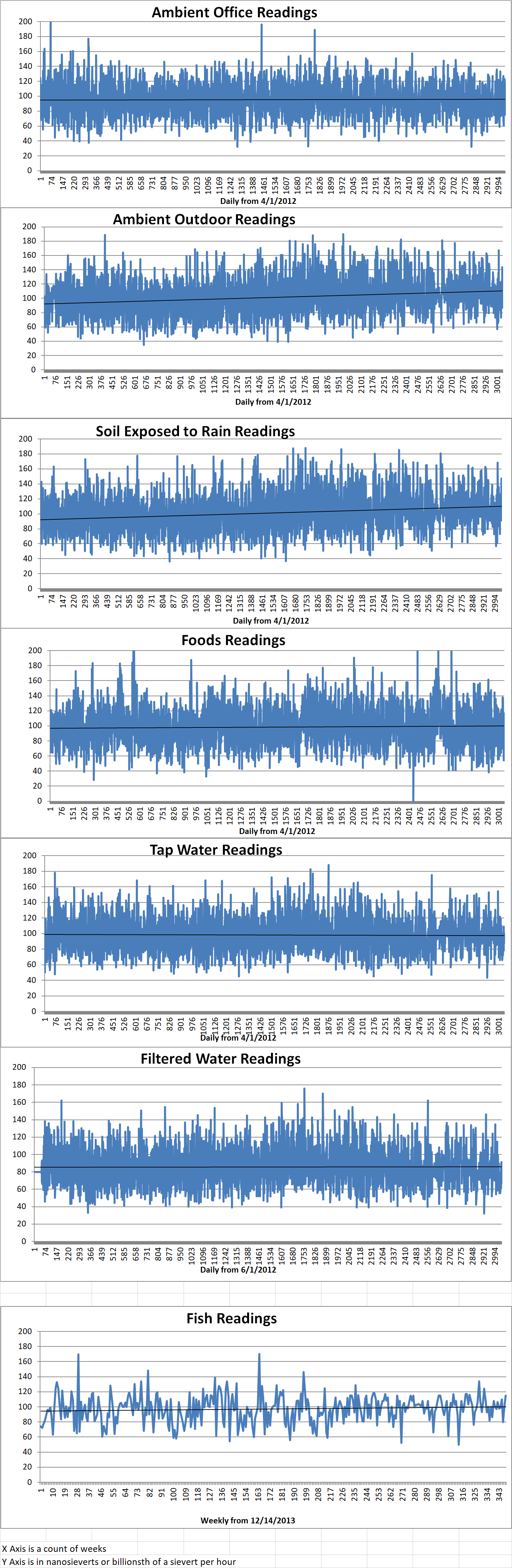
Geiger Readings for Oct 24, 2020
Ambient office = 95 nanosieverts per hour
Ambient outside = 87 nanosieverts per hour
Soil exposed to rain water = 91 nanosieverts per hour
Tomato from Central Market = 84 nanosieverts per hour
Tap water = 90 nanosieverts per hour
Filtered water = 70 nanosieverts per hour
Dover sole – Caught in USA = 115 nanosieverts per hour