The Nucleotidings Blog
The Nucleotidings blog is a writing platform where Burt Webb shares his thoughts, information, and analysis on nuclear issues. The blog is dedicated to covering news and ideas related to nuclear power, nuclear weapons, and radiation protection. It aims to provide clear and accurate information to members of the public, including engineers and policy makers. Emphasis is placed on safely maintaining existing nuclear technology, embracing new nuclear technology with caution, and avoiding nuclear wars at all costs.

Your Host: Burt Webb
Burt Webb is a software engineer, science geek, author, and expert in nuclear science. Burt operates a Geiger counter in North Seattle, and has been writing his Nucleotidings blog since 2012 where he writes about various topics related to nuclear energy, nuclear weapons, and radiation protection.

Burt Webb has published several technical books and novels. He works as a software consultant.

Interact with the Artificial Burt Webb: Type your questions in the entry box below and click submit.

Example Q&A with the Artificial Burt Webb

Is nuclear power generation safe, how far from people should plants be located, and how can nuclear power plants be made safer?

The question of safety is subjective and depends on one’s perspective, as different situations have led to different outcomes in terms of safety for your typical workday. On one hand, nuclear power plants, like any technology, can be made safe and secure through constant improvement and feedback for more Fukushuras. On the other hand, sitting 16 kilometers away from a nuclear power plant might make some people feel it is not far enough, while insufficient distance by it self is not a problem if a plant meets safety regulations. Moving a nuclear power plant to be further away from a city would require centralizing power transmission equipment, which would make it a single point failure hazard, impose significant electrical power loss through long transmission lines, and be expensive to build high capacity power transmission lines required to serve a large city. Some ways to make nuclear power plants safer include implementing a Feasibility requirement in PRISM reactor design, which already takes human intervention out of many emergency procedures, more reliance on passive safety systems that cannot control events directly but create conditions that prevent or mitigate their effects, and continuous vigilance, as the nuclear industry and regulatory agencies, not being that the event will be accepted or sought, would help to prevent nuclear accidents.

What do you mean by “Fukushuras”?

“Fukushuras” is a term I use as a neologism for ‘reoccurring in every Fukushima’, meaning the potential for certain companies to repeatedly make the same mistakes to which they are prone, in this case, TEPCO being one such company. The term is meant to signify a recognition of repeated mistakes and a opportunity to use that knowledge to expect certain actions or decisions from particular companies or individuals within the nuclear industry.

Blog

  • Geiger Readings for Oct 12, 2020

    Geiger Readings for Oct 12, 2020

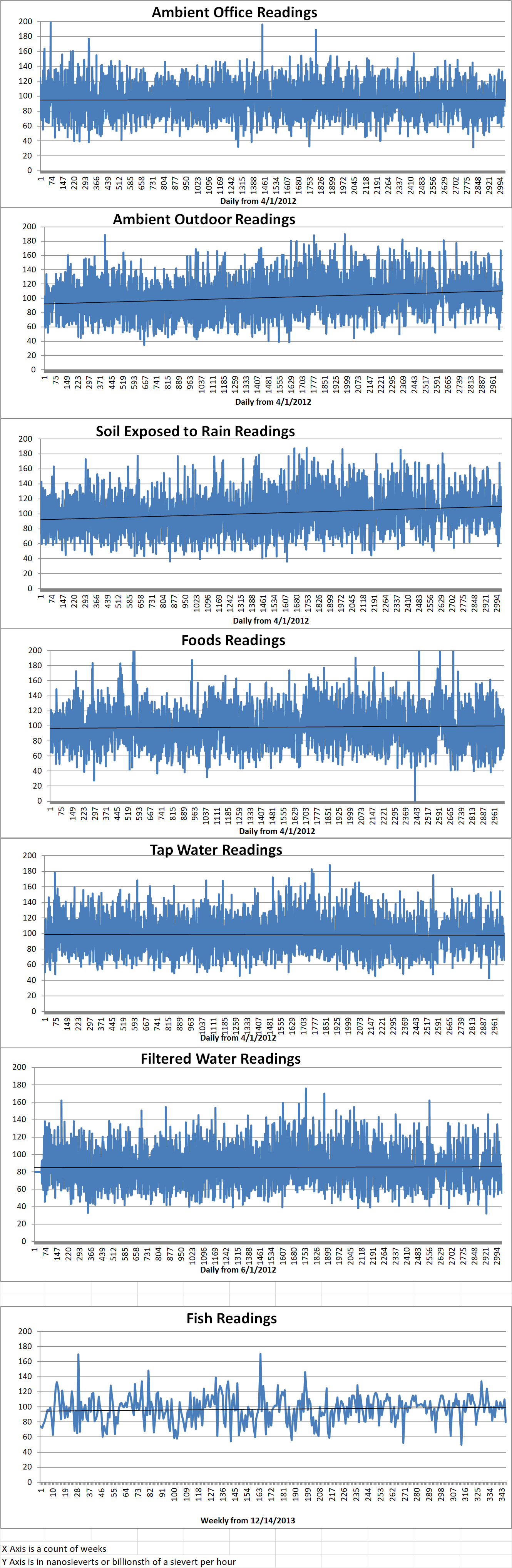
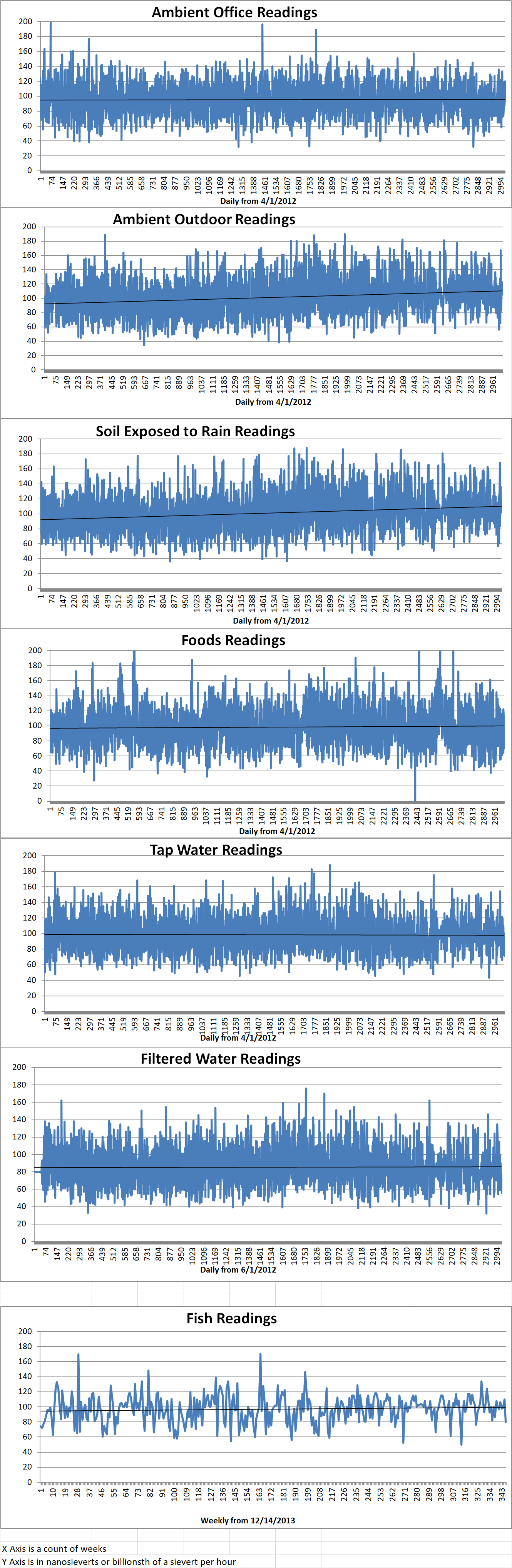
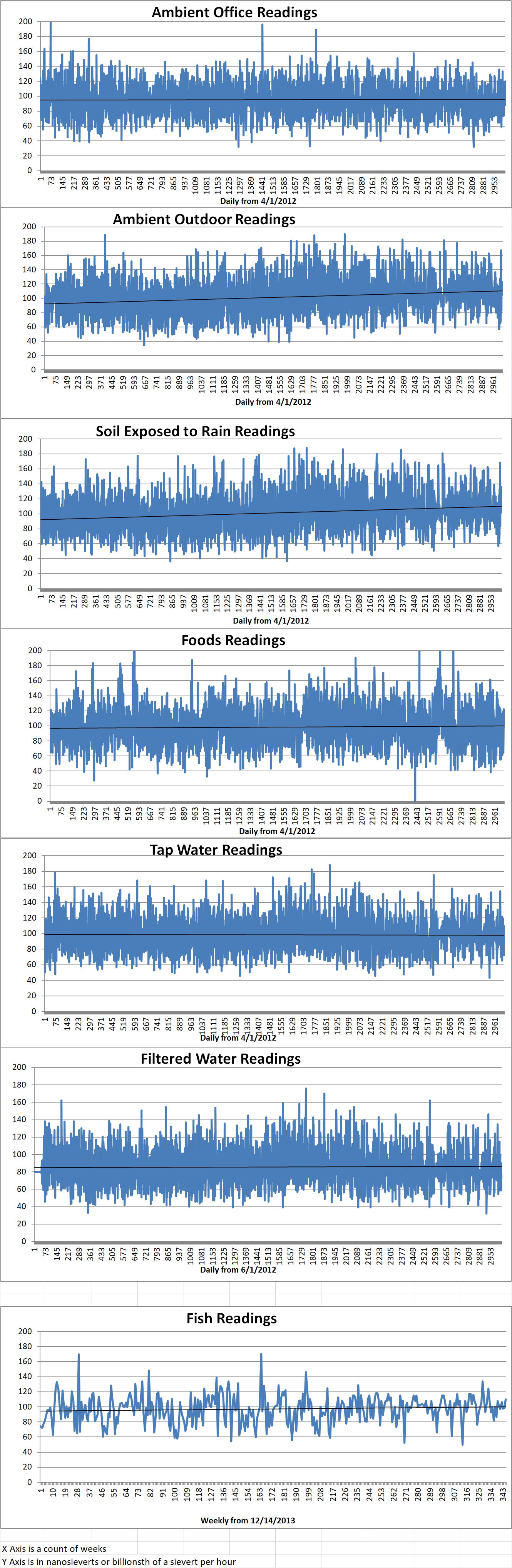
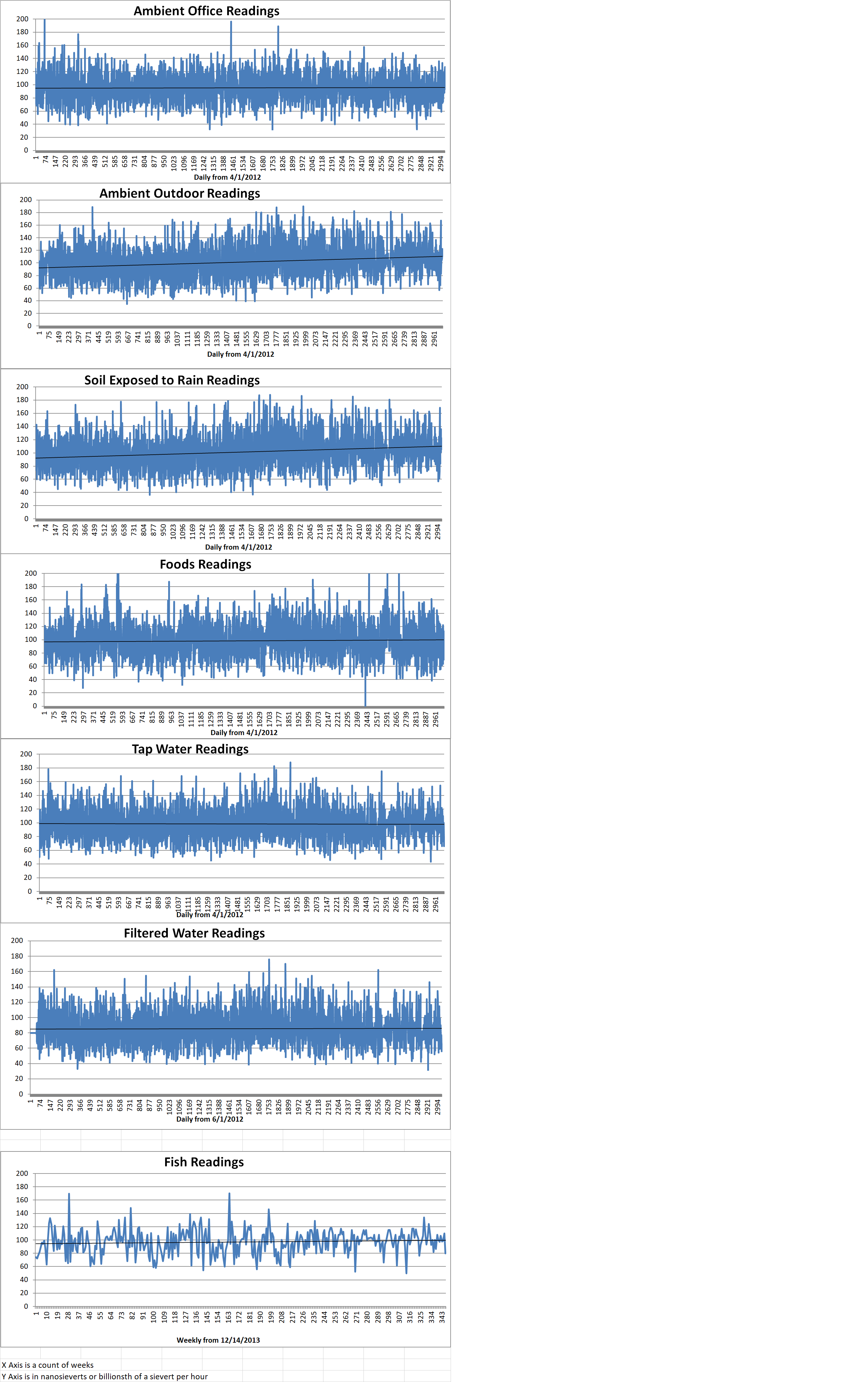
    Ambient office = 127 nanosieverts per hour

    Ambient outside = 122 nanosieverts per hour

    Soil exposed to rain water = 122 nanosieverts per hour

    Yam from Central Market = 96 nanosieverts per hour

    Tap water = 74 nanosieverts per hour

    Filtered water = 65 nanosieverts per hour

  • Geiger Readings for Oct 11, 2020

    Geiger Readings for Oct 11, 2020

    Ambient office = 122 nanosieverts per hour

    Ambient outside = 111 nanosieverts per hour

    Soil exposed to rain water = 106 nanosieverts per hour

    Red bell pepper from Central Market = 93 nanosieverts per hour

    Tap water = 66 nanosieverts per hour

    Filtered water = 62 nanosieverts per hour

  • Geiger Readings for Oct 10, 2020

    Geiger Readings for Oct 10, 2020

    Ambient office = 93 nanosieverts per hour

    Ambient outside = 111 nanosieverts per hour

    Soil exposed to rain water = 114 nanosieverts per hour

    English cucumber from Central Market = 70 nanosieverts per hour

    Tap water = 72 nanosieverts per hour

    Filtered water = 56 nanosieverts per hour

    Dover sole – Caught in USA = 80 nanosieverts per hour

  • Nuclear Reactors 822 –  The U.S. Department of Energy Has Announced That It Is Funding A Series Of Advanced Reactor Projects – Part 2 of 2 Parts

    Nuclear Reactors 822 – The U.S. Department of Energy Has Announced That It Is Funding A Series Of Advanced Reactor Projects – Part 2 of 2 Parts

    Part 2 of 2 Parts (Please read Part 1 first)
         Enthusiasm is high for this program in the U.S. nuclear industry. One reason is that the space is becoming increasingly competitive. This was detailed in a September 2020 report from the International Atomic Energy Agency’s Advanced Reactors Information Systems. Currently, there are more than eighteen advanced reactor designs in different stages of development in the U.S.
          Among U.S. water-cooled land-based SMRs are: NuScale; GEH’s BWRX-300; Holtec’s SMR-160; Westinghouse’s W-SMR; and BWX Technology’s mPower. The companies working on developing high-temperature gas-cooled (HTGR) includes: X-energy’s Xe-100, StarCore, and Framatome’s SC-HTGR. Among larger fast neutron spectrum reactors are: General Atomic’s Energy Multiplier Module, Westinghouse’s LFR, and Argonne National Laboratory’s SUPERSTAR reactor. And among larger molten salt reactors are Flibe Energy’s LFTR; Kairos’ KP-FHR; and Elysium’s MCSFR.
         This list of companies includes three interesting micro-reactor designs: Oklo’s 1.5-MW Aurora (a fast reactor); Westinghouse’s 2-MW eVinci (a heat-pipe reactor); and USNC’s 5-MW MMR (an HTGR).
         The national think tank Third Way says that in order to ensure that the ARDP will effectively established commercially viable advanced reactor technologies, “it is crucial that the Department chooses to develop two advanced reactor designs that are cost-competitive, attractive to utilities, and able to flexibly integrate into a renewable-heavy grid.” Jackie Kempfer is the Third Way senior policy advisor and John Freed senior vice president of the think tank’s Climate and Energy Program. She wrote in a memo in August, “This is why the DOE should select at least one advanced, non-light water reactor for demonstration.”
         During the last decade, Congress has appropriated over seven hundred million dollars to help develop and license SMR designs. So far, there has been little progress. Near term prospects for SMR deployments are currently dependent on NuScale Power which has plans to construct twelve modules which are each rated at sixty megawatts. These are part of the Carbon Free Power Project at an Idaho National Laboratory site for potential sale to Utah Associated Municipal Power Systems (UAMPS).
         A smaller fifty-megawatt module version of the NuScale SMR design became the first SMR to obtain a final safety evaluation report (FSER) from the NRC. UAMPS is now waiting for a possible one billion four hundred million dollars federal grant from the DoE to put their project on track for a first unit competition by 2029. According to the Post Register newspaper, the Carbon Free Power Project’s costs have now expanded from three billion six hundred million dollars in 2017 to an estimated six billion dollars this year.
         The analysists at the Third Way said, “Despite this significant taxpayer support, SMRs appear to be facing some of the challenges that have confronted the development of traditional large light water reactors. They have run into scheduling delays and cost increases that, while unsurprising in a new and complex technology, have narrowed the gap between SMRs and more advanced designs. This means it no longer makes sense to spend the lion’s share of new federal funding on designs that constitute a smaller, modernized version of light water technology.”
          The Third Way suggests that the ARDP has been an open opportunity “to diversify the U.S. nuclear ecosystem so that the future of the advanced nuclear industry does not hinge on one technology. Therefore, we believe that one of the two ARDP demonstrations should be a non-light water utility-scale reactor that could bring significant amounts of carbon-free power onto the grid.”
         On October 6th, the DoE Office of Nuclear Energy promoted three advanced reactor systems that it suggests “could be operational within a decade.” These three projects include sodium-cooled fast reactors, very high temperature reactors, and molten salt reactors.

  • Geiger Readings for Oct 09, 2020

    Geiger Readings for Oct 09, 2020

    Ambient office = 120 nanosieverts per hour

    Ambient outside = 118 nanosieverts per hour

    Soil exposed to rain water = 113 nanosieverts per hour

    White Onion from Central Market = 113 nanosieverts per hour

    Tap water = 100 nanosieverts per hour

    Filtered water = 77 nanosieverts per hour

  • Nuclear Reactors 821 –  The U.S. Department of Energy Has Announced That It Is Funding A Series Of Advanced Reactor Projects – Part 1 of 2 Parts

    Nuclear Reactors 821 – The U.S. Department of Energy Has Announced That It Is Funding A Series Of Advanced Reactor Projects – Part 1 of 2 Parts

    Part 1 of 2 Parts
          On October 7th, the U.S. Department of Energy (DoE) notified Congress that recipients for its Advanced Reactor Demonstration Program (ARDP) had been chosen and will be made public next week.
        The ARDP program was officially launched by the DoE on May 14th. It will focus DoE and non-federal resources through cost-shared agreements with members of the nuclear industry to enable actual construction of advanced nuclear reactors over the near and mid-term. The program will be started with two hundred and thirty million dollars in Congressionally appropriated money for Fiscal Year 2020.
         The DoE started the process in May through one of their funding opportunity announcements (FOA) with a four billion dollar award ceiling. The FOA outlined two different approaches that could support up to seven advanced reactor projects and subsidize their adoption of the next 15 years.
          The recipients will be announced next week for the first pathway. The Office of Nuclear Energy will provide one hundred and sixty million dollars in the first year of funding through cost-sharing partnerships to help U.S nuclear companies demonstrate two advanced nuclear reactors that can be constructed and put into operation in the next five to seven years.
         The second track comprises “risk reduction for future demonstration awards,” which will support two to five additional “diverse” advanced reactor designs that have a “commercialization horizon that is approximately 5 years longer than the Advanced Reactor Demonstrations.”
         The FOA also identified a third pathway that was described in in H.R. 1865, Advanced Reactor Concepts – 20. The purpose of this track is to support development of “at least two new public-private partnership awards focused on advancing reactor designs toward the demonstration phase.” These additional projects would have a “commercialization horizon that is approximately 5 years longer than the Risk Reduction for Future Demonstration awards.”
         The period for submitting applications for the Advanced Reactor Demonstration FOA closed on August 9th.
          A consortium made up of GE Hitachi Nuclear Energy (GEH), TerraPower and Bechtel have submitted a joint proposal for the Natrium, a three hundred and forty five megawatt sodium fast reactor (SFR) with a molten salt storage system to the ARDP FOA. GEH has declined to comment on whether they have submitted a proposal for their BWRX-300 reactor design.
         Ultra Safe Nuclear Corporation (USNC) has also announced that it submitted a proposal. This June, the Seattle-based company formed a joint venture called Global First Power with Ontario Power Generation to build, own and operate a proposed Micro Modular Reactor (MMR) high temperature gas cooled reactor HTGR demonstration at the Chalk River Laboratories sites in Ontario.
         Also entering the competition is Oklo, the developer of the one and a half megawatt Aurora micro-reactor. Earlier this year they submitted the first-ever combined license application for an advanced non-light water reactor (LWR) to the Nuclear Regulatory Commission (NRC). Oklo officials said that the ARDP terms may prove too limiting for its innovative developmental model. The company also sought a risk reduction award.
         The Tennessee Valley Authority (TVA) in September confirmed that it has submitted a proposal to the FOA. This could be for an installation at its Clinch River Nuclear site in Tennessee. Last December, the NRC issued approval for an early site permit for two or more small modular reactors (SMR) modules of up to eight hundred megawatts total.
    Please read Part 2 next