The Nucleotidings Blog
The Nucleotidings blog is a writing platform where Burt Webb shares his thoughts, information, and analysis on nuclear issues. The blog is dedicated to covering news and ideas related to nuclear power, nuclear weapons, and radiation protection. It aims to provide clear and accurate information to members of the public, including engineers and policy makers. Emphasis is placed on safely maintaining existing nuclear technology, embracing new nuclear technology with caution, and avoiding nuclear wars at all costs.

Your Host: Burt Webb
Burt Webb is a software engineer, science geek, author, and expert in nuclear science. Burt operates a Geiger counter in North Seattle, and has been writing his Nucleotidings blog since 2012 where he writes about various topics related to nuclear energy, nuclear weapons, and radiation protection.

Burt Webb has published several technical books and novels. He works as a software consultant.

Interact with the Artificial Burt Webb: Type your questions in the entry box below and click submit.

Example Q&A with the Artificial Burt Webb

Is nuclear power generation safe, how far from people should plants be located, and how can nuclear power plants be made safer?

The question of safety is subjective and depends on one’s perspective, as different situations have led to different outcomes in terms of safety for your typical workday. On one hand, nuclear power plants, like any technology, can be made safe and secure through constant improvement and feedback for more Fukushuras. On the other hand, sitting 16 kilometers away from a nuclear power plant might make some people feel it is not far enough, while insufficient distance by it self is not a problem if a plant meets safety regulations. Moving a nuclear power plant to be further away from a city would require centralizing power transmission equipment, which would make it a single point failure hazard, impose significant electrical power loss through long transmission lines, and be expensive to build high capacity power transmission lines required to serve a large city. Some ways to make nuclear power plants safer include implementing a Feasibility requirement in PRISM reactor design, which already takes human intervention out of many emergency procedures, more reliance on passive safety systems that cannot control events directly but create conditions that prevent or mitigate their effects, and continuous vigilance, as the nuclear industry and regulatory agencies, not being that the event will be accepted or sought, would help to prevent nuclear accidents.

What do you mean by “Fukushuras”?

“Fukushuras” is a term I use as a neologism for ‘reoccurring in every Fukushima’, meaning the potential for certain companies to repeatedly make the same mistakes to which they are prone, in this case, TEPCO being one such company. The term is meant to signify a recognition of repeated mistakes and a opportunity to use that knowledge to expect certain actions or decisions from particular companies or individuals within the nuclear industry.

Blog

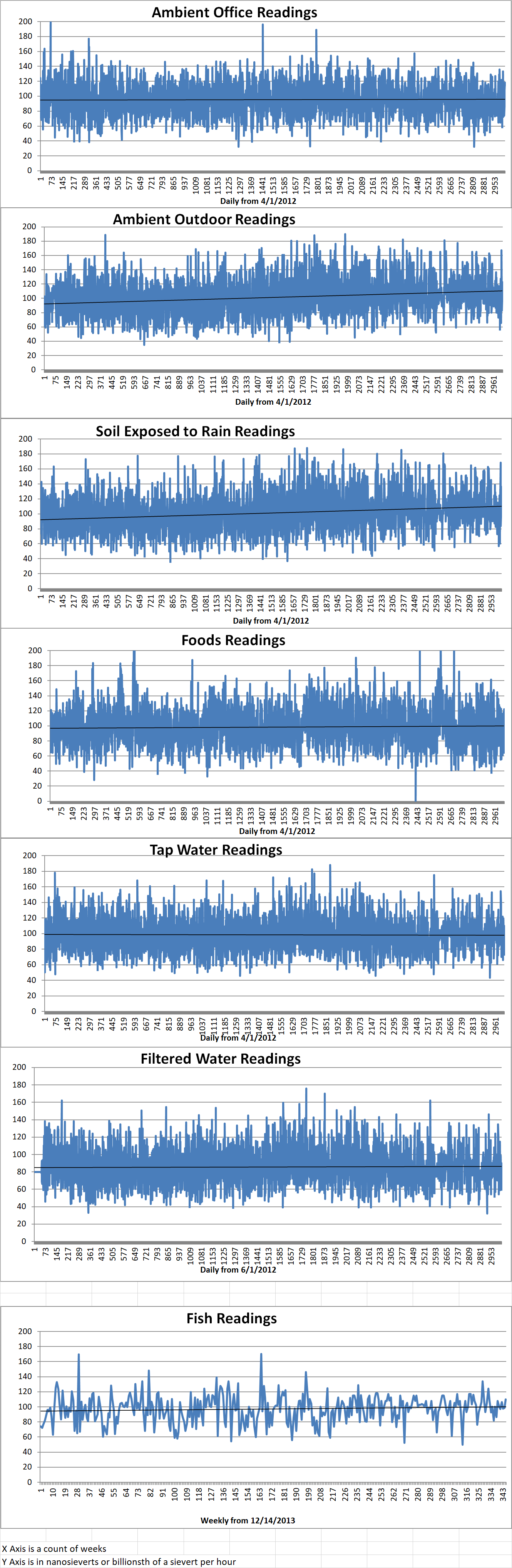
  • Geiger Readings for Oct 08, 2020

    Geiger Readings for Oct 08, 2020

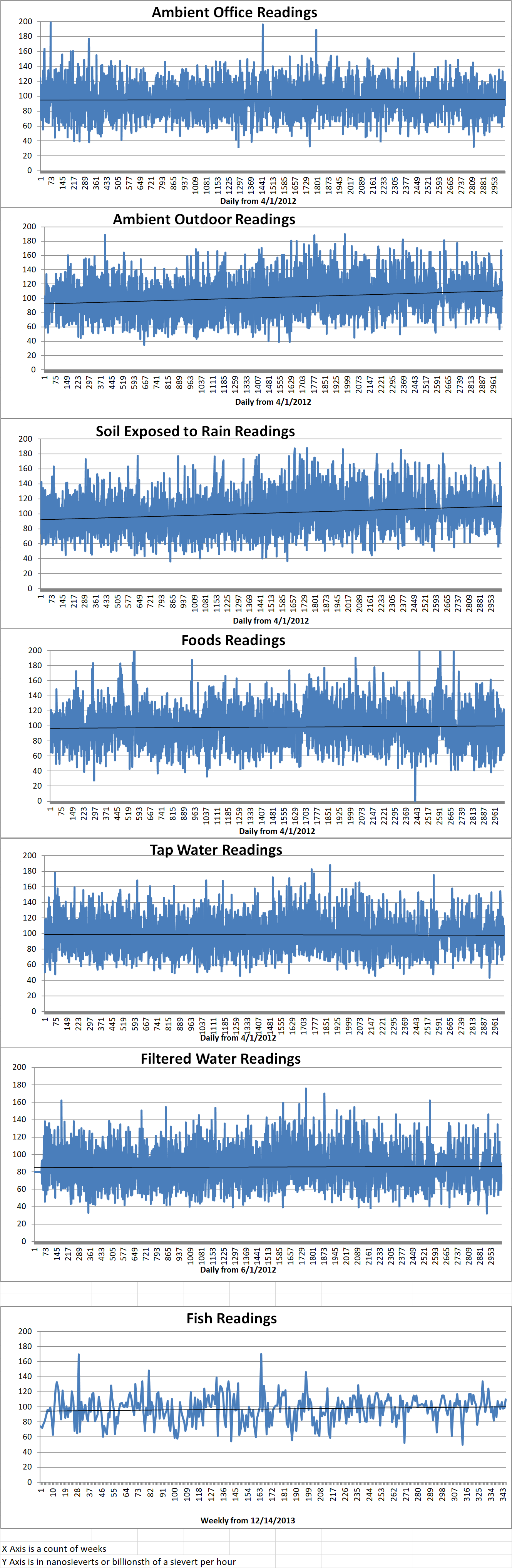
    Ambient office  = 119 nanosieverts per hour

    Ambient outside = 121 nanosieverts per hour

    Soil exposed to rain water = 119 nanosieverts per hour

    Blueberry from Central Market = 100 nanosieverts per hour

    Tap water = 87 nanosieverts per hour

    Filtered water = 77 nanosieverts per hour

  • Nuclear Reactors 820 – Samuel Laurence Foundation Petitions The Nuclear Regulatory Commission To Study Cancer Occurrence Near Nuclear Power Plants – Part 2 of 2

    Nuclear Reactors 820 – Samuel Laurence Foundation Petitions The Nuclear Regulatory Commission To Study Cancer Occurrence Near Nuclear Power Plants – Part 2 of 2

    Part 2 of 2 Parts (Please read Part 1 first)
         Brian Sheron is the retired director of the NRC’s Office of Nuclear Regulatory research and a supporter of the study commissioned in 2010. He commented in 2017 that “Most people realize that all the evidence shows you’re not going to find anything. There are so many variables. The point was, even if you found something that looked like a relationship, you wouldn’t know what to attribute it to. Did the person live their whole life near the nuclear plant? Or did they live somewhere downwind of an asbestos factory for 20 years? In order to get all the facts, it was going to be prohibitively expensive.”
          Ourania Kosti headed the aborted effort at the NAS. She said “You do not know whether the study will find something unless you do the study. The NRC asked us to do the study because of concerns of members of the public who live near the nuclear facilities it regulates. I think it is important to use the best information available to communicate with members of the public about risks.”
         More recent studies on this issue in Europe have found that children living withing three miles of a nuclear power plant have twice the risk of developing acute leukemia as children living father away. The peak impact is on children between the ages of two and four.
        The current theory of the effect of radioactivity on human health is called linear/no threshold. This means that the more radioactivity, the more danger to health. It also means that there is no minimum amount of radiation below which, the radioactivity is not a threat to health.
         Operators of nuclear power plants often say that the radioactivity of their emissions are in the same range as the naturally occurring radioactivity. That does raise questions about just how much radioactivity they are adding to the environment during normal operations. Even if they are only adding five or ten percent to the background radioactivity that still means that increases danger to health.
         The estimation of the release of radioactive emissions by nuclear power plants is based on an annual average. What is missing from this estimation is fact that nuclear power plants have to be refueled every eighteen to twenty four months. During refueling, the reactor has to be opened up which means there is a spike in emissions way above the annual average for as long as the reactor is open.
         Some studies for individual nuclear power plants have shown that there is evidence of increased cancers in people living near the plant. There is also some evidence of people working at nuclear power plants developing cancer and other illnesses potentially caused by exposure to radiation.
         It is true that this is a complex issue and there are many variables that have to be included. However, Considering the impact that cancer has on public health, it would seem that a few million dollars is a small price to pay to clarify this issue. Public health impact is a very important concern when power generation systems are being compared.

  • Geiger Readings for Oct 07, 2020

    Geiger Readings for Oct 07, 2020

    Ambient office  = 88 nanosieverts per hour

    Ambient outside = 106 nanosieverts per hour

    Soil exposed to rain water = 106 nanosieverts per hour

    Avocado from Central Market = 102 nanosieverts per hour

    Tap water = 93 nanosieverts per hour

    Filtered water = 73 nanosieverts per hour

  • 2239 – Nuclear Reactors 819 – Samuel Laurence Foundation Petitions The Nuclear Regulatory Commission To Study Cancer Occurrence Near Nuclear Power Plants – Part 1 of 2

    2239 – Nuclear Reactors 819 – Samuel Laurence Foundation Petitions The Nuclear Regulatory Commission To Study Cancer Occurrence Near Nuclear Power Plants – Part 1 of 2

    Part 1 of 2 Parts
         More than a decade ago, staffers at the NRC began asking for an update to an outdated 1990 study on the possibility that nuclear power plants caused increase rates of cancer in people who lived near the plant. The 1990 study was based on even older data. The NRC contracted with the National Academy of Sciences which is a separate federal agency. They request that the NAS design a modern scientific assessment in 2010.
         In 2010, the Nuclear Regulatory Commission (NRC) launched a pilot study to research the occurrence of cancer near nuclear power plants. It was intended to be the most comprehensive such study ever undertaken. The study was funded to the tune of eight million dollars. One and a half million dollars was spent but five years later in 2015, the project was killed because the NRC decided that it would ultimately be too expensive and that it would not be able to link cancer to nuclear power plants. Last week, a petition with twelve hundred signatures was presented to members of Congress from Southern and Central California demanding that the study be resumed.
         The petition states, “This is a scientific endeavor which will improve our understanding of cancer, the leading cause of death in California,” the petition states. “It is especially important for women, children, and the human fetus who are much more vulnerable to the biological effects of harmful ionizing radiation.”
          The petition went on to point out that the retired San Onofre and Diablo California nuclear power plants were both shut down in 2013. They had been discharging low-level radioactivity into the ocean and atmosphere for decades. No one knows for sure whether or not such discharges posed a threat to the health of people living nearby. The petition said, “The most recent research in the United States was carried out 29 years ago and is now considered heavily flawed and outdated. More recent studies in Europe have reported an increase in cancer risks for those living near nuclear power plants.”
         The Samuel Laurence Foundation (SLF) is a nonprofit that “strives to promote human interaction and encourage broader community access to science, education, and the arts.” It has been highly critical of what has happened at the San Onofre nuclear power plant as the plant is decommissioned. The SLF headed up the signature gathering effort for the petition.
         The petition was presented to U.S. Reps. Mike Levin, D-San Juan Capistrano; Katie Porter, D-Irvine; Harley Rouda, D-Laguna Beach; and Salud Carbajal, D-Santa Barbara. Levin said in a prepared statement, “I support investing in federal research to better understand cancer risks associated with nuclear facilities, and I’m proud that members of my San Onofre Task Force are leading this effort. This will be one of my priorities for future appropriations bills.” Rouda agreed with Levin. He said “We must study the health risks associated with proximity to SONGS and find long-term solutions to secure our nation’s nuclear waste. He mentioned that the three million six hundred thousand pounds of nuclear waste at San Onofre is only one hundred feet from the shoreline and sit on top of active fault lines. He considers it a serious threat to families in the area. To date, the NRC has declined to make any comment with respect to the petition.
    Please read Part 2 next

  • Geiger Readings for Oct 06, 2020

    Geiger Readings for Oct 06, 2020

    Ambient office  = 103 nanosieverts per hour

    Ambient outside = 106 nanosieverts per hour

    Soil exposed to rain water = 102 nanosieverts per hour

    Iceberg lettuce from Central Market = 110 nanosieverts per hour

    Tap water = 84 nanosieverts per hour

    Filtered water = 71 nanosieverts per hour

  • Nuclear Reactors 818 – University of Sussex Business School and the ISM International School of Management Study Found That Nuclear Power Is Not An Effective Carbon Emission Reducer

    Nuclear Reactors 818 – University of Sussex Business School and the ISM International School of Management Study Found That Nuclear Power Is Not An Effective Carbon Emission Reducer

        Researchers at the University of Sussex Business School, in Britain, and the ISM University of Management and Economics, in Lithuania, studied renewable energy projects and nuclear energy projects in one hundred and twenty countries in the last twenty five years and published their report Monday in the journal Nature Energy.
         The primary finding of the study was that countries with larger scale national nuclear installation do not tend to achieve significantly lower carbon emissions. In poorer countries, nuclear programs tend to be associated with relatively higher emissions. The report showed that nuclear and renewable energy programs do not tend to co-exist well together in national low-carbon energy systems. They crowd each other out and limit effectiveness.
         Benjamin K. Sovacool is the professor of Energy Policy in the Science Policy Research Unit (SPRU) at the University of Sussex Business School. He said, “The evidence clearly points to nuclear being the least effective of the two broad carbon emissions abatement strategies, and coupled with its tendency not to co-exist well with its renewable alternative, this raises serious doubts about the wisdom of prioritizing investment in nuclear over renewable energy. Countries planning large-scale investments in new nuclear power are risking suppression of greater climate benefits from alternative renewable energy investments.”
         The researchers used World Bank and International Energy Agency data for the period of 1990 to 2014. They discovered that nuclear and renewables tend to show lock-ins and path dependencies that crowd each out. They identified a variety of ways in which a combined nuclear and renewable energy mix is incompatible.
          One way they mutually interfere is that the configuration of electricity transmission and distribution systems where a grid structure is optimized for large scale centralized power production such as that found in conventional nuclear power systems will make it more difficult, time consuming and expensive to introduce small-scale distributed renewable energy sources.
         Another problem is that financial markets, regulatory institutions and employment practices that are developed around large-scale base-load, long-lead time construction projects dedicated to centralized thermal generating plants are not a very well designed to facility a multiplicity of much smaller shorter distributions initiatives.
          Andy Stirling is the Professor of Science and Technology Policy at the University of Sussex Business School. He said, “This paper exposes the irrationality of arguing for nuclear investment based on a ‘do everything’ argument. Our findings show not only that nuclear investments around the world tend on balance to be less effective than renewable investments at carbon emissions mitigation, but that tensions between these two strategies can further erode the effectiveness of averting climate disruption.”
         The Sussex study found that in countries which had a high GDP per capita, nuclear energy production is associated with a small drop in CO2 emissions. However, in comparative terms, this reduction is smaller than that which would be achieved with a move to renewable power. In countries with a low GDP per capita, nuclear electrical production is clearly associated with CO2 emissions being higher than those that result from the use of renewable energy sources.
         Patrick Schmid works at the ISM International School of Management München. He said, “While it is important to acknowledge the correlative nature of our data analysis, it is astonishing how clear and consistent the results are across different time frames and country sets. In certain large country samples the relationship between renewable electricity and CO2-emissions is up to seven times stronger than the corresponding relationship for nuclear.”

  • Geiger Readings for Oct 05, 2020

    Geiger Readings for Oct 05, 2020

    Ambient office  = 115 nanosieverts per hour

    Ambient outside = 123 nanosieverts per hour

    Soil exposed to rain water = 136 nanosieverts per hour

    Heirloom tomato from Central Market = 122 nanosieverts per hour

    Tap water = 73 nanosieverts per hour

    Filtered water = 60 nanosieverts per hour