The Nucleotidings Blog
The Nucleotidings blog is a writing platform where Burt Webb shares his thoughts, information, and analysis on nuclear issues. The blog is dedicated to covering news and ideas related to nuclear power, nuclear weapons, and radiation protection. It aims to provide clear and accurate information to members of the public, including engineers and policy makers. Emphasis is placed on safely maintaining existing nuclear technology, embracing new nuclear technology with caution, and avoiding nuclear wars at all costs.

Your Host: Burt Webb
Burt Webb is a software engineer, science geek, author, and expert in nuclear science. Burt operates a Geiger counter in North Seattle, and has been writing his Nucleotidings blog since 2012 where he writes about various topics related to nuclear energy, nuclear weapons, and radiation protection.

Burt Webb has published several technical books and novels. He works as a software consultant.

Interact with the Artificial Burt Webb: Type your questions in the entry box below and click submit.

Example Q&A with the Artificial Burt Webb

Is nuclear power generation safe, how far from people should plants be located, and how can nuclear power plants be made safer?

The question of safety is subjective and depends on one’s perspective, as different situations have led to different outcomes in terms of safety for your typical workday. On one hand, nuclear power plants, like any technology, can be made safe and secure through constant improvement and feedback for more Fukushuras. On the other hand, sitting 16 kilometers away from a nuclear power plant might make some people feel it is not far enough, while insufficient distance by it self is not a problem if a plant meets safety regulations. Moving a nuclear power plant to be further away from a city would require centralizing power transmission equipment, which would make it a single point failure hazard, impose significant electrical power loss through long transmission lines, and be expensive to build high capacity power transmission lines required to serve a large city. Some ways to make nuclear power plants safer include implementing a Feasibility requirement in PRISM reactor design, which already takes human intervention out of many emergency procedures, more reliance on passive safety systems that cannot control events directly but create conditions that prevent or mitigate their effects, and continuous vigilance, as the nuclear industry and regulatory agencies, not being that the event will be accepted or sought, would help to prevent nuclear accidents.

What do you mean by “Fukushuras”?

“Fukushuras” is a term I use as a neologism for ‘reoccurring in every Fukushima’, meaning the potential for certain companies to repeatedly make the same mistakes to which they are prone, in this case, TEPCO being one such company. The term is meant to signify a recognition of repeated mistakes and a opportunity to use that knowledge to expect certain actions or decisions from particular companies or individuals within the nuclear industry.

Blog

  • Geiger Readings for Sep 16, 2020

    Geiger Readings for Sep 16, 2020

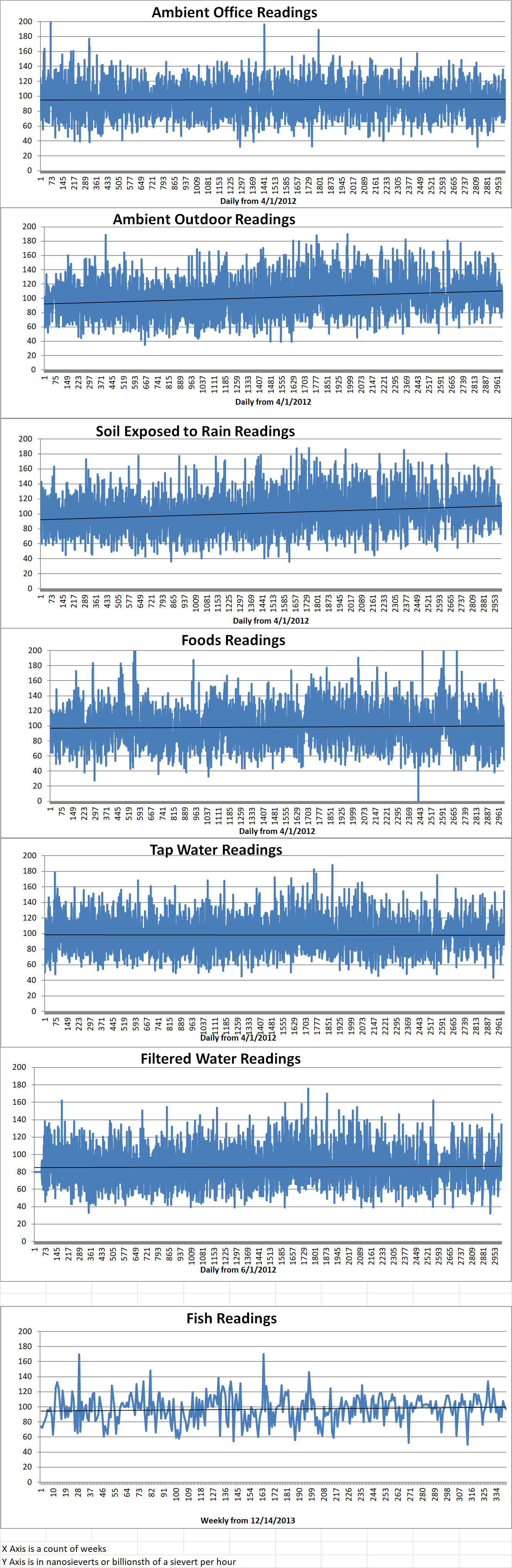
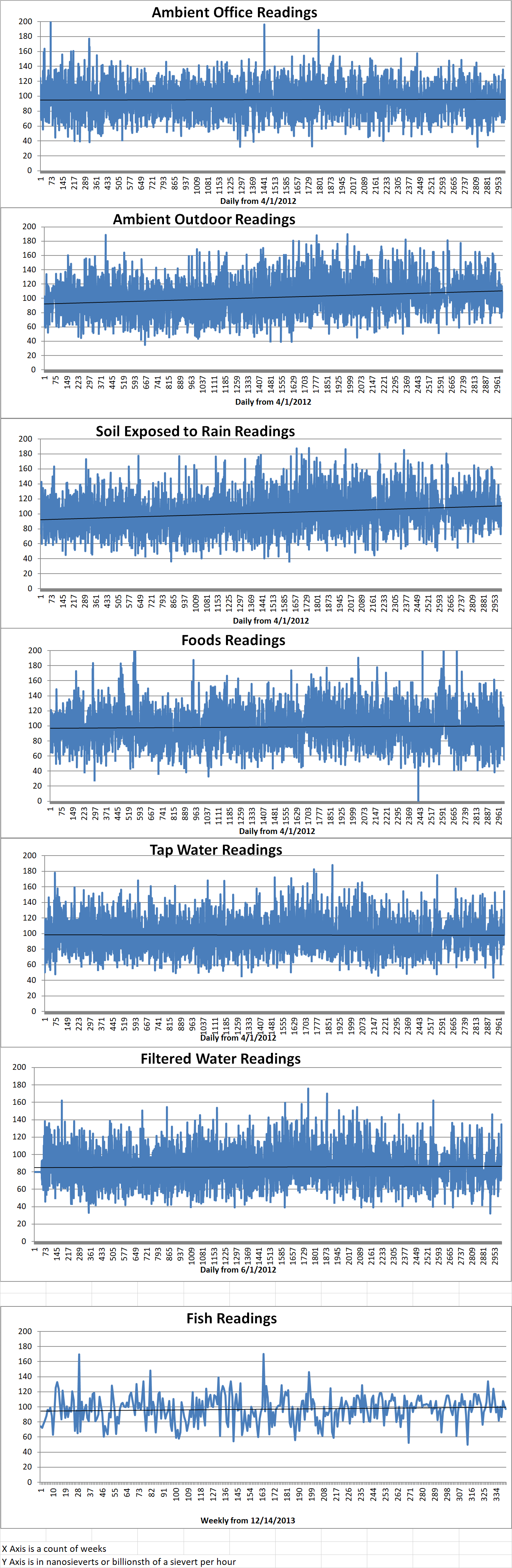
    Ambient office  = 59 nanosieverts per hour

    Ambient outside = 80 nanosieverts per hour

    Soil exposed to rain water = 87 nanosieverts per hour

    Bartlett pear from Central Market = 100 nanosieverts per hour

    Tap water = 116 nanosieverts per hour

    Filtered water = 100 nanosieverts per hour
  • Nuclear Reactors 811 – Recommendations For Improving Attraction Of Investments In Nuclear Power Generation – Part 2 of 3 Parts

    Nuclear Reactors 811 – Recommendations For Improving Attraction Of Investments In Nuclear Power Generation – Part 2 of 3 Parts

    Part 2 of 3 Parts (Please read Part 1 first)
          Jostein Kristensen outlined to the Driving investment towards nuclear projects panel the various ways that new nuclear build projects may be financed.
          The traditional approach for financing new nuclear projects has involved participation with government through public ownership of nuclear power plants. Understanding such utility infrastructure as a strategic asset in the current context of decarbonization is a serious challenge. He said that it may seem hard to justify state involvement in a new nuclear build when the cost of other low-carbon generation technology such as renewable is falling rapidly while there is a widespread perception that the costs in the nuclear sector are not going down. A challenge to public finance in some countries comes from recent experience of macroeconomic developments connected with financial crises. The coronavirus pandemic has introduced an “an entirely new dimension” with regard to macroeconomic risks.
          A second financing model for nuclear power is for utilities to finance nuclear plants. However, competition in the electricity markets has “weighed down on the balance sheet capacity” of some nuclear utility companies in the past fifteen years, Kristensen said. In addition, some of these companies are focusing on decarbonization through renewables. The result of these factors is that the nuclear industry is unlikely to see as much investment in this method of financing as in the past.
         A third model of nuclear financing which is often used for energy infrastructure in general is signing long-term contracts between generators and their customers. Sometimes it is “difficult to reconcile” having a relatively small number of very large energy-intensive users with very long-term contracts for the offtake of power from nuclear generating plants with liberalized market arrangements. Also, contract disputes can be hard to resolve and as such might not be an attractive basis for future investment.
          A fourth model is based on government support mechanisms that enable private finance. These can include feed-in tariffs and contract-for-difference. However, the construction risk is still mostly borne by the developer, said Kristensen. The inconsistency in government commitment to nuclear generation means that such incentives may be changed or not repeated. Thus, it can be difficult to rely on support schemes being in place in the way that they were originally envisaged in the long-term. Market arrangements can also change “very dramatically”, which can result in a significant impact on the business case of new builds as well.
         The regulated asset base (RAB) model has great potential according to Kristensen because there are a lot of infrastructure investors or pension funds seeking to place their money in long-term assets. These investors have “a more patient attitude” towards the capital allocation and are quite familiar with this model in other sectors.
          One major problem for any investor considering investment in nuclear power projects lies in the fact that a single accident at a nuclear facility anywhere in the world can impact nuclear power plants everywhere in the world which can suddenly imperil their investment.
    Please read Pa
    rt 3 next

  • Geiger Readings for Sep 15, 2020

    Geiger Readings for Sep 15, 2020

    Geiger Readings for Sep 15, 2020
    Latitude 47.704656 Longitude -122.318745
    Nuclear News Roundup Sep 15, 2020

    Sep 15

    Ambient office  = 96 nanosieverts per hour

    Ambient outside = 80 nanosieverts per hour

    Soil exposed to rain water = 84 nanosieverts per hour

    New potato from Central Market = 70 nanosieverts per hour

    Tap water = 100 nanosieverts per hour

    Filtered water = 93 nanosieverts per hour

  • Nuclear Reactors 810 – Recommendations For Improving Attraction Of Investments In Nuclear Power Generation – Part 1 of 3 Parts

    Nuclear Reactors 810 – Recommendations For Improving Attraction Of Investments In Nuclear Power Generation – Part 1 of 3 Parts

    Part 1 of 3 Parts
          Jostein Kristensen is a partner with the economic consultancy firm Oxera. He addressed participants in the World Nuclear Association’s Strategic eForum last week as a member of the high-level panel titled Driving investment towards nuclear projects which was convened on the 10th of September. He said that energy markets currently do not reflect the value of nuclear power as a sustainable and reliable source of energy in the fight against climate change. His recommendation was that the nuclear industry should work closely with policymakers on the design of market mechanisms that can produce what he calls a clear price signal that will attract investors to this low-carbon form of electrical generation. He presented his analysis of three challenges which currently confront the nuclear industry.
         The first problem that Kristensen mentioned was inconsistent commitment by governments with respect to nuclear generating technologies which can serve to make investment conditions very uncertain and result in the failure to achieve economies of scale for the nuclear generation sector. This means that the ability to lower costs over the long term is “a chance that might be missed”.
         The second problem that Kristensen discussed was that nuclear generation is a “long lived asset” that also has some significant long-term liabilities. These liabilities are likely to require some risk transfer from the private sector to the public sector. This is particularly true regarding nuclear waste management and disposal. Establishing these kinds of regulatory and contractual arrangement can definitely be difficult to achieve and also quite time consuming according to Kristensen.
         The third problem that Kristensen described regards market arrangements that are put into place for the pricing of electricity that do not necessarily reflect the true underlying costs and benefits of different technologies or at least their costs and benefits to the overall energy marketplace. These issues include grid and balancing costs and ensuring that there is enough backup generation to handle demands. He said, “All of these things together imply that the value for money of nuclear generation, as compared to other competing generation technologies, may not be fully reflected in market prices.”
          Policymakers must play a crucial role to make improvements in this situations, Kristensen said, “It’s vital that the nuclear industry provides a clear and credible case for nuclear generation benefits to the systems in which the nuclear plants operate over the long run. One of the key things that can be done would be to ensure that the nuclear sector pulls together and provides the mechanisms, and develops the procedures and arrangements that will enable the sector to reduce costs and to also reduce the risk of cost overruns in the long term. Achieving that ultimately requires cooperation with governments, particularly in relation to financing arrangements. The financing considerations will be the key area for the nuclear sector to improve upon in future.”
         Unfortunately, appealing to government to solve all these outstanding problems with nuclear power generation may be a futile exercise. There are influences on legislators and government official that are not restricted to science and long term social and economic planning.
    Please read Part 2 next

  • Geiger Readings for Sep 14, 2020

    Geiger Readings for Sep 14, 2020

    Ambient office  = 88 nanosieverts per hour

    Ambient outside = 81 nanosieverts per hour

    Soil exposed to rain water = 91 nanosieverts per hour

    Blueberry from Central Market = 123 nanosieverts per hour

    Tap water = 88 nanosieverts per hour

    Filtered water = 82 nanosieverts per hour

  • Geiger Readings for Sep 13, 2020

    Geiger Readings for Sep 13, 2020

    Ambient office  = 70 nanosieverts per hour

    Ambient outside = 105 nanosieverts per hour

    Soil exposed to rain water = 114 nanosieverts per hour

    Red bell pepper from Central Market = 103 nanosieverts per hour

    Tap water = 138 nanosieverts per hour

    Filtered water = 121 nanosieverts per hour