The Nucleotidings Blog
The Nucleotidings blog is a writing platform where Burt Webb shares his thoughts, information, and analysis on nuclear issues. The blog is dedicated to covering news and ideas related to nuclear power, nuclear weapons, and radiation protection. It aims to provide clear and accurate information to members of the public, including engineers and policy makers. Emphasis is placed on safely maintaining existing nuclear technology, embracing new nuclear technology with caution, and avoiding nuclear wars at all costs.

Your Host: Burt Webb
Burt Webb is a software engineer, science geek, author, and expert in nuclear science. Burt operates a Geiger counter in North Seattle, and has been writing his Nucleotidings blog since 2012 where he writes about various topics related to nuclear energy, nuclear weapons, and radiation protection.

Burt Webb has published several technical books and novels. He works as a software consultant.

Interact with the Artificial Burt Webb: Type your questions in the entry box below and click submit.

Example Q&A with the Artificial Burt Webb

Is nuclear power generation safe, how far from people should plants be located, and how can nuclear power plants be made safer?

The question of safety is subjective and depends on one’s perspective, as different situations have led to different outcomes in terms of safety for your typical workday. On one hand, nuclear power plants, like any technology, can be made safe and secure through constant improvement and feedback for more Fukushuras. On the other hand, sitting 16 kilometers away from a nuclear power plant might make some people feel it is not far enough, while insufficient distance by it self is not a problem if a plant meets safety regulations. Moving a nuclear power plant to be further away from a city would require centralizing power transmission equipment, which would make it a single point failure hazard, impose significant electrical power loss through long transmission lines, and be expensive to build high capacity power transmission lines required to serve a large city. Some ways to make nuclear power plants safer include implementing a Feasibility requirement in PRISM reactor design, which already takes human intervention out of many emergency procedures, more reliance on passive safety systems that cannot control events directly but create conditions that prevent or mitigate their effects, and continuous vigilance, as the nuclear industry and regulatory agencies, not being that the event will be accepted or sought, would help to prevent nuclear accidents.

What do you mean by “Fukushuras”?

“Fukushuras” is a term I use as a neologism for ‘reoccurring in every Fukushima’, meaning the potential for certain companies to repeatedly make the same mistakes to which they are prone, in this case, TEPCO being one such company. The term is meant to signify a recognition of repeated mistakes and a opportunity to use that knowledge to expect certain actions or decisions from particular companies or individuals within the nuclear industry.

Blog

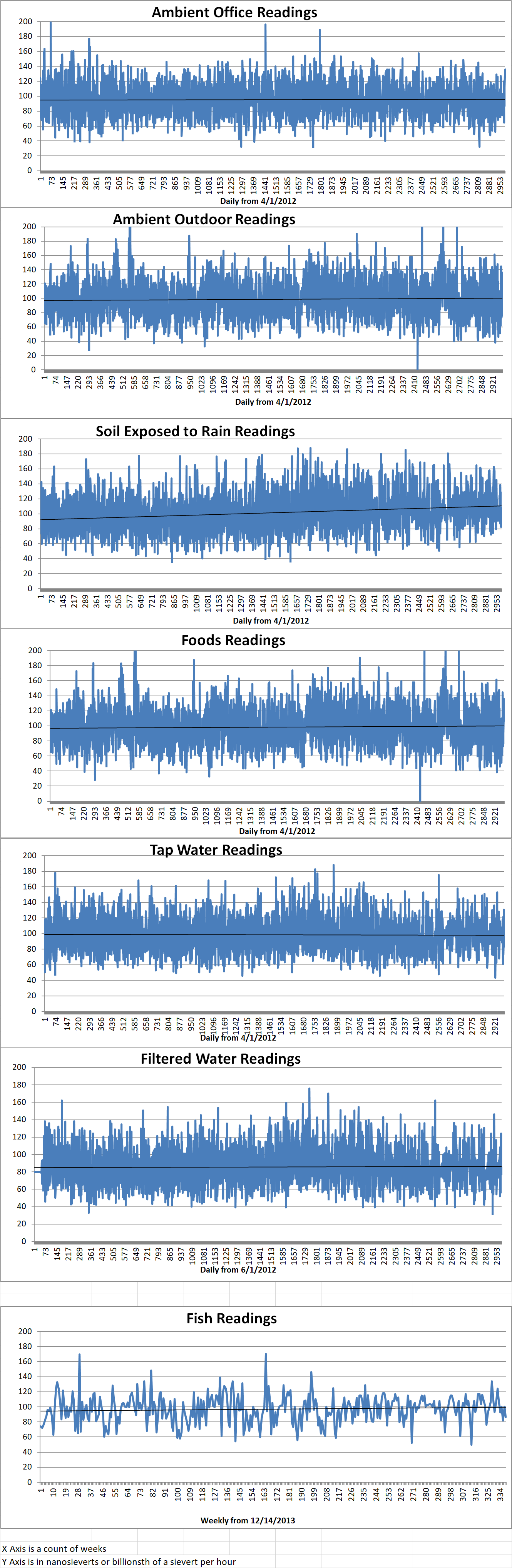
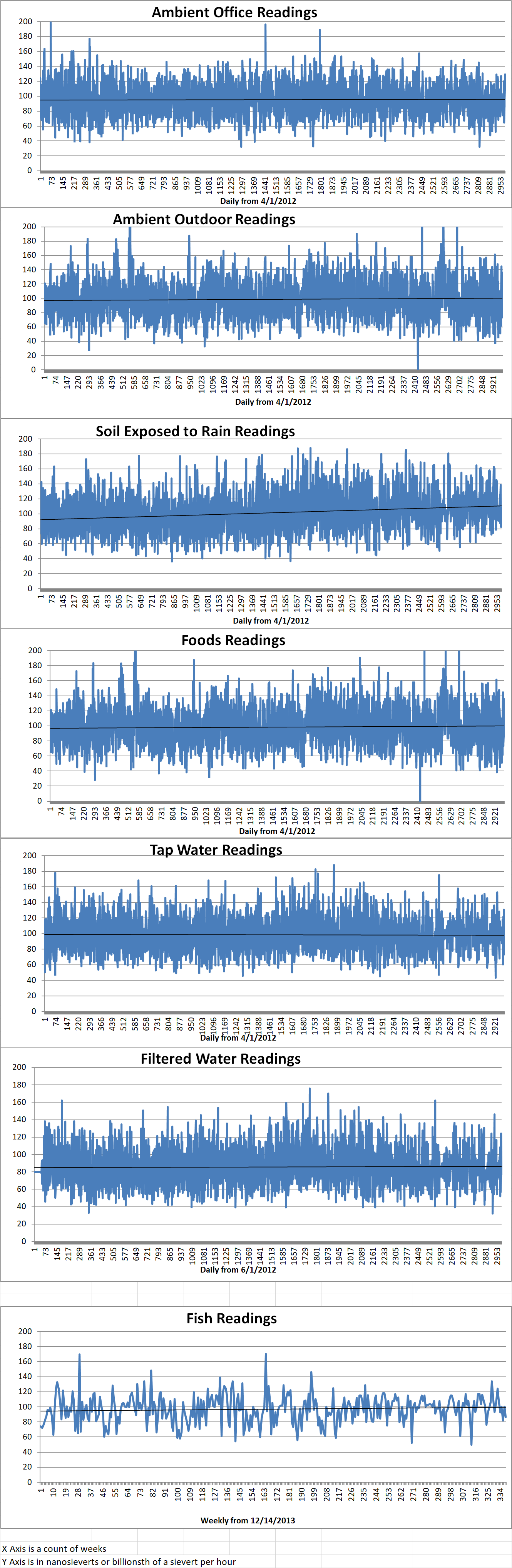
  • Geiger Readings for Sep 01, 2020

    Geiger Readings for Sep 01, 2020

    Ambient office  = 96 nanosieverts per hour

    Ambient outside = 106 nanosieverts per hour

    Soil exposed to rain water = 106 nanosieverts per hour

    Red bell pepper from Central Market = 128 nanosieverts per hour

    Tap water = 94 nanosieverts per hour

    Filtered water = 72 nanosieverts per hour

  • Geiger Readings for Aug 31, 2020

    Geiger Readings for Aug 31, 2020

    Ambient office  = 102 nanosieverts per hour

    Ambient outside = 119 nanosieverts per hour

    Soil exposed to rain water = 123 nanosieverts per hour

    Russet potato from Central Market = 74 nanosieverts per hour

    Tap water = 89 nanosieverts per hour

    Filtered water = 72 nanosieverts per hour

  • Geiger Readings for Aug 30, 2020

    Geiger Readings for Aug 30, 2020

    Ambient office  = 136 nanosieverts per hour

    Ambient outside = 98 nanosieverts per hour

    Soil exposed to rain water = 99 nanosieverts per hour

    Vine ripened tomato from Central Market = 115 nanosieverts per hour

    Tap water = 101 nanosieverts per hour

    Filtered water = 81 nanosieverts per hour

  • Nuclear Fusion 108 – Researchers Are Working On Reverse Field Configuration Designs For Nuclear Fusion  – Part 6 of 6 Part

    Nuclear Fusion 108 – Researchers Are Working On Reverse Field Configuration Designs For Nuclear Fusion – Part 6 of 6 Part

    Part 6 of 6 Parts (Please read Part 1, 2, 3, 4 and 5 first)
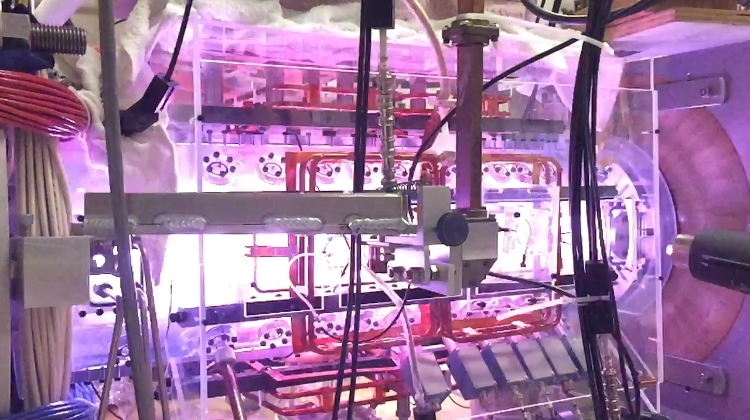
         Cohen has been working on his Princeton Field Reversed Configuration (PFRC) design since 2002. He places great importance on simplicity and compactness. The cylindrical plastic chamber of his current prototype labeled PFRC-2 is only about a yard long. There are no plasma cannons or neutral beam injectors. Instead, the FRC is generated by a technique first investigated by Austrian and Australian physicists and refined by Cohen.
        Cohen has four rectangular copper coils that surround the middle of the tube, one each for its front, back, top and bottom. Each rectangle is divided into two smaller rectangles. The basic concept of the arrangement is to drive oscillating currents through these coils in a way that sets up a rotating magnetic field inside the tube. A loop of flux whirls around through the plasma and drags the plasma particles around and around in the center of the cylinder. Cohen says that “the fields create, stabilize, and heat the FRC.”
         Cohen routinely demonstrates the basic concept in his lab. Every two second, the hydrogen plasma is spun into a FRC which causes a flash of light. Each flash lasts for about eight milliseconds because extending the flash any longer risks melting the cables that supply the magnetic coils with power. He says that they have to make better cables which will allow them to keep the FRC going indefinitely. 
         In the meantime, Cohen and his team are working on the main goal of the PFRC-2 prototype which is to improve the ability of the magnetic coils to heat the plasma. Binderbauer says, “I know Sam well, we root for each other. But his plasma are cold.” He goes on to say that it still remains to be seen whether or not the rotating magnetic fields approach will work in a full-scale fusion reactor. He said, “I’m not trying to say that it can’t be done, but I think those are some of the things that they’re going to have to address.”
         Cohen remains confident about the TAE approach. If things go as planned in the next few years, the PFRC-2 will be replaced by the PFRC-3 which will be twice as big. This new machine should allow them to keep FRCs going for up to ten seconds with plasma temperatures as high as sixty million degrees Kelvin. A few years after that, the plan calls for developing the PFRC-4 which will be even larger and will be designed to use live fusion fuel at temperatures of six hundred million degrees Kelvin.
         The fuel that will be burned in the PFRC-4 will be deuterium-helium-3 which Cohen calls the “Goldilocks approach” between deuterium-tritium and proton-boron-11. Helium-3 is extremely rare on Earth although a tiny amount is produced during natural gas extraction and during the operation of nuclear fission reactors. It is possible to make and capture helium-3 from the fusing of deuterium-helium but Cohen and his team will not attempt it at this stage. He feels that there will be enough helium-3 available to use for powering spacecrafts with his fusion engine.
         It will be another ten to fifteen years before PFRC-based fusions reactors are reliable enough to sustain a multi-year deep-space mission, assuming that they work at all. But, the same thing could be said about any of the alternative nuclear fusion reactor designs currently being worked on.
    Princeton Field Reversed Configuration 2

  • Geiger Readings for Aug 29, 2020

    Geiger Readings for Aug 29, 2020

    Ambient office  = 129 nanosieverts per hour

    Ambient outside = 105 nanosieverts per hour

    Soil exposed to rain water = 108 nanosieverts per hour

    English cucumber from Central Market = 107 nanosieverts per hour

    Tap water = 95 nanosieverts per hour

    Filtered water = 85 nanosieverts per hour

    Dover sole – Caught in USA = 100 nanosieverts per hour

  • Nuclear Fusion 107 – Researchers Are Working On Reverse Field Configuration Designs For Nuclear Fusion  – Part 5 of 6 Parts

    Nuclear Fusion 107 – Researchers Are Working On Reverse Field Configuration Designs For Nuclear Fusion – Part 5 of 6 Parts

    Part 5 of 6 Parts (Please read Part 1, 2, 3 and 4 first)
           In order to achieve fusion power generation through the proton-boron-11 fuel, TAE was challenged with developing an advanced design for their reactor. They chose to cap their reactor at both ends with electromagnetic cannons with their barrels pointing at each other. To start the process, each of the cannons fires a ring of plasma into a central chamber. The rings of plasma merge into a single, rapidly spinning FRC. Next, a beam of neutral atoms is fired into the center of the chamber from the side. This heats up the plasma, supplies it with more proton-boron-11 fuel and helps to stabilize the plasma by maintaining the spin rate.
           TAE demonstrated a prototype of their reactor design in 2012. This demonstration only involved hydrogen so there was no fusion. Michl Binderbauer is the CEO of TAE. He said, “We showed these beautiful experiments where, if you start with the standard FRC and you don’t do anything, it dies. But if you start injecting particles, you slow down the decay and expand how long it lives.” He went on to say that TAE has demonstrated that this process can sustain the FRC for the five to ten milliseconds needed for the twenty-five megawatt beam to exhaust the energy that the researchers have stored for each shot.
           In an actual functioning fusion reactor, the power beam would be generated by the fusion reaction itself, so the beam and FRC would keep functioning as long as desired. TAE hopes to reach that milestone with a proton-boron-11 fuel mixture before the end of the 2020s. This machine will be about the size of four double-decker busses parked end to end. That may not seem so small, but it is tiny compared to the ITER.
         In Bellevue, Washington, there is another company exploring fusion reaction design based on the FRC approach. Helion Energy was founded by researchers from the University of Washington in Seattle in 2013. Helion officials are not currently discussing their plans publicly but they have been forthcoming about their approach on their website and in their publications.
         Helion’s fusion reactor will be a linear tube that uses twin plasma guns to form a stationary FRC in a chamber in the middle. Instead of trying to sustain the FRC as in the TAE reactor, they will compress it with a huge magnetic field until the plasma has been heated and compressed enough for fusion to take place. The burst of thermonuclear energy will then cause the ball of plasma to explode outward which will push against the magnetic field and generate energy. This cycle will repeat once a second, generating a steady average power output similar to the way an internal combustion engine functions.
          The Helion reactor burns a different fuel than the TAE reactor. Instead of using proton-boron-11 fuel, the Helion reactor will burn deuterium-helium-3. This isotope of helium is called a “helion” which is where the company got its name. The reaction requires a temperature of several hundred million degrees which is midway between the temperature requirements of deuterium-tritium and proton-boron-11 fuels. 
    Please read Part 6 next