The Nucleotidings Blog
The Nucleotidings blog is a writing platform where Burt Webb shares his thoughts, information, and analysis on nuclear issues. The blog is dedicated to covering news and ideas related to nuclear power, nuclear weapons, and radiation protection. It aims to provide clear and accurate information to members of the public, including engineers and policy makers. Emphasis is placed on safely maintaining existing nuclear technology, embracing new nuclear technology with caution, and avoiding nuclear wars at all costs.

Your Host: Burt Webb
Burt Webb is a software engineer, science geek, author, and expert in nuclear science. Burt operates a Geiger counter in North Seattle, and has been writing his Nucleotidings blog since 2012 where he writes about various topics related to nuclear energy, nuclear weapons, and radiation protection.

Burt Webb has published several technical books and novels. He works as a software consultant.

Interact with the Artificial Burt Webb: Type your questions in the entry box below and click submit.

Example Q&A with the Artificial Burt Webb

Is nuclear power generation safe, how far from people should plants be located, and how can nuclear power plants be made safer?

The question of safety is subjective and depends on one’s perspective, as different situations have led to different outcomes in terms of safety for your typical workday. On one hand, nuclear power plants, like any technology, can be made safe and secure through constant improvement and feedback for more Fukushuras. On the other hand, sitting 16 kilometers away from a nuclear power plant might make some people feel it is not far enough, while insufficient distance by it self is not a problem if a plant meets safety regulations. Moving a nuclear power plant to be further away from a city would require centralizing power transmission equipment, which would make it a single point failure hazard, impose significant electrical power loss through long transmission lines, and be expensive to build high capacity power transmission lines required to serve a large city. Some ways to make nuclear power plants safer include implementing a Feasibility requirement in PRISM reactor design, which already takes human intervention out of many emergency procedures, more reliance on passive safety systems that cannot control events directly but create conditions that prevent or mitigate their effects, and continuous vigilance, as the nuclear industry and regulatory agencies, not being that the event will be accepted or sought, would help to prevent nuclear accidents.

What do you mean by “Fukushuras”?

“Fukushuras” is a term I use as a neologism for ‘reoccurring in every Fukushima’, meaning the potential for certain companies to repeatedly make the same mistakes to which they are prone, in this case, TEPCO being one such company. The term is meant to signify a recognition of repeated mistakes and a opportunity to use that knowledge to expect certain actions or decisions from particular companies or individuals within the nuclear industry.

Blog

  • Geiger Readings for Aug 06, 2020

    Geiger Readings for Aug 06, 2020

    Ambient office  = 97 nanosieverts per hour

    Ambient outside = 98 nanosieverts per hour

    Soil exposed to rain water = 100 nanosieverts per hour

    Tomato from Central Market = 70 nanosieverts per hour

    Tap water = 95 nanosieverts per hour

    Filtered water = 74 nanosieverts per hour

  • Nuclear Fusion 90 – Powerful Lasers And A  Mixture of Hydrogen and Boron Are Being Researched As The Basis For Nuclear Fusion Power Generation – Part 7 of 18 Parts

    Nuclear Fusion 90 – Powerful Lasers And A Mixture of Hydrogen and Boron Are Being Researched As The Basis For Nuclear Fusion Power Generation – Part 7 of 18 Parts

    Part 7 of 18 Parts (Please read Parts 1 thru 6 first)
        Following the success of the hydrogen bomb project to generate huge amounts of energy via fusion reactions, the next obvious question was whether thermonuclear fusion explosions could be scaled down and controlled to the point where they might be able to be used for commercial power generation.
         There is no theoretical reason why thermonuclear fusion generation cannot be miniaturized. There is no theoretical limit to the amount of fuel that could be used to create a fusion “microexplosion.” On the other hand, the way that thermonuclear fusion bombs are triggered cannot be scaled down. A self-sustaining nuclear fission chain reaction requires a minimum critical mass of fissionable materials. Such a chain reaction results in an unavoidable huge explosion. Even if it were possible to make fission microexplosions, they would still generate radioactivity.
        Avoiding energy generation that produces radioactivity is one of the main reasons for research into nuclear fusion. If we are going to use hydrogen bombs as a starting point for the evolution of commercial fusion energy, we first had to find a way to replace the fission trigger used in thermonuclear bombs.
         One of the very useful properties that lasers have is that a laser beam can be focused down to a tiny spot limited only by the wavelength of the light produced by the laser. Very high intensities of light can be produced by concentrating laser beams to a point. There are powerful laser systems commercially available which can vaporize any known physical material. These laser systems are also capable of reaching temperatures in the hundreds of millions of degrees which are needed to trigger nuclear fusion reactions.
        By 1968, just eight years after the invention of the first laser, the USSR’s Lebedev Institute of Physics run by Nikola Basov reported that they had observed nuclear fusion reactions when they used a laser to irradiate a lithium hydride target. The observations reported by the Soviet scientists were soon duplicated in U.S. and French laboratories. John Nuckolls in the U.S. had been researching the question of how to miniaturize thermonuclear explosions without the need for the fission trigger used in fusion bombs.
         The basic idea pursued in laser fusion research which has emerged since the original proposals of Basov and Nuckolls is based on the same fundamental principles of radiative implosion used in the Teller-Ulam hydrogen bomb. A tiny spherical fuel pellet is hit from all sides simultaneously by powerful laser pulses. At first, the laser energy is absorbed by the outer layer of the pellet which causes it to expand explosively. Due to the physical principle of action-reaction, when the outer layers of the pellet expand away from the pellet, the inner layers are driven toward the center of the pellet with enormous pressure. This generates shockwaves that compress the core of the pellet to an extreme density. Thus, temperatures in the hundreds of million of degrees are produced in the pellet which are needed to trigger the fusion process.
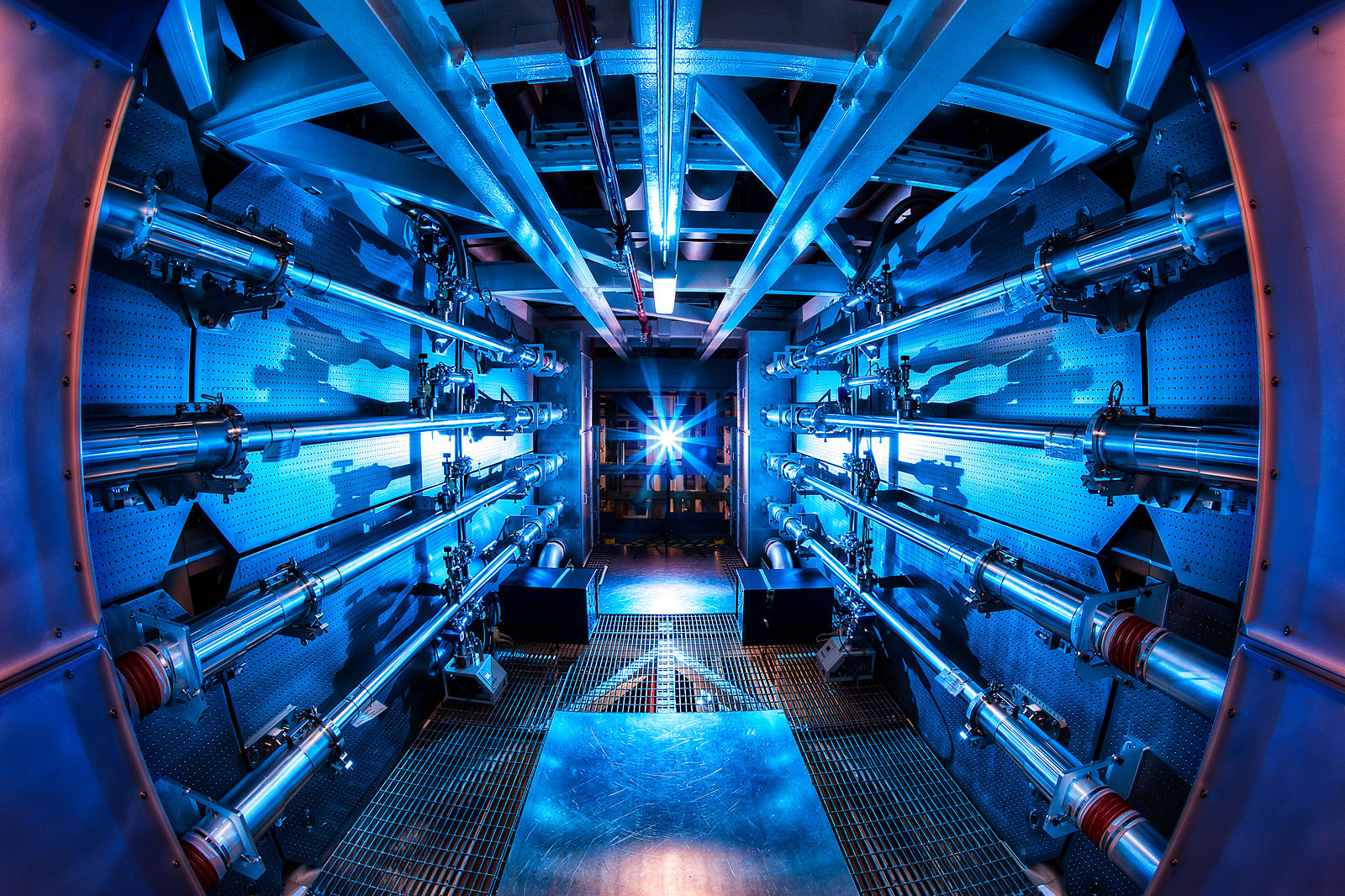
         This approach has been pursued in many experiments with powerful lasers which have been carried out in the U.S., Europe, Japan and the former Soviet Union over the decades since the development of the hydrogen bomb and the laser. The ultimate result of all this research has been the creation of the one hundred and ninety-two laser beam National Ignition Facility at the U.S. Lawrence Livermore Laboratory. This is the biggest laser system in the world. The NIF has used a laser set-up in which the laser energy is first converted to X-rays by the interaction of the laser light with a metallic shell around the fuel pellet. It was hoped that this would result in a much more efficient implosion of the fuel pellet.
        However, there are immense difficulties with this approach. The radiative implosion process is vulnerable to hydrodynamic instabilities which can prevent effective compression. The efficiency of the coupling of the laser energy to the fuel pellet is low, there are radiative losses and other problems.
        Today, there are new strategies being explored. It is hoped that these new approaches will be able to overcome impediments to the progress of fusion energy research since the very beginning.

    Please read Part 8 next.

  • Nuclear News Roundup Aug 05, 2020

    Ambient office  = 88 nanosieverts per hour

    Ambient outside = 115 nanosieverts per hour

    Soil exposed to rain water = 111 nanosieverts per hour

    Blueberry from Central Market = 91 nanosieverts per hour

    Tap water = 100 nanosieverts per hour

    Filtered water = 97 nanosieverts per hour

  • Geiger Readings for Aug 05, 2020

    Geiger Readings for Aug 05, 2020

    Ambient office  = 88 nanosieverts per hour

    Ambient outside = 115 nanosieverts per hour

    Soil exposed to rain water = 111 nanosieverts per hour

    Blueberry from Central Market = 91 nanosieverts per hour

    Tap water = 100 nanosieverts per hour

    Filtered water = 97 nanosieverts per hour

  • Nuclear Fusion 89 – Powerful Lasers And A  Mixture of Hydrogen and Boron Are Being Researched As The Basis For Nuclear Fusion Power Generation – Part 6 of 18 Parts

    Nuclear Fusion 89 – Powerful Lasers And A Mixture of Hydrogen and Boron Are Being Researched As The Basis For Nuclear Fusion Power Generation – Part 6 of 18 Parts

    Part 6 of 18 Parts (Please read Parts 1 thru 5 first)
         While the ITER project looks like a dead end as far as commercial nuclear fusion power generation, there are a variety of smaller devices that use highly nonequilibrium, pulsed systems such as the so-called dense plasma focus (DPF). The DPF exploits self-organizing processes in the plasma to reach extremely high energy densities.
         The second main approach to fusion is called inertial confinement fusion (ICF). The ICF approach does not try to limit the expansion of the plasma. The plasma is subject to extreme temperature and pressure before the fusion reactions are triggered which means that the majority of the fusion occurs before the plasma has a chance to expand. In the tiny instant in which the process is triggered, the energy released by each of the fusion reactions heat the plasma even more. The process becomes self-sustaining which is referred to as ignition. In essence, a tiny thermonuclear explosion is triggered. A future commercial nuclear fusion ICF reactor would be on a pulsed regime. Tiny pellets of fuel would be dropped one at a time into an explosion chamber and ignited by intense simultaneous laser pulses. The basis physics of ICF were developed in the context of nuclear weapons research and that research still overlaps with classified military research.
        Up to the present, the only way to generate a large amount of excess energy from fusion reactions is the hydrogen bomb also referred to as the thermonuclear bomb. The technology of hydrogen bombs was first successfully tested on October 31, 1952.
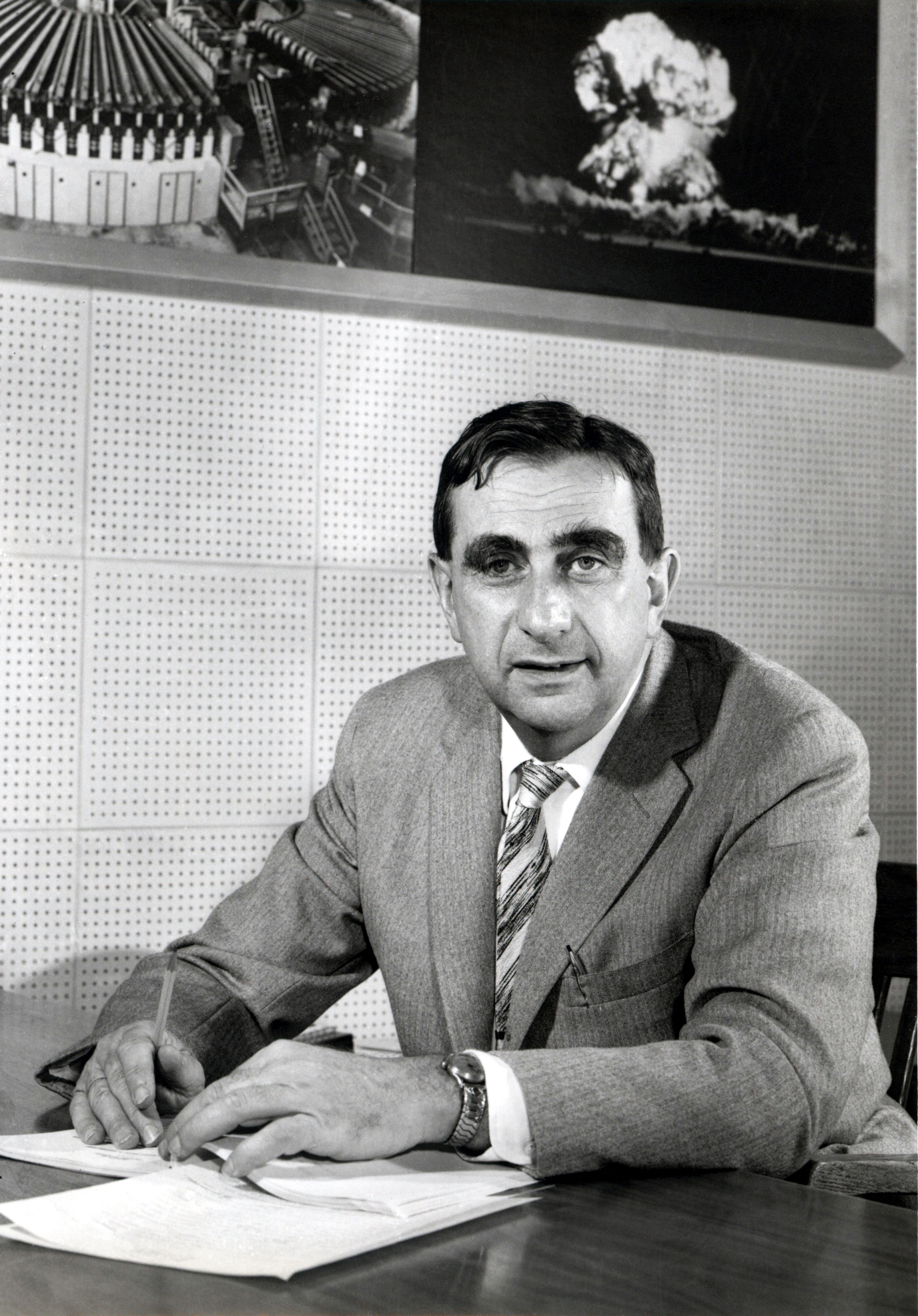
        While the U.S. was carrying out the Manhattan Project to build the first atomic bomb based on fission, the physicist Edward Teller developed the idea of a potentially far more destructive weapon. This new bomb would not be based on the triggering of a fission chain reaction of uranium. Instead, it would be based on the fusion of hydrogen isotopes. It was clear that chemical explosives could not generate the extreme temperatures needed to ignite fusion reactions .The only option was to use a fission bomb to trigger the fusion reactions needed for the hydrogen bomb.
         In 1946, the physicists John von Neumann and Klaus Fuchs applied for a patent application for a modified approach to a hydrogen bomb. The title on the patent was “Improvement in the Methods and Means for Utilizing Nuclear Energy.” The contents of this patent is still an official U.S. government secret. However, a copy of the patent can be found in a series of volumes published in Russia in 2008 which contain declassified Soviet documents. In addition to detailed text with calculations and diagrams, there are commentaries on the patent by leading Soviet nuclear researchers in 1948. It turns out that Klaus Fuchs was a Soviet secret agent and he passed the patent to the Soviets.
         The von Neuman-Fuchs design incorporates the basic operating principle of the hydrogen bomb developed by the U.S. The original hydrogen bomb design called for wrapping the fusion fuel around the fission bomb. The von Neuman-Fuchs design put the fusion fuel in a separate container and exploited the intense pulse of radiation generated by a fission explosion to heat, compress and ignite the fusion fuel.
          The design of the device that was finally successfully tested in 1952 relied on this radiation implosion approach in a more advanced design created by Edward Teller and Stanislav Ulam. This is the famous two-state “Teller-Ulam configuration.” It became a model for the later development of laser-based fusion.
    Please read Part 7 next

  • Geiger Readings for Aug 04, 2020

    Geiger Readings for Aug 04, 2020

    Ambient office  = 83 nanosieverts per hour

    Ambient outside = 97 nanosieverts per hour

    Soil exposed to rain water = 97 nanosieverts per hour

    Red bell pepper from Central Market = 77 nanosieverts per hour

    Tap water = 103 nanosieverts per hour

    Filtered water = 83 nanosieverts per hour

  • Nuclear Fusion 88 – Powerful Lasers And A  Mixture of Hydrogen and Boron Are Being Researched As The Basis For Nuclear Fusion Power Generation – Part 5 of 18 Parts

    Nuclear Fusion 88 – Powerful Lasers And A Mixture of Hydrogen and Boron Are Being Researched As The Basis For Nuclear Fusion Power Generation – Part 5 of 18 Parts

    Part 5 of 18 Parts (Please read Parts 1 thru 4 first)
         One of the major concerns about the use of a mixture of hydrogen and boron as a fuel for a fusion reactor is the fact that the hydrogen – boron reactions can only be triggered by very extreme physical conditions. Up until now, the deuterium-tritium reaction has been the focus of most fusion research because the conditions required are not as extreme as those needed for hydrogen-boron fusion. After more than fifty years of efforts around the world with investments rising into the tens of billion of dollars it is still not possible to make accurate predictions about when a commercial fusion reactor employing deuterium-tritium fusion might be available. It is pretty obvious that new approaches are needed. Perhaps a whole new paradigm must be found. One suggestion is what has been called the “non-thermal-paradigm.”
         In fusion research, the main topic being discussed is thermonuclear fusion. This refers to fusion reactions caused by raising the plasma mixture to millions of degrees and subjecting them to intense presssure. This is also the meaning of the term “thermonuclear” weapon or what is often called a “hydrogen bomb.”
         However, it is not just enormous temperatures that are needed for fusion. Much lower temperatures will turn the fuel mixture into a plasma. This means that most of the electrons are no longer bound to the atomic nuclei. They are able to move around in the plasma but as still influenced by the electromagnetic forces of attraction and repulsion among them. The motion of the electrons gives rise to electrical currents and magnetic fields. These, in turn, act on the whole plasma. One often used term is “magneto-hydrodynamics.”
         Plasma behavior is very nonlinear. Plasmas can exhibit a huge variety of different waves and oscillations. They emit electromagnetic radiation and display collective, self-organizing properties. There are collisions between the particles in the plasmas and quantum effects. Predicting and controlling the behavior of plasma at enormous energies is a formidable task. Even the most powerful supercomputers have difficulties working on these calculations.
         Million-degree temperatures create extremely high pressures. If there are no mechanisms to confine the plasma, the heat and pressure will cause the plasma to expand rapidly and the density needed for fusion reactions quickly disappears. Attempts to solve this problem have given rise to two very different strategies.
         The first strategy is to confine the hot plasma in a “magnetic bottle.” Super powerful magnetic fields are used to counteract the enormous force of expansion of the plasma. Research today is dominated by the huge International Thermonuclear Experimental Reactor (ITER) project which is now under construction in Cadarache, France by multiple nations. ITER is very important as a platform for plasma research, technology development and as a means of supporting what could be considered as an ecosystem for scientists and engineers working in the relevant areas. However, as far as being an actual realization of a prototype of a possible commercial nuclear fusion reactor, there is little possibility of that.
    Please read Part 6 next