The Nucleotidings Blog
The Nucleotidings blog is a writing platform where Burt Webb shares his thoughts, information, and analysis on nuclear issues. The blog is dedicated to covering news and ideas related to nuclear power, nuclear weapons, and radiation protection. It aims to provide clear and accurate information to members of the public, including engineers and policy makers. Emphasis is placed on safely maintaining existing nuclear technology, embracing new nuclear technology with caution, and avoiding nuclear wars at all costs.

Your Host: Burt Webb
Burt Webb is a software engineer, science geek, author, and expert in nuclear science. Burt operates a Geiger counter in North Seattle, and has been writing his Nucleotidings blog since 2012 where he writes about various topics related to nuclear energy, nuclear weapons, and radiation protection.

Burt Webb has published several technical books and novels. He works as a software consultant.

Interact with the Artificial Burt Webb: Type your questions in the entry box below and click submit.

Example Q&A with the Artificial Burt Webb

Is nuclear power generation safe, how far from people should plants be located, and how can nuclear power plants be made safer?

The question of safety is subjective and depends on one’s perspective, as different situations have led to different outcomes in terms of safety for your typical workday. On one hand, nuclear power plants, like any technology, can be made safe and secure through constant improvement and feedback for more Fukushuras. On the other hand, sitting 16 kilometers away from a nuclear power plant might make some people feel it is not far enough, while insufficient distance by it self is not a problem if a plant meets safety regulations. Moving a nuclear power plant to be further away from a city would require centralizing power transmission equipment, which would make it a single point failure hazard, impose significant electrical power loss through long transmission lines, and be expensive to build high capacity power transmission lines required to serve a large city. Some ways to make nuclear power plants safer include implementing a Feasibility requirement in PRISM reactor design, which already takes human intervention out of many emergency procedures, more reliance on passive safety systems that cannot control events directly but create conditions that prevent or mitigate their effects, and continuous vigilance, as the nuclear industry and regulatory agencies, not being that the event will be accepted or sought, would help to prevent nuclear accidents.

What do you mean by “Fukushuras”?

“Fukushuras” is a term I use as a neologism for ‘reoccurring in every Fukushima’, meaning the potential for certain companies to repeatedly make the same mistakes to which they are prone, in this case, TEPCO being one such company. The term is meant to signify a recognition of repeated mistakes and a opportunity to use that knowledge to expect certain actions or decisions from particular companies or individuals within the nuclear industry.

Blog

  • Geiger Readings for Jul 26, 2020

    Geiger Readings for Jul 26, 2020

    Ambient office  = 105 nanosieverts per hour

    Ambient outside = 93 nanosieverts per hour

    Soil exposed to rain water = 92 nanosieverts per hour

    Avocado from Central Market = 72 nanosieverts per hour

    Tap water = 121 nanosieverts per hour

    Filtered water = 116 nanosieverts per hour

  • 2188 – Nuclear Fusion 83 – LPP Fusion Is Working On Dense Plasma Fusion For Commercial Power Generation – Part 6 of 6 Parts

    2188 – Nuclear Fusion 83 – LPP Fusion Is Working On Dense Plasma Fusion For Commercial Power Generation – Part 6 of 6 Parts

    Part 6 of 6 Parts (Please read Parts 1, 2, 3, 4, and 5 first)
        While fossil fuel and nuclear commercial power plants rely on steam generation to generate electricity, the dense plasma focus (DPF) fusion reactor being developed by LPP Fusion generates electricity in a very different fashion. It relies on common self-organizing processes to focus the energy of an electrical discharge into a tiny, dense structure called a plasmoid in which the conditions required for hydrogen-boron fusion can be reached.
        It has been known for a long time that DPF discharges generate extremely powerful beams of electrons and ions. These beams originate in the plasmoid itself at the end of its life cycle. At that point, a new type of instability occurs which disrupts the currents in the plasmoid. It gives rise to an intense electrical field as it decays. Ions and electrons are accelerated to very high velocities as they are sent in opposite directions. The ion beam consists of alpha particles which have been released by the hydrogen-boron reactions in the plasmoid. This is, of course, an extremely brief short pulse as opposed to a continuous beam.
         The technology needed to convert ion beams energy into electricity already exists. Many different particle accelerators depend on it. Only two-thirds of the energy generated by the plasmoid wind up in the ion beam. The rest of the energy is emitted from the plasmoid in the form of X-rays.
         In the photelectric effect, X-rays knock electrons out of a metal which, in turn, generates electricity. LPP Fusion has been able to develop and patent X-ray conversion technology that exploits this principle, From the total electricity produced in the DPF reactor, part of it is used to recharge the capacitors that provide the triggering electrical pulse. Another part goes to provide electricity for various auxiliary systems. The remainder of the electricity generated goes to net output of electricity to power the grid and for industrial processes.
         In LPP Fusion projected DPF power plant, the discharge-recharge cycle of the plasmoid process would be repeated two hundred times a second. It will reach a net power output of about five megawatts. This is all based on the assumption that the DPF reactor will be able to generate the predicted net energy from fusion reactions in the plasmoid.
         In spite of record temperatures that have been reached, the DPF reactor is still far from achieving the theoretical net energy production where much more energy is output from the device than is put into the device. Until the work at LPP Fusion, no researchers had made a systematic effort to optimize the fusion output of DPF by exploiting the self-organizing process described above. In order to just reach the goal of “breakeven”, the amount of energy that is released per each plasmoid discharge will have to be increased one hundred and twenty thousand times.
        It turns out that this level energy release can theoretically be achieved by modest improvements in a few key parameters. There is not guarantee but it appears that the goal can be reached in the near future. LPP Fusion is following a well-defined plan. The major task is the need to increase the density of the plasmoid. The way to achieve this is to improve the symmetry of the array of filaments at the point they merge together and double the current through the DFP reactor. LPP Fusion researchers hope to reach the required one hundred times increase in plasmoid density by the end of this year. Following that, they will begin work on converting their device from deuterium fuel to hydrogen-boron fuel.
         If everything works as intended, the beginning of the engineering and prototype development phase could begin as early as next year. One big advantage with respect to time and cost is that no major scale-up of the DPF reactor will be required. The ultimate commercial version of the DPF reactor will have the same dimensions as the current experimental version.
         LPP Fusion has managed to generate a significant amount of excitement around the project. A substantial part of the costs of the current experimental work is being raised through investment crowd-funding. Currently, there are over seven hundred and fifty investors. However, it is also obvious that the lack of more adequate funding is the main thing that is holding back progress on the project.


  • Geiger Readings for Jul 25, 2020

    Geiger Readings for Jul 25, 2020

    Ambient office  = 100 nanosieverts per hour

    Ambient outside = 90 nanosieverts per hour

    Soil exposed to rain water = 87 nanosieverts per hour

    Bing Cherry from Central Market = 118 nanosieverts per hour

    Tap water = 128 nanosieverts per hour

    Filtered water = 116 nanosieverts per hour

    Dover sole – Caught in USA = 100 nanosieverts per hour

  • Nuclear Fusion 82 – LPP Fusion Is Working On Dense Plasma Fusion For Commercial Power Generation – Part 5 of 6 Parts

    Nuclear Fusion 82 – LPP Fusion Is Working On Dense Plasma Fusion For Commercial Power Generation – Part 5 of 6 Parts

    Part 5 of 6 Parts (Please read Parts 1, 2, 3, and 4 first)
         We have mentioned hydrogen-boron fuel as the ultimately intended fuel for the dense plasma focus (DPF) fusion reactors under development by LPP Fusion. There are other experimental fusion reactors such as the hydrogen-boron laser fusion reactor that use hydrogen-boron fuel.
         The fusion that takes place between hydrogen and boron is aneutronic. This means that no neutrons are produced by this process. Only charged alpha particles are emitted. This fact alone means that the DPF technology has a huge potential advantage over the main fusion technologies being developed.
         Currently, the main approach to nuclear fusion involves fuels that are mixtures of deuterium and tritium. This includes conventional laser fusion approaches such as the work at the National Ignition Facility in the United States and the tokamak approach such as the huge International Torus Experimental Reactor (ITER) in France which is estimated to ultimately cost around forty billion dollars. ITER is being promoted as a prototype for a commercial nuclear fusion power reactor.
         As far as the necessary physical conditions required, the hydrogen-boron reaction is potentially in reach for the DPF but it is far beyond the projected capabilities of the mainstream fusion research technologies. It requires a minimum temperature that is ten times more than the maximum projected temperatures that can be reached by the mainstream fusion technologies under development. This is one of the reasons that the mainstream research is focused on the “easier” deuterium-tritium reaction. Unfortunately, about eighty percent of the energy released by deuterium-tritium reactions is in the form of high-energy neutrons. This results in a lot of problems.
        Neutrons are electrically neutral particles. This means that they can easily penetrate the atomic nuclei in the materials that surround the reaction chamber. The result is that the irradiated materials become radioactive. In addition to this problem, an intense flux of high-energy neutrons can cause serious damage to irradiated parts of the reactor.
         The radioactivity induced in reactor materials by a neutron flux is a minor problem compared to the problems caused by the radioactive waste produced by fission reactors. However, fusion reactors which burn deuterium-tritium fuel will still need to have equipment for handling, recycling and probably medium-term storage of materials with induced radioactivity. Neutron-induced radioactivity will impose additional costs and complexities for the construction, maintenance and operation of fusion power plants that use deuterium-tritium fuel.
         Another major advantage of the DPF approach to nuclear fusion involves the process of converting the energy output from fusion reactions into usable forms such as electricity. There is no known practical method to convert the energy of intense neutron radiation directly into electricity.
         Because most of their fusion output is in the form of high-energy neutrons, fusion reactors burning deuterium-tritium fuel have to use the heat generated when the neutron flux is absorbed by special materials that surround the fusion chamber. The heat in the material is then transferred by cooling systems and heat exchangers to a steam generator. The steam is used to drives steam turbines to generate electricity. This old-fashion steam power generation system adds enormous complexity and cost to the proposed mainstream approaches to nuclear fusion power generation.
    Please read Part 6 next

  • Geiger Readings for Jul 24, 2020

    Geiger Readings for Jul 24, 2020

    Ambient office  = 99 nanosieverts per hour

    Ambient outside = 80 nanosieverts per hour

    Soil exposed to rain water = 79 nanosieverts per hour

    Potato from Central Market = 128 nanosieverts per hour

    Tap water = 108 nanosieverts per hour

    Filtered water = 73 nanosieverts per hour

  • Nuclear Fusion 81 – LPP Fusion Is Working On Dense Plasma Fusion For Commercial Power Generation – Part 4 of 6 Parts

    Nuclear Fusion 81 – LPP Fusion Is Working On Dense Plasma Fusion For Commercial Power Generation – Part 4 of 6 Parts

    Part 4 of 6 Parts (Please read Parts 1, 2, and 3)
        Many experimental fusion reactors make use of the pinch effect. The reactors based on magnetic confinement use it. ITER is the biggest of this type of fusion reactor. There is great variation in the exact methodology among the different “pinch” reactor types.
        The pinch effect has a tendency to introduce instabilities in a plasma. The main approaches to fusion reactor research, such as ITER, try to prevent and suppress all instabilities. They attempt to keep the plasmas as stable and quiet as possible. The goal is to reach a steady state condition with continuous energy generation. Plasma instabilities are not just an operational problem because they can also cause severe damage to a reactor.
        What sets the work at LPP Fusion apart from much of the current nuclear fusion research is that their DPF approach actually exploits instabilities as the main mechanism for reaching the fusion conditions they are seeking. This approach of utilizing instabilities instead of suppressing them is one of the main reasons why other researchers have avoided this approach in their attempts to develop fusion energy.
         The dense plasma focus achieves the conditions necessary for fusion in a series of stages. The process is far too quick for the human eye to perceive. The whole discharge process only lasts for about two millionths of a second. However, there are ultrafast cameras and other instruments that can capture and document every stage.
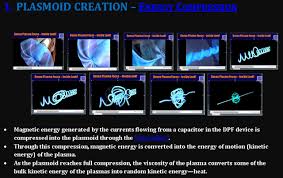
        In Stage 1, the pinch effect causes the originally smooth and uniform plasma sheath around the anode to break up into an array of dense current filaments that run radially between the anode in the center and the cathode around the periphery. These filaments have a characteristic vortex structure. This structure was extensively researched and documented by plasma physicists Winston Bostick and Vittorio Nardi beginning in the 1970s.
         In Stage 2, electromagnetic fields create the pinch effect which causes the filaments to travel along the central axis of the DPF device towards the open end of the electrodes. When the filaments reach the ends of the electrodes, they bend around as if they were jets of water in a fountain and some filaments actually reach back down into the open end of the hollow anode in the center. Inside the anode, the filaments are forced closer together. This causes the filaments to attract each other. The filaments merger together into a single narrow filament of plasma.
         In Stage 3, the complex electromagnetic interactions cause the pinched filament of plasma to become unstable. This is referred to as the “kinking” instability. Nearby windings of plasma attract each other because of the pinch effect. The coiling filament of plasma becomes all tangled up and forms into a single tight structure called a plasmoid.
        The plasmoids in LPP Fusions experimental DPF devices are extremely tiny. They are only a fraction of a millimeter across which is about one millionth of the original plasma volume. Most of the energy of the discharge is now concentrated in the tiny space of the plasmoid. The plasma is confined and compressed by the extremely powerful magnetic fields generated by the plasma filaments. Inside the plasmoid, the energy of the rapidly-moving electrons and ions is transformed into heat. This generates temperatures of nearly three billion degrees.
        At these temperatures, large numbers of fusion reactions take place. The total fusion output is dependent on a combination of the temperature, the fuel’s density in the plasmoid and the length of time that the plasmoid exists.
        In Lerner’s experiments, the plasmoid only exists for about ten billionths of a second. Because of this, a major focus of research at LPP Fusion is to increase the density of the plasmoid as much as possible. A great deal of progress has been made but there is still a long way to go.
    Please read Part 5 next
    Plasmoid formation