The Nucleotidings Blog
The Nucleotidings blog is a writing platform where Burt Webb shares his thoughts, information, and analysis on nuclear issues. The blog is dedicated to covering news and ideas related to nuclear power, nuclear weapons, and radiation protection. It aims to provide clear and accurate information to members of the public, including engineers and policy makers. Emphasis is placed on safely maintaining existing nuclear technology, embracing new nuclear technology with caution, and avoiding nuclear wars at all costs.

Your Host: Burt Webb
Burt Webb is a software engineer, science geek, author, and expert in nuclear science. Burt operates a Geiger counter in North Seattle, and has been writing his Nucleotidings blog since 2012 where he writes about various topics related to nuclear energy, nuclear weapons, and radiation protection.

Burt Webb has published several technical books and novels. He works as a software consultant.

Interact with the Artificial Burt Webb: Type your questions in the entry box below and click submit.

Example Q&A with the Artificial Burt Webb

Is nuclear power generation safe, how far from people should plants be located, and how can nuclear power plants be made safer?

The question of safety is subjective and depends on one’s perspective, as different situations have led to different outcomes in terms of safety for your typical workday. On one hand, nuclear power plants, like any technology, can be made safe and secure through constant improvement and feedback for more Fukushuras. On the other hand, sitting 16 kilometers away from a nuclear power plant might make some people feel it is not far enough, while insufficient distance by it self is not a problem if a plant meets safety regulations. Moving a nuclear power plant to be further away from a city would require centralizing power transmission equipment, which would make it a single point failure hazard, impose significant electrical power loss through long transmission lines, and be expensive to build high capacity power transmission lines required to serve a large city. Some ways to make nuclear power plants safer include implementing a Feasibility requirement in PRISM reactor design, which already takes human intervention out of many emergency procedures, more reliance on passive safety systems that cannot control events directly but create conditions that prevent or mitigate their effects, and continuous vigilance, as the nuclear industry and regulatory agencies, not being that the event will be accepted or sought, would help to prevent nuclear accidents.

What do you mean by “Fukushuras”?

“Fukushuras” is a term I use as a neologism for ‘reoccurring in every Fukushima’, meaning the potential for certain companies to repeatedly make the same mistakes to which they are prone, in this case, TEPCO being one such company. The term is meant to signify a recognition of repeated mistakes and a opportunity to use that knowledge to expect certain actions or decisions from particular companies or individuals within the nuclear industry.

Blog

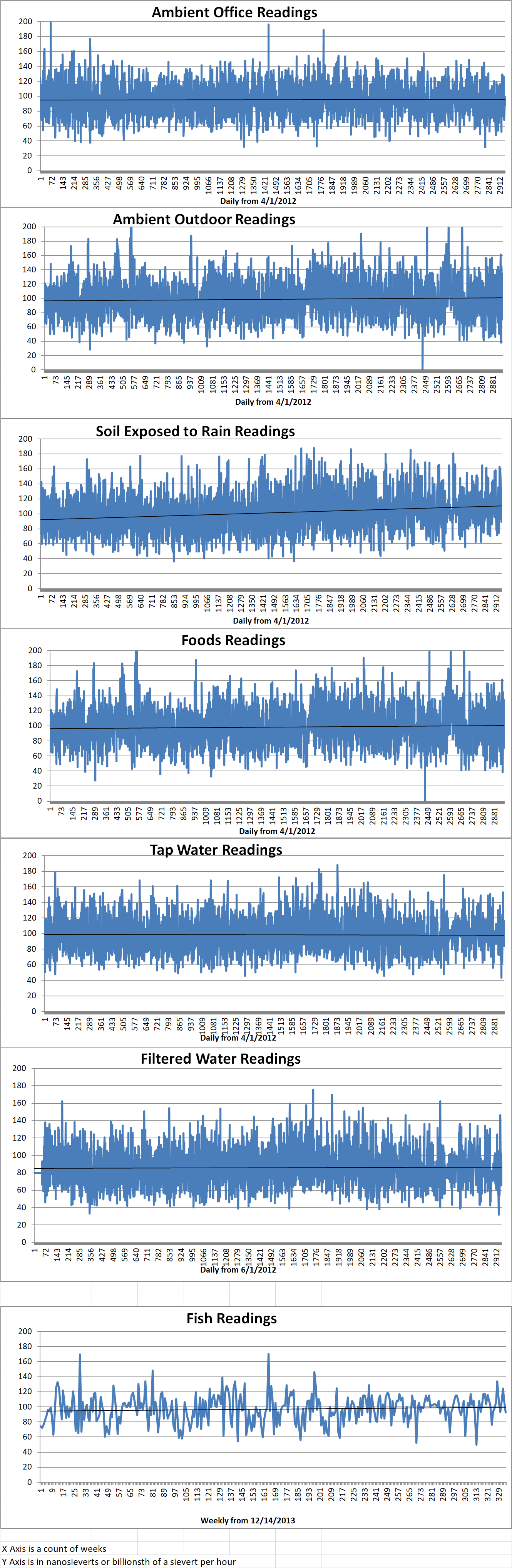
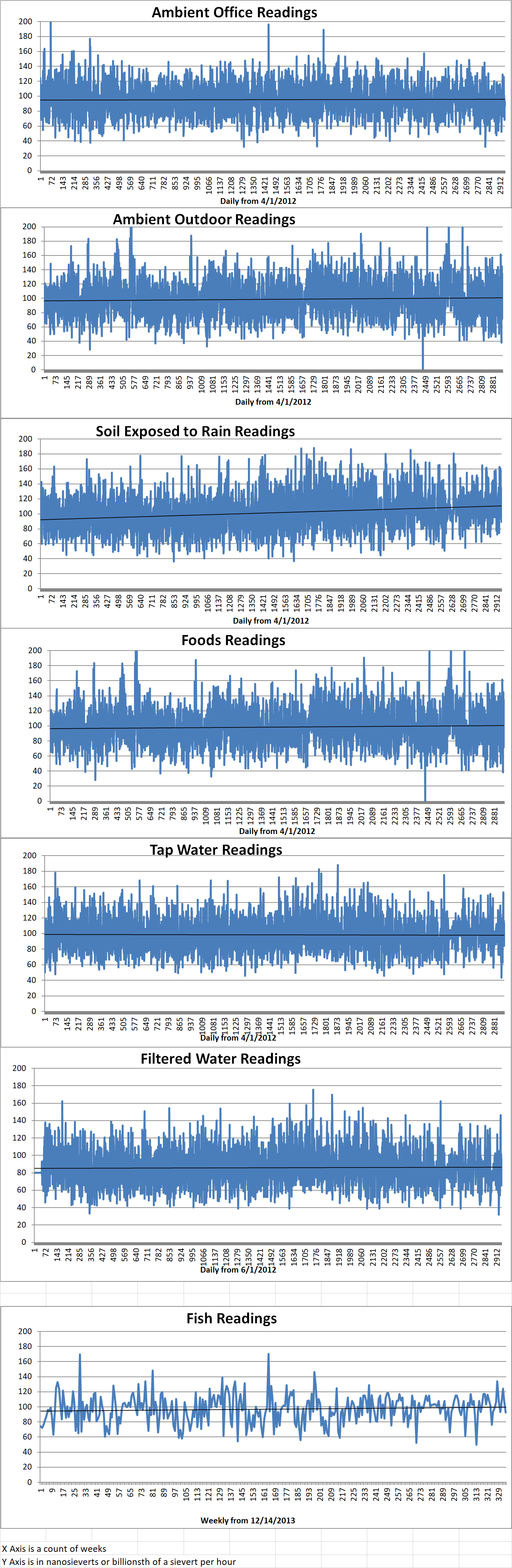
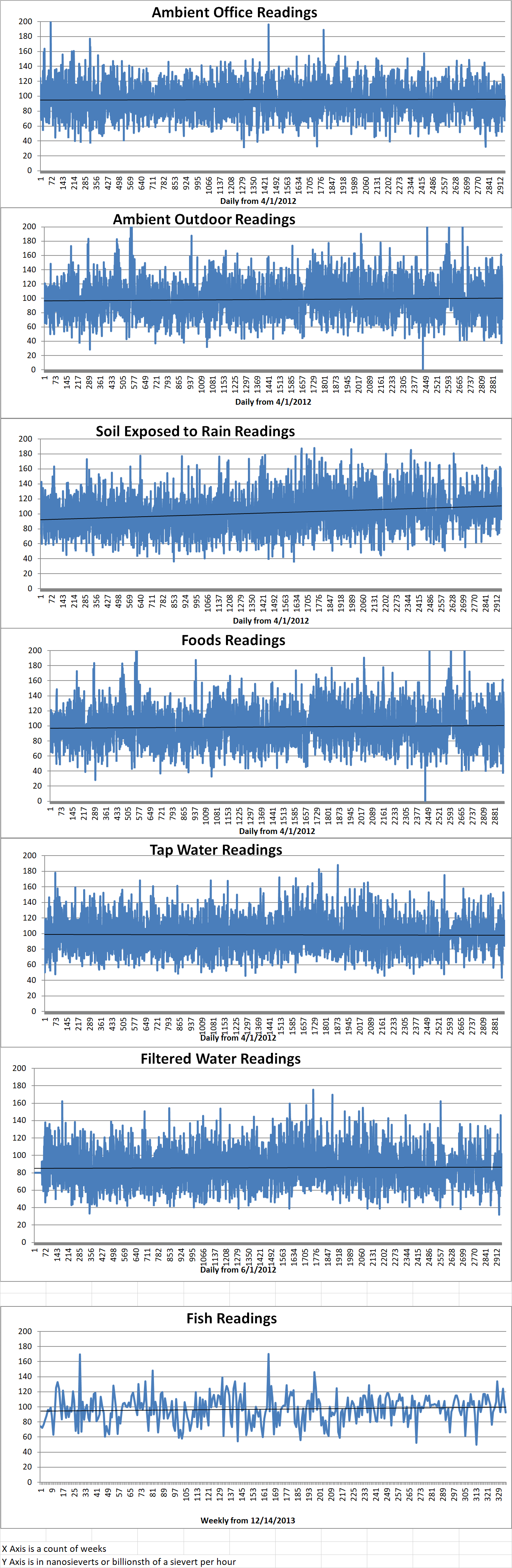
  • Geiger Readings for Jul 23, 2020

    Geiger Readings for Jul 23, 2020

    Ambient office  = 87 nanosieverts per hour

    Ambient outside = 94 nanosieverts per hour

    Soil exposed to rain water = 89 nanosieverts per hour

    English cucumber from Central Market = 135 nanosieverts per hour

    Tap water = 101 nanosieverts per hour

    Filtered water = 93 nanosieverts per hour

  • Nuclear Fusion 80 – LPP Fusion Is Working On Dense Plasma Fusion For Commercial Power Generation – Part 3 of 6 Parts

    Nuclear Fusion 80 – LPP Fusion Is Working On Dense Plasma Fusion For Commercial Power Generation – Part 3 of 6 Parts

    Part 3 of 6 Parts (Please read Parts 1 and 2 first)
         The physicals principles of dense plasma focus have been well understood for decades. They have been demonstrated in many experiments since the 1970s. The experiments have shown an amazing complexity of phenomena in DPF discharges. They are characterized by self-organization and the formation of highly energy-dense structures.
         The DPF design used by Lerner at LPP Fusion consists of a pair of concentric beryllium electrodes which are four inches long. They are mounted in a chamber that is filled with gaseous fuel at low temperatures. The outer electrode functions as the cathode. It is a ring of slender vertical columns. It has an outside radius of two inches. The inner electrode which functions as the anode is a hollow vertical cylinder about an inch in diameter. The electrodes are connected by a fast switch to a bank of capacitors which are charged to a voltage of forty thousand volts.
         When the switch is thrown, the bank of capacitors sends a very powerful pulse of electricity to the electrodes which causes an electrical discharge shaped like a ring to form between them. At the peak of the discharge, a current of over a million amps flows through the device. Connecting the capacitor bank to the electrodes creates a strong electrical field in the space between the electrodes. The small number of electrons that are not bound to nuclei in the gaseous fuel mixture are accelerated with great force towards the anode. They collide with atoms along the way and cause other electrons to be released.
         Atoms that lose electrons turn into positively charged ions and are accelerated towards the cathode. They also collide with other atoms as they move. Some collide with the cathode and release more electrons. An avalanche of electrons develops in a chain reaction as more and more electrons are knocked loose from atoms, creating more and more free electrons and ions and still more collisions. The gaseous fuel mixture is turned into a very hot, high-energy plasma consisting of free electrons and ions. Most of the matter in the universe consists of plasmas.
         The flows of electrons towards the anode and the ions towards the cathode are electrical currents. Whenever a flow of charged particles occurs, magnetic fields are generated. The magnetic fields act upon the electrons and ions. This can, in turn, result in changes in the pattern of the currents.
         At this point in the process, a mechanism known as the “pinch effect” occurs. The pinch effect provides the key mechanism by which the LPP Fusion DPF device concentrates its energy. In simple terms, the pinch effect refers to the fact that two parallel currents are attracted to each other. The effect is a result of the aforementioned magnetic fields generated by the currents. This means that a plasma carrying strong electrical currents will be “pinched” or compressed at right angles to the direction of the current.
    Please read Part 4 next

  • Geiger Readings for Jul 22, 2020

    Geiger Readings for Jul 22, 2020

    Ambient office  = 79 nanosieverts per hour

    Ambient outside = 135 nanosieverts per hour

    Soil exposed to rain water = 138 nanosieverts per hour

    Blueberry from Central Market = 69 nanosieverts per hour

    Tap water = 106 nanosieverts per hour

    Filtered water = 88 nanosieverts per hour

  • Nuclear Fusion 79 – LPP Fusion Is Working On Dense Plasma Fusion For Commercial Power Generation – Part 2 of 6 Parts

    Nuclear Fusion 79 – LPP Fusion Is Working On Dense Plasma Fusion For Commercial Power Generation – Part 2 of 6 Parts

    Part 2 of 6 Parts (Please read Part 1 first)
         Operating on a very limited budget with a few collaborators, LPP Fusion has increased the performance of its DPF technology step by step and is coming close to being able to create the conditions required for net energy generation.
         In 2016, LPP Fusion’s DPF device managed to achieve a plasma temperature of two billion eight hundred million degrees. This is the highest such temperature ever reached by any fusion device to date. This is over two hundred times hotter than the temperature at the center of the sun and fifteen times the project maximum temperature which can be reached by the ITER project.
       LPP Fusion has either matched or come close to results achieved by other fusion devices that cost hundreds of times more than the seven million dollars spent by LPP Fusion in the past decade. LPP Fusion intends to utilize hydrogen-boron instead of the popular deuterium-tritium fuel. The world-record temperatures already achieved provide the basis for moving forward with hydrogen-boron fuel.
         The hydrogen-boron fusion reaction is the Holy Grail of nuclear fusion research. It generates no radioactive waste and does not irradiate the components of the reactor. There is a virtually unlimited supply of fuel. And, best of all, it allows for the possibility of the direct conversion of the energy generated by the fusion process into electricity instead of following the complex process of generating steam to drive a steam turbine.
         It has been estimated that one gram of hydrogen-boron mixture could produce about as much energy as would be released by the burning of three tons of coal. The fusion experiments with at LPP Fusion have been carried out with deuterium so far. The first experiments with the hydrogen-boron fuel are planned for the end of this year.
         The LPP Fusion project is currently in the advanced research phase. The main task now is to progress from the already demonstrated production of big numbers of fusion reactions to achieving net energy output from the DPF device. If they are successful, the next stage will be the engineering phase. There is no guarantee that they will be successful, of course. But if they are successful, the payoff will be huge. 
         DPF-based hydrogen-boron fusion power plants would combine simplicity of construction and operation. The units would be small, and they would have low investment costs, low fuel costs and be intrinsically safe.
         With regard to commercial power production, the DPF device will be combined with a patented system that will allow the direct conversion of fusion energy into electricity.
         The LPP Fusion system would pulse at the rate of two hundred discharges per second and deliver an electric power output of five megawatts. A complete DPF power unit would only be a few yards across. This will make it easy to achieve any desired power output just by adding more units to the system. The technology is well suited to mass production of standardized units.
         Reasonable estimates suggest the DPF technology could reduce the cost of producing electricity by ten times or even more when compared with conventional and alternative energy technologies.
    Please read Part 3 next

  • Geiger Readings for Jul 21, 2020

    Geiger Readings for Jul 21, 2020

    Ambient office  = 87 nanosieverts per hour

    Ambient outside = 94 nanosieverts per hour

    Soil exposed to rain water = 89 nanosieverts per hour

    Tomato from Central Market = 135 nanosieverts per hour

    Tap water = 101 nanosieverts per hour

    Filtered water = 93 nanosieverts per hour

  • Nuclear Fusion 78 – LPP Fusion Is Working On Dense Plasma Fusion For Commercial Power Generation – Part 1 of 6 Parts

    Nuclear Fusion 78 – LPP Fusion Is Working On Dense Plasma Fusion For Commercial Power Generation – Part 1 of 6 Parts

    Part 1 of 6 Parts
             Nuclear fusion for power generation holds great promise but it has been a huge challenge because of the extreme physical conditions that are required to generate the fusion reaction. First of all, temperatures of almost two hundred million degrees Fahrenheit are needed to heat the ionized gas called a plasma. Second, enormous pressure must be applied to the plasma. And, most important of all, these conditions must be maintained long enough to achieve a net energy output.
         Attempts to achieve workable nuclear fusion reactors are currently dominated by expensive, large-scale experimental facilities that utilize super powerful lasers and microwave generators, particle beams, giant superconducting magnet systems and other advanced technologies. There are companies working on simpler and cheaper systems but these have not borne fruit. It may be that workable fusion will require complex and very expensive technology.
         However, there is a possible approach to nuclear fusion that might not require an expensive investment in complex technology. It would make use of a device called the dense plasma focus (DPF). The DPF operates by generating an electrical discharge that evolves rapidly in time and space, concentrating its energy into an array of filamentary structures and ultimately into a tiny knot-like entity that is referred to as a plasamoid. Inside the plasmoid, the extreme conditions that are needed for fusion arise. The DPF has been created in a variety of forms since the 1960s. Dozens of universities and government laboratories all over the world has utilized DFF devices for experimental research in the field of plasma physics. DPFs are also used as a source of x-rays and neutrons.
         In addition to the many laboratory uses of DPFs, they demonstrate phenomena that serve as a model for a variety of self-organizing processes in natures. These ranges from the laboratory scale all the way to the scale of galaxies.
         It has been experimentally demonstrated that a DPF can generated a large number of fusion reactions when it is operated in a chamber full of deuterium gas. It is strange that the idea of using the DPF for commercial power production has never received the attention and funding required to explore that potential.
         Most of the money being spent on fusion research today is being applied to large, expensive projects such as the huge giant International Torus Experimental Reactor (ITER) now being constructed in southern France with an estimated total cost of over forty billion dollars. Smaller more innovative project that are less prestigious have trouble finding funding.
         There is some good news with respect to DPF research. Lawrenceville Plasma Physics, Inc (LPP Fusion) is dedicated to developing dense plasma focus into commercial sources of energy. This work still has a long way to go but analysts say that there is a good chance that it will be successful. The founder and head of LPP Fusion is physicist Eric Lerner. He is one of the leading experts in the world on the plasma focus and related areas of plasma physics and astrophysics.
    Please read Part 2 next

  • Geiger Readings for Jul 20, 2020

    Geiger Readings for Jul 20, 2020

    Ambient outside = 128 nanosieverts per hour

    Soil exposed to rain water = 135 nanosieverts per hour

    Corn from Central Market = 118 nanosieverts per hour

    Tap water = 84 nanosieverts per hour

    Filtered water = 65 nanosieverts per hour