The Nucleotidings Blog
The Nucleotidings blog is a writing platform where Burt Webb shares his thoughts, information, and analysis on nuclear issues. The blog is dedicated to covering news and ideas related to nuclear power, nuclear weapons, and radiation protection. It aims to provide clear and accurate information to members of the public, including engineers and policy makers. Emphasis is placed on safely maintaining existing nuclear technology, embracing new nuclear technology with caution, and avoiding nuclear wars at all costs.

Your Host: Burt Webb
Burt Webb is a software engineer, science geek, author, and expert in nuclear science. Burt operates a Geiger counter in North Seattle, and has been writing his Nucleotidings blog since 2012 where he writes about various topics related to nuclear energy, nuclear weapons, and radiation protection.

Burt Webb has published several technical books and novels. He works as a software consultant.

Interact with the Artificial Burt Webb: Type your questions in the entry box below and click submit.

Example Q&A with the Artificial Burt Webb

Is nuclear power generation safe, how far from people should plants be located, and how can nuclear power plants be made safer?

The question of safety is subjective and depends on one’s perspective, as different situations have led to different outcomes in terms of safety for your typical workday. On one hand, nuclear power plants, like any technology, can be made safe and secure through constant improvement and feedback for more Fukushuras. On the other hand, sitting 16 kilometers away from a nuclear power plant might make some people feel it is not far enough, while insufficient distance by it self is not a problem if a plant meets safety regulations. Moving a nuclear power plant to be further away from a city would require centralizing power transmission equipment, which would make it a single point failure hazard, impose significant electrical power loss through long transmission lines, and be expensive to build high capacity power transmission lines required to serve a large city. Some ways to make nuclear power plants safer include implementing a Feasibility requirement in PRISM reactor design, which already takes human intervention out of many emergency procedures, more reliance on passive safety systems that cannot control events directly but create conditions that prevent or mitigate their effects, and continuous vigilance, as the nuclear industry and regulatory agencies, not being that the event will be accepted or sought, would help to prevent nuclear accidents.

What do you mean by “Fukushuras”?

“Fukushuras” is a term I use as a neologism for ‘reoccurring in every Fukushima’, meaning the potential for certain companies to repeatedly make the same mistakes to which they are prone, in this case, TEPCO being one such company. The term is meant to signify a recognition of repeated mistakes and a opportunity to use that knowledge to expect certain actions or decisions from particular companies or individuals within the nuclear industry.

Blog

  • Geiger Readings for Jun 27, 2020

    Geiger Readings for Jun 27, 2020

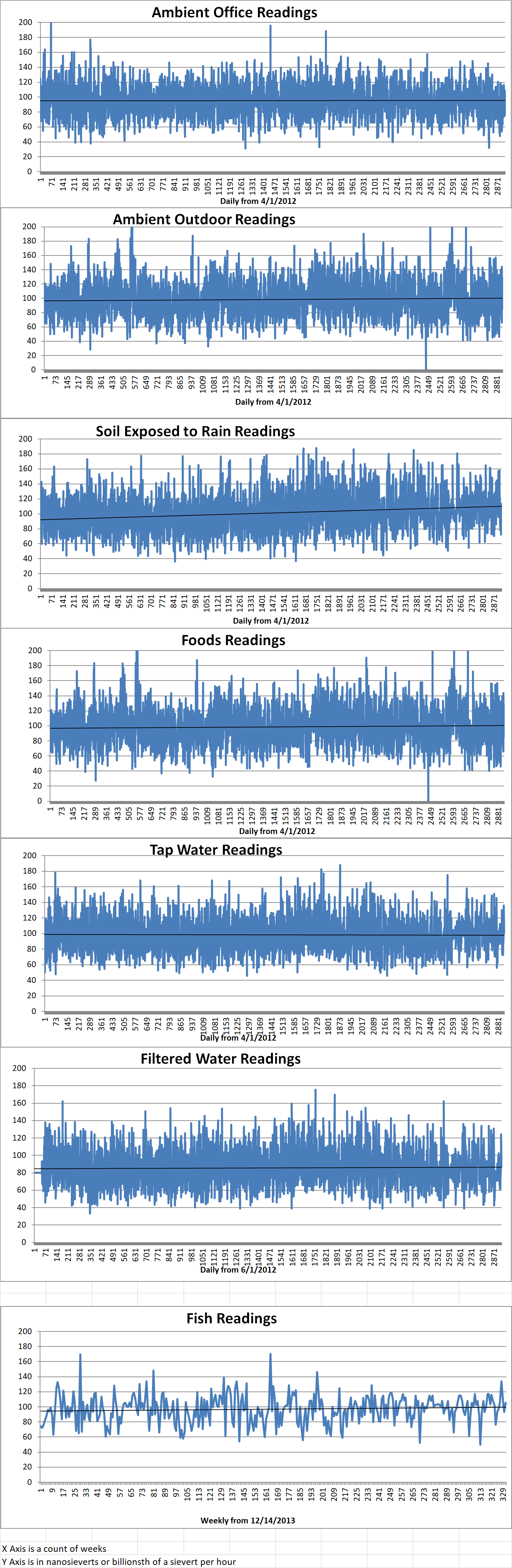
    Ambient office  = 77 nanosieverts per hour

    Ambient outside = 105 nanosieverts per hour

    Soil exposed to rain water = 108 nanosieverts per hour

    English cucumber from Central Market = 86 nanosieverts per hour

    Tap water = 112 nanosieverts per hour

    Filtered water = 91 nanosieverts per hour

    Dover sole – Caught in USA = 105 nanosieverts per hour

  • Deinococcus Radiodurans Is An Extremophile That May Help Develop Vaccines More Quickly – Part 5 of 7

    Deinococcus Radiodurans Is An Extremophile That May Help Develop Vaccines More Quickly – Part 5 of 7

    Part 5 of 7 Parts (Please read Parts 1, 2, 3, and 4 first)
          Battista said, “I’ve known Michael Daly for decades now. He’s not the kind of guy that’s going to just put stuff together willy nilly and push it out into the press.” Although Battista said that he is still personally confounded by how exactly the bacteria’s manganese-complexes could preferentially protect proteins over lipids (like cell membranes) and nucleic acids (like DNA and RNA), he does think that Daly’s idea could prove to be a really novel twist on the way vaccines are made. “Being perfectly honest with you, the thing that has bothered me the most about it is, ‘Why would one set of macromolecules be protected and the other not?’”
         Daly does not believe that his explanation is complicated, he says that it is just “chemistry”. When a cell is exposed to gamma radiation, the superoxide that is produced does not interact chemically with either DNA or RNA. It does, however, do serious damage to the cellular proteome. Both the intracellular manganese antioxidant complexes present in D. radiodurans (which consist mainly of manganese, orthophosphate, and peptides) and the synthetic version produced by Daly’s team in bulk for their experiments (a manganese-decapeptide complex they named MDP) only scavenge superoxide efficiently. Daly says this means that MDP protects proteins, not genomes.”
       
        For the family of RNA-based viruses in general and the coronavirus in particular, the MDP complexes only interact with the exterior proteins. They never penetrate the capsid shell and thus then never get close enough to protect the RNA genome from the inactivating gamma radiation. The end result is an empty viral husk that drifts inertly through the human body, ready to be investigated, captured and studied by the human immune system.
        In spite of billion of dollars donated by Bill and Melinda Gates, there is no reliably effective vaccine for malaria. In 2018, malaria killed over four hundred thousand people around the world. Most of the victims were under the age of five, according to the World Health Organization. Respiratory syncytial virus is a common precursor for both viral bronchiolitis and pneumonia and it kills an estimated two hundred and fifty thousand people around the world every year. There is no clinically proven vaccine for that. There is no vaccine for chikungunya, no vaccine for HIV/AIDS, no vaccine for hepatitis C. Theoretically, with access to a small amount of radiation and some manganese-decapeptide complexes, viable vaccine candidates could be developed for each of these diseases, in much less time that it takes of many vaccine development schemes to even come up with a working theoretical model of a vaccine.
        Consider just some of the exhausting fifty-three-year history of the quest for a malaria vaccine. It all started with successfully immunizing mice with an irradiated malarial causing parasite in 1967. It then continued decades later with a U.S. military study in which eleven volunteers were bitten by irradiated mosquitos thousands of times on hundreds of occasions across the 1990s. The research has yet to reach a workable solution for a malaria vaccine.
    Please read Part 6 next

  • Geiger Readings for Jun 26, 2020

    Geiger Readings for Jun 26, 2020

    Ambient office  = 80 nanosieverts per hour

    Ambient outside = 114 nanosieverts per hour

    Soil exposed to rain water = 113 nanosieverts per hour

    Russett potato from Central Market = 89 nanosieverts per hour

    Tap water = 100 nanosieverts per hour

    Filtered water = 91 nanosieverts per hour

  • Deinococcus Radiodurans Is An Extremophile That May Help Develop Vaccines More Quickly – Part 4 of 7 Parts

    Deinococcus Radiodurans Is An Extremophile That May Help Develop Vaccines More Quickly – Part 4 of 7 Parts

    Part 4 of 7 Parts (Please read Parts 1, 2 and 3 first)
         Jean Peccoud is a molecular biologist at Colorado State University. He recently wrote about competing approaches to a coronavirus vaccine for The Conversation. He is concerned that Daly’s manganese complex method may hit complications during mass production. Laboratories across the world have proven able to grow the coronavirus in a cell culture. This is a highly scalable approach when compared to the time-consuming method by which flu shots have been incubated in hen’s eggs for the past seventy years. There are still obvious potential risks growing up to industrial quantities of a lethal pathogen. Peccoud said, “If you look at who is winning the race to develop a vaccine, none of the leading teams are approaching it by growing the virus on a large scale.”
        There are currently about one hundred and fifteen different coronavirus vaccine candidates which are being fast-tracked. The furthest along of these efforts have involved a method borrowed from gene replacement therapy where a harmless adenovirus is created with the genetic materials that is required to produce some but not all of the coronavirus’ telltale surface proteins.  The Jenner Institute at Oxford University and its partners in industry, as well as the Chinese biotech company CanSino and China’s Academy of Military Sciences, have reported success testing their adenoviral vector vaccines. However, the New York Times noted in its recent coverage, “Neither technology has ever produced a licensed drug or been manufactured at scale.”
        Peccoud suggests that “this technology with the manganese complexes might be more relevant if coronavirus stays around for years and we need to have a really good vaccine because it’s becoming an endemic disease, like malaria in tropical regions or chicken pox among school children across the world. Maybe the vector vaccines, because they are going after a single antigen, their efficacy is not going to be as high as a whole virus vaccine.”
         For Tobin’s group at BMI, the manner in which Daly’s approach innovates upon this very old and well-established method for vaccine development (the inactivated virus vaccine) is in fact its strong suit. Tobin says it is a much more certain investment in time and resources.
        Michael Cox is a past D. radiodurans researcher. He talked about the reaction of microbiologists and radiobiologists when Daly and his team first proposed that “very high intracellular manganese” was the secret to the radiation defense of the bacteria in 2004 in the journal Science. Cox said “There was some strong pushback, and I think there still is. I think it’s going to turn out that Daly was probably right, and I think it’s going to turn out that there were other factors involved, as well.”
       John Battista is a chemist whose has a lab at Louisiana State University (LSU) in Baton Rouge. He has used DNA microarrays to identify the cellular components in the D. radiodurans genome that are responsible for expressing its novel repair proteins. He suspects that “in the end, it will be some mixture of the two” explanations. D. radiodurans will be found to contain some uniquely competent DNA and RNA repair proteins and, also, some uniquely effective antioxidants protecting them. Battista has mostly retired from the study of and debate over D. radiodurans but he continues to peer review studies on the microbe at the journal Frontiers in Microbiology, where he is an editor.
    Please read Part 5 next

  • Geiger Readings for Jun 25, 2020

    Geiger Readings for Jun 25, 2020

    Ambient office  = 109 nanosieverts per hour

    Ambient outside = 103 nanosieverts per hour

    Soil exposed to rain water = 108 nanosieverts per hour

    Blueberry from Central Market = 90 nanosieverts per hour

    Tap water = 100 nanosieverts per hour

    Filtered water = 87 nanosieverts per hour

  • Deinococcus Radiodurans Is An Extremophile That May Help Develop Vaccines More Quickly – Part 3 of 7 Parts.

    Deinococcus Radiodurans Is An Extremophile That May Help Develop Vaccines More Quickly – Part 3 of 7 Parts.

    Part 3 of 7 Parts (Please read Parts 1 and 2 first)
       Daly said, “If you can grow-up your pathogen (whatever it is), if you mix it in with manganese antioxidants you should be able to obliterate the genome, whether it’s RNA or DNA, and render it completely non-infective and sterile, while at the same time preserving all the structures and peptides, all the ligands and all the things that make up the surface of the virus or bacteria. Then you’ve sort of got like a ghost of what the real thing is.” Today, the reigning speed record for the creation of a new vaccine is Jonas Salk’s development of a polio vaccine. A six-year project was split between about four years of basic research and two years of clinical trials. Daly’s process could reduce the time needed for basic research.
         Complex “trial and error” experimentation is included in many of the traditional and even more modern methods of vaccine development. Contemporary subunit vaccines use recombinant DNA to produce only those parts of a virus that are able to induce a safe response. They are more efficient and cost effective that older vaccine development techniques. However, each subunit vaccine requires their own indefinite period of laboratory research to determine accurately exactly which parts of the pathogen will work in a vaccine. The older methods such as producing a whole virus vaccine with some combination of heat and chemical treatments skip most of the time consuming effort needed by subunit vaccine development needed to identify useful parts of the virus. However, such approaches often damage enough key surface proteins on the virus in the development process that the immune response they evoke can be weak. This weakness is why some vaccine require periodic booster shots.
         There are many theoretically promising vaccine development techniques. As these techniques are investigated a lot of laborious trial and error arises in practice. First, strains of a virus need to be identified and compared. Second, the genomes of the virus needs to be mapped to find the genetic codes for the most useful surface proteins. Third, inactivation methods need to be adjusted or wholly rethought for a given virus. What Daly’s team has done is to figure out a way to bypass most of this activity to make a classic inactivated whole virus vaccine. This can be done very quickly and with little damage to the critical antigenic proteins on the surface of the virus.
        Thanh Nguyen is a mechanical engineer at the University of Connecticut. He works on tiny biodegradable structures for vaccine delivery. He describes Daly’s work as being “really exciting” and “definitely significant.” Sandip Datta is an infectious disease doctors who is currently a clinical director at pharmaceutical giant Merch and was previously the head of the National Institutes of Health’s Bacterial Pathogenesis Unit. He agrees with Daly that this production method could be uniquely suited for expediting vaccine candidates during a pandemic like the current covid-19 crisis.
    Please read Part 4 next