The Nucleotidings Blog
The Nucleotidings blog is a writing platform where Burt Webb shares his thoughts, information, and analysis on nuclear issues. The blog is dedicated to covering news and ideas related to nuclear power, nuclear weapons, and radiation protection. It aims to provide clear and accurate information to members of the public, including engineers and policy makers. Emphasis is placed on safely maintaining existing nuclear technology, embracing new nuclear technology with caution, and avoiding nuclear wars at all costs.

Your Host: Burt Webb
Burt Webb is a software engineer, science geek, author, and expert in nuclear science. Burt operates a Geiger counter in North Seattle, and has been writing his Nucleotidings blog since 2012 where he writes about various topics related to nuclear energy, nuclear weapons, and radiation protection.

Burt Webb has published several technical books and novels. He works as a software consultant.

Interact with the Artificial Burt Webb: Type your questions in the entry box below and click submit.

Example Q&A with the Artificial Burt Webb

Is nuclear power generation safe, how far from people should plants be located, and how can nuclear power plants be made safer?

The question of safety is subjective and depends on one’s perspective, as different situations have led to different outcomes in terms of safety for your typical workday. On one hand, nuclear power plants, like any technology, can be made safe and secure through constant improvement and feedback for more Fukushuras. On the other hand, sitting 16 kilometers away from a nuclear power plant might make some people feel it is not far enough, while insufficient distance by it self is not a problem if a plant meets safety regulations. Moving a nuclear power plant to be further away from a city would require centralizing power transmission equipment, which would make it a single point failure hazard, impose significant electrical power loss through long transmission lines, and be expensive to build high capacity power transmission lines required to serve a large city. Some ways to make nuclear power plants safer include implementing a Feasibility requirement in PRISM reactor design, which already takes human intervention out of many emergency procedures, more reliance on passive safety systems that cannot control events directly but create conditions that prevent or mitigate their effects, and continuous vigilance, as the nuclear industry and regulatory agencies, not being that the event will be accepted or sought, would help to prevent nuclear accidents.

What do you mean by “Fukushuras”?

“Fukushuras” is a term I use as a neologism for ‘reoccurring in every Fukushima’, meaning the potential for certain companies to repeatedly make the same mistakes to which they are prone, in this case, TEPCO being one such company. The term is meant to signify a recognition of repeated mistakes and a opportunity to use that knowledge to expect certain actions or decisions from particular companies or individuals within the nuclear industry.

Blog

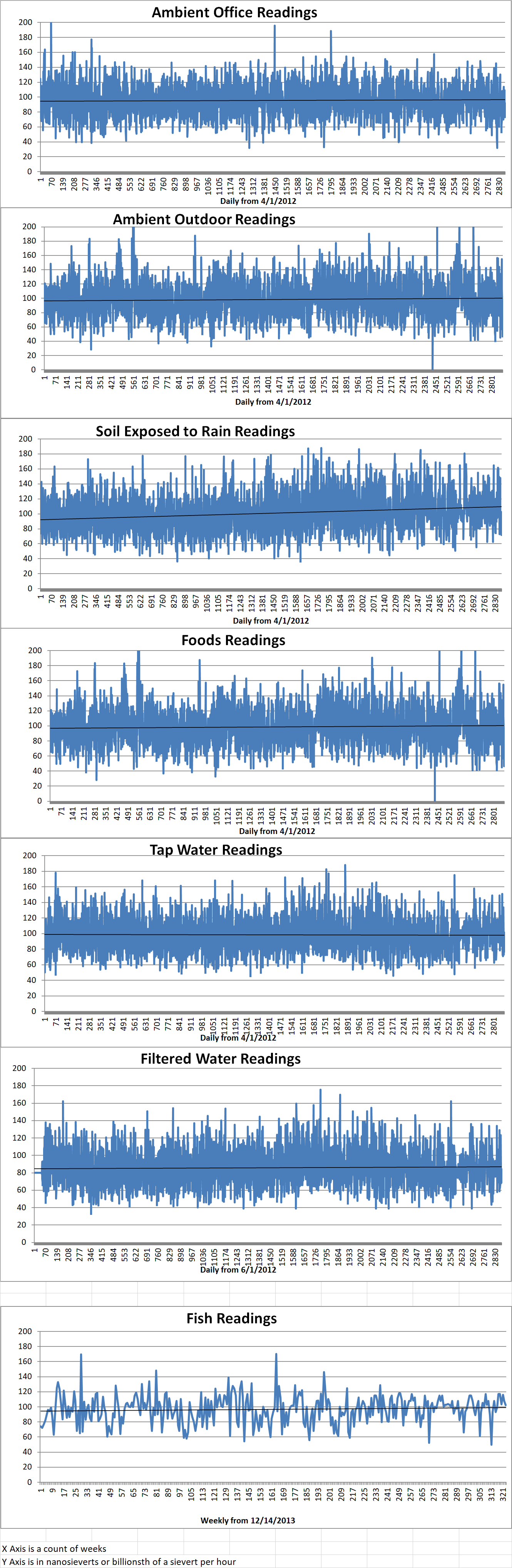
  • Geiger Readings for May 8, 2020

    Geiger Readings for May 8, 2020

    Ambient office  = 72 nanosieverts per hour

    Ambient outside = 115 nanosieverts per hour

    Soil exposed to rain water = 116 nanosieverts per hour

    English cucumber from Central Market = 126 nanosieverts per hour

    Tap water = 90 nanosieverts per hour

    Filtered water = 84 nanosieverts per hour

  • Nuclear Fusion 72 – University of Princeton And The Princeton Plasma Physics Laboratory Are Using Radio Waves To Control Plasma Instability

    Nuclear Fusion 72 – University of Princeton And The Princeton Plasma Physics Laboratory Are Using Radio Waves To Control Plasma Instability

        I have blogged before about the problems with magnetic confinement in nuclear fusion reactors such as stellarators and tokamaks. Now scientists from Princeton University and the Department of Energy’s Princeton Plasma Physics Laboratory (PPPL) may have found a way to deal with a problems that have been known for decades.
       Tokamaks are shaped like a donut. They use magnetic fields to trap a twisted donut of hydrogen plasma that is as hot as the sun. As the plasma moves around the reaction chamber, it is compressed by magnetic fields. The plasma must be kept from touching any part of the physical structure of the reaction chamber. The goal is to achieve a fusion reaction in the plasma that will generate a great deal more energy that the energy required to confine and heat the plasma.
        Unfortunately, there is a serious problem in stabilizing the plasma. As the plasma travels around the tokamak, “bubble-like” structures referred to as “magnetic islands” form. The Oak Ridge National Laboratory released a report back in 1974 that said, “These may be produced from helical current perturbations in the plasma. Physically the islands are a result of having a harmonic component of the radial component of the perturbed magnetic field in resonance with the unperturbed rational surface field lines, in the presence of shear.”
         When one of these islands disrupts the flow of the plasma, the tokamak can lose temperature to the point where it can take days or even months to restore. The plasma can also escape the safe zone and actually hit and damage the physical structure of the tokamak. Repairing such damage in expensive, difficult and time-consuming. For decades, fusion researchers have been working on ways of dealing with these islands. Such problems often end plasma streams that have been sustained for lengthy periods.
        It has been forty-six years since the Oak Ridge report and magnetic islands are still one of the major problems with the development of tokomaks. Stellarators were developed before tokamaks but fell out of favor with researchers even though it is claimed that they do a better job of controlling the configuration of the plasma than tokamaks. While the exterior of a tokamak is smooth, the surface of a stellarator is covered with hundreds of cylinders and rectangular compartments to hold the magnets that confine the plasma.
         The work at the U of P and the PPPL is a continuation of research that has been ongoing since the 1980s. Researchers found that injecting radio waves helped to stabilize the plasma stream and reduced the factors that led to islands disrupting the geometry of the plasma. In 2019, a new group of researchers identified a way to improve just how much help these radio waves could be when they were boosted by exploiting tiny fluctuations of temperature called perturbations.
        The researchers found that when they “deposit” radio frequency waves inside the magnetic islands, the islands can be suspended and prevented from growing. In the new research paper, researchers suggested that by the careful control and variation of the temperature of the plasma, they can magnify the controlling effects of radio waves.
        This nonlinear treatment of plasma temperature does introduce new variables that will need to be dealt with. The researchers are excited about the possibility of new plasma control schemes and other subsequent research.

  • Geiger Readings for May 7, 2020

    Geiger Readings for May 7, 2020

    Ambient office  = 92 nanosieverts per hour

    Ambient outside = 80 nanosieverts per hour

    Soil exposed to rain water = 72 nanosieverts per hour

    Avocado from Central Market = 47 nanosieverts per hour

    Tap water = 92 nanosieverts per hour

    Filtered water = 84 nanosieverts per hour

  • Nuclear Reactors 778 – The Volatile History Of The U.S. Uranium Market – Part 3 of 3 Parts

    Nuclear Reactors 778 – The Volatile History Of The U.S. Uranium Market – Part 3 of 3 Parts

    Part 3 of 3 Parts (Please read Parts 1 and 2 first)
       The U.S. nuclear industry got a boost in 1990 when the U.S. Department of Commerce put restrictions on the import of uranium from the Soviet Union which was dumping cheap uranium on the U.S. market.
        Unfortunately, the boost from the import restrictions ended a year later when the U.S. and Russia made a deal for the U.S. to buy five hundred tons of weapons-grade Russian uranium from the dismantling of old Soviet nuclear warheads. The Russians converted the highly enriched uranium to low enriched uranium suitable for burning in nuclear power plants. This Russian uranium supplied about one third of the U.S. nuclear industry for twenty years under the Megatons to Megawatts program. By the year 2000, U.S. uranium production dropped to its lowest level in fifty years.
        Around the year 2000, the former Soviet state of Kazakhstan ramped up uranium mining and quickly rose to the top of the global suppliers of uranium. They became the second biggest supplier of uranium to the U.S. Kazakhstan has very lax regulations which allow miners to use in situ leaching, a cheap method of extraction which has severe environmental consequences and helped boost Kazakhstan’s share of the uranium market.
         In the early 2000s, falling global stockpiles and booming economies in both China and India drove new uranium demands as these countries invested heavily in nuclear power. Unfortunately, the financial crisis of 2008 caused a crash in uranium demand. The Fukushima nuclear disaster in Japan in 2011 set of a new round of reactor closures and caused Germany to turn away from nuclear power completely. They plan to have closed all their reactors by 2022.
         The third surge in the uranium market had a very shaky start. The global strategic uranium reserves are in no danger of running out in the near future. In 2016, the International Atomic Energy Agency (IAEA) announced that their survey showed that the current global fleet of power reactors has sufficient stockpiles to operate for a hundred and thirty years. The global uranium market has the ability to quickly respond to any temporary shortfalls in the supply of uranium.
         The IAEA report said, “Regardless of the role that nuclear energy ultimately plays in meeting future electricity demand and moving towards global climate objectives, the uranium resource base … is more than adequate. In the wake of recent significant reductions in uranium production, the coming challenges are likely to be those associated with constrained investment capabilities …”
         More significant is the fact that an attempt to open up new mining permission in the western U.S. will definitely meet stiff resistance and widespread public backlash. For all of its problems and setbacks over the decades, nuclear power is still popular in the U.S. The turning point for that interest and support came in 2016 when the major of the U.S. citizenry turned against it. The last major poll taken in 2019 showed that the U.S. public is split in its attitude towards nuclear power. Forty nine percent of U.S. adults either strongly favor or somewhat favor nuclear power while forty nine percent either strongly oppose or somewhat oppose nuclear power.
        A 2020 Colorado College Conservation in the West poll discovered that seventy one percent of the voters in the Mountain West and seventy seven percent of the Arizona voters oppose the development of new uranium mines on public lands next to the Grand Canyon.

  • Geiger Readings for May 6, 2020

    Geiger Readings for May 6, 2020

    Ambient office  = 90 nanosieverts per hour

    Ambient outside = 91 nanosieverts per hour

    Soil exposed to rain water = 87 nanosieverts per hour

    Red bell pepper from Central Market = 76 nanosieverts per hour

    Tap water = 102 nanosieverts per hour

    Filtered water = 84 nanosieverts per hour

  • Nuclear Reactors 777 – The Volatile History Of The U.S. Uranium Market – Part 2 of 3 Parts

    Nuclear Reactors 777 – The Volatile History Of The U.S. Uranium Market – Part 2 of 3 Parts

    Part 2 of 3 Parts (Please read Part 1 first)
        The Nuclear Energy Institute (NEI) supports the proposals of the NFWG. They say that the creation of federal stockpile of uranium is important for the development of the next generation of nuclear technologies as well as advanced nuclear fuels.
         There are important benefits that would result from the development of a domestic nuclear stockpile such as the improvement of the U.S. uranium industry which produces a fuel that is critically important to the U.S. energy supply.
         In 2017, the U.S. uranium industry produced only two million four hundred thousand pounds of uranium concentrate known as U308. At the height of the U.S. uranium industry, forty-four million pounds were produced by domestic producers in 1980. Domestic U.S. nuclear power plants bought just seven percent of their uranium last year from domestic producers. This is a strong indication of the sad state of current U.S. uranium production. The U.S. has ninety-eight operational nuclear power reactors that generate over eight hundred terawatts per year. This is about twenty percent of the total electricity generated in the U.S. annually.
         One of the reasons for the poor state of the U.S. uranium industry is that fact that although the U.S. does have a lot of domestic deposits of uranium ore, those deposits are not as rich and accessible as those is some other countries such as Canada and Australia. Richer deposits mean lower production costs and prices. U.S. uranium mines have difficulty making profit even when the global price of uranium is high. The U.S. uranium industry has largely depended on help from the federal government to survive.
        The period from 1955 to 1980 is often considered to be the “golden age” of U.S. domestic uranium production. The U.S. gave out big uranium bonuses in order to expand its uranium stockpile during the Cold War. These bonuses included ten-year price guarantees for certain kinds of ore as well as ten thousand dollars discovery and production bonuses which amount to about a hundred thousand dollars in today’s dollars. These incentives and the high demand set off a “gold rush” in the western U.S. as miners rushed to find and exploit new uranium deposits. The incentive program was a great success and U.S. stockpiles exploded to the point where the bonuses were halted in the 1960s. Suddenly, an industry that had come to be very dependent on government incentives found itself without this source of income.
         By 1975, the U.S. government opened our domestic uranium market to a growing percentage of overseas suppliers. This opened the U.S. market to foreign suppliers such as Canada and Australia who could supply uranium at a lower price. By 1987, the uranium market in the U.S. had been turned upside down. The U.S. imported almost fifteen million pounds of uranium while domestic production was only about thirteen million pounds.
         Growing competition impacted domestic production. The long-term nuclear love affair of the U.S. public based on claims that nuclear power would be very cheap or even free crashed as economic reality set in. The Three Mile Island nuclear disaster in 1979 shocked the nation and turned much of the public against nuclear power. U.S. utilities grew tired of the time and cost required to design, license, build, operate and maintain nuclear power reactors and the demand for new builds fell. The result was that U.S. domestic uranium production fell to a thirty-five year low by the time the last big wave of reactors came online in 1990.
    Please read Part 3 next