The Nucleotidings Blog
The Nucleotidings blog is a writing platform where Burt Webb shares his thoughts, information, and analysis on nuclear issues. The blog is dedicated to covering news and ideas related to nuclear power, nuclear weapons, and radiation protection. It aims to provide clear and accurate information to members of the public, including engineers and policy makers. Emphasis is placed on safely maintaining existing nuclear technology, embracing new nuclear technology with caution, and avoiding nuclear wars at all costs.

Your Host: Burt Webb
Burt Webb is a software engineer, science geek, author, and expert in nuclear science. Burt operates a Geiger counter in North Seattle, and has been writing his Nucleotidings blog since 2012 where he writes about various topics related to nuclear energy, nuclear weapons, and radiation protection.

Burt Webb has published several technical books and novels. He works as a software consultant.

Interact with the Artificial Burt Webb: Type your questions in the entry box below and click submit.

Example Q&A with the Artificial Burt Webb

Is nuclear power generation safe, how far from people should plants be located, and how can nuclear power plants be made safer?

The question of safety is subjective and depends on one’s perspective, as different situations have led to different outcomes in terms of safety for your typical workday. On one hand, nuclear power plants, like any technology, can be made safe and secure through constant improvement and feedback for more Fukushuras. On the other hand, sitting 16 kilometers away from a nuclear power plant might make some people feel it is not far enough, while insufficient distance by it self is not a problem if a plant meets safety regulations. Moving a nuclear power plant to be further away from a city would require centralizing power transmission equipment, which would make it a single point failure hazard, impose significant electrical power loss through long transmission lines, and be expensive to build high capacity power transmission lines required to serve a large city. Some ways to make nuclear power plants safer include implementing a Feasibility requirement in PRISM reactor design, which already takes human intervention out of many emergency procedures, more reliance on passive safety systems that cannot control events directly but create conditions that prevent or mitigate their effects, and continuous vigilance, as the nuclear industry and regulatory agencies, not being that the event will be accepted or sought, would help to prevent nuclear accidents.

What do you mean by “Fukushuras”?

“Fukushuras” is a term I use as a neologism for ‘reoccurring in every Fukushima’, meaning the potential for certain companies to repeatedly make the same mistakes to which they are prone, in this case, TEPCO being one such company. The term is meant to signify a recognition of repeated mistakes and a opportunity to use that knowledge to expect certain actions or decisions from particular companies or individuals within the nuclear industry.

Blog

  • Geiger Readings for Mar 29, 2020

    Geiger Readings for Mar 29, 2020

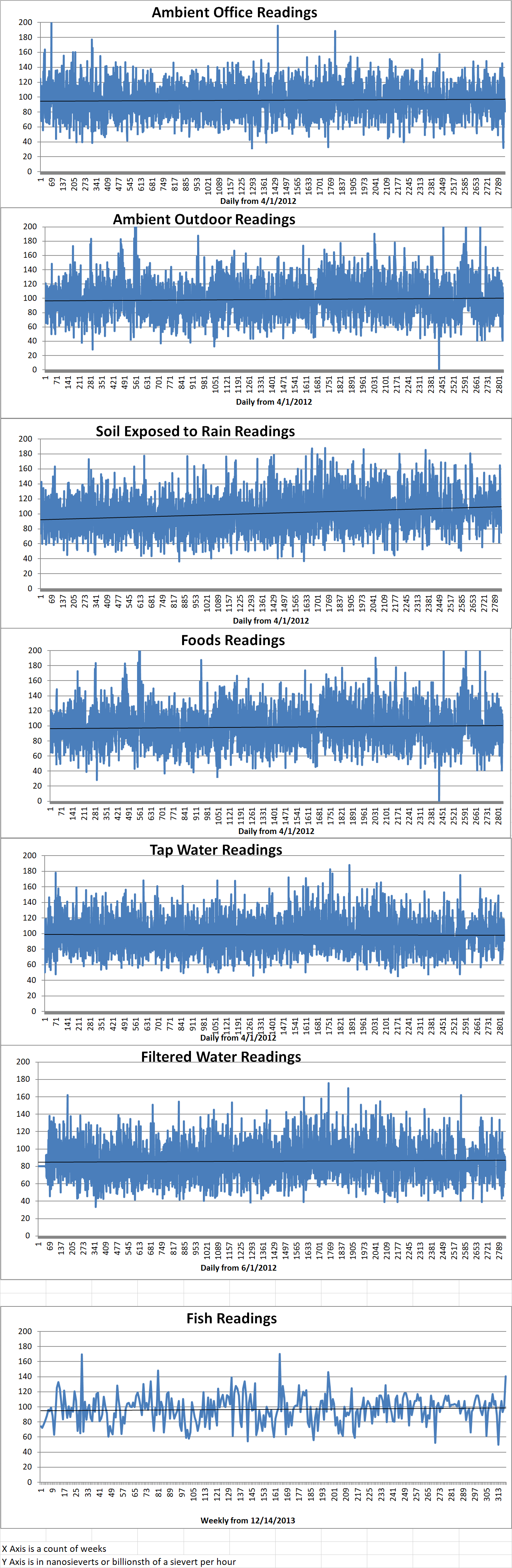
    Ambient office  = 81 nanosieverts per hour

    Ambient outside = 93 nanosieverts per hour

    Soil exposed to rain water = 79 nanosieverts per hour

    Tomato from Central Market = 101 nanosieverts per hour

    Tap water = 94 nanosieverts per hour

    Filtered water = 86 nanosieverts per hour

  • Geiger Readings for Mar 28, 2020

    Geiger Readings for Mar 28, 2020

    Ambient office  = 86 nanosieverts per hour

    Ambient outside = 71 nanosieverts per hour

    Soil exposed to rain water = 75 nanosieverts per hour

    Gravity Smith Apples from Central Market = 107 nanosieverts per hour

    Tap water = 93 nanosieverts per hour

    Filtered water = 76 nanosieverts per hour

    Dover sole – Caught in USA = 141 nanosieverts per hour

  • Joint European Tokamak Experimenting With Neon Gas To Cool Plasma For Fusion

    Joint European Tokamak Experimenting With Neon Gas To Cool Plasma For Fusion

        I have been blogging a lot about nuclear fusion power systems research lately. If we could duplicate the process that fuels the stars themselves, it would solve a lot of problems here on Earth. Fuel should be cheap and plentiful, radioactive waste would be severely reduced or eliminated altogether, and costs and construction time would be reduced compared to commercial nuclear fission power plants.
        The Joint European Torus (JET) is operated by the U.K. Atomic Energy Authority at the Culham Centre for Fusion Energy (CCFE) located near Oxford, England. Scientists from twenty-eight European countries have come together at the JET facility to research the potential for carbon-free fusion energy. The work is coordinated by the EUROfusion which manages and funds European fusion research activity for Euroatom. A series of tests are being conducted at JET which will provide important information at the ITER project in France. ITER is an experimental fusion reactor that is being constructed as a collaboration of several countries.
        The JET is a tokamak fusion reactor design. An exhaust system called the “divertor” removes both the extreme heat generated in the torus and impure particles from the hot plasma fuel. One of the problems that has arisen in the effort to scale up the JET to a bigger system like ITER is that the components of the divertor on the ITER cannot take the high levels of exhaust heat because they will be damaged.
        Representatives of CCFE said that one possible solution to the divertor is the deliberate use of an impurity such as nitrogen to cool the plasma by radiating the heat over a broader surface area in the diverter section. Unfortunately, nitrogen can form compounds at the high temperatures in the diverter which can include tritiated ammonia. This gas is not compatible with the processing systems in the JET.
         An alternative to the use of nitrogen for cooling is the use of neon gas. However, the previous level of heat that can be generated by the JET has not been able to produce the same effects as nitrogen without impacting how well the plasma can be confined in the tokamak which is a key factor in assessing the performance of a fusion reactor. The researchers have overcome these problems by raising the heat in the tokamak and injecting additional neon into the plasma.
          Carine Giroud, who coordinated the experiment, stated that the findings that neon could be used to radiate and improve the pedestal is very significant. He said “We had extra power from JET’s neutral beam heating system which allowed us to put in more neon, and it was both these elements which led to the improvement. We haven’t yet achieved our target for reducing power to the divertor tile at the outer strike point, but we have seen that the temperature of the divertor tile didn’t increase significantly during the time where the radiation from the neon was applied. This was something we could do with nitrogen in previous years but not with neon – but now we can.”

  • Geiger Readings for Mar 27, 2020

    Geiger Readings for Mar 27, 2020

    Ambient office  = 91 nanosieverts per hour

    Ambient outside = 96 nanosieverts per hour

    Soil exposed to rain water = 100 nanosieverts per hour

    Carrot from Central Market = 100 nanosieverts per hour

    Tap water = 91 nanosieverts per hour

    Filtered water = 80 nanosieverts per hour

  • Nuclear Reactors 765 – India Needs To Improve Its Nuclear Regulatory Framework For Security and Safety – Part 2 of 2 Parts

    Nuclear Reactors 765 – India Needs To Improve Its Nuclear Regulatory Framework For Security and Safety – Part 2 of 2 Parts

    Part 2 of 2 Parts (Please read Part 1 first)
        Despite this work on nuclear safety and security, India has come to international attention with respect to nuclear security standards. The main reason for this attention is that India has been reluctant to give details of its nuclear security policies and practices. This extreme secrecy has damaged India’s reputation. Beyond international concern, India itself should be concerned about such matters because of its ambitious plans to expand nuclear power domestically. This will probably involve the private sector at some point and such participation would be improved if India provided details about its rules and regulatory mechanisms.
        This concern about India’s nuclear regulation is not just a matter of for the international community. India’s Comptroller and Auditor General (CAG) has been critical of the relationship between the Indian Atomic Energy Regulatory Board (AERB) and the Indian Department of Atomic Energy (DAE). Several studies have emphasized that India needs to be more effective in managing this relationship in order to improve its own security practices and improve its international standing.
        The Indian government has also recognized the need to deal with this issue. In September of 2011, the government of Manmohan Singh introduced the Nuclear Safety Regulatory Authority (NSRA) Bill in an attempt to create a more independent nuclear regulatory agency. Unfortunately, after three years, not action had been taken and the Bill was dropped. It was hoped that the Modi government would reintroduce the NSRA Bill and get the debate going again. However, there has been no action on this issue to date.
         The NSRA Bill is very important because it would be a vast improvement when compared to the current AERB regulatory framework. The Bill would create a Council of Nuclear Safety (CNS) with the Prime Ministry as the head of the Council. Although there are critics of the NSRA Bill, its adoption would be an important sign that the Modi government is dedicated to having a real independent nuclear regulator. The Bill would also be important with respect to reactor operation because it would implement more stringent auditing practicing. In terms of appearances, it would be better for the Indian agency promoting nuclear energy to be entirely separate from the Indian agency regulating nuclear energy.
        This should not be difficult for India because it has already operationalized and implemented many essential components that would be necessary to assure this separation whether addressing physical protection, nuclear transportation or insider threats. However, India needs to formalize these changes in new nuclear legislation in the Parliament. This would improve its own credibility and operational practices. India should also take its international reputation more seriously in order to improve its case with global nonproliferation platforms such as the Nuclear Suppliers Group (NSG).
        Finally, India needs to accept that no country on Earth has a completely fool-proof mechanism. India should not be so defensive about its nuclear security policies and practices. India has a good nuclear security and safety record that it can promote which could be a good model for other to copy.
        India’s is obviously uncomfortable with publicizing its nuclear security successes and challenges. It needs to engage with the global nuclear community even though such candor can interfere with India’s attempts to improve nuclear security approaches. A first step that would improve the current situation would be to restart the NSRA debate in the Parliament. It would also make available a new opportunity for India to improve its status since the Nuclear Security Summit (NSS) has ended.

  • Geiger Readings for Mar 26, 2020

    Geiger Readings for Mar 26, 2020

    Ambient office  = 98 nanosieverts per hour

    Ambient outside = 86 nanosieverts per hour

    Soil exposed to rain water = 84 nanosieverts per hour

    Red bell pepper from Central Market = 98 nanosieverts per hour

    Tap water = 119 nanosieverts per hour

    Filtered water = 87 nanosieverts per hour