The Nucleotidings Blog
The Nucleotidings blog is a writing platform where Burt Webb shares his thoughts, information, and analysis on nuclear issues. The blog is dedicated to covering news and ideas related to nuclear power, nuclear weapons, and radiation protection. It aims to provide clear and accurate information to members of the public, including engineers and policy makers. Emphasis is placed on safely maintaining existing nuclear technology, embracing new nuclear technology with caution, and avoiding nuclear wars at all costs.

Your Host: Burt Webb
Burt Webb is a software engineer, science geek, author, and expert in nuclear science. Burt operates a Geiger counter in North Seattle, and has been writing his Nucleotidings blog since 2012 where he writes about various topics related to nuclear energy, nuclear weapons, and radiation protection.

Burt Webb has published several technical books and novels. He works as a software consultant.

Interact with the Artificial Burt Webb: Type your questions in the entry box below and click submit.

Example Q&A with the Artificial Burt Webb

Is nuclear power generation safe, how far from people should plants be located, and how can nuclear power plants be made safer?

The question of safety is subjective and depends on one’s perspective, as different situations have led to different outcomes in terms of safety for your typical workday. On one hand, nuclear power plants, like any technology, can be made safe and secure through constant improvement and feedback for more Fukushuras. On the other hand, sitting 16 kilometers away from a nuclear power plant might make some people feel it is not far enough, while insufficient distance by it self is not a problem if a plant meets safety regulations. Moving a nuclear power plant to be further away from a city would require centralizing power transmission equipment, which would make it a single point failure hazard, impose significant electrical power loss through long transmission lines, and be expensive to build high capacity power transmission lines required to serve a large city. Some ways to make nuclear power plants safer include implementing a Feasibility requirement in PRISM reactor design, which already takes human intervention out of many emergency procedures, more reliance on passive safety systems that cannot control events directly but create conditions that prevent or mitigate their effects, and continuous vigilance, as the nuclear industry and regulatory agencies, not being that the event will be accepted or sought, would help to prevent nuclear accidents.

What do you mean by “Fukushuras”?

“Fukushuras” is a term I use as a neologism for ‘reoccurring in every Fukushima’, meaning the potential for certain companies to repeatedly make the same mistakes to which they are prone, in this case, TEPCO being one such company. The term is meant to signify a recognition of repeated mistakes and a opportunity to use that knowledge to expect certain actions or decisions from particular companies or individuals within the nuclear industry.

Blog

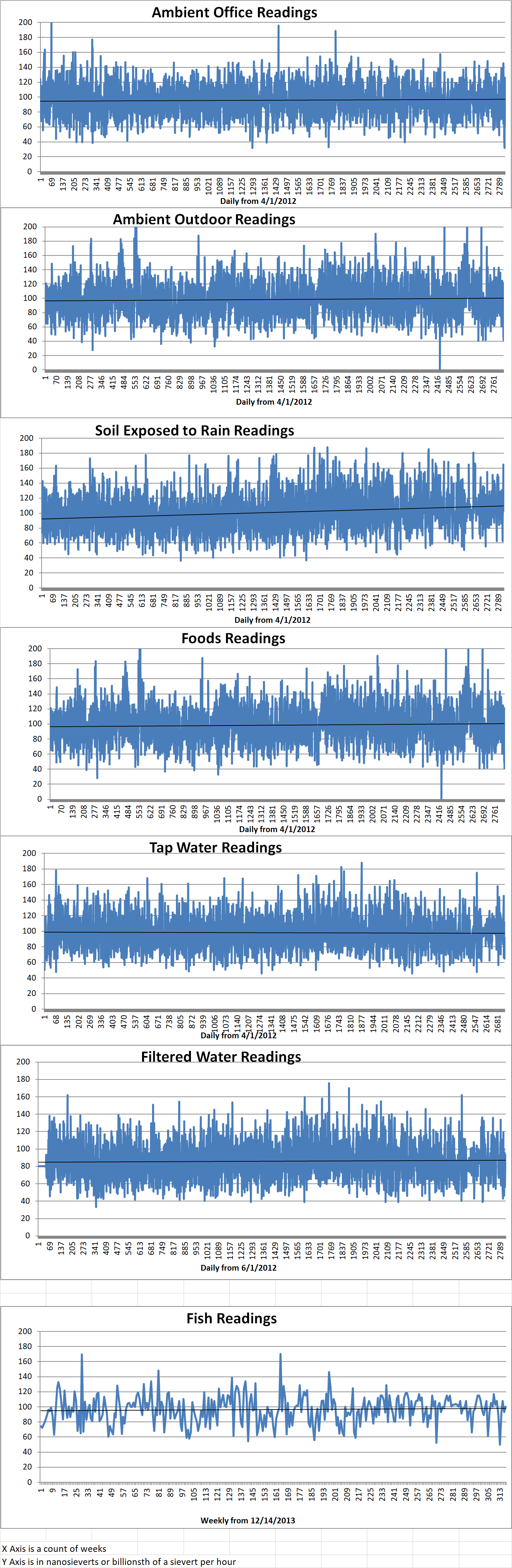
  • Geiger Readings for Mar 22, 2020

    Geiger Readings for Mar 22, 2020

    Ambient office  = 122 nanosieverts per hour

    Ambient outside = 118 nanosieverts per hour

    Soil exposed to rain water = 118 nanosieverts per hour

    Yam from Central Market = 31 nanosieverts per hour

    Tap water = 104 nanosieverts per hour

    Filtered water = 87 nanosieverts per hour

  • Geiger Readings for Mar 21, 2020

    Geiger Readings for Mar 21, 2020

    Ambient office  = 126 nanosieverts per hour

    Ambient outside = 103 nanosieverts per hour

    Soil exposed to rain water = 103 nanosieverts per hour

    English cucumber from Central Market = 46 nanosieverts per hour

    Tap water = 100 nanosieverts per hour

    Filtered water = 93 nanosieverts per hour

    Dover sole – Caught in USA = 119 nanosieverts per hour

  • New Radiocarbon Dating Refinements Call For Adjusting Dates Of Historical Artifacts

    New Radiocarbon Dating Refinements Call For Adjusting Dates Of Historical Artifacts

        Radiocarbon dating was invented in the late 1940s. It has been continuously improved to provide more accurate measurements. It is the standard techniques for identifying the dates of artifacts in archeology and other scientific disciplines.
       Stuart Manning is the Goldwin Smith Professor of Classical Archaeology in the College of Arts and Sciences at Cornell University. Manning says, “If it’s organic and old — up to 50,000 years — you date it by radiocarbon.” Manning is the lead author of a new paper published in March in the journal Science Advances. In his paper, Manning makes a case for the need to further refine the radiocarbon dating technique. The results of his research have great relevance for understanding Mediterranean history and prehistory.
         Carbon-14 is an unstable radioactive isotope of carbon. It is created by cosmic radiation and it is present in all organic matter. The flux of cosmic radiation is not constant. In order to take into account fluctuations in cosmic radiation in the atmosphere of the Earth, scientists use the radiocarbon content of tree rings whose ages are known going back thousands of years. Radiocarbon dating measures the decomposition of Carbon-14.
        The wide use of radiocarbon dating began around 1970. In 1986, scientists developed a standard calibration curve. The curve is updated every few years as more data is accumulated. Manning said, “A single Northern Hemisphere calibration curve has formed the basis of radiocarbon dating in Europe and the Mediterranean for five decades, setting the time frame for prehistory. However, as measurement precision increases, there is mounting evidence for some small but substantive regional (partly growing season) offsets in the same-year radiocarbon levels.”
        In the study conducted by Manning and his team, they raised the question of the accuracy of using a single calibration curve for all of the Northern Hemisphere. One laboratory collected information to control for interlaboratory variations. With this data, Manning and his team compared radiocarbon dating from Germany and Central Turkey in the first and second millennia B.C. The researchers found that there were small but critical periods of variation for the radiocarbon dating of these two locations. Other laboratories had taken samples from central Italy and northern Turkey which confirmed the consistency of the variations between these two areas.
          One reason for the variation involves the growing season according to Manning’s report. The radiocarbon level on Earth depends on the season. There is a winter low level and a summer high level. The carbon in a tree ring is related to the time that the tree is photosynthesizing. This process involves the tree in absorbing carbon dioxide from the atmosphere. Manning said, “In northern Europe or in North America, a tree is going to be doing this in April through September. But a tree in Jordan or Israel does that October through April — almost the opposite time of the year.” These variations are small but they can affect the calendar dates for prehistorical artifacts by as much as a few decades.
          Even date offsets of fifty years or less can have a significant effect on constructing the timeline of the Mediterranean region. This region was a hotbed of related cultures in the last two centuries B.C. The dates adjusted by the research of Manning have helped to synchronize previously discordant dates for some historically important events. These events include the death and burial for the Egyptian Pharaoh Tutankhamun. This happened between 1320 and 1310 B.C. according to recent work in Egyptology.
        Manning’s research has also contributed to a debate over the date of a huge volcanic eruption on the Greek island of Santorini. This event has been extensively studied and is currently dated around 1500 B.C. by archeologists but is dated to between 1630 and 1600 B.C. by scientists. According to Manning, his work indicates that the eruption could not have occurred around the 1500 B.C. date. The 1630 to 1600 B.C. period is still possible with respect to Manning’s new dating but a later date in the 1600 to 1550 B.C. period is also possible and this is more in accord with existing archaeological and historical records.
        Manning’s research also has important implications for which ancient culture influenced both the Minoans and the Mycenaeans. These cultures were the foundation for the culture of ancient Greece. Manning said, “Getting the date right will rewrite and get our history correct in terms of what groups were significant in shaping what then became classical civilization. An accurate timeline is key to our history.”
         Manning predicts that follow-up studies will lead to more regionally specific regional calibration for the Northern Hemisphere. This should lead to more adjustments of the dates for historical artifacts.
         Grants from the U.S. National Science Foundation and the Canadian Social Science and Humanities Research Council funded Manning’s research.

  • Geiger Readings for Mar 20, 2020

    Geiger Readings for Mar 20, 2020

    Ambient office  = 64 nanosieverts per hour

    Ambient outside = 129 nanosieverts per hour

    Soil exposed to rain water = 129 nanosieverts per hour

    Broccoli from Central Market = 52 nanosieverts per hour

    Tap water = 103 nanosieverts per hour

    Filtered water = 91 nanosieverts per hour

  • Nuclear Fusion 70 – Permanent Magnets May Be A Gamechanger For Stellarator Fusion Reactors

    Nuclear Fusion 70 – Permanent Magnets May Be A Gamechanger For Stellarator Fusion Reactors

        I have been writing about nuclear fusion lately. A great deal of current research is being conducted with tokamaks which are donut shaped cavities surrounded by superconducting electromagnets to heat, compress, and confine a hydrogen plasma. A stellarator was an early design concept in which the cavity was twisted from the tokamak donut configuration to more of a figure eight. This helped confine the plasma through magnetic field geometry. Although the stellarator was invented in 1951, problems with plasma confinement and heating have discouraged the idea of trying to build a commercial fusion reactor according to that design for many years.
         Michael Zarnstorff at the Max Planck-Princeton Research Center for Plasma Physics and three other researchers are working on a new concept for stellarators that is based on the use of permanent magnets instead of electromagnets. In a new paper about their work, he said, “It is shown that the magnetic-field coils of a stellarator can, at least in principle, be substantially simplified by the use of permanent magnets.”  
         In a permanent magnet, the magnetic field is caused by the chemical elements involved as well as the arrangement of domains in the material. In an electromagnetic, the magnetic field is a result of passing an electric current through a metal coil. Permanent magnets cannot generate the necessary plasma flux in a stellarator. Zarnstorff says that they have other ways of shaping the flux of the plasma to control it.
        The stability of a tokamak or stellarator in dependent on careful management of the shape and strength of the magnetic field inside. Extremely hot moving plasma has a very corrosive effect on any containment vessel. The process of corrosion can reduce the temperature of the plasma and move it out of the energy producing zone. This is the part of the stellarator design that can be improved by permanent magnetics.
         Permanent magnets cannot be used to generate the entire magnetic field necessary for the stellarator. However, they can supplement the field generated by the electromagnetics and add necessary structure to the field. The repost says, “Such magnets cannot produce toroidal magnetic flux, but they can create poloidal flux and rotational transform of the magnetic field, and thus help to simplify stellarator design.”
        “In the original design, the magnetic field was created by 20 nonplanar, modular coils of 5 different types. Leaving permanent magnets to do most of the plasma shaping, a new optimization was now carried out where only 8 identical, planar, circular toroidal-field coils proved necessary.”
        Permanent magnets are fixed solids and do not require any special equipment or injection of energy. When they are used to replace complicated electromagnetic coils in stellarators it makes design and construction simpler. In addition, it is easier to generate and maintain the high temperature needed in the plasma.
        Tokamaks and stellarators are just two of the designs being explored for the creation of a nuclear fusion reactor. Other designs fire lasers into a hydrogen pellet. A company in Seattle Washington is working on a system that uses powerful electromagnets to squeeze a magnetic field around a cloud of deuterium and helium-3 to send out pulses of electricity. There are at least a half-dozen different approaches to nuclear fusion being developed for commercial nuclear fusion by startups around the U.S. Time will tell if any of them can be the basis of electricity generated by the fusion process.

  • Geiger Readings for Mar 19, 2020

    Geiger Readings for Mar 19, 2020

    Ambient office  = 58 nanosieverts per hour

    Ambient outside = 165 nanosieverts per hour

    Soil exposed to rain water = 165 nanosieverts per hour

    Red bell pepper from Central Market = 121 nanosieverts per hour

    Tap water = 96 nanosieverts per hour

    Filtered water = 87 nanosieverts per hour

  • Nuclear Fusion 69 – Breakthrough In Hydrogen Injection For Fusion Reactors – Part 2 of 2 Parts

    Nuclear Fusion 69 – Breakthrough In Hydrogen Injection For Fusion Reactors – Part 2 of 2 Parts

    Part 2 of 2 Parts (Please read Part 1 first)
        The phys.org article says, “The experiments revealed a significantly higher pressure of plasma—a key to fusion reactions—using hydrogen ice compared to gas injection when the rate of fueling is roughly evenly matched between the two methods.”
        There is currently a great deal of research into nuclear fusion. At least a half dozen companies in the U.S. alone are working on fusion reactor designs based on a number of different approaches with different fuels. The race is on to develop a nuclear fusion reactor prototype that can be the basis of commercial nuclear fusion power. Nuclear fusion is much cleaner than nuclear fission which is the basis of the global commercial nuclear power industry. Some designs for fusion reactors only need hydrogen gas, other designs may include deuterium, tritium, helium-3 or ions of lithium. These are all much safer that the heavy radioactive elements which are the basis of nuclear fission. The waste left behind by nuclear fission are dangerously radioactive for thousands of years and are piling up around the planet because no one has yet constructed a permanent geological repository although there are several test repositories being built. With respect to the return on energy and fuel expended, nuclear fusion is several times more powerful than nuclear fission. However, while we developed techniques to extract power from nuclear fission reactions decades ago, we have still not managed to build a nuclear fusion reactor which is able to generate more energy than it consumers even thought decades of research and billions of dollars have been invested.
        Nuclear fusion for power generation may still be decades away but a great deal of progress has been made. ITER is a huge international cooperative effort to achieve break-even nuclear fusion where as much energy is generated as is put into the reactor to trigger the fusion reaction. The ITER reactor is being constructed in France with money and components from a number of countries. Last summer, ITER announced that in seven years, they would have the first live tests with plasma in their tokamak. In August of 2019, the Oak Ridge National Laboratory operated by the DoE reported another important breakthrough which applies new artificial intelligence developments and super computers to scaling up nuclear fusion reactors and successfully manage the plasma in the reactor. Last October, the Los Alamos National Laboratory’s Plasma Liner Experiment announced that their complex combination of plasma guns, powerful magnet and super lasers in a hybrid approach to fusion will be operational later this year. Last month, an Australian fusion startup named HB11 began acquiring patents for their approach to nuclear fusion.
        The development of a better approach to the injection of hydrogen into nuclear power reactors mentioned above at the start of this blog post means that the achievement of commercial nuclear fusion power is getting closer and closer. The implications of the development of a practical commercial nuclear fusion reactor are profound and far-reaching for the future of human civilization. The availability of virtually endless cheap zero-carbon energy that would be made possible by nuclear fusion may be the decisive factor in the expansion of humanity into space.