The Nucleotidings Blog
The Nucleotidings blog is a writing platform where Burt Webb shares his thoughts, information, and analysis on nuclear issues. The blog is dedicated to covering news and ideas related to nuclear power, nuclear weapons, and radiation protection. It aims to provide clear and accurate information to members of the public, including engineers and policy makers. Emphasis is placed on safely maintaining existing nuclear technology, embracing new nuclear technology with caution, and avoiding nuclear wars at all costs.

Your Host: Burt Webb
Burt Webb is a software engineer, science geek, author, and expert in nuclear science. Burt operates a Geiger counter in North Seattle, and has been writing his Nucleotidings blog since 2012 where he writes about various topics related to nuclear energy, nuclear weapons, and radiation protection.

Burt Webb has published several technical books and novels. He works as a software consultant.

Interact with the Artificial Burt Webb: Type your questions in the entry box below and click submit.

Example Q&A with the Artificial Burt Webb

Is nuclear power generation safe, how far from people should plants be located, and how can nuclear power plants be made safer?

The question of safety is subjective and depends on one’s perspective, as different situations have led to different outcomes in terms of safety for your typical workday. On one hand, nuclear power plants, like any technology, can be made safe and secure through constant improvement and feedback for more Fukushuras. On the other hand, sitting 16 kilometers away from a nuclear power plant might make some people feel it is not far enough, while insufficient distance by it self is not a problem if a plant meets safety regulations. Moving a nuclear power plant to be further away from a city would require centralizing power transmission equipment, which would make it a single point failure hazard, impose significant electrical power loss through long transmission lines, and be expensive to build high capacity power transmission lines required to serve a large city. Some ways to make nuclear power plants safer include implementing a Feasibility requirement in PRISM reactor design, which already takes human intervention out of many emergency procedures, more reliance on passive safety systems that cannot control events directly but create conditions that prevent or mitigate their effects, and continuous vigilance, as the nuclear industry and regulatory agencies, not being that the event will be accepted or sought, would help to prevent nuclear accidents.

What do you mean by “Fukushuras”?

“Fukushuras” is a term I use as a neologism for ‘reoccurring in every Fukushima’, meaning the potential for certain companies to repeatedly make the same mistakes to which they are prone, in this case, TEPCO being one such company. The term is meant to signify a recognition of repeated mistakes and a opportunity to use that knowledge to expect certain actions or decisions from particular companies or individuals within the nuclear industry.

Blog

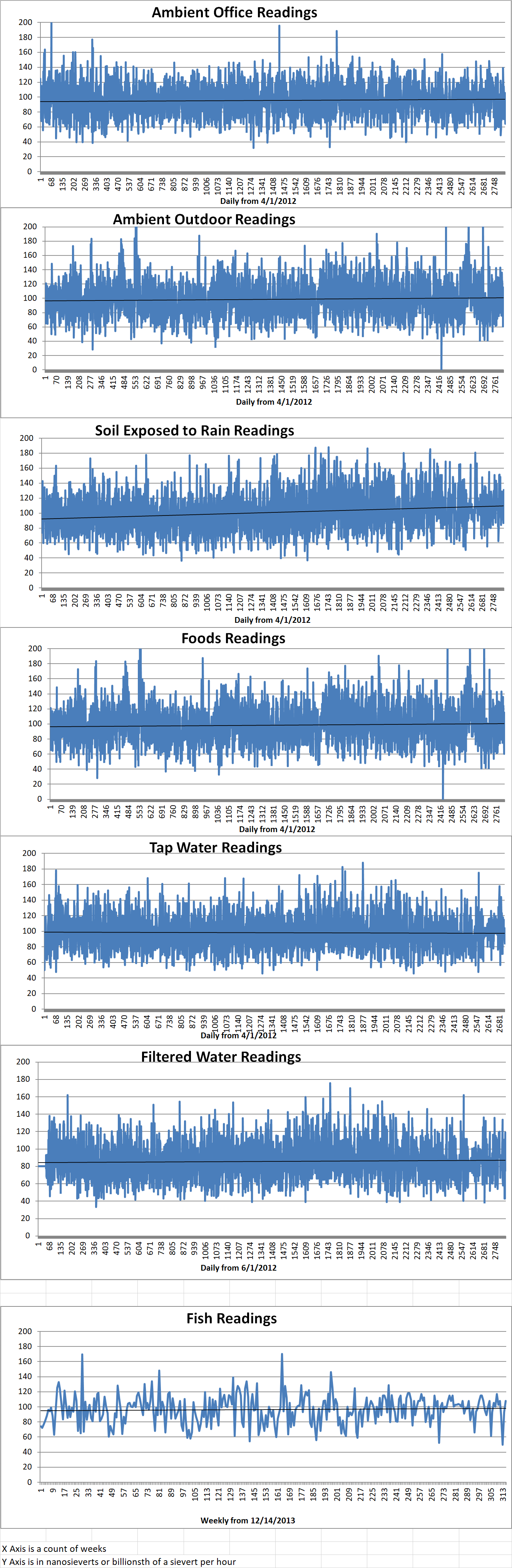
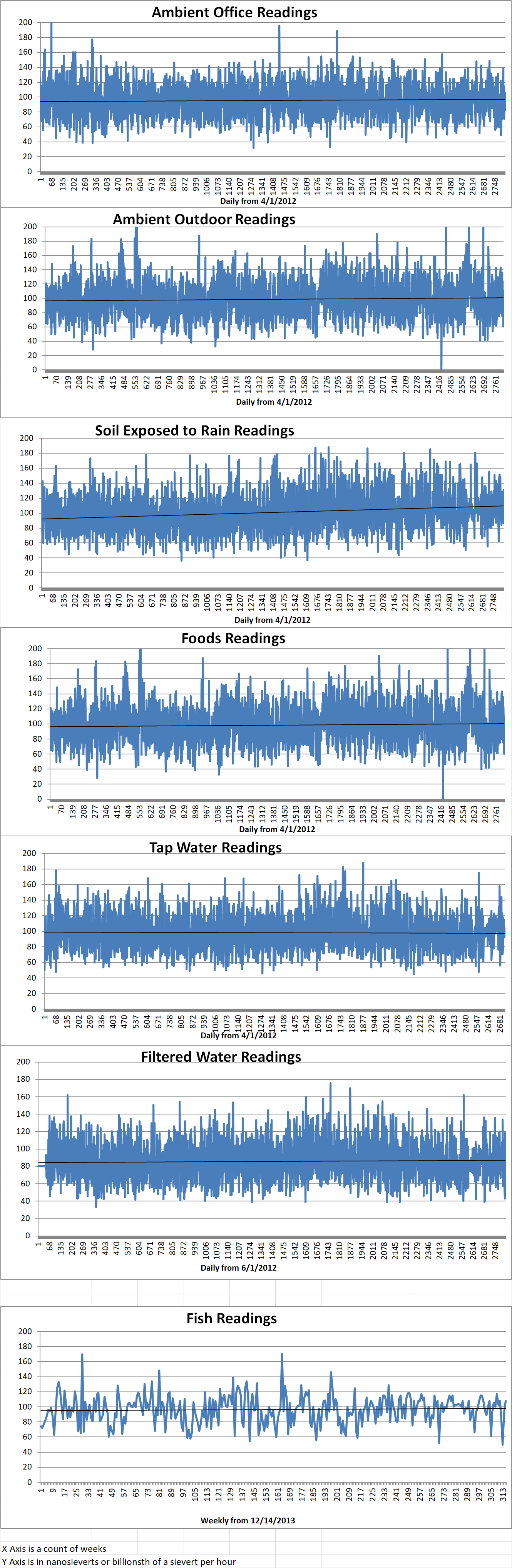
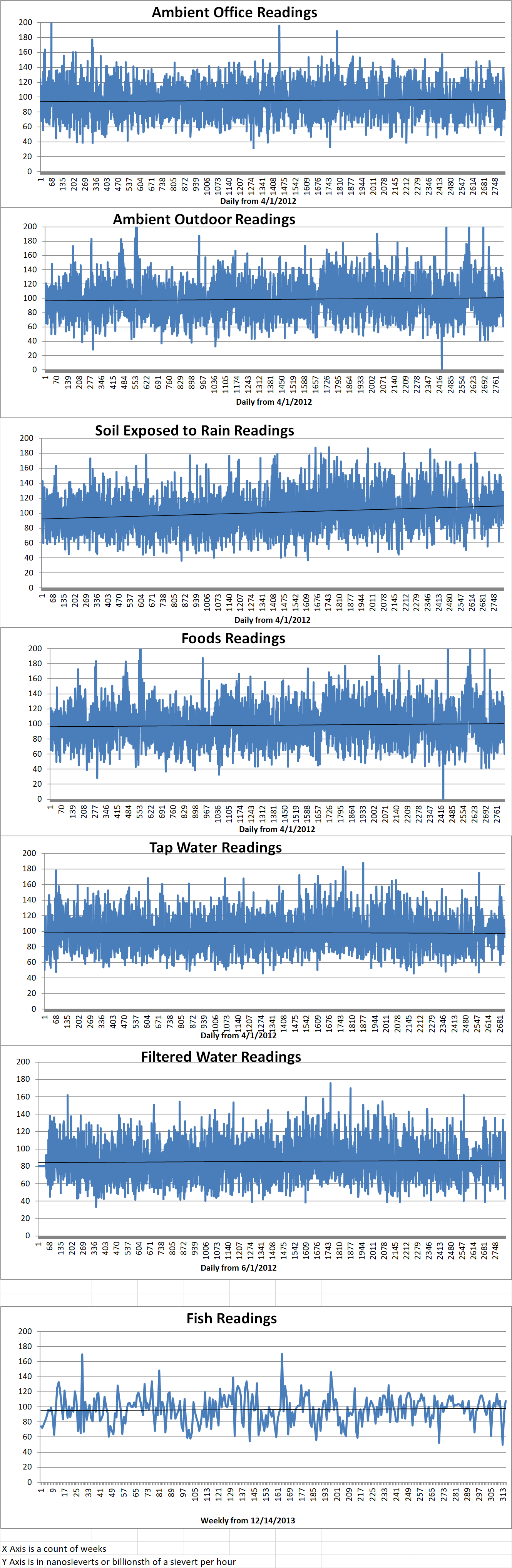
  • Geiger Readings for Mar 11, 2020

    Geiger Readings for Mar 11, 2020

    Ambient office  = 64 nanosieverts per hour

    Ambient outside = 123 nanosieverts per hour

    Soil exposed to rain water = 123 nanosieverts per hour

    Red bell pepper from Central Market = 115 nanosieverts per hour

    Tap water = 83 nanosieverts per hour

    Filtered water = 75 nanosieverts per hour

  • Nuclear Reactors 760 – Belarus And The United Arab Emirates Will Soon Start Up Their First Nuclear Power Reactor

    Nuclear Reactors 760 – Belarus And The United Arab Emirates Will Soon Start Up Their First Nuclear Power Reactor

         The International Atomic Energy Agency (IAEA) has just finished a twelve day Integrated Nuclear Infrastructure Review (INIR) mission to Belarus. The review is intended to analyze the infrastructure development of the country with respect to its first nuclear power reactor. Belarus is ready to complete the construction of its first nuclear power plant this year.
        Belarus’s first nuclear power plant will be located 80 miles north-west of Minsk, the capitol of Belarus. The Ostrovets 1 nuclear power reactor will be a VVER-1200 Russian reactor that will produce one thousand two hundred megawatts. The Ostrovets 2 reactor will be finished by 2021 and connected to the national grid. It will also be a VVER-1200 Russian reactor that produces one thousand two hundred megawatts.
       Belarus decided that it needed nuclear power in order to reduce its dependency on Russia. In order to reduce Russian dependency by twenty five percent, Belarus developed a 2011 to 2020 plan. This plan promoted the Ostrovet 1 and 2 reactors but also supported hydroelectric and wind power projects.
         Mikhail Chudakov is the IAEA deputy director- general. He said, “Developing the infrastructure required for a nuclear power program requires significant financial and human resources, and long lead times for preparation and the construction activities. Belarus has made commendable progress since the decision to launch a nuclear power program 10 years ago.”
         The IAEA utilized its Milestone approach to review the Belarus nuclear program. This approach was designed specifically to help countries develop their first nuclear program. The aim of the IAEA review is to assist states in achieving “the commitments and obligations associated with developing a nuclear power program.”
         Mikhail Mikhadyuk is the Belarus deputy energy minister. He said, “Hosting the INIR mission, Belarus demonstrated its transparency and genuine interest to receive an objective professional assessment of the readiness of its nuclear power infrastructure for the commissioning of the country’s first nuclear power plant.”
        The Barakah 1 will be the first United Arab Emirates first nuclear power plant as well as the first nuclear power plant in the Arab world. This project was developed as a joint venture between Saudi Nawah Energy and the South Korean utility company KEPCO. It will become operational and produce electricity for the national grid in the next few months. The Barakah nuclear power plant will ultimately consist of four APR-1400 nuclear power reactors which will generate a total of five thousand six hundred megawatts. The construction site is in Abu Dhabi on the coast between the Persian Gulf and the E11 highway, thirty one miles from Ruwais.
         Johnathan Cobb is the World Nuclear Association’s communication manager. He said in an interview, “With the UAE and Belarus expected to start up their first reactors this year, we are seeing the first of a new wave of countries choosing to use nuclear energy to help transition to a cleaner energy mix. They will soon be joined by reactors currently under construction in Turkey and Bangladesh, with plans for new construction well advanced in countries such as Egypt and Uzbekistan.”

  • Geiger Readings for Mar 10, 2020

    Geiger Readings for Mar 10, 2020

    Ambient office  = 106 nanosieverts per hour

    Ambient outside = 130 nanosieverts per hour

    Soil exposed to rain water = 131 nanosieverts per hour

    Crimini mushroom from Central Market = 90 nanosieverts per hour

    Tap water = 121 nanosieverts per hour

    Filtered water = 100 nanosieverts per hour

  • Nuclear Reactors 759 – Metanalysis of Nuclear Power Shows That It Emits More CO2 Than Most Renewable Energy Sources

    Nuclear Reactors 759 – Metanalysis of Nuclear Power Shows That It Emits More CO2 Than Most Renewable Energy Sources

         One response of nations concerned with climate change mitigation is that there needs to be a massive build up of nuclear power plants which are considered to be zero-carbon energy sources by many. Uranium is actually a fossil fuel. It exists naturally in the ground and is dug up to be used. The idea that nuclear power generates carbon free electricity is a lie promulgated by lobbyists and politicians on behalf of the nuclear industry. Considered from the point of view of the entire life cycle of nuclear reactors, nuclear power is most certainly not a zero-carbon energy source.
        The truth is that at every stage of the generation of electricity with nuclear energy large quantities of fossil fuels are burned. This includes the mining of uranium, the transportation, milling and enrichment of the ore to make a substance called “yellow cake” which is a high-grade uranium powder. The yellow cake is processed into pellets which are made into fuel rods. Then the fuel rods must be transported to one of the ninety six operational nuclear power reactors in the U.S. All U.S. uranium processing and fuel rod production facilities are powered by the U.S. electrical grid which receives at least sixty four percent of its electricity from other fossil fuel sources.
        All of the U.S. commercial nuclear power plants are tied to the U.S. electrical grid. They are connected to the grid to send their electricity to consumers and to receive electricity from the grid to power operations during reactor shutdowns, startups and operations. A huge amount of carbon dioxide is produced during the construction and decommissioning of nuclear power plants.
         Dr. Benjamin K. Sovacool is a professor of Energy Policy at the University of Sussex in the United Kingdom. In 2008, he analyzed over a hundred studies in order to obtain a best estimate of the emissions from nuclear power plants. He found that the mean value of carbon dioxide emission over the lifetime of a commercial nuclear power reactor is sixty-six grams per kilowatt-hour of electricity. That amounts to sixty six grams of CO2 per kilowatt-hour multiplied by twenty four hours in a day, multiplied by three hundred and sixty five days in a year, times the estimated operation life time of forty years for a total of about twenty three million grams of carbon dioxide that would be discharged into the atmosphere over the lifespan of the reactor.
        Twenty-three million grams of carbon dioxide is equivalent to about twenty-five and a half tons of CO2 emissions. When twenty-five and a half tons is multiplied by the ninety-six operational nuclear power reactors, that amounts to a grand total of two and one half thousand tons of CO2 emissions from nuclear power reactors in the U.S. This is obviously not an example of “carbon-free energy”.
         The metanalysis concluded that the commercial nuclear power plants in the U.S. emit more greenhouse gases than the majority of renewable energy sources. Since its publication, the article about the metanalysis has been cited hundreds of times and is considered to be definitive. As climate change accelerates, it would be a mistake to make a massive investment in nuclear power.

  • Geiger Readings for Mar 09, 2020

    Geiger Readings for Mar 09, 2020

    Ambient office  = 83 nanosieverts per hour

    Ambient outside = 99 nanosieverts per hour

    Soil exposed to rain water = 97 nanosieverts per hour

    Broccoli from Central Market = 108 nanosieverts per hour

    Tap water = 103 nanosieverts per hour

    Filtered water = 95 nanosieverts per hour

  • Geiger Readings for Mar 08, 2020

    Geiger Readings for Mar 08, 2020

    Ambient office  = 96 nanosieverts per hour

    Ambient outside =87 nanosieverts per hour

    Soil exposed to rain water = 87 nanosieverts per hour

    Blueberry from Central Market = 60 nanosieverts per hour

    Tap water = 127 nanosieverts per hour

    Filtered water = 119 nanosieverts per hour