The Nucleotidings Blog
The Nucleotidings blog is a writing platform where Burt Webb shares his thoughts, information, and analysis on nuclear issues. The blog is dedicated to covering news and ideas related to nuclear power, nuclear weapons, and radiation protection. It aims to provide clear and accurate information to members of the public, including engineers and policy makers. Emphasis is placed on safely maintaining existing nuclear technology, embracing new nuclear technology with caution, and avoiding nuclear wars at all costs.

Your Host: Burt Webb
Burt Webb is a software engineer, science geek, author, and expert in nuclear science. Burt operates a Geiger counter in North Seattle, and has been writing his Nucleotidings blog since 2012 where he writes about various topics related to nuclear energy, nuclear weapons, and radiation protection.

Burt Webb has published several technical books and novels. He works as a software consultant.

Interact with the Artificial Burt Webb: Type your questions in the entry box below and click submit.

Example Q&A with the Artificial Burt Webb

Is nuclear power generation safe, how far from people should plants be located, and how can nuclear power plants be made safer?

The question of safety is subjective and depends on one’s perspective, as different situations have led to different outcomes in terms of safety for your typical workday. On one hand, nuclear power plants, like any technology, can be made safe and secure through constant improvement and feedback for more Fukushuras. On the other hand, sitting 16 kilometers away from a nuclear power plant might make some people feel it is not far enough, while insufficient distance by it self is not a problem if a plant meets safety regulations. Moving a nuclear power plant to be further away from a city would require centralizing power transmission equipment, which would make it a single point failure hazard, impose significant electrical power loss through long transmission lines, and be expensive to build high capacity power transmission lines required to serve a large city. Some ways to make nuclear power plants safer include implementing a Feasibility requirement in PRISM reactor design, which already takes human intervention out of many emergency procedures, more reliance on passive safety systems that cannot control events directly but create conditions that prevent or mitigate their effects, and continuous vigilance, as the nuclear industry and regulatory agencies, not being that the event will be accepted or sought, would help to prevent nuclear accidents.

What do you mean by “Fukushuras”?

“Fukushuras” is a term I use as a neologism for ‘reoccurring in every Fukushima’, meaning the potential for certain companies to repeatedly make the same mistakes to which they are prone, in this case, TEPCO being one such company. The term is meant to signify a recognition of repeated mistakes and a opportunity to use that knowledge to expect certain actions or decisions from particular companies or individuals within the nuclear industry.

Blog

  • Geiger Readings for Mar 07, 2020

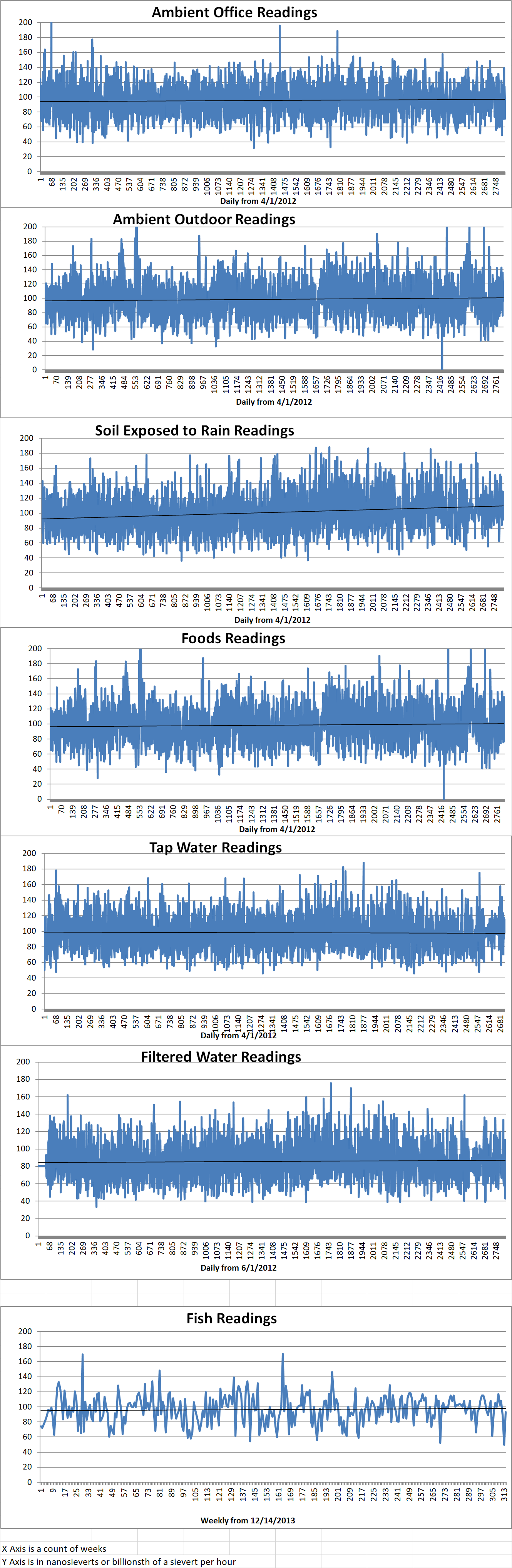
    Geiger Readings for Mar 07, 2020

    Ambient office  = 91 nanosieverts per hour

    Ambient outside = 106 nanosieverts per hour

    Soil exposed to rain water = 106 nanosieverts per hour

    Avocado from Central Market = 100 nanosieverts per hour

    Tap water = 98 nanosieverts per hour

    Filtered water = 84 nanosieverts per hour

    Dover sole – Caught in USA = 108 nanosieverts per hour

  • Nuclear Reactors 758 – The U.S. Should Support Chinese Nuclear Export Ambitions – Part 2 of 2 Parts

    Nuclear Reactors 758 – The U.S. Should Support Chinese Nuclear Export Ambitions – Part 2 of 2 Parts

    Part 2 of 2 Parts (Please read Part 1 first)
         In the last seven years, China has signed more than ten nuclear power reactor construction agreements with foreign buyers. The Chinese Belt and Road Initiative (BRI) has concentrated these reactor sales in Asia. China has already constructed multiple nuclear power plants in Pakistan and is constructing more. There are plans for power reactor construction in Turkey. Altogether, the biggest Chinese nuclear company has plans to construct at least thirty nuclear power reactors in other countries that are part of the BRI by 2030.
        China has been working on exporting nuclear power reactors to the United Kingdom. It partnered with a British power company for the construction of the Hinkley Point C nuclear project. When completed, Hinkley Point C is expected to supply as much as seven percent of Britain’s electricity demand. If China can get the approval of the tight European energy market, that endorsement could launch China to become the definer of international standards of nuclear technology.
       China’s aggressive program of nuclear export will hold serious implications for their customer safety, security and diplomatic standing.  The International Atomic Energy Agency (IAEA) has given Chinese nuclear plants high ratings for safety. However, a French nuclear regulator recently said that Chinese regulators “lack means. They are overwhelmed.” Any major domestic safety issues regarding nuclear power reactors in China would be a disaster for the global nuclear industry. China has to ensure that its nuclear regulatory bodies are well equipped to deal with their massive and expanding workload.
        Security and diplomacy will also be huge challenges for Chinese nuclear exports, especially in Europe. Permitting a foreign company, particularly one that is state owned such as those in Russia and China, to build and operate a dangerous and critical piece of energy infrastructure is a serious risk. The foreign government, acting through its state-owned nuclear company, could exert diplomatic pressure by overtly or implicitly threatening to turn off the nuclear power reactor they operate and thus deprive their customer of a significant proportion of their electricity. This could even extend to the exporting country sending in troops to protect their investment or they could weaponize the reactor in case of war.
        For the near future, Russia and China will be the lowest-cost and most reliable suppliers of nuclear technology. China may have a major advantage over Russia in this marketplace. Russia has demonstrated that it can be an aggressive exporter of energy and energy technology. It has repeatedly utilized other countries reliance on energy from Russia to leverage diplomatic pressure. Russia views energy exports and nuclear exports in particular as “as a vehicle for expanding and enhancing its influence.”
        China will obviously pursue its nuclear export ambitions regardless of whether or not the U.S. approves. Instead of opposing Chinese nuclear expansion, the U.S. should work with China and its overloaded regulators to enforce international safety standards and regulations to prevent serious nuclear disasters and work with Chinese nuclear customers to reinforce their security.
        Many developing countries desperately need to expand their energy portfolios. A switch from coal to nuclear could help these countries fight climate change. Importing nuclear power reactors from China instead of Russia is preferable geopolitically. China also aims to dominate the nuclear export market, but they have not demonstrated Russia’s history of weaponizing their energy exports. The U.S. involvement with Chinese nuclear exports would help reduce that concern for potential customers.
         This is not a suggestion that other nuclear exporting nations should abandon their own ambitions to capture a share of the nuclear export market. More competition can help to ensure that no country has outsized power in the nuclear marketplace. It would be best for the U.S. to help China in the international nuclear marketplace rather than oppose their nuclear ambitions and possibly drive other nations to do business with Russia.

  • Geiger Readings for Mar 06, 2020

    Geiger Readings for Mar 06, 2020

    Ambient office  = 95 nanosieverts per hour

    Ambient outside = 122 nanosieverts per hour

    Soil exposed to rain water = 118 nanosieverts per hour

    English cucumber  from Central Market = 111 nanosieverts per hour

    Tap water = 68 nanosieverts per hour

    Filtered water = 43 nanosieverts per hour

  • Nuclear Reactors 757 – The U.S. Should Support Chinese Nuclear Export Ambitions – Part 1 of 2 Parts

    Nuclear Reactors 757 – The U.S. Should Support Chinese Nuclear Export Ambitions – Part 1 of 2 Parts

    Part 1 of 2 Parts
        As the U.S. and China trade war seem to be cooling, China is poised to dominate the global nuclear reactor industry. Nuclear power has great strategic importance both diplomatically and as a way of combatting climate change. The Trump Administration views China as a major adversary both militarily and economically. This extends to the Chinese focus on the export on nuclear power reactors. Critics of the Chinese ambitions demand that the U.S. federal government fund and guide the revival of the U.S. nuclear industry in order to compete abroad against Russia and China as they attempt to corner the global market for nuclear power reactors.
         On the other hand, many in the U.S. nuclear industry feel that it may be a mistake to see Russia and China as a single challenge for nuclear power supremacy. The fact is that Russia and China are competing for market share. They are not cooperating in an attempt to capture the global market in nuclear power plant export and construction. China has risen to give Russia a serious competitor in the global nuclear marketplace and this is a benefit to the U.S. nuclear industry. The U.S. has an opportunity to influence the global nuclear export market in a way that will ensure safety and protection for countries purchasing Chinese hardware and expertise in the construction of nuclear power reactors.
          Russia currently claims that they account for about sixty percent of worldwide nuclear power reactor sales. This position has been achieved through offering buyers generous export packages. Russia offers cheaper nuclear reactor designs and financing options. Some of the development organizations in other countries and treaties between other countries prohibit the use of public money to finance nuclear power reactor construction. Cheaper natural gas has also contributed to constraining the competition in the global nuclear export market.
         While Russia is currently dominating nuclear power reactor sales, China is busy developing a nuclear industry that is poised to battle for global nuclear market share. China’s nuclear industry is relatively young when compared to Russia’s but it produces the third biggest share of domestic nuclear energy. They plan to add as much as three hundred gigawatts of nuclear energy in the next ten to twenty years. The Chinese domestic market for nuclear power is the greatest in the world and that scale factor provides a path to Chinese nuclear export dominance.
        Although domestic nuclear power production is a priority for China, its nuclear ambitions do not stop at its borders. The Chinese national government has created incentives that will encourage nuclear power reactor exports and drive the Chinese nuclear industry into foreign markets. This includes laws that support nuclear exports both financially and technologically. China’s nuclear industry now enjoys the same advantages that launched Russia to its current dominance of the nuclear export industry. State ownership of utilities helps them deal with funding issues, reduces the public impact of big natural disasters and provides them with security and diplomatic support.
         China has also adopted the financing option that has helped to drive Russia to nuclear export market dominance. This is referred to as the build, own, and operate (BOO) model. This means that the exporting country handles all the aspects of design, construction, operation and nuclear waste handling for an exported nuclear power reactor. This results in long term dependence of the buyer on the seller.
    Please read Part 2 next

  • Geiger Readings for Mar 05, 2020

    Geiger Readings for Mar 05, 2020

    Ambient office  = 71 nanosieverts per hour

    Ambient outside = 89 nanosieverts per hour

    Soil exposed to rain water = 91 nanosieverts per hour

    Red bell pepper from Central Market = 97 nanosieverts per hour

    Tap water = 64 nanosieverts per hour

    Filtered water = 43 nanosieverts per hour

  • Companies Are Working On Stabalizing The Global Supply Of Medical Radioisotopes

    Companies Are Working On Stabalizing The Global Supply Of Medical Radioisotopes

        One of the most important uses for radioactive isotopes is in medical diagnostic and treatment.  A major problem with such isotopes is ensuring a reliable supply to meet world needs. There have been three recent announcements that should help stabilize future supplies of important medical isotopes.
        Cobalt-60 (Co-60) is a popular isotope for sterilizing medical instruments. It is also used in many cancer treatments. In order to produce Co-60, rods of Co-59 are irradiated in a nuclear reactor. Most of the world’s Co-60 is produced in Candu reactors that are manufactured in Canada. Most of the Co-60 from Candu reactors is produced in Canada but some is produced in Argentina, China and South Korea. Russia produces some Co-60s in their RBMK reactors and one fast neutron reactor.
        Nordion is a subsidiary of Sotera Heath Company. Nordion and Westinghouse have recently signed a Letter of Intent under which they pledge to develop “innovative isotope production technology” in order to produce Co-60 in pressurized water reactors (PWR).
         There are almost one hundred PWRs in the U.S. alone. Expanding Co-60 production to PWRs will help expand and strengthen the diversity of the Co-60 global supply chain. Kevin Brooks is the President of Nordion. He said Expanding production to PWRs – of which there are nearly 100 in North America alone – will strengthen the diversity of the global supply chain, the companies said. “This partnership will substantially expand future supply options for life-saving cobalt-60. Cobalt-60 is critical to our mission … and we continue to invest heavily in maintaining a reliable, long-term supply.”
        Framatome is a French company. Kinetics is a company located in Canada. They have announced that they are going to enter into a joint venture called Isogen in order to support the production of lutetium-177 (Lu-177). Lu-177 is employed as a gamma emitter for medial imaging. It is also utilized as a beta emitter for targeted treatment of cancers including prostate cancer, neuroendocrine tumors and bone metastases.
         Isogen has formed a partnership with Bruce Power, a Canadian utility, to produce Lu-177 through the irradiation of ytterbium-176 in the eight Candu reactors owned by Bruce Power. Isogen’s role will be to design and support the licensing of an isotope production system that will permit the large-scale production of lu-177. The production will, of course, be dependent on regulatory and other approvals. Isotope Technologien München is a German company that specialized in radiopharmaceuticals. They will deliver the ytterbium-176 to the Bruce Power site. Isogen will be responsible for handling and preparing the ytterbium-176 to meet ITM requirements.
       Tecnetium-99m (Tc-99m) is the most commonly used radioisotope in medical diagnostic and treatment. It is employed in eighty five percent of diagnostic scans in the world and eighty percent of all nuclear medicine procedures. Tc-99m is produced at the site of use from molybdenum-99 (Mo-99). Both of them are very short lived so there has to be a very stable and constant supply of both. BWXT developed proprietary technology in 2018 that employs a neutron capture technique to create Mo-99.
       
    BWX Technologies (BWXT) has announced that is has successfully “labeled” nine popular “cold kits” using technetium-99m (Tc-99m) derived from its proprietary molybdenum-99 (Mo-99). Cold kits are chemical reagents which are combined with Tc-99m to produce a radiopharmaceutical to be used to treat an individual patient. Labeling cold kits is critical to BWXT in order to gain regulatory approval and market acceptance for the BWXT Tc-99m generator.
        BWXT is currently modifying existing facilities and constructing new facilities. It was originally going to introduce the new technology by the end of 2019 but the project has encountered difficulties that have pushed the schedule back. Natural Mo-99 targets will be irradiated primarily at the Darlington nuclear power plant in Canada owned by Ontario Power Generation which is a subsidiary of Lauentis Energy Partners. There is also a reactor service contract between BWXT and Missouri University Research Reactor supplied services to BWXT with respect to the Mo-99 in the cold-kit labeling.

  • Geiger Readings for Mar 04, 2020

    Geiger Readings for Mar 04, 2020

    Ambient office  = 93 nanosieverts per hour

    Ambient outside = 133 nanosieverts per hour

    Soil exposed to rain water = 128 nanosieverts per hour

    Danjo pear from Central Market = 101 nanosieverts per hour

    Tap water = 63 nanosieverts per hour

    Filtered water = 53 nanosieverts per hour