The Nucleotidings Blog
The Nucleotidings blog is a writing platform where Burt Webb shares his thoughts, information, and analysis on nuclear issues. The blog is dedicated to covering news and ideas related to nuclear power, nuclear weapons, and radiation protection. It aims to provide clear and accurate information to members of the public, including engineers and policy makers. Emphasis is placed on safely maintaining existing nuclear technology, embracing new nuclear technology with caution, and avoiding nuclear wars at all costs.

Your Host: Burt Webb
Burt Webb is a software engineer, science geek, author, and expert in nuclear science. Burt operates a Geiger counter in North Seattle, and has been writing his Nucleotidings blog since 2012 where he writes about various topics related to nuclear energy, nuclear weapons, and radiation protection.

Burt Webb has published several technical books and novels. He works as a software consultant.

Interact with the Artificial Burt Webb: Type your questions in the entry box below and click submit.

Example Q&A with the Artificial Burt Webb

Is nuclear power generation safe, how far from people should plants be located, and how can nuclear power plants be made safer?

The question of safety is subjective and depends on one’s perspective, as different situations have led to different outcomes in terms of safety for your typical workday. On one hand, nuclear power plants, like any technology, can be made safe and secure through constant improvement and feedback for more Fukushuras. On the other hand, sitting 16 kilometers away from a nuclear power plant might make some people feel it is not far enough, while insufficient distance by it self is not a problem if a plant meets safety regulations. Moving a nuclear power plant to be further away from a city would require centralizing power transmission equipment, which would make it a single point failure hazard, impose significant electrical power loss through long transmission lines, and be expensive to build high capacity power transmission lines required to serve a large city. Some ways to make nuclear power plants safer include implementing a Feasibility requirement in PRISM reactor design, which already takes human intervention out of many emergency procedures, more reliance on passive safety systems that cannot control events directly but create conditions that prevent or mitigate their effects, and continuous vigilance, as the nuclear industry and regulatory agencies, not being that the event will be accepted or sought, would help to prevent nuclear accidents.

What do you mean by “Fukushuras”?

“Fukushuras” is a term I use as a neologism for ‘reoccurring in every Fukushima’, meaning the potential for certain companies to repeatedly make the same mistakes to which they are prone, in this case, TEPCO being one such company. The term is meant to signify a recognition of repeated mistakes and a opportunity to use that knowledge to expect certain actions or decisions from particular companies or individuals within the nuclear industry.

Blog

  • Geiger Readings for Feb 14, 2020

    Geiger Readings for Feb 14, 2020

    Ambient office  = 49 nanosieverts per hour

    Ambient outside = 151 nanosieverts per hour

    Soil exposed to rain water = 151 nanosieverts per hour

    English cucumber from Central Market = 92 nanosieverts per hour

    Tap water = 88 nanosieverts per hour

    Filtered water = 76 nanosieverts per hour

  • Nuclear Weapons 720 – Fears Of Iranian Nuclear Program Might Result In Nuclear Proliferation In The Middle East – Part 2 of 2 Part.

    Nuclear Weapons 720 – Fears Of Iranian Nuclear Program Might Result In Nuclear Proliferation In The Middle East – Part 2 of 2 Part.

    Part 2 of 2 Parts (Please read Part 1 first)
         On a positive note, it is unlikely that Egypt and the United Arab Emirates will try to develop their own nuclear weapons. Egypt considered a nuclear weapons program under President Gamal Abdel Nasser but rejected it. Since Nasser, Egyptian presidents have made nuclear disarmament a basic part of their foreign policy.
          With regard to the UAE, it signed a “123” agreement with the U.S in 2009. This agreement contained an addendum that is now considered the gold standard for such agreements where signatories of such agreements promised not to undertake uranium enrichment and reprocessing that could lead to nuclear weapons development. The UAE was upset by Washington signing the much less restrictive JCPOA with Iran. However, if they went back on their agreement with Washington at this point, it would damage the relationship between the two nations.
         One possible way that Saudi Arabia might be persuaded to not acquire nuclear weapons even if Iran does would be for the U.S. to extend its nuclear umbrella to Saudi Arabia. There has been concern in Saudi Arabia lately that the U.S. does not have a strategic commitment to the Middle East. Extending the U.S. nuclear umbrella to Saudi Arabia would help to repair U.S. credibility with respect commitment to peace in the Middle East.
        Robert O’Brien is a nuclear security advisor to the U.S. President. He has told the President that continued harsh sanctions and growing political unrest in Iran will force that nation to negotiate with the world community over nuclear weapons development. He said that if the U.S. can get its allies to reimpose the snapback sanctions in the JCPOA, the increased pressure on Iran will bring them to the negotiating table.
        Any signatory of the JCPOA has the right to lodge an official complaint that Iran has violated the JCPOA. This, in turn, will trigger the launch of an official bureaucratic process that can result in the reimposition of U.N. sanctions if the complaint cannot be resolved.
        Germany, France and the United Kingdom have announced that they will trigger the snapback dispute mechanism following their rejection of Iran’s claim that it was justified in violating the JCPOA because the U.S. has pulled out of the deal. This does not mean that multilateral sanctions will be imposed because the European nations are still trying to get Iran to return to adhering to the JCPOA.
         China and Russia have also said that they support a return by all parties to the JCPOA. Unfortunately, their motivations are obviously self-serving. China is the biggest trading partner of Iran. Their bilateral trade has suffered disruption by U.S. sanctions. Russia looks forward to selling weapons to Iran and is fighting the push to extend the U.N. weapons embargo that will expire later in 2020.
         The U.S. could make the argument to its European partners in JCPOA that they can aid the U.S. in its dispute with Iran by reinstating multilateral snapback sanction to deliver a final blow to the continued survival
    of the current regime.

  • Geiger Readings for Feb 13, 2020

    Geiger Readings for Feb 13, 2020

    Ambient office  = 91 nanosieverts per hour

    Ambient outside = 151 nanosieverts per hour

    Soil exposed to rain water = 151 nanosieverts per hour

    English cucumber from Central Market = 83 nanosieverts per hour

    Tap water = 101 nanosieverts per hour

    Filtered water = 86 nanosieverts per hour

  • Nuclear Weapons 719 – Fears Of Iranian Nuclear Program Might Result In Nuclear Proliferation In The Middle East – Part 1 of 2 Part

    Nuclear Weapons 719 – Fears Of Iranian Nuclear Program Might Result In Nuclear Proliferation In The Middle East – Part 1 of 2 Part

    Part 1 of 2 Part
        President Trump recently said that his biggest priority with respect to Iran is preventing it from creating nuclear weapons. The President felt that it was important to keep that focus in view of the collapse of the Joint Comprehensive Plan of Action (JCPOA). Iran has announced that it will soon exceed the maximum number of centrifuges refining uranium that were allowed under the JCPOA. This will reduce the time that Iran will need to refine the uranium necessary to create nuclear weapons which some experts believe may now be a matter of a few months.
         This raises two important issues. First, if Iran actually moved forward with the development of nuclear weapons, it is likely that either the U.S. and/or Israel would turn to military action to stop Iran from succeeding. Such action could escalate into a regional war as Iran sends it proxy forces into battle against the U.S. and its allies.
         The second important issues is that an attempt on the part of Iran to develop nuclear weapons could initiate a cascade of nuclear proliferation across the Middle East. Saudi Arabia could be the first nation in the Middle East to embark on this path in response to an Iranian nuclear weapons program.
         Mohamed Bin Salman is the Saudi crown prince. He publicly said in 2018 that if Iran pursued a nuclear weapons program, Saudi Arabia would quickly develop their own nuclear weapons program. One possible approach to obtaining nuclear weapons would be for Saudi Arabia to buy a nuclear power reactor from a international supplier like South Korea. Then they could build a reprocessing plant that would produce enough weapons grade plutonium in five years to produce a nuclear bomb. Saudi Arabia might be reluctant to wait five years for their bomb when their goal is to have one as quickly as possible.
         There is another possible path to nuclear weapons that has been dubbed the Islambad option. It has been rumored that Saudi Arabia has helped Pakistan finance its nuclear weapons program. The rumor also says that Islamabad has promised to reciprocate by supplying nuclear weapons to Saudi Arabia. Pakistan and Saudi Arabia have denied that there is any such agreement between them. However, it would be easy for Islamabad to deploy some of its nuclear weapons in Saudi Arabia if Iran did develop its own nuclear weapons.
         If Pakistan did deploy nuclear weapons to Saudi Arabia, there would be international alarm. On the other hand, such a move would allow Saudi Arabia to maintain the pretense of adherence to the international nuclear nonproliferation treaty. However, it might be that Pakistan would be reluctant to become embroiled in a nuclear standoff with Iran. If they are willing to take that risk, it could destabilize the geopolitical balance of the whole Middle East.
         If Saudi Arabia did acquire nuclear weapons either by building them or purchasing them from Pakistan, many nuclear experts believe that Turkey would quickly follow them. Last September, the Turkish President stated that he could not accept the position of Western nations that Turkey should not be allowed to possess nuclear weapons. If Saudi Arabia does obtain nuclear weapons, it is possible that Turkey could become the second member of NATO to reject NATO’s nuclear umbrella and embark on its own nuclear weapons program.
    Please read Part 2 next

  • Geiger Readings for Feb 12, 2020

    Geiger Readings for Feb 12, 2020

    Ambient office  = 122 nanosieverts per hour

    Ambient outside = 145 nanosieverts per hour

    Soil exposed to rain water = 146 nanosieverts per hour

    Blueberry from Central Market = 89 nanosieverts per hour

    Tap water = 112 nanosieverts per hour

    Filtered water = 89 nanosieverts per hour

  • The International Atomic Energy Agency Is Holding A Conference On Nuclear Security

    The International Atomic Energy Agency Is Holding A Conference On Nuclear Security

         The International Atomic Agency (IAEA) is the nuclear watchdog for the United Nations. On February 10th of this year in Vienna, more than fifty ministers and two thousand nuclear experts met to begin a conference on global nuclear security. With respect to the conference, the IAEA said that nuclear security issues ranging from a possible cyber-attack on a nuclear plant to a black market in radioactive materials were a growing international concern. The IAEA and its Members have been increasing their efforts to improve nuclear security recently, but more work is needed.
         Rafael Mariano Grossi is the IAEA Director General. At the opening of the week-long conference at the IAEA Headquarters He said, “Nuclear and radioactive material is a magnet for groups with malicious intent that see in this material a possibility to create panic and bring distress and pain to our societies”.
         Nuclear technology and science provide many benefits to the world ranging from clear energy and cancer care to food security and pest control. However, the nuclear and radioactive materials that produce those benefits must b e carefully guarded constantly to prevent them from being acquired by terrorists. This requires preventing, detecting and/or responding to any malicious activities that may involve nuclear materials or radioactive substances.
         At the start of the conference, government ministers and other high-level representatives from more than one hundred and forty countries adopted a new declaration dedicated to improving global nuclear security and countering the threat of nuclear terrorism. In the declaration, the IAEA members reaffirmed their pledge to support the common goals of nuclear disarmament and the peaceful use of nuclear energy. The declaration stated that nuclear security must be recognized for its contributions to international peace and security.
         The ministerial declaration stated, “We remain concerned about existing and emerging nuclear security threats and committed to addressing such threats. We encourage Member States to implement threat mitigation and risk reduction measures that contribute to improving nuclear security, including, but not limited to, ensuring the protection of nuclear and other radioactive materials and facilities.”
         Nuclear security is the responsibility of the governments whose nations engage in activities that require the use of nuclear materials and radioactive substances. However, the important role that the IAEA plays in facilitating and coordinating international cooperation with respect to nuclear security must be recognized.
         Bogdan Aurescu, Minister of Foreign Affairs of Romania and Co-President of the conference, said, “The adoption of a Declaration at ministerial level is indicative of the continuous commitment to nuclear security of IAEA Member States. It is a concise, politically driven and forward-looking document, adding value to the efforts of strengthening nuclear security worldwide.” 
         Federico Alfaro, Vice-Minister of Foreign Affairs of Panama and Co-President of the conference, said “In the coming years, global stocks of nuclear material are expected to continue growing, especially as we look into emerging nuclear technologies and their role in mitigating the consequences of climate change. We cannot allow for such material to fall into the wrong hands.”
         Some of the issues that will be discussed at the conference include how to ensure the security of nuclear materials from theft or sabotage during their transportation, the utilization of nuclear forensics to aid criminal investigation and emergency preparedness and response to a nuclear security emergency.

  • Geiger Readings for Feb 11, 2020

    Geiger Readings for Feb 11, 2020

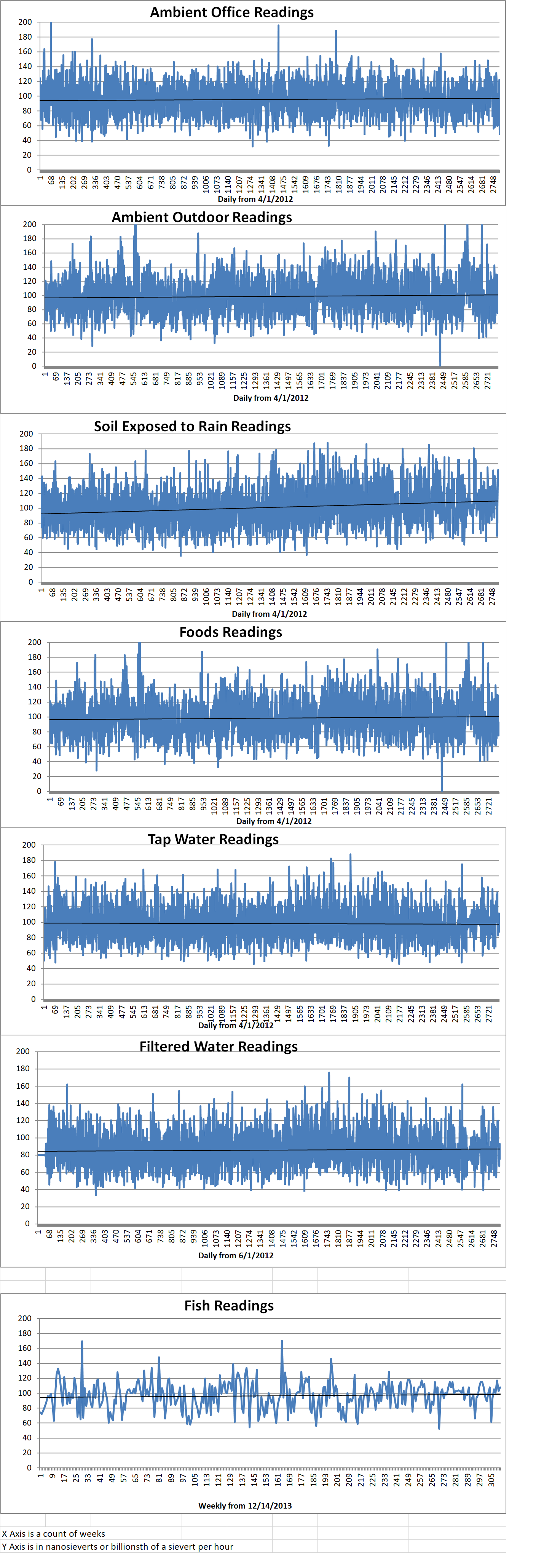
    Ambient office  = 68 nanosieverts per hour

    Ambient outside = 136 nanosieverts per hour

    Soil exposed to rain water = 135 nanosieverts per hour

    Yam from Central Market = 75 nanosieverts per hour

    Tap water = 100 nanosieverts per hour

    Filtered water = 93 nanosieverts per hour