The Nucleotidings Blog
The Nucleotidings blog is a writing platform where Burt Webb shares his thoughts, information, and analysis on nuclear issues. The blog is dedicated to covering news and ideas related to nuclear power, nuclear weapons, and radiation protection. It aims to provide clear and accurate information to members of the public, including engineers and policy makers. Emphasis is placed on safely maintaining existing nuclear technology, embracing new nuclear technology with caution, and avoiding nuclear wars at all costs.

Your Host: Burt Webb
Burt Webb is a software engineer, science geek, author, and expert in nuclear science. Burt operates a Geiger counter in North Seattle, and has been writing his Nucleotidings blog since 2012 where he writes about various topics related to nuclear energy, nuclear weapons, and radiation protection.

Burt Webb has published several technical books and novels. He works as a software consultant.

Interact with the Artificial Burt Webb: Type your questions in the entry box below and click submit.

Example Q&A with the Artificial Burt Webb

Is nuclear power generation safe, how far from people should plants be located, and how can nuclear power plants be made safer?

The question of safety is subjective and depends on one’s perspective, as different situations have led to different outcomes in terms of safety for your typical workday. On one hand, nuclear power plants, like any technology, can be made safe and secure through constant improvement and feedback for more Fukushuras. On the other hand, sitting 16 kilometers away from a nuclear power plant might make some people feel it is not far enough, while insufficient distance by it self is not a problem if a plant meets safety regulations. Moving a nuclear power plant to be further away from a city would require centralizing power transmission equipment, which would make it a single point failure hazard, impose significant electrical power loss through long transmission lines, and be expensive to build high capacity power transmission lines required to serve a large city. Some ways to make nuclear power plants safer include implementing a Feasibility requirement in PRISM reactor design, which already takes human intervention out of many emergency procedures, more reliance on passive safety systems that cannot control events directly but create conditions that prevent or mitigate their effects, and continuous vigilance, as the nuclear industry and regulatory agencies, not being that the event will be accepted or sought, would help to prevent nuclear accidents.

What do you mean by “Fukushuras”?

“Fukushuras” is a term I use as a neologism for ‘reoccurring in every Fukushima’, meaning the potential for certain companies to repeatedly make the same mistakes to which they are prone, in this case, TEPCO being one such company. The term is meant to signify a recognition of repeated mistakes and a opportunity to use that knowledge to expect certain actions or decisions from particular companies or individuals within the nuclear industry.

Blog

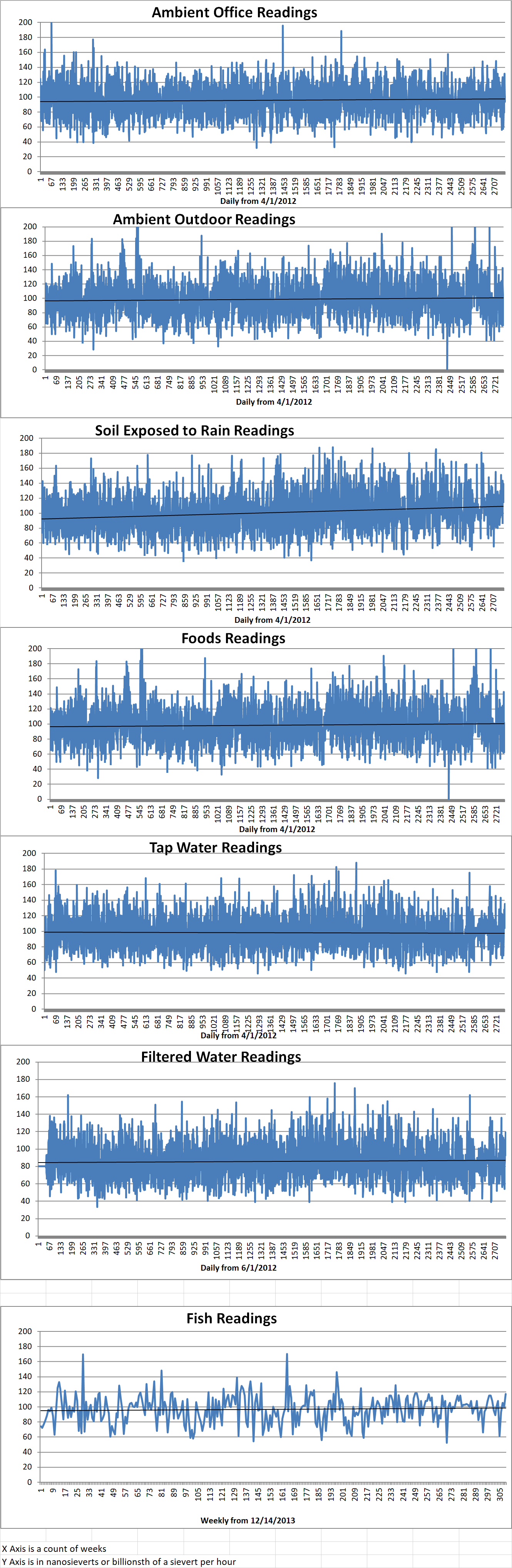
  • Geiger Readings for Jan 30, 2019

    Geiger Readings for Jan 30, 2019

    Ambient office  = 101 nanosieverts per hour

    Ambient outside = 123 nanosieverts per hour

    Soil exposed to rain water = 119 nanosieverts per hour

    English cucumber from Central Market = 101 nanosieverts per hour

    Tap water = 135 nanosieverts per hour

    Filtered water = 119 nanosieverts per hour

  • Radioactive Waste 434 – Some Uses For Radioactive Waste – Part 1 of 2 Parts

    Radioactive Waste 434 – Some Uses For Radioactive Waste – Part 1 of 2 Parts

    Part 1 of 2 Parts
        I have been blogging about various aspects of dealing with radioactive waste in the past few columns. Today I am going to list a few suggestions and practices for repurposing radioactive waste.
        One major type of radioactive waste is material left when nuclear fuel has been “burned” in a common light water fission reactor used for electrical generation. About ninety six percent of the waste consists of uranium isotopes. One percent is plutonium isotopes and the remaining three percent are a variety of isotopes of other elements. This type of waste makes up most of the radioactive waste in the world. Some of the isotopes in this spent nuclear fuel waste are radioactive and dangerous for thousand and thousand of years.
    Fast Breeder Reactors
        One suggestion for reducing the production of this waste consists of switching to what are called fast neutron reactors. These reactors “breed” non-fissile isotopes such as uranium-238 into plutonium-239 and plutonium-240 which are fissile and can be used to produce new nuclear fuel. There are designs for such reactors that can process out other actinides and use them as fuel for reactors. (Actinides are the 15 metallic chemical elements with atomic numbers from 89 to 103.) One of the major benefits is that these reactors are able to utilize almost all of the energy in uranium fuel. This reduces fuel use by sixty to one hundred times when compared to nuclear fuel used in conventional power reactors.
        Fast breeder technology has not been widely adopted because of economic considerations. In the 1970s, new abundant deposits of uranium ore were discovered. This meant that is was much cheaper to just dig and refine uranium ore instead of developing expensive new technologies. A big concern about fast breeder reactors is that they can be used to create radioactive isotopes that are suitable for construction of nuclear weapons. This has impeded progress and adoption of such reactors. Some promising technologies have been developed but it is likely that major developments necessary to create safe and efficient fast breeder reactors are many years away.
    Nuclear Batteries
        Solar power is often used to provide power for satellites. However, when satellites are sent into the outer solar system far from the sun, solar power does not produce enough energy. This type of satellite and mission requires an alternate power source such as radioisotope thermoelectric generators (RTGs). Radioactive materials are placed in a container with thermocouples which utilize the heat generated by the materials to produce electricity. The heat produced by the radioactive materials also helps to keep the components in the satellites from freezing.
        In the past, these RTGs have been used by the U.S. and Russia. The European Space Agency is also very interested in adopting this technology. They plan to extract radioactive americium-214 from the plutonium in the waste from reprocessed nuclear fuels. Such use of waste materials would have little impact on reducing the huge amount of such waste but would be good source of radioactive materials for RTGs. This is especially relevant because the U.S. stockpile of plutonium waste is rapidly diminishing because it is produced by the reactors that are used to produce plutonium for nuclear weapons and nuclear weapons production has be shut down in the U.S. The U.S. is working on producing more plutonium-238 but, for the moment, the British have an opportunity in this area.
        Another idea for nuclear batteries is under development. This new type of battery is called a “beta-voltaic” battery. In this type of battery, a semiconductor material is used to capture electrons produced by the beta-decay of radioactive materials. The University of Bristol in the U.K. is working on such a battery that uses diamonds. This battery utilizes radioactive carbon-14 from the graphite blocks used as moderators in U.K. commercial power reactors. First, the outer layer which contains most of the carbon-14 is scraped off the graphite blocks. This material is used to produce manmade diamonds that release electrons as they decay. These radioactive diamonds are encased in non-radioactive carbon-12 which prevents the escape of electrons from the battery. The electrons which are produced by the beta-decay are very low energy so only a thin shielding layer is needed. These batteries will be able to produce hundred of microwatts of electricity for thousands of years.
    Please read Part 2

  • Geiger Readings for Jan 29, 2019

    Geiger Readings for Jan 29, 2019

    Ambient office  = 99 nanosieverts per hour

    Ambient outside = 145 nanosieverts per hour

    Soil exposed to rain water = 139 nanosieverts per hour

    Ahaheim pepper from Central Market = 77 nanosieverts per hour

    Tap water = 122 nanosieverts per hour

    Filtered water = 97 nanosieverts per hour

  • Radioactive Waste 433 – Researchers Develop Method To Improve The Safety And Efficiency Of Reprocessing Spent Nuclear Fuel

    Radioactive Waste 433 – Researchers Develop Method To Improve The Safety And Efficiency Of Reprocessing Spent Nuclear Fuel

         Recently an important article was published in the journal Chemistry about a means of more safely and efficiently reprocessing spent nuclear fuel. Nuclear energy currently produces about ten percent of the electricity in the world. However, the nuclear fuel that is used in nuclear power reactors becomes less efficient over time and needs to be replaced about every five years.
        Spent nuclear fuel is still very radioactive and produces a lot of heat. Prior to being reprocessed or permanently disposed of, spend nuclear fuel is immersed in special cooling ponds under more than forty feet of water. The water provides shielding for the spent fuel and is continuously cooled and recirculated to remove the heat. It takes over a year in the cooling pool for the spent fuel rods to cool to the point where they can be reprocessed to remove uranium and plutonium which can then be used to create more fuel.
         The elements americium, curium and neptunium, which are called the minor actinides, are produced by the nuclear reactions of the fissioning nuclear fuel. After the uranium and plutonium are removed, the minor actinides are still present and they account for most of the residual radioactivity and heat. These elements remain dangerously radioactive for about nine thousand years. This makes either storage or disposal very dangerous.
         The removal of these actinide would make nuclear power a much safer and more sustainable power source. The remaining spent fuel following the removal of the actinides would only be dangerously radioactive for about three hundred years which is a more manageable time frame.
         There are molecules called trazines that can be used to selectively remove or extract the actinides from spent nuclear fuel. These trazines have been known for quite some time. Researchers decided to determine how the modification of selected part of these molecules could alter their ability bind and extract the minor actinides at a molecular level. If useful modifications could be identified and exploited, it should be possible to design better versions of the molecules that would be more efficient for reprocessing spent nuclear fuel in the future.
         The researched altered the size of the aliphatic rings in the current benchmark molecules. They were changed from six-part rings to five-part rings. It turned out that this minor alteration had surprising effects on the efficiency of these molecules to bind and extract minor actinides. The new configuration is much more efficient than the benchmark molecules. The researchers then used a variety of experimental techniques to discover exactly how the change in configuration improved efficiency.
         Dr. Frank Lewis is a senior lecturer in organic chemistry in Northumbria University’s Department of Applied Sciences. He said, “The findings are significant as they could allow better molecules to be designed in a more rational way, rather than simply by trial and error. The knowledge and insights we have gained by tuning the cyclic aliphatic part of these molecules could pave the way for the rational design of improved actinide selective ligands for reprocessing spent nuclear fuels. Modifying these molecules in different ways to improve their extraction properties could make future reprocessing more efficient and could be essential if they are to be used industrially in future. We believe that these results are of great importance to the field of nuclear energy, and this has been confirmed by the panel who reviewed the paper before publication.”

  • Geiger Readings for Jan 28, 2019

    Geiger Readings for Jan 28, 2019

    Ambient office  = 94 nanosieverts per hour

    Ambient outside = 120 nanosieverts per hour

    Soil exposed to rain water = 114 nanosieverts per hour

    Organic Hawaiian avocado from Central Market = 87 nanosieverts per hour

    Tap water = 104 nanosieverts per hour

    Filtered water = 93 nanosieverts per hour

  • Radioactive Waste 432 – Researchers Discover That Vitrification Materials Accelerate Corrosion In Stainless Steel Nuclear Waste Storage Containers

    Radioactive Waste 432 – Researchers Discover That Vitrification Materials Accelerate Corrosion In Stainless Steel Nuclear Waste Storage Containers

         One of the main problems with nuclear power is how to store and dispose of nuclear waste produced by develop and manufacture of nuclear weapons. Currently, vitrification is used for permanent long-term storage of nuclear waste in underground geological repositories. Nuclear waste is mixed with other materials that form glass or ceramics when heated and then enclosed in metallic cylinders. Unfortunately, scientists have now found that the glass and ceramic materials used in vitrification can interact with the stainless steel of the cylinders. This can result in an acceleration of corrosion of the cylinders.
         This accelerated corrosion will definitely affect the estimated service life nuclear waste storage. This, in turn, could increase the risk of the release of radioactive materials into the environment. Pollution of drinking and irrigation water as well as injury to public health would be a probable result.
          Xiaolei Guo is the lead author of the sturdy. He is the director of Ohio State’s Center for Performance and Design of Nuclear Waste Forms and Containers. He says, “Under specific conditions, the corrosion of stainless steel will go crazy. It creates a super-aggressive environment that can corrode surrounding materials.” Nuclear waste can remain radioactive and dangerous to human beings and the natural environment for hundreds of thousands of years.
        In response to this longevity of risk, countries that possess nuclear waste related to nuclear weapons have created plans to store this high-level waste up to three thousand and two hundred feet below the ground in a deep geological repository. This deep storage should prevent contamination of ground water and a threat of the release of radioactive materials into the environment. High level waste is created in liquid form during nuclear weapons production. Guo said, “In the current disposal plan for many countries, the high-level nuclear waste will be primarily mixed with other materials to form glass or ceramic waste forms.”
         Dr. Gerald Frankel at Ohio State University and his team carried out experiments for this study. They pressed pieces of stainless steel against vitrification materials such as a borosilicate glass and titanate-based ceramics. They studied the rate of corrosion in the stainless steel and found that the degree of corrosion was much faster in areas where the vitrification materials were in contact with the stainless steel.
         Guo said, “’Severe’ corrosion was found between stainless steel and both borosilicate glass and the ceramic waste form. Our study showed that the release rate could be enhanced due to the corrosion interactions between different materials used to isolate these wastes. Specifically, the corrosion of metallic canisters creates a highly aggressive environment that can corrode the surrounding materials faster than what was predicted.”
         The accelerate corrosion could be the result of chemical changes that take place in a confined space over time. This research should be carefully reviewed when assessing the safety of nuclear waste disposal and materials when selecting the material that will be used to enclose the waste.
         Guo says, “The corrosion that is accelerated by the interface interaction between dissimilar materials could profoundly impact the service life of the nuclear waste packages, which, therefore should be carefully considered when evaluating the performance of waste forms and their packages. Moreover, compatible barriers should be selected to further optimize the performance of the geological repository system.”
         In the United Kingdom, HLW treatment is carried out at Sellafield which is a two square mile site that is near Seascale on the coast of Cumbria. The site does not have a deep geological repository. Sellafield spokesmen say that the U.K. government is searching for a site for a deep geological repository but they are storing HLW for the time being on site.
         In the U.S., there are over ninety thousand metric tons of nuclear waste that await disposal. For the moment, the waste is stored onsite near the reactors in temporary canisters. A permanent deep geological repository has been proposed for Yucca Mountain in Nevada but work was halted in 2009.
        Only Finland has begun construction on a deep geological repository for HLW. Guo said, “At this stage, it is still a plan for most countries, but there have been continuous research and risk assessment efforts on this topic. Eventually, it is very likely to occur.”