
Fake News And Nuclear Weapons Don’t Play Well Together In The South China Sea
TVA approved for early site permit for smaller nuclear reactor in Oak Ridge wbir.com
Europe Power-Spot plunges on increase in wind, nuclear power supply af.reuters.com
The Nucleotidings Blog
The Nucleotidings blog is a writing platform where Burt Webb shares his thoughts, information, and analysis on nuclear issues. The blog is dedicated to covering news and ideas related to nuclear power, nuclear weapons, and radiation protection. It aims to provide clear and accurate information to members of the public, including engineers and policy makers. Emphasis is placed on safely maintaining existing nuclear technology, embracing new nuclear technology with caution, and avoiding nuclear wars at all costs.
Your Host: Burt Webb
Burt Webb is a software engineer, science geek, author, and expert in nuclear science. Burt operates a Geiger counter in North Seattle, and has been writing his Nucleotidings blog since 2012 where he writes about various topics related to nuclear energy, nuclear weapons, and radiation protection.
Burt Webb has published several technical books and novels. He works as a software consultant.
Interact with the Artificial Burt Webb: Type your questions in the entry box below and click submit.
Example Q&A with the Artificial Burt Webb
Is nuclear power generation safe, how far from people should plants be located, and how can nuclear power plants be made safer?
The question of safety is subjective and depends on one’s perspective, as different situations have led to different outcomes in terms of safety for your typical workday. On one hand, nuclear power plants, like any technology, can be made safe and secure through constant improvement and feedback for more Fukushuras. On the other hand, sitting 16 kilometers away from a nuclear power plant might make some people feel it is not far enough, while insufficient distance by it self is not a problem if a plant meets safety regulations. Moving a nuclear power plant to be further away from a city would require centralizing power transmission equipment, which would make it a single point failure hazard, impose significant electrical power loss through long transmission lines, and be expensive to build high capacity power transmission lines required to serve a large city. Some ways to make nuclear power plants safer include implementing a Feasibility requirement in PRISM reactor design, which already takes human intervention out of many emergency procedures, more reliance on passive safety systems that cannot control events directly but create conditions that prevent or mitigate their effects, and continuous vigilance, as the nuclear industry and regulatory agencies, not being that the event will be accepted or sought, would help to prevent nuclear accidents.
What do you mean by “Fukushuras”?
“Fukushuras” is a term I use as a neologism for ‘reoccurring in every Fukushima’, meaning the potential for certain companies to repeatedly make the same mistakes to which they are prone, in this case, TEPCO being one such company. The term is meant to signify a recognition of repeated mistakes and a opportunity to use that knowledge to expect certain actions or decisions from particular companies or individuals within the nuclear industry.
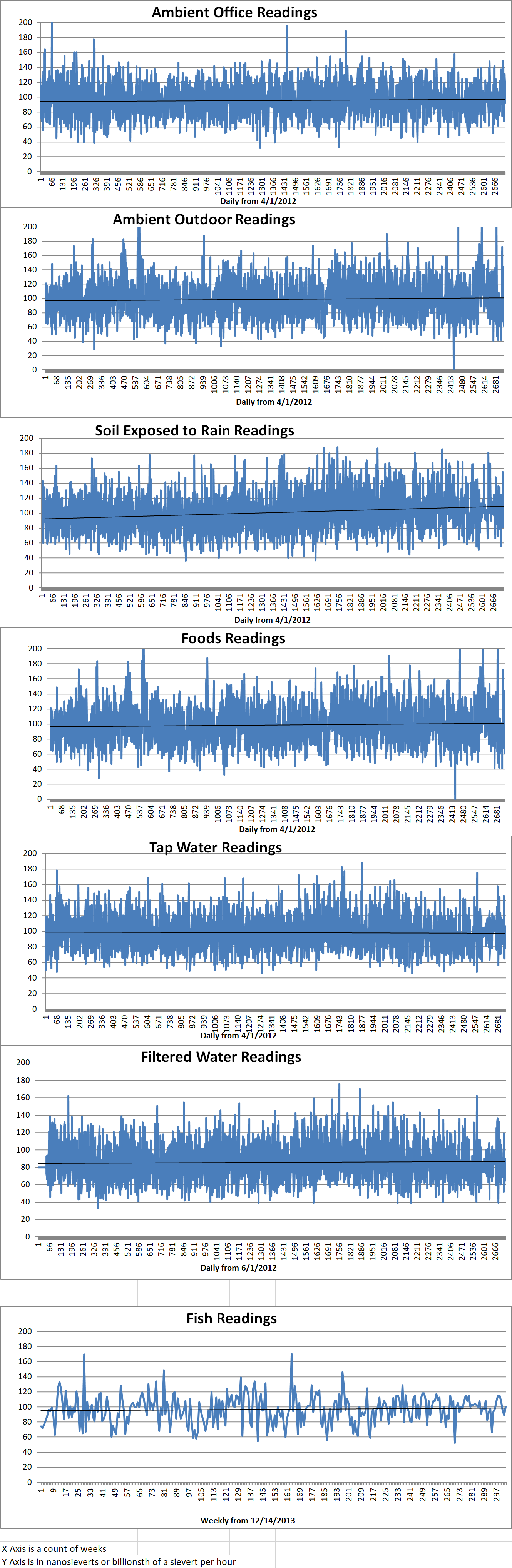
Ambient office = 93 nanosieverts per hour
Ambient outside = 119 nanosieverts per hour
Soil exposed to rain water = 121 nanosieverts per hour
Bartlett pear from Central Market = 62 nanosieverts per hour
Tap water = 83 nanosieverts per hour
Filtered water = 66 nanosieverts per hour

Part 5 of 5 parts (Please read Parts 1,2,3 and 4 first)
Following seven years of research, the team at the Glasgow was given intellectual property rights to their work. In 2016, the team started a private company called Lynkeos Technology. The company is working on its first commercial contact which is to create images of vitrified waste that is created by a new process know as GeoMelt. GeoMelt is a process by which dangerous, contaminated materials such as radioactive waste and heavy metals are mixed with clean soil, a blend of industrial minerals, and/or glass frit (A “frit” is a ceramic composition that has been fused, quenched, and granulated.) This combination of materials is then melted to create an extremely hard and leach-resistant glass product.
The researchers have shown that muons can reveal whether or not the waste has melted uniformly and whether it contains any metallic items. The research team has been utilizing their new detector at Sellafield since October of 2018 to image waste that contains radioactive materials, including uranium. They are now working on the creation of images of the contents of waste boxes that are about three cubic yards in size.
Researchers at the universities of Bristol and Sheffield in the U.K. and the Warsaw Technical University in Poland are also working on muon detection systems. This collaboration is commissioning the development of a fifteen-foot-high muon detector which is constructed with resistive plate chambers. These detect the ionization of gases with metallic strips that are attached to glass plates. Several utilities in Europe are interested in testing the new detector but none of them have committed so far. The leader of the collaboration said that “It’s not easy to get on sites with nuclear waste and ask them to get their drums out.”
The sensitivity of debating the handling of nuclear waste makes it difficult to develop any new technology that could help. This is especially the case with respect to dealing with spent nuclear fuel. Safeguard agencies may be reluctant to adopt new technologies such as muon detection. The IAEA has stated that it does not currently use muon detection for verification of the presence of nuclear materials because “there are still limitations on its use for this purpose”. It has said that it is following muon detection technology development.
Aymanns of the Jülich Research Centre points out that it is proper for the IAEA and other nuclear materials monitoring agencies to decide whether and when they would be interested in deploying new monitoring technology. She says that scientists can help move the process of adoption along by carrying out field tests. She has no doubt that new monitoring technology is needed. She says, “Even if you have surveillance you have to be prepared for it to fail. Maybe it will never happen but if it ever does you have to be ready.”
Considering the huge amount of spent nuclear fuel and other dangerous nuclear waste that are scattered around the globe, the development of new monitoring technology is obviously a major priority.
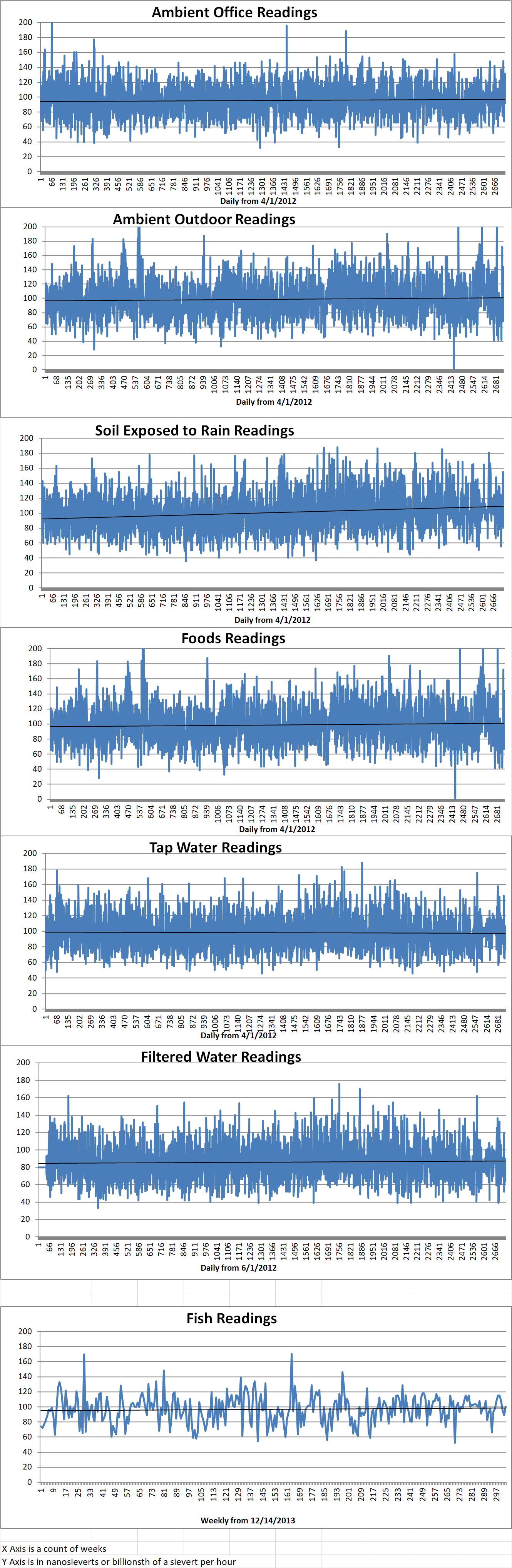
Ambient office = 92 nanosieverts per hour
Ambient outside = 110 nanosieverts per hour
Soil exposed to rain water = 106 nanosieverts per hour
Tomato from Central Market = 75 nanosieverts per hour
Tap water =93 nanosieverts per hour
Filtered water = 71 nanosieverts per hour

Part 4 of 5 Parts (Please read Parts 1,2 and 3 first)
Aymanns contacted Paolo Checchia at the Legnaro National Laboratory in Padua, Italy. Checchia and colleagues are also researching muon detectors constructed with drift tubes. Their work is based on technology that was developed for Compact Muon Solenoid detectors at the CERN laboratory in Geneva, Switzerland. They have computer simulations that shows that is theoretically possible to spot if a fuel assembly has been removed from a dry cask. They have created a prototype detector that contains sixty-four drift tubes in eight layers.
Last year, Checchia and colleagues performed tests that were partly funded by Euratom which is the organization that is responsible for monitoring spent nuclear fuel within Europe. For these tests, a prototype detector was attached to a dry cask at the Neckarwestheim nuclear power plant near Stuttgart. They were not able to make a detailed study of the contents of the test casks. However, the team did show that they could detect muon behavior above the faint radiation from the contents of the cask. They will need to make bigger detectors to determine the presence or absence of fuel assemblies in dry casks.
Finland and Sweden could definitely benefit from muography. Both of these countries are developing geological repositories for spent nuclear waste. Morris and his team have computer simulations that show that it should be possible to identify missing or replaced fuel assemblies with only twenty-four hours of muon tracking in the copper and iron casks that will be used in Scandinavia. The researchers say that carrying out these measurements immediately before burying the dry casks would be “the last chance for inspectors to evaluate state declarations of spent fuel disposal”.
Muons can be used to images other types of nuclear waste beyond spent nuclear fuel. One of these is the metal cladding of the tubes that contain the uranium pellets which has to be removed when spent nuclear fuel is reprocessed. In the U.K. there are tens of thousands five hundred liter stainless-steel drums full of fuel rod cladding that is encased in concrete.
Ralf Kaiser works at the University of Glasgow. He says that some cladding-filled drums have been bulging. This suggests that there may be some spent nuclear fuel in the drum. Uranium has a tendency to expand when it oxidizes which could account for the bulging. Since the drums are hard to access, it is difficult to know how many drums might contain spent nuclear fuel. Bulging might result in drums cracking open which could release radioactive materials. The ability to identify which drums contain spent fuel could help prevent such leaks.
Kaiser and his colleagues at the University are working on muon detectors that consist of thousands of plastic scintillating fibers. Collaborating with researchers from the National Nuclear Laboratory at the Sellafield reprocessing plant, the Glasgow team first created a small prototype followed by a full-sized system that could hold one five hundred liter drum. A series of laboratory tests from 2015 on showed that the system could image a range of objects inside one of the concrete drums. This included detection of a one-inch long cylinder of uranium.
Please read Part 5
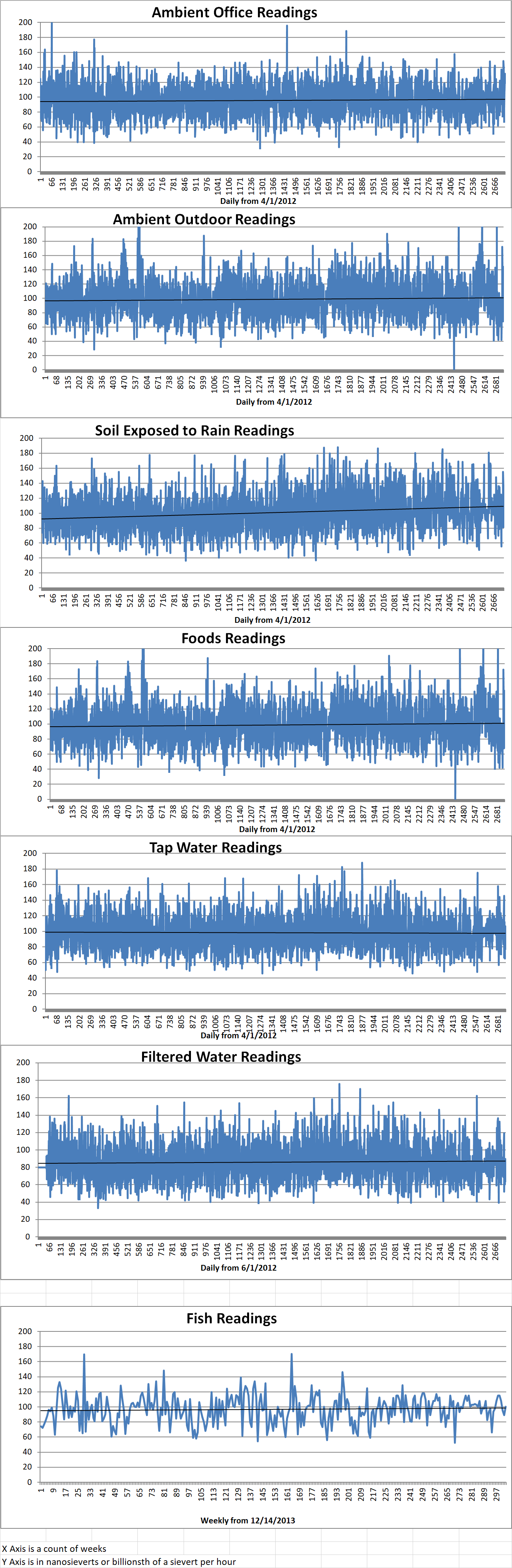
Ambient office = 119 nanosieverts per hour
Ambient outside = 97 nanosieverts per hour
Soil exposed to rain water = 93 nanosieverts per hour
Red bell pepper from Central Market = 121 nanosieverts per hour
Tap water = 85 nanosieverts per hour
Filtered water = 69 nanosieverts per hour
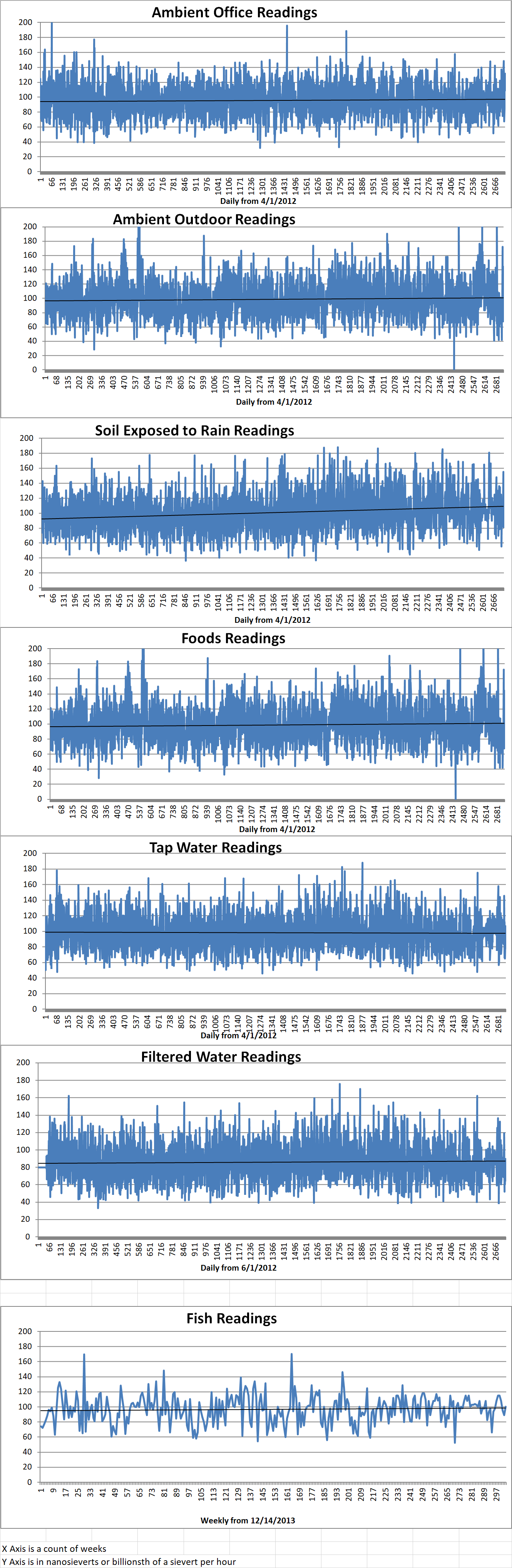
Ambient office = 131 nanosieverts per hour
Ambient outside = 96 nanosieverts per hour
Soil exposed to rain water = 111 nanosieverts per hour
Cucumber from Central Market = 144 nanosieverts per hour
Tap water = 106 nanosieverts per hour
Filtered water = 89 nanosieverts per hour