
Part 3 of 3 Parts (Please read Parts 1 and 2 first)
Poor enforcement of regulations is part of the reason that wastewater spills are so common across the country. Between 2009 and 2014, over one hundred and eighty million gallons of was spilled as reported by the Associated Press. The Press added up the quantity of wastewater spilled in the twenty-one thousand six hundred and fifty-one accidents that had been reported to state or federal authorities during that period.
The naturally occurring radioactive materials in fracking wastewater are especially troublesome. This is partly because of their longevity in the environment. It is also partly due to loose regulatory standards that the shale industry has with respect to hazardous waste when compared to other industries.
Last January, North Dakota regulators lowered their standards for dumping radioactive materials again. They now permit many landfills in the state to take drilling wastewater that is more radioactive than was previously allowed. Economic difficulties for the shale industry were given as the reason for lowering the standards. Environmentalists are critical of these looser standards because they believe that dangerous radioactive materials are not being handled properly.
Darrell Dorgan chairs the North Dakota Energy Industry Waste Coalition. He said in a recent interview “If people think this study points to a building tragedy, just wait. The new rules allow radioactive waste that is 10 times more dangerous.”
The spills investigated by the Duke team often were the result of a failure to properly maintain infrastructure including pipelines and storage tanks. About half of the spills came from pipelines that burst. Next most common were leaks for valves and pipeline connectors. These were followed by tank leaks or overflows.
Recent floods in the Texas Eagle Ford shale region showed that natural disasters pose a serious danger for shale drilling operations. Regulators in Texas have photographs of plumes of wastewater contamination around submerged drilling sites. There were also similar incidents in Colorado. Dr. Walter Tsou is the former president of the American Public Health Association. He said in an interview that “That’s a potential disaster.” Some federal agencies have taken note of risks associated with fracking in flood zones. However, this attention has been of little benefit to the locals in affected areas.
The Federal Emergency Management Agency’s Hazard Mitigation Grant Program is a program designed to help people move away from areas subject to recurring floods. In 2012, the program encountered a series of conflicts over oil and gas leases on properties that would have otherwise been eligible for buy-outs. Some homeowners in Pennsylvania were unable to participate in the Grant Program because there were oil and gas leases or pipeline leases on their properties. This means that it may be more difficult for people whose property has been frequently flooded and who have signed oil and gas or pipeline leases to obtain assistance from FEMA.
The new report from the Duke team indicated that the less visible wastewater brines might be a more long-lasting problem that that of spilled oil. The Duke researchers only sampled and tested sites that had been reported to state regulators. They warned that very little is being done to clean up spill sites or to even track smaller spills, especially if they are on reservation lands which produce a quarter of the state’s oil.
Blog
-

Radioactive Waste 426 – Duke University Publishes Study On Radioactive Materials In Fracking Wastewater – Part 3 of 3 Parts
-
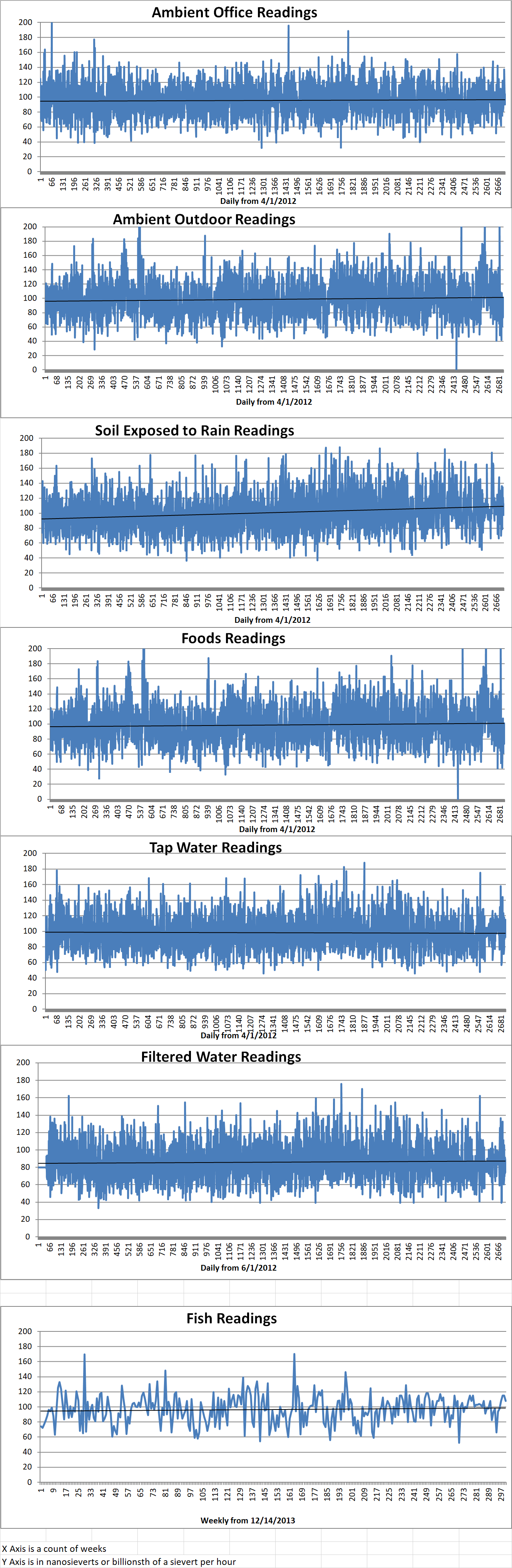
Geiger Readings for Nov 29, 2019
Ambient office = 103 nanosieverts per hour
Ambient outside = 106 nanosieverts per hour
Soil exposed to rain water = 105 nanosieverts per hour
English cucumber from Central Market = 94 nanosieverts per hour
Tap water = 93 nanosieverts per hour
Filtered water = 74 nanosieverts per hour
-
Radioactive Waste 425 – Duke University Publishes Study On Radioactive Materials In Fracking Wastewater – Part 2 of 3 Parts
Part 2 of 3 Parts (Please read Part 1 first)
Cleanup efforts are taking place at three out of the four sites that were sampled and tested by the team from Duke. This was reported by a North Dakota State Health Department official who had been asked to comment on the Duke report. However, the contamination at the fourth site was not currently being dealt with. The official was critical of the research done by the Duke team because he said that the researchers had failed to do any serious testing at other sites where there had been extensive cleanup work.
The four sites that were tested by the Duke team included the areas where two of the biggest spills in the history of North Dakota occurred. At one of the sites, almost three million gallons of wastewater was released in 2015. Two smaller spill sites from 2011 were also tested. The samples from all four of the sites were collected in 2015. The National Science Foundation and the Natural Resources Defense Council provided funds for the Duke study.
In the past decade, about nine thousand seven hundred wells have been drilled in North Dakota in the Bakken Shale and Bottineu oilfield region. Doing the math, there has been roughly one spill reported for every three wells that have been drilled.
Avner Vengosh is a professor of geochemistry and water quality at Duke’s Nicholas School of the Environment. When the Duke study was published, he commented that “Until now, research in many regions of the nation has shown that contamination from fracking has been fairly sporadic and inconsistent. In North Dakota, however, we find it is widespread and persistent, with clear evidence of direct water contamination from fracking.”
One of the most difficult problems for the shale industry has been handling the wastewater produced by drilling and fracking. The shale industry often pumps its toxic wastewater underground in a process referred to as wastewater injection. Every day, about two billion gallons of oil and gas wastewater in injected back into the ground across the U.S. Wastewater injection has been linked to swarms of earthquakes. This has resulted in legal challenges to the injection process.
The enormous volume of wastewater generated by the shale industry has often been beyond the coping ability of state regulators. This is especially true because federal law created an exemption for the fracking waste from the normal hazardous waste handling laws in the 1980s, regardless of how toxic or dangerous the waste is. Policing the waste from the shale industry has largely been left to individual states. Regulations vary from state to state and enforcement is often difficult.
Budgets for regulators have often failed to keep pace with the rapid expansion of the shale industry. For example, in North Dakota the number of wells per state inspector rose from about three hundred and sixty each in 2012 to five hundred each in 2018. The ratios are even worse in other fracking states. Wyoming oil and gas inspectors were each responsible for almost three thousand wells in 2015. As a result of the recent crash of oil and gas prices, funds for oil and gas inspections have also fallen in many states.
Please read Part 3 -
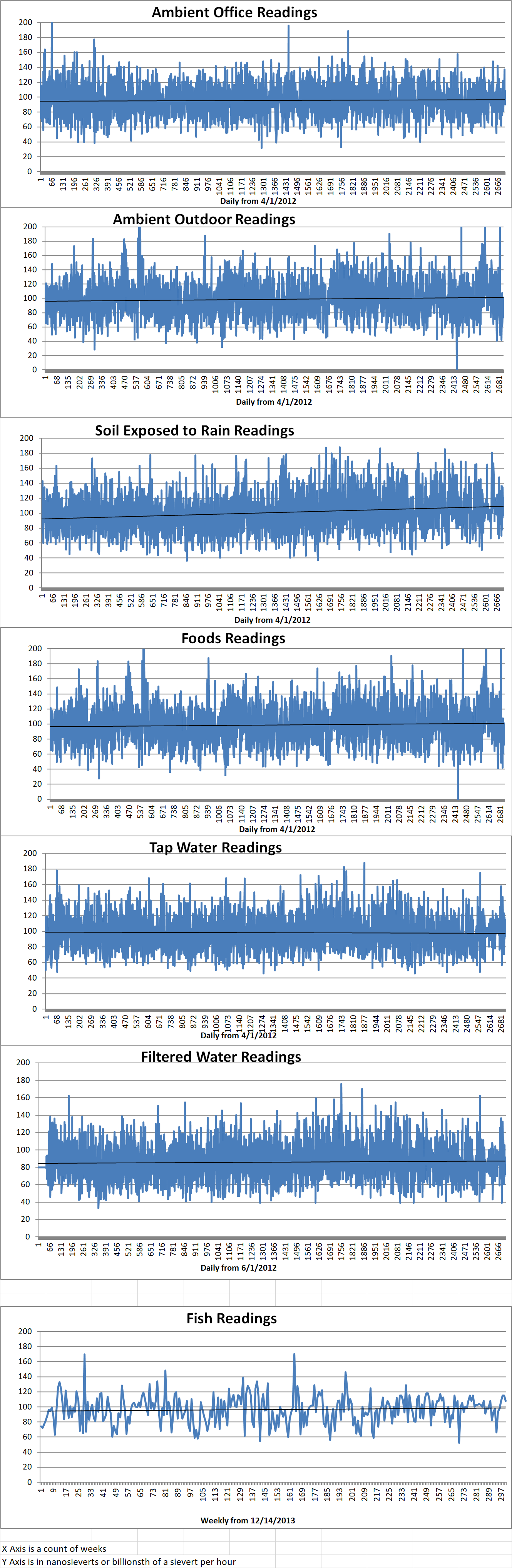
Geiger Readings for Nov 28, 2019
Ambient office = 90 nanosieverts per hour
Ambient outside = 95 nanosieverts per hour
Soil exposed to rain water = 97 nanosieverts per hour
Avocado from Central Market = 101 nanosieverts per hour
Tap water = 94 nanosieverts per hour
Filtered water = 85 nanosieverts per hour
-

Radioactive Waste 424 – Duke University Publishes Study On Radioactive Materials In Fracking Wastewater – Part 1 of 3 Parts
Part 1 of 3 Parts
Researchers at Duke University have released a new report which was published in Environmental Science & Technology. The report found that thousands of oil and gas industry wastewater spills in North Dakota have resulted in “widespread” contamination including radioactive materials, heavy metals and corrosive salts. This contamination poses a very serious threat to public health and the environment.
Testing near the sites of wastewater spills shows that some rivers and streams in North Dakota currently contain levels of these contaminants that rise above the federal drinking water standards. Many cities and towns in North Dakota draw their drinking water from contaminated sources. Federal law mandates that drinking water be treated to remove contaminants. The researchers did not test the quality of tap water in affected cities.
High levels of lead and the radioactive element radium have been found near spill sites. Selenium in some of the water in North Dakota was more than thirty-five times higher than the federal thresholds that apply to fish, mussels and other wildlife. People eat many of these.
Contamination was found on land in addition to that found in water. High levels of radium were discovered in ground downstream from the original location of the spills. There were significant amounts of radium in soil that was further from the spill origin. This research shows that radioactive materials were soaking into the ground and concentrations in the soil were building up as the spills flowed over the ground.
The total number of spills in the past few years is surprisingly high. The Duke researchers mapped out almost four thousand accidental spills of oil and gas wastewater in North Dakota. At the oldest spill site that was tested, contamination remained. About three hundred barrels of wastewater were released four years before the samples were taken and tested. This indicates that any attempts at remediation of that spill site were not sufficient to remove the contamination.
Nancy Lauer is a Duke University PhD student who was the lead author on the report. She said, “Unlike spilled oil, which starts to break down in soil, these spilled brines consist of inorganic chemicals, metals and salts that are resistant to biodegradation. They don’t go away; they stay. This has created a legacy of radioactivity at spill sites.”
The greatest concentration of radium found by the researchers measured over four thousand six hundred Bequerels per kilogram. This is more than two and one half times the level of radium found at a spill site in Pennsylvania which attracted national attention when it was discovered. North Dakota law states that waste that is more than one hundred and eighty-five Bequerels per kilogram is too radioactive to dump in regular landfills unless the dumper has a special permit. Such waste cannot even be transported over North Dakota roads without a special state license. The researched concluded that the radioactive contamination found in North Dakota will be present for thousands of years unless extraordinary efforts are made to clear it up.
In their conclusion, the researchers said that “The results of this study indicate that the water contamination from brine spills is remarkably persistent in the environment, resulting in elevated levels of salts and trace elements that can be preserved in spill sites for at least months to years. The relatively long half-life of [Radium 226] (∼1600 years) suggests that [Radium] contamination in spill sites will remain for thousands of years.”
Please read Part 2 -
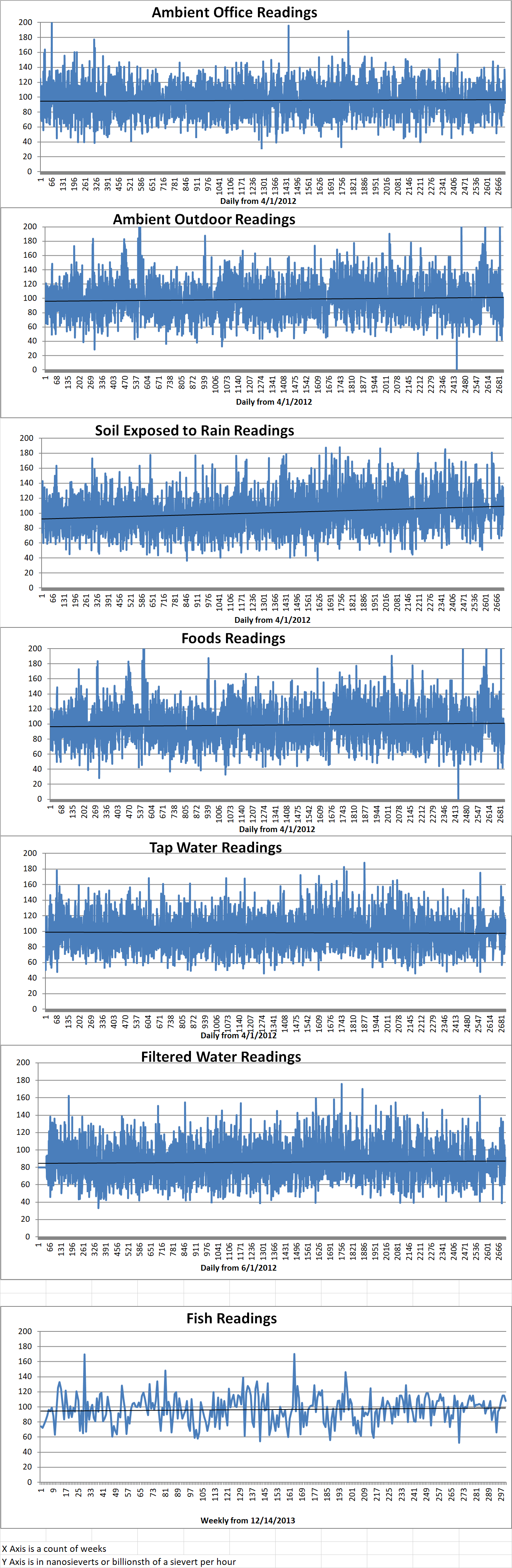
Geiger Readings for Nov 27, 2019
Ambient office = 92 nanosieverts per hour
Ambient outside = 110 nanosieverts per hour
Soil exposed to rain water =112 nanosieverts per hour
Bartlett pear from Central Market = 96 nanosieverts per hour
Tap water = 99 nanosieverts per hour
Filtered water = 88 nanosieverts per hour
-
Nuclear Reactors 739 – Research Team Pioneers New Safety System For Light Water Reactors – Part 2 of 2 Par
Part 2 of 2 Parts
Part of the team’s proposal includes the formation of an Emergency Rescue Team (ERT) that would consist of a group of highly trained and specialized rescuers. The ERT would have specialized machinery and equipment. They would have access to every nuclear power reactor installed in an assigned area. The intention is to have the ERT be able to reach any of its assigned reactors within and hour and/or be able to execute a remote shut down of the reactor experience difficulties.
In their report, the team explains how and why the features of their new system could have prevented core meltdowns and the resulting nuclear disasters for each of the three major nuclear accidents listed above.
The Three Mile Island nuclear disaster was the most devastating accident in the history of U.S. nuclear power plants. The accident was ultimately found to be the result of a series of typical failures that combined to cause the disaster. If the operators of Three Mile Island had access to an alarm from the E-SMD detectors, an emergency shutdown of the reactor could have been carried out well before the events that led to the disaster.
The Chernobyl accident in Ukraine was the result of critical errors on the part of the staff at the power plant. If the proposed ERT had been available, they could have executed a remoted control shutdown. The intervention of military units might have prevented the catastrophe that resulted from the human errors.
With the flooding of the emergency generators at Fukushima, the flow of cooling water to the reactors was lost which resulted in the meltdown of Units 1, 2 and 3 as well as the explosive destruction of Unit 4. Alarms from E-SMD detectors and quick response from the EFT could have prevent the destruction of the Fukushima nuclear power plant.
The report states that while there have be three notorious major nuclear plant accidents, there have been about five hundred safely operated nuclear power plants since controlled fission was first demonstration in 1942 and the connection of the first nuclear fission power reactor to the U.S. electrical grid in 1954. In addition, there have been a few thousand accident-free reactors utilized for purposes other than the generation of electricity. These specialized reactors were dedicated to such uses as research, nuclear isotope production and marine propulsion.
In conclusion, the authors of the report state that “The industry and/or the Government of responsible Countries where applicable, become the main players for the possible implementation of the ideas in this paper. A strategy is needed in this connection: academia and research institutes willing to be engaged into practical applications of the nuclear technology should become actors.”
The intentions of the research team are admirable. We have about four hundred nuclear power reactors currently operating around the world. Anything that can make them safer would be very important. However, the bigger problem is than no matter how good nuclear power reactor safety is, there is still the possibility that there will be another major nuclear accident. It is probable that one more major accident will turn public opinion, political support and investor interest against further expansion of nuclear power.