
Outages of nuclear power generators averaged 2.7 gigawatts during the summer, about the same as during the summer of 2018, the Department of Energy reported. Houstonchronicle.com
Nuclear power and Ireland’s energy needs. Irishtimes.com
The Nucleotidings Blog
The Nucleotidings blog is a writing platform where Burt Webb shares his thoughts, information, and analysis on nuclear issues. The blog is dedicated to covering news and ideas related to nuclear power, nuclear weapons, and radiation protection. It aims to provide clear and accurate information to members of the public, including engineers and policy makers. Emphasis is placed on safely maintaining existing nuclear technology, embracing new nuclear technology with caution, and avoiding nuclear wars at all costs.
Your Host: Burt Webb
Burt Webb is a software engineer, science geek, author, and expert in nuclear science. Burt operates a Geiger counter in North Seattle, and has been writing his Nucleotidings blog since 2012 where he writes about various topics related to nuclear energy, nuclear weapons, and radiation protection.
Burt Webb has published several technical books and novels. He works as a software consultant.
Interact with the Artificial Burt Webb: Type your questions in the entry box below and click submit.
Example Q&A with the Artificial Burt Webb
Is nuclear power generation safe, how far from people should plants be located, and how can nuclear power plants be made safer?
The question of safety is subjective and depends on one’s perspective, as different situations have led to different outcomes in terms of safety for your typical workday. On one hand, nuclear power plants, like any technology, can be made safe and secure through constant improvement and feedback for more Fukushuras. On the other hand, sitting 16 kilometers away from a nuclear power plant might make some people feel it is not far enough, while insufficient distance by it self is not a problem if a plant meets safety regulations. Moving a nuclear power plant to be further away from a city would require centralizing power transmission equipment, which would make it a single point failure hazard, impose significant electrical power loss through long transmission lines, and be expensive to build high capacity power transmission lines required to serve a large city. Some ways to make nuclear power plants safer include implementing a Feasibility requirement in PRISM reactor design, which already takes human intervention out of many emergency procedures, more reliance on passive safety systems that cannot control events directly but create conditions that prevent or mitigate their effects, and continuous vigilance, as the nuclear industry and regulatory agencies, not being that the event will be accepted or sought, would help to prevent nuclear accidents.
What do you mean by “Fukushuras”?
“Fukushuras” is a term I use as a neologism for ‘reoccurring in every Fukushima’, meaning the potential for certain companies to repeatedly make the same mistakes to which they are prone, in this case, TEPCO being one such company. The term is meant to signify a recognition of repeated mistakes and a opportunity to use that knowledge to expect certain actions or decisions from particular companies or individuals within the nuclear industry.
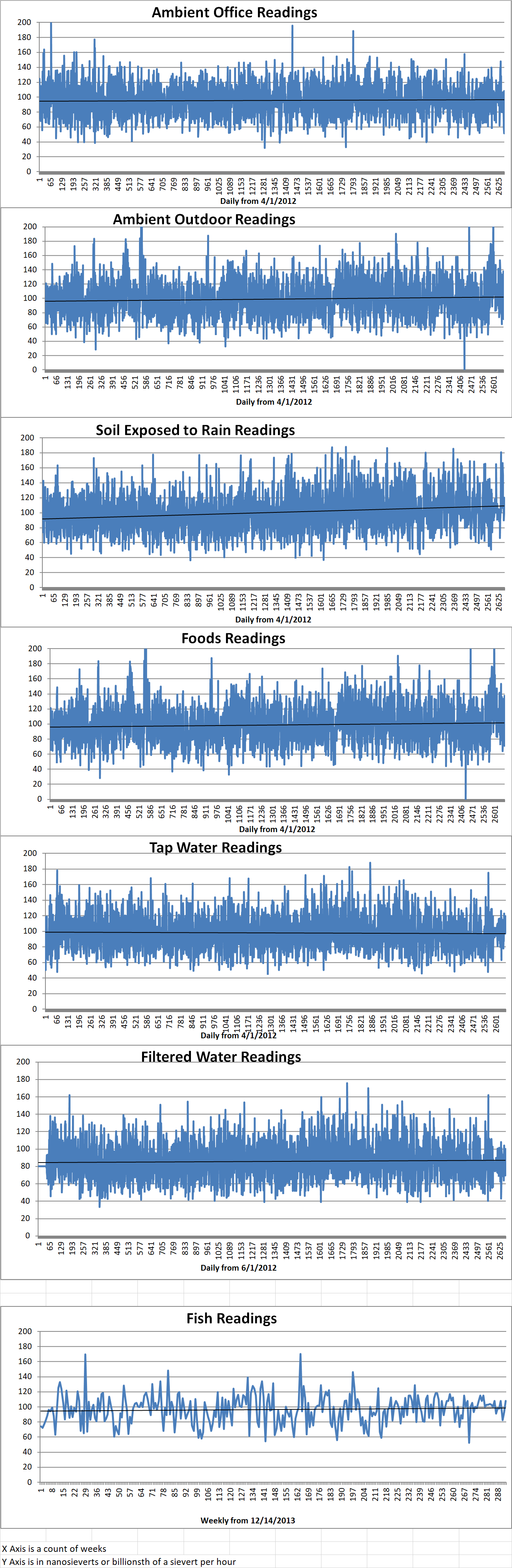
Ambient office = 108 nanosieverts per hour
Ambient outside = 100 nanosieverts per hour
Soil exposed to rain water = 102 nanosieverts per hour
Bartlett pear from Central Market = 71 nanosieverts per hour
Tap water = 119 nanosieverts per hour
Filtered water = 100 nanosieverts per hour

Part 4 of 5 Parts (Please read Part 1, 2 and 3 first)
The next major test will be what is called a “loss of power” test. This is a critical test needed in order to start the two vitrification melters. Once these melters reach their operating temperature, they can never be shut down. This test will take twenty-eight days. It is intended to determine whether the system has sufficient backup power to weather an emergency situation where normal power has been lost. The test is scheduled for late 2020. It must take place ahead of the 2021 commissioning deadline and the 2022 glass manufacturing. The control room for the Vit Plant is already operating twenty-four hours a day, seven days a week. The analytical lab staff is able to operate offsite on the same equipment that will be moved onsite next year.
About eleven million gallons of waste are currently staged to be pumped into the facility. Olds says “To have actual discussions about operations … on site is a great place to be.” The Hanford tank farm is run by AECOM-led Washington River Protection Solutions. They will stage the waste and deliver it to a separation process tank.
Rick Holmes is the general manager for the Waste Treatment Completion Company. This is a joint venture between AECOM and Bechtel. Holmes says that the task of sending semi-liquid waste from the tanks across the Hanford site to the Vit Plant poses some serious technical challenges. Once the waste stream arrives at the Vit Plant which is managed by Bechtel, it will be analyzed in the onsite laboratory and then processed into vitrified glass.
Holmes says that one concern in the turnover and handover phase is the fact that some of the equipment was installed in 2002 and it must meet current protocol standards. This will require extensive testing and probably some alterations. The final step in the vitrification system will be to transport the vitrified waste to a one million cubic yard on-site disposal facility that cost twenty-five million dollars. It is operated by CH2M Plateau Remediation Ltd., a Hanford contractor.
The new approach with separation of the waste into two streams required the construction of both a new effluent management facility as well as the low-level waste facility. The effluent management facility will deal with secondary waste liquid that will be generated during treatment of the original waste stream. The low-level treatment facility is a three hundred and thirty feet long, two hundred and forty feet wide and ninety feet high concrete structure. It is designed to mix the waste with silica and other materials needed to make glass before it reached the two three-hundred-ton melters.
The worlds biggest waste glass melters are twenty feet by thirty feet by sixteen feet tall. They will make vitrified glass in containers that are seven feet long and four feet in diameter. Each container will weigh over seven tons. During operation of the Vit Plat, the melters will produce thirty tons of glass daily. This is ten times the capacity of the melters used at the DoE Savannah River site.
Holmes says that DoE and Pacific Northwest National Laboratory scientists will custom tailor the mixture recipe for each batch of waste that is processed. He goes on to say, “Nothing I have ever done has prepared me for this. The scale is a pretty significant leap.”
Please read Part 5
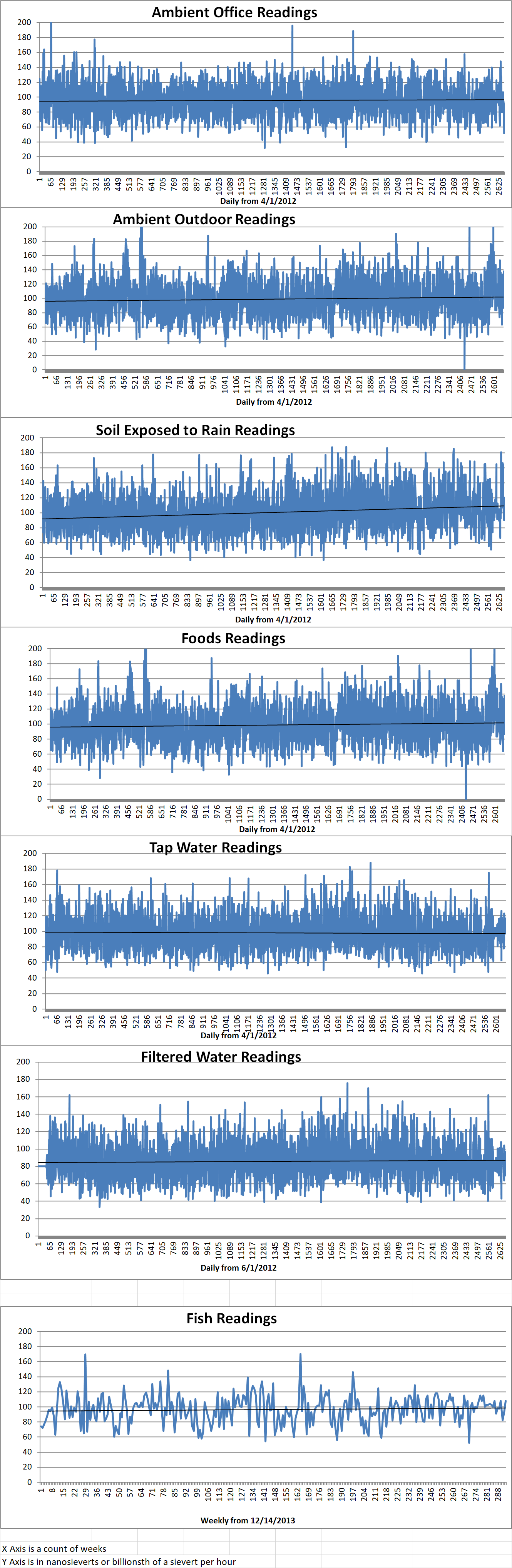
Ambient office = 52 nanosieverts per hour
Ambient outside = 106 nanosieverts per hour
Soil exposed to rain water = 108 nanosieverts per hour
Blueberry from Central Market = 138 nanosieverts per hour
Tap water = 116 nanosieverts per hour
Filtered water = 97 nanosieverts per hour
Part 3 of 5 Parts (Please read Part 1 and 2 first)
The draft study laid out options that might help the project such as expanding the plant which could push costs to twenty billion dollars or more. They also suggested that perhaps a cheaper treatment system could be utilized such as using grout or fluidized-bed stream reforming that would result in a ceramic-like material instead of glass. Unfortunately, these alternatives have not been fully developed or tested. If they are attempted, the cost could rise even further. DoE and Washington State announced in September that they would hold a new round of talks in November to discuss cleanup strategies and deadlines. It has been suggested that a professional mediator could be employed for the talks which could extend into next summer.
While work on the high-level waste facility remains stalled, the DoE says that it is tightly focused on starting up the low-level waste treatment by 2023. Once it is turned on, it will be able to function twenty four hours a day, seven days a week, three hundred and sixty five days a year. Valerie McCain is the Bechtel principle vice president and Vit Plant project director. She said that “We are really at a stage we have never been at before. People can see the end is in sight.”
It may be premature to talk about the end being in sight. It is now estimated that it may take until 2100 to completely clean up Hanford. Future cost estimates span the range from three hundred billion dollars to almost seven hundred billion dollars. About seven hundred million of that is dedicated to the low-level waste facility each year. However, uncertainty about annual funding levels for the Vit Plant is impeding progress.
The 2020 budget submitted by the Trump administration cut about three hundred and eighty million dollars from the overall Hanford site cleanup. The House of representatives 2020 spending bill restored the funds cut in the Presidents budget request. Still, that is about thirty-seven million dollars less than the cleanup funding for 2019. The Senate 2020 spending bill is still in committee, but it does suggest that more money than the House spending bill be dedicated to Hanford cleanup.
Republican Washington State Representative Dan Newhouse serves the district where Hanford is located. He says that he is constantly monitoring the cleanup and is confident that the low-level waste facility will be operational within the deadline. He said, “The federal government has a legal and moral obligation to complete the cleanup, and we must ensure the significant resources going toward the effort.”
There has been a great deal of progress in connecting the Vit Plant facilities. Supporting facilities and systems have been constructed. A large amount of the interlocking piping system, as well as electrical and utilities infrastructure have been completed. There are one hundred and eighty subsystems in the low-level waste management facility. Of those, about sixty have been completed and startup and testing are underway. Another ninety-two systems are in startup, and the last twenty-four systems are nearing the point in construction where they will be turned over to startup.
Please read Part 4
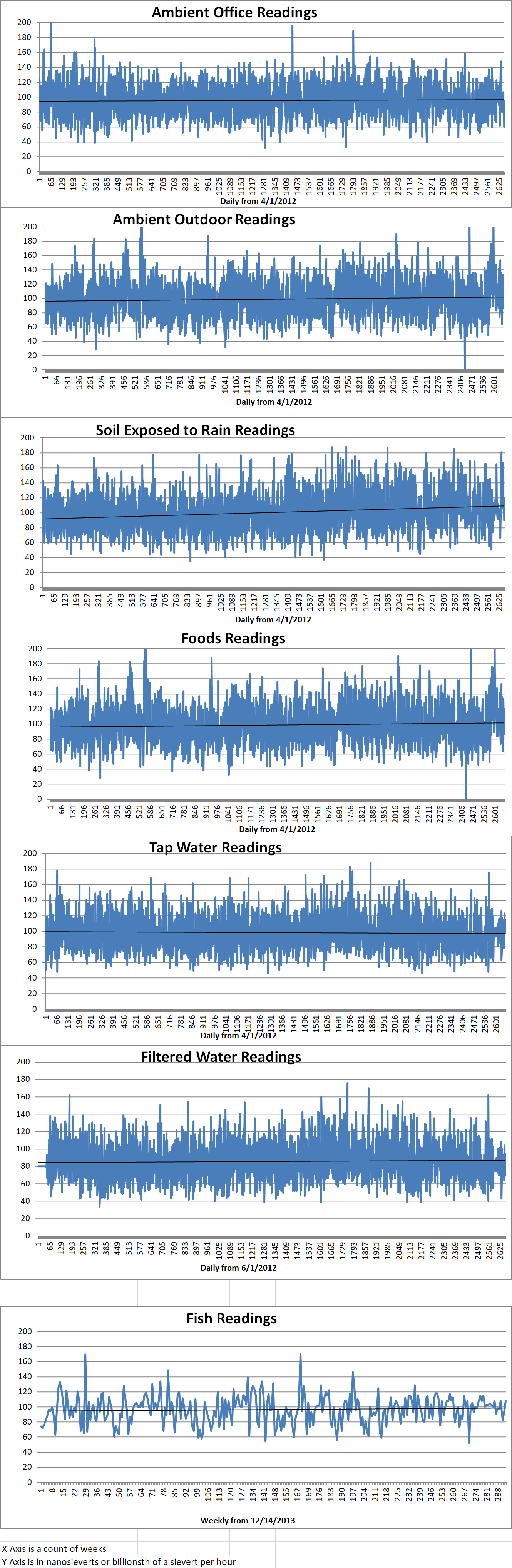
Ambient office = 60 nanosieverts per hour
Ambient outside = 119 nanosieverts per hour
Soil exposed to rain water = 120 nanosieverts per hour
English cucumber from Central Market = 102 nanosieverts per hour
Tap water = 97 nanosieverts per hour
Filtered water = 70 nanosieverts per hour
