
Nuclear weapons, interfaith ties top pope’s agenda in Asia. Cbs17.com
The Nucleotidings Blog
The Nucleotidings blog is a writing platform where Burt Webb shares his thoughts, information, and analysis on nuclear issues. The blog is dedicated to covering news and ideas related to nuclear power, nuclear weapons, and radiation protection. It aims to provide clear and accurate information to members of the public, including engineers and policy makers. Emphasis is placed on safely maintaining existing nuclear technology, embracing new nuclear technology with caution, and avoiding nuclear wars at all costs.
Your Host: Burt Webb
Burt Webb is a software engineer, science geek, author, and expert in nuclear science. Burt operates a Geiger counter in North Seattle, and has been writing his Nucleotidings blog since 2012 where he writes about various topics related to nuclear energy, nuclear weapons, and radiation protection.
Burt Webb has published several technical books and novels. He works as a software consultant.
Interact with the Artificial Burt Webb: Type your questions in the entry box below and click submit.
Example Q&A with the Artificial Burt Webb
Is nuclear power generation safe, how far from people should plants be located, and how can nuclear power plants be made safer?
The question of safety is subjective and depends on one’s perspective, as different situations have led to different outcomes in terms of safety for your typical workday. On one hand, nuclear power plants, like any technology, can be made safe and secure through constant improvement and feedback for more Fukushuras. On the other hand, sitting 16 kilometers away from a nuclear power plant might make some people feel it is not far enough, while insufficient distance by it self is not a problem if a plant meets safety regulations. Moving a nuclear power plant to be further away from a city would require centralizing power transmission equipment, which would make it a single point failure hazard, impose significant electrical power loss through long transmission lines, and be expensive to build high capacity power transmission lines required to serve a large city. Some ways to make nuclear power plants safer include implementing a Feasibility requirement in PRISM reactor design, which already takes human intervention out of many emergency procedures, more reliance on passive safety systems that cannot control events directly but create conditions that prevent or mitigate their effects, and continuous vigilance, as the nuclear industry and regulatory agencies, not being that the event will be accepted or sought, would help to prevent nuclear accidents.
What do you mean by “Fukushuras”?
“Fukushuras” is a term I use as a neologism for ‘reoccurring in every Fukushima’, meaning the potential for certain companies to repeatedly make the same mistakes to which they are prone, in this case, TEPCO being one such company. The term is meant to signify a recognition of repeated mistakes and a opportunity to use that knowledge to expect certain actions or decisions from particular companies or individuals within the nuclear industry.
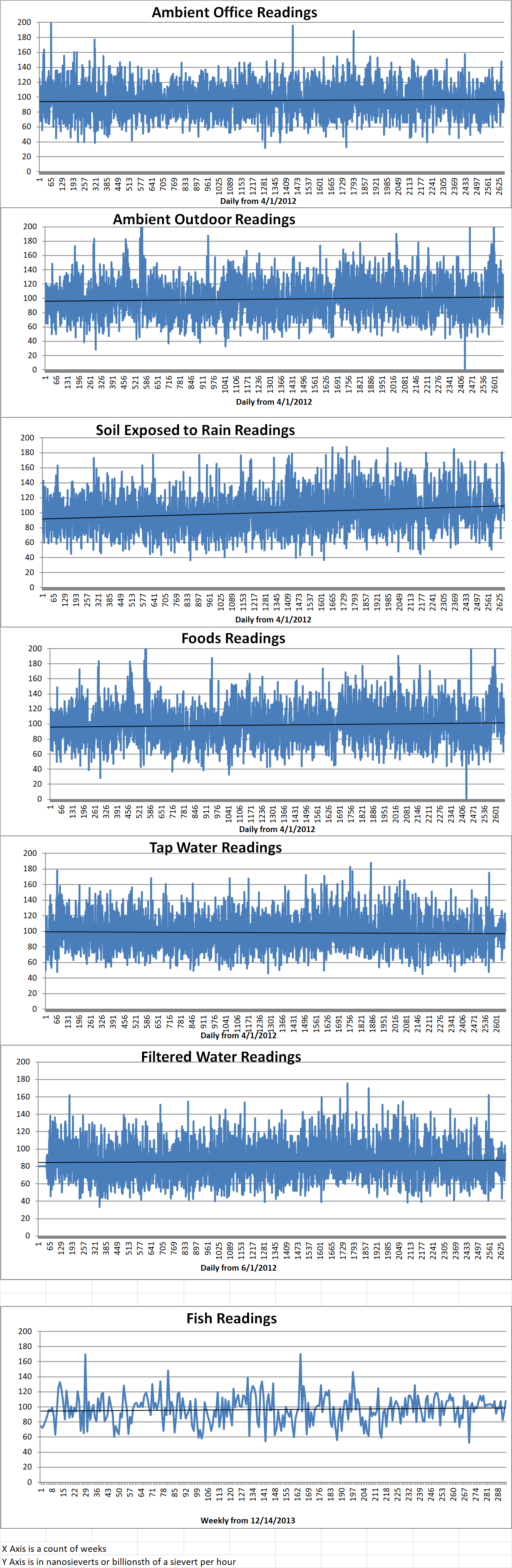
Ambient office = 91 nanosieverts per hour
Ambient outside = 94 nanosieverts per hour
Soil exposed to rain water = 90 nanosieverts per hour
Avocado from Central Market = 86 nanosieverts per hour
Tap water = 111 nanosieverts per hour
Filtered water = 89 nanosieverts per hour
Dover sole – Caught in USA = 108 nanosieverts per hour

Part 2 of 5 Parts (Please read Part 1 first)
Since 2002, the Vit Plant project has been carried out by Bechtel National, Inc. The project covers sixty-five acres. It has four major components. A twelve-story pretreatment facility will separate the radioactive waste stream into different streams based on level of radioactivity. There will be a small facility that will be used to vitrify low level waste with small amounts of radioactive isotopes. A six-story structure with one hundred and twenty thousand square feet will house a facility to treat high-level waste. There will also be an analytical laboratory. The Bechtel company is designing, constructing and commissioning what will be the biggest radioactive waste treatment plant in the world.
The project has seen many delays since it began, and the estimated cost is now four times the original estimate. The estimation of the ultimate cost of the Vit Plant is a moving target and the completion of the project is at least a decade in the future.
Managers of the project have fought with regulators repeatedly over scope changes. They have also battled over progress and cost impacts that affect the performance incentives that have been given to Bechtel.
After years of schedule delays and cost overruns, DoE has worked to reduce expectations as issues of safety and quality assurance have emerged with respect to the high-level waste treatment process. Some of these issues have been raised by whistleblowers. In one case, a whistleblower was ultimately fired by AECOM, a Hanford contractor, which resulted in a four-million-dollar wrongful termination judgement.
Originally, it was thought that the Vit Plant could be designed to handle a single waste stream. In 2013, DoE was forced to change the design to handle two different waste streams. They believe that the low-level waste treatment facility will be able to vitrify about ninety percent of the tank waste. This facility will be in operation while engineers work on the redesign and construction of the facility for high-level waste treatment.
Brian Vance heads DOE operations at Hanford. He recently told the Washington State Department of Ecology in a “notice of serious risk” that his agency cannot guarantee when either the pretreatment plant or the high-level treatment facility will be completed.
Washington State was granted some legal oversight over the cleanup activity at Hanford by a 1989 consent decree from a federal court. An agreement that was signed mandates that Bechtel demonstrate that both facilities will work with radioactive waste by 2033 and be fully operational by 2036. A Washington State representative said that they were still reviewing the notice and its implications. Washington State authorities have been holding frequent talks with DoE since spring of this year because the top environmental official of Washington had asked for a “frank discussion” of the challenges that confront the project.
With the new process to separate waste streams, the DoE issued a statement that it “remains firmly committed to and is on schedule to meet” starting treatment of low-level wastes by December 2023. However, the National Academies of Science drafted a report last month that reported serious concerns about whether the current design would, in fact, be able to start treatment of low-level wastes by the deadline.
Please read Part 3
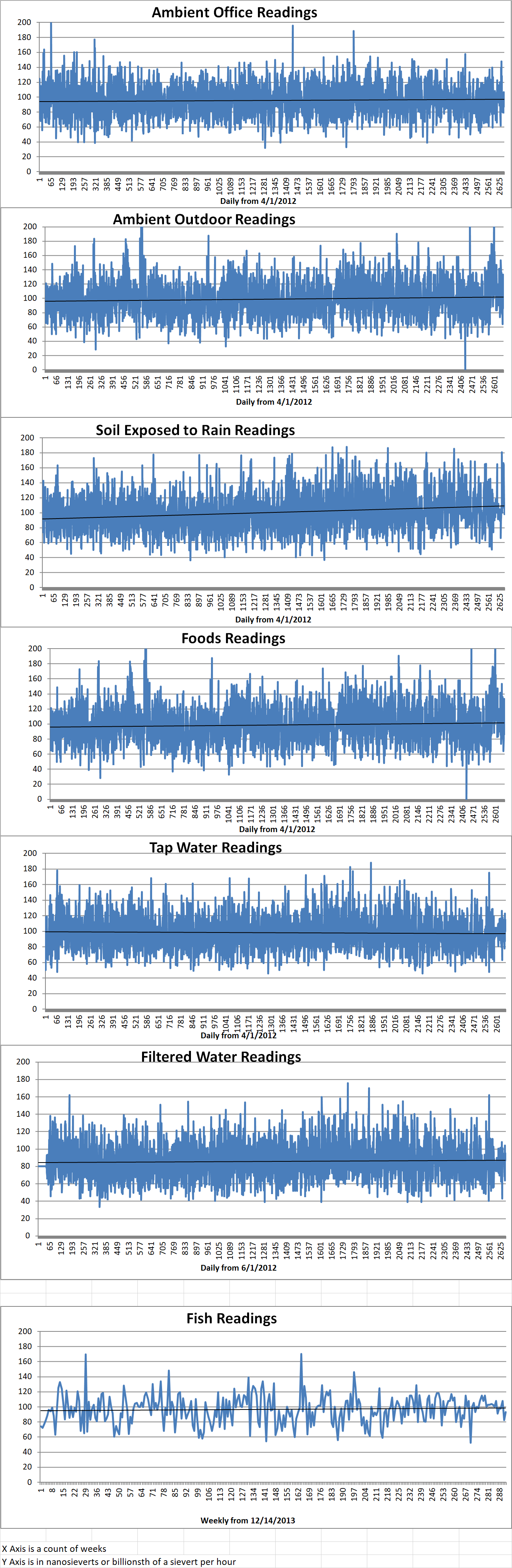
Ambient office = 95 nanosieverts per hour
Ambient outside = 100 nanosieverts per hour
Soil exposed to rain water = 98 nanosieverts per hour
Blueberry from Central Market = 109 nanosieverts per hour
Tap water = 109 nanosieverts per hour
Filtered water = 95 nanosieverts per hour
Part 1 of 5 Parts
One of the most radioactively contaminated places in the world is the Hanford Nuclear Complex in south central Washington State. Decades of production of uranium and plutonium for the U.S. nuclear arsenal with little regard for environmental damage left a great deal of radioactive and toxic waste stored in underground tanks which are leaking. The U.S. Department of Energy has spent billions of dollars to clear up the mess but billions more are required to finish the job.
It was decided a couple of decades ago that the answer to disposing of the fifty-six million gallons of waste in the one hundred and seventy-seven underground tanks was to fuse the waste into glass logs where it would be inert and could be safely buried. Sixty of the tanks have leaked. Work on the Tank Waste Treatment and Immobilization Plant began seventeen years ago (also called the Vit Plant). So far seventeen billion dollars has been spent.
The process that the tank waste would be subjected to is referred to as vitrification. The waste pumped out of the tanks will be heated to two thousand degrees Fahrenheit and mixed with materials that are used to make glass. The molten mixture will be poured into stainless steel canisters and allowed to cool and solidify. Once the glass logs in the canisters have cooled sufficiently, they can be safely buried and will not threaten human health and the environment during the thousands of years it will take for the radioactivity to dissipate.
Vitrification technology has been used in other countries including Japan, France, Russia and the United Kingdom. In the U.S., forty million gallons of radioactive waste at the DoE Savannah River site in South Carolina has been vitrified. Unfortunately, the waste being treated at Hanford is a very complex mixture of radioactive materials and eighteen hundred other dangerous and toxic chemicals. Erik Olds is the DoE deputy project integration manager at Hanford. He said, “One of the last major challenges left, if not the last major challenge left, is to get the waste out of those tanks and turned into stable forms where we will store the waste.”
One of the reasons for the long construction phase is the fact that they began building before they understood serious problems. The contents of the tanks vary in viscosity and there are different sizes of granular materials in some of the tanks. It turned out that the system of pipes that fed the tank contents into the processing area were subjected to vibrations because of the varying physical properties of the waste stream. These vibrations caused leaks in the pipes of waste and hydrogen gas which could have resulted in explosions. Work has been stopped on the high-level waste treatment facility and the pretreatment facility since 2012.
Almost three thousand workers are attached to the Vit Plant at Hanford. This includes fifteen hundred trade workers. Hanford is ready to start the first phase of the new Vit Plant as it struggles to meet mandates imposed for the cleanup by federal courts. There are still technical and funding problems that confront the project.
Please read Part 2
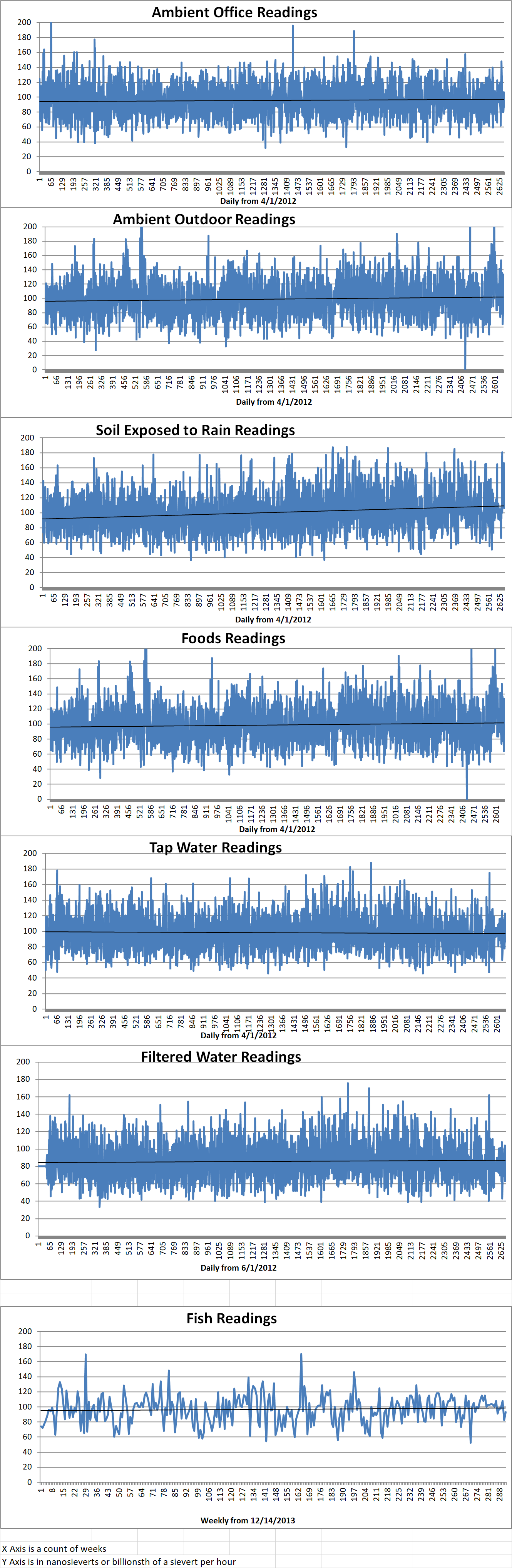
Ambient office = 93 nanosieverts per hour
Ambient outside = 115 nanosieverts per hour
Soil exposed to rain water = 112 nanosieverts per hour
English cucumber from Central Market = 86 nanosieverts per hour
Tap water = 100 nanosieverts per hour
Filtered water = 87 nanosieverts per hour
Recently during a time of hurricane activity on the U.S. coast, President Trump asked advisors if we could extinguish a hurricane by detonating an atomic bomb in it. I wrote about it at the time but there has been repeated mentions of the idea since the hurricane. I decided to revisit this idea in more detail.
It turns out that the idea of using a nuclear bomb on a hurricane has been around for decades. In the 1950s, it was suggested by a meteorologist named Jack Reed. He thought that it might be possible to use a nuclear bomb to prevent a hurricane from making landfall on the U.S. coast. Since Jack Reed first proposed it the question has been raised so often that the National Oceanic and Atmospheric Administration has a webpage on its site dedicated to answering the question.
A hurricane can generate as much energy as the detonation of ten thousand nuclear bombs. The physical size of a hurricane is one of the major problems with trying to use a nuclear bomb to stop one. For example, Hurricane Irma was about four hundred miles in diameter. A modern nuclear bomb with a one megaton yield would have a blast radius of about four miles. This means that Irma was be a hundred times bigger in diameter than the blast zone of such a bomb. Detonating a nuclear bomb inside a hurricane would be like shooting a pea shooter at a speeding car and expecting that to change the course of the car.
If you were to detonate a nuclear bomb inside a hurricane, that would result in seeding radioactive fallout throughout the storm. The best-case scenario would be for the fallout to rain out of the hurricane quickly. If it did not and the hurricane reached land, the fallout would contaminate the environment in the track of the hurricane.
Even if the fallout rained down into the ocean, the results would be harmful. When the U.S. detonated a large thermonuclear device in the Marshall Islands in the Pacific Ocean, a lot of fish were contaminated by the fallout for thousands of miles. Japan halted fish consumption for a period following the detonation because of the contamination. It was estimated that about half of the cancers occurring in people living on islands near the detonation were caused by fallout from the blast.
If we had dropped a nuclear bomb into Hurricane Sandy, there would have been additional damage caused to fishing industries along the U.S. East Coast. There would have been damage to the health of people along the track of the storm and other repercussions. If people wanted to rebuild homes destroyed by the hurricane, all of the debris of the destroyed houses would have to be removed along with several inches of topsoil and disposed of as radioactive waste.
The bottom line is that using a nuclear bomb on a hurricane would not only have little effect on the strength or trajectory of the storm but would cause additional serious problems.