
Thief jeopardizes state secrets by using nuclear power plant to mine cryptocurrency. Thenextweb.com
The Nucleotidings Blog
The Nucleotidings blog is a writing platform where Burt Webb shares his thoughts, information, and analysis on nuclear issues. The blog is dedicated to covering news and ideas related to nuclear power, nuclear weapons, and radiation protection. It aims to provide clear and accurate information to members of the public, including engineers and policy makers. Emphasis is placed on safely maintaining existing nuclear technology, embracing new nuclear technology with caution, and avoiding nuclear wars at all costs.
Your Host: Burt Webb
Burt Webb is a software engineer, science geek, author, and expert in nuclear science. Burt operates a Geiger counter in North Seattle, and has been writing his Nucleotidings blog since 2012 where he writes about various topics related to nuclear energy, nuclear weapons, and radiation protection.
Burt Webb has published several technical books and novels. He works as a software consultant.
Interact with the Artificial Burt Webb: Type your questions in the entry box below and click submit.
Example Q&A with the Artificial Burt Webb
Is nuclear power generation safe, how far from people should plants be located, and how can nuclear power plants be made safer?
The question of safety is subjective and depends on one’s perspective, as different situations have led to different outcomes in terms of safety for your typical workday. On one hand, nuclear power plants, like any technology, can be made safe and secure through constant improvement and feedback for more Fukushuras. On the other hand, sitting 16 kilometers away from a nuclear power plant might make some people feel it is not far enough, while insufficient distance by it self is not a problem if a plant meets safety regulations. Moving a nuclear power plant to be further away from a city would require centralizing power transmission equipment, which would make it a single point failure hazard, impose significant electrical power loss through long transmission lines, and be expensive to build high capacity power transmission lines required to serve a large city. Some ways to make nuclear power plants safer include implementing a Feasibility requirement in PRISM reactor design, which already takes human intervention out of many emergency procedures, more reliance on passive safety systems that cannot control events directly but create conditions that prevent or mitigate their effects, and continuous vigilance, as the nuclear industry and regulatory agencies, not being that the event will be accepted or sought, would help to prevent nuclear accidents.
What do you mean by “Fukushuras”?
“Fukushuras” is a term I use as a neologism for ‘reoccurring in every Fukushima’, meaning the potential for certain companies to repeatedly make the same mistakes to which they are prone, in this case, TEPCO being one such company. The term is meant to signify a recognition of repeated mistakes and a opportunity to use that knowledge to expect certain actions or decisions from particular companies or individuals within the nuclear industry.
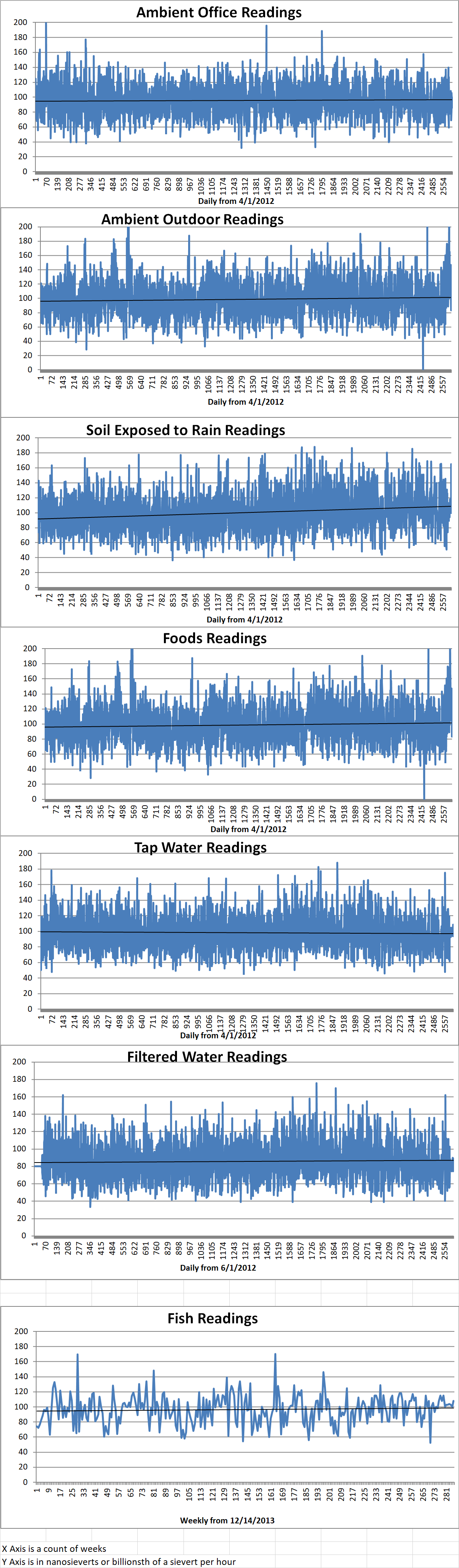
Ambient office = 86 nanosieverts per hour
Ambient outside = 165 nanosieverts per hour
Soil exposed to rain water = 165 nanosieverts per hour
Blueberry from Central Market = 84 nanosieverts per hour
Tap water = 94 nanosieverts per hour
Filtered water = 76 nanosieverts per hour
Part 1 of 3 Parts
Chernobyl has been in the news a lot lately with a television miniseries and a newly constructed cover. It is a nuclear power plant in Ukraine that is famous for a horrible nuclear accident in 1986. So much radiation was released in the surrounding area that it was closed to human activity. There is a forest near the plant where all the trees are dead and their leaves are red. The radiation released by the accident was so intense that it killed all the bacterial and fugus that would have caused the trees to rot away. Mushrooms in nearby countries triggered a Geiger counter soon after the accident. The meat of wild boars in the area was dangerous because they foraged in the ground for mushrooms and thus consumed radioactive materials.
The Russians government that followed the Soviet control of the area did not admit anything about the accident until ten years had passed. Before they admitted that there had been an accident, the area that was evacuated around the plant was designated on maps as a wildlife refuge. Wildlife did flourish in the area but there are questions about the health of the animals roving around eating and reproducing in an irradiated area.
The Ukraine government has been promoting travel to the Chernobyl plant lately in their thrust to expand tourism. Some of the radiation from the accident has dissipated in the thirty years since the accident. Visitors to some areas have to wear dosimeters to measure possible exposure to radiation. While Ukraine is entitled to manage their land as they see fit, it would be better for them to find someplace not quite as problematic as Chernobyl to promote.
The U.S. has its own legacy of sites that were once utilized for nuclear projects mostly related to the military where wildlife now roams free. A diverse array of animals and habitats now flourishes in six obsolete weapons complexes because the U.S. government has prevented the public from entering parts of those areas for decades. Parts of these areas were converted into wildlife refuges under the authority of the U.S. Fish and Wildlife Service. The cost has been exorbitant, and critics of the program say that the sites have not been decontaminated sufficiently for the wildlife and people to be safe from radiation and toxic chemicals.
The U.S. Department of Energy (DoE), Department of Defense (DoD) and some private companies have spent over fifty-seven billion dollars to clean up serious pollution on the six sites. The DoE estimates that between three hundred twenty-three billion dollars and six hundred and seventy-seven billion dollars of additional spending will be needed to finish cleaning up just the Hanford Nuclear Reservation in Washington State.
Despite the expensive cleanup carried out to date, critics say that there is still dangerous contamination on the sites. They say that there must be tighter restrictions on where the public is allowed on the sites. They also say that the federal government must monitor the sites for centuries.
Please read Part 2 next
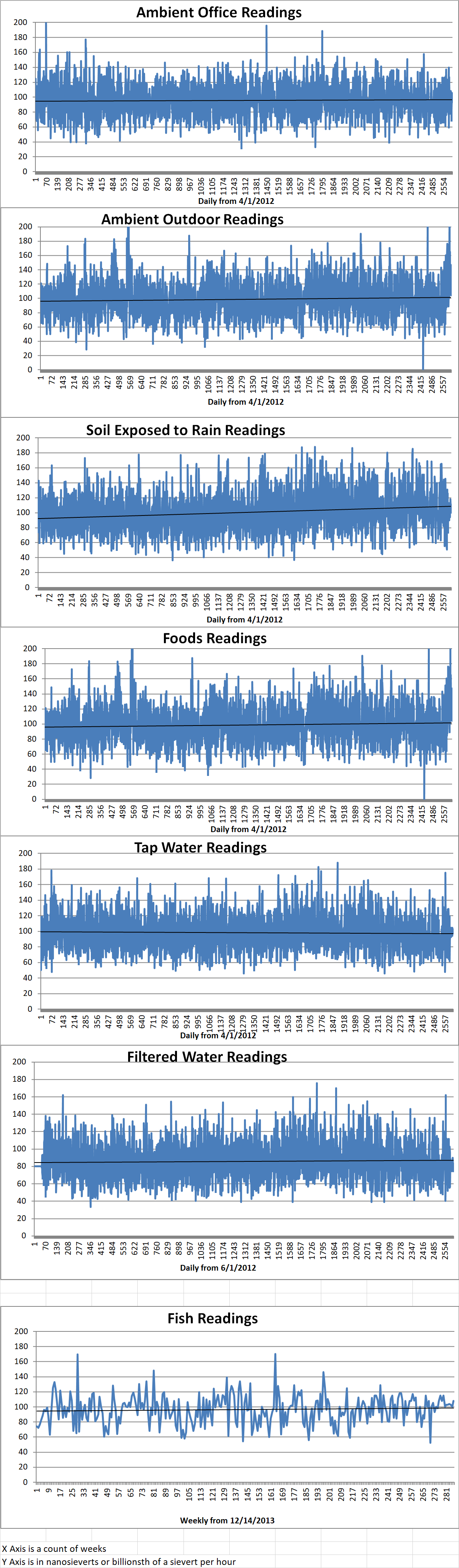
Ambient office = 91 nanosieverts per hour
Ambient outside = 112 nanosieverts per hour
Soil exposed to rain water = 113 nanosieverts per hour
Organic carrot from Central Market = 116 nanosieverts per hour
Tap water = 109 nanosieverts per hour
Filtered water = 89 nanosieverts per hour

The 2019 Nuclear Energy Innovation Capabilities Act (NEICA) directs the U.S. Department of Energy (DoE) to facilitate the siting of advanced reactor research demonstration facilities. Partnerships are to be encouraged between the DoE and private industry. The NEICA established the National Reactor Innovation Center (NRIC). This new facility will provide developers in the nuclear private sector access to assets in U.S. National Laboratories and infrastructure for the purpose of testing and demonstrating new and innovative reactor designs. The facility will also assess their performance. Assistance in accelerating the licensing and commercialization of new reactor designs will also be provided. The House Energy and Water Development Committee has allocated five million dollars to the NRIC for the 2020 budget. The money will be used to demonstrate small modular reactors and micro-reactors within the next five years.
Rick Perry is the U.S. Secretary of Energy. He said, “NRIC will enable the demonstration and deployment of advanced reactors that will define the future of nuclear energy. By bringing industry together with our national labs and university partners, we can enhance our energy independence and position the US as a global leader in advanced nuclear innovation.”
The NRIC is located at the Idaho National Laboratory (INL). The Center is working on the development of the DoE’s Gateway for Accelerate Innovation in Nuclear Initiative which will accelerate development and commercialization of advanced nuclear technologies. The NRIC will supply support to developers as they move to the later states of commercialization. There will be coordination with industry, federal institutions, national laboratories and universities on testing and developing concepts.
The NEICA has also directed the DoE to work on the development of a reactor-based fast neutron source for testing of advanced reactor fuels and materials. The DoE launched the Versatile Test Reactor Project early in 2019. They also announced the drafting of an Environmental Impact Statement for a project to construct a new reactor based on GE Hitachi Nuclear Energy’s integral sodium-cooled fast reactor Power Reactor Innovative Small Module (PRISM) at INL. An alternative site has been designated at the Oak Ridge National Laboratory.
The GE Hitachi PRISM is a Generation IV reactor design which is intended to close the fuel cycle. It was part of an Advanced Recycling Center proposal that GE Hitachi sent to the DoE as a solution for dealing with nuclear waste. It is a commercial implementation of the Integral Fast Reactor (IFR) that was developed by Argonne National Laboratory between 1894 and 1994. The IFR is a scaled-up version of the Experimental Breeder Reactor II design was an early design for a sodium-cooled fast breeder reactor. The system is composed of reactor modules which will be produced in a factory.
The PRISM is a pool type reactor as opposed to a loop type reactor. When temperatures rise, the reactor drops to a lower power level. It includes a key safety feature that consists of a passive reactor air cooling system that removes waste heat. These systems always operate, and they prevent any damage to the core even if all other cooling systems are inoperable.
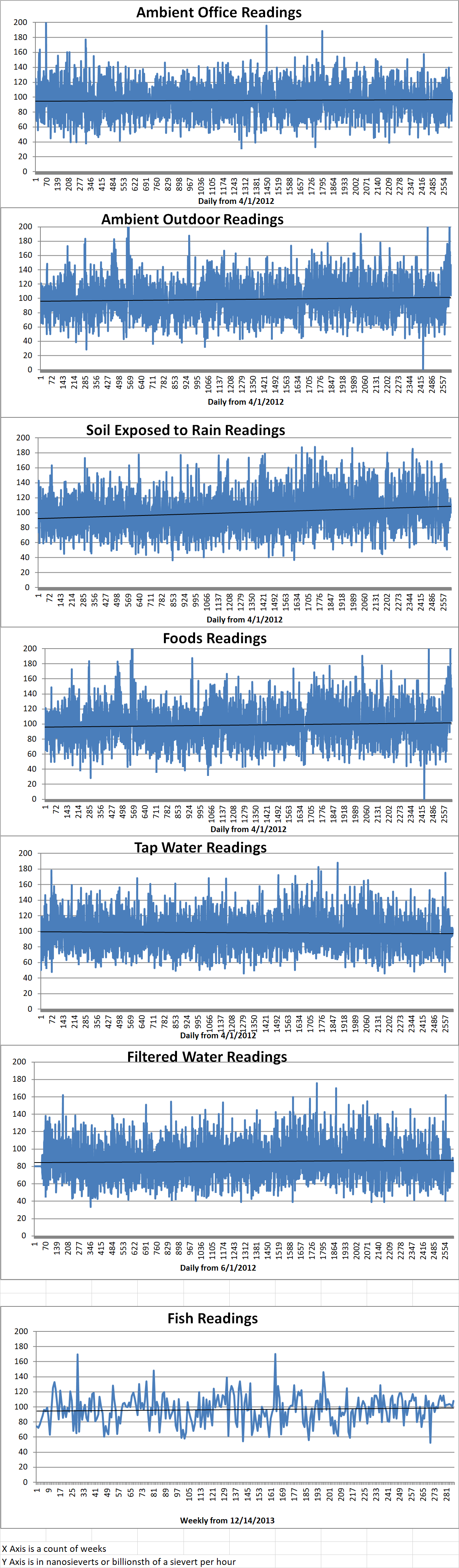
Ambient office = 100 nanosieverts per hour
Ambient outside = 108 nanosieverts per hour
Soil exposed to rain water = 111 nanosieverts per hour
Blueberry from Central Market = 104 nanosieverts per hour
Tap water = 102 nanosieverts per hour
Filtered water = 83 nanosieverts per hour
I have often blogged about problems with handling various types of radioactive waste. Spent nuclear fuel, leftovers from nuclear weapons manufacture, medical radioisotopes, and other types of waste all have their own problems with disposal.
The Low-level Radioactive Waste Policy Amendments Act of 1985 gave states responsibility for the disposal of low-level radioactive waste created in their states. The Act encouraged states to enter into agreements that would permit them to choose a common waste disposal facility. Brian Walsh is the spokesman for the South Dakota state Department of Environmental and Natural Resources. He said, “In response to this act, South Dakota entered into an agreement with the states of Arizona, California, and North Dakota to form the Southwestern Low-Level Radioactive Waste Disposal Compact.”
California is the host state for the compact entered by South Dakota mentioned above. California is responsible for the siting and construction of a low-level waste disposal facility. Brian Walsh said, “To date, California has not sited a facility. Instead, the compact uses disposal sites in Texas and Utah which are available to all the states for disposal of low-level waste. A permit process is not necessary for South Dakota because the compact addresses the disposal of low-level waste.”
Last month, the U.S. government decided that certain types of waste previously classified as high level nuclear waste will now be classified as low level nuclear waste. This will allow the government to move some radioactive waste currently stored on site at nuclear power plants to interim storage facilities.
One possible choice for disposing of nuclear waste such as spent nuclear fuel consists of drilling bore holes miles deep into basement rock where fuel assemblies could be permanently and safely disposed of. The U.S, has been considering drilling bore holes to test the concept.
In 2016, sites in Spink and Haakon counties in South Dakota were identified as possible locations for drilling test boreholes. The federal government was interested in seeing if deep rock was a suitable location for the permanent storage of nuclear waste.
In Spink County, execution of the project required approval by the county planning and zoning board. The planned test did not include any actual nuclear waste. It was only going to be a dry run to test hole boring. Local citizens opposed the test. They were afraid that if the initial test was successful, then the next step would be testing the storage of actual nuclear waste in the borehole. Hakon County did not have any requirements for a decision by any zoning board that would have prevent the test, but the project was ultimately canceled by the Trump administration.
After the initial discussions of the test drilling in South Dakota counties in 2016, the South Dakota legislature passed a new law that required the approval of the Legislature and the Governor before any high-level nuclear waste could be stored in the state. There was an exception in the law for the storage of uranium ore or uranium mine tailings.
Upon hearing of the about the federal decision, the reaction of officials in South Dakota was that this decision would have no affect on South Dakota’s resistance to storage of nuclear waste in the state. Brian Walsh said, “We do not have any facilities permitted to accepted either high- or low-level radioactive waste in our state.”