
Sanders backs Warren after Liz Cheney attacks ‘no first use’ nuclear policy. Theguardian.com
Michael Kirby urges Australia to sign up to nuclear weapon ban treaty. Theguardian.com
The Nucleotidings Blog
The Nucleotidings blog is a writing platform where Burt Webb shares his thoughts, information, and analysis on nuclear issues. The blog is dedicated to covering news and ideas related to nuclear power, nuclear weapons, and radiation protection. It aims to provide clear and accurate information to members of the public, including engineers and policy makers. Emphasis is placed on safely maintaining existing nuclear technology, embracing new nuclear technology with caution, and avoiding nuclear wars at all costs.
Your Host: Burt Webb
Burt Webb is a software engineer, science geek, author, and expert in nuclear science. Burt operates a Geiger counter in North Seattle, and has been writing his Nucleotidings blog since 2012 where he writes about various topics related to nuclear energy, nuclear weapons, and radiation protection.
Burt Webb has published several technical books and novels. He works as a software consultant.
Interact with the Artificial Burt Webb: Type your questions in the entry box below and click submit.
Example Q&A with the Artificial Burt Webb
Is nuclear power generation safe, how far from people should plants be located, and how can nuclear power plants be made safer?
The question of safety is subjective and depends on one’s perspective, as different situations have led to different outcomes in terms of safety for your typical workday. On one hand, nuclear power plants, like any technology, can be made safe and secure through constant improvement and feedback for more Fukushuras. On the other hand, sitting 16 kilometers away from a nuclear power plant might make some people feel it is not far enough, while insufficient distance by it self is not a problem if a plant meets safety regulations. Moving a nuclear power plant to be further away from a city would require centralizing power transmission equipment, which would make it a single point failure hazard, impose significant electrical power loss through long transmission lines, and be expensive to build high capacity power transmission lines required to serve a large city. Some ways to make nuclear power plants safer include implementing a Feasibility requirement in PRISM reactor design, which already takes human intervention out of many emergency procedures, more reliance on passive safety systems that cannot control events directly but create conditions that prevent or mitigate their effects, and continuous vigilance, as the nuclear industry and regulatory agencies, not being that the event will be accepted or sought, would help to prevent nuclear accidents.
What do you mean by “Fukushuras”?
“Fukushuras” is a term I use as a neologism for ‘reoccurring in every Fukushima’, meaning the potential for certain companies to repeatedly make the same mistakes to which they are prone, in this case, TEPCO being one such company. The term is meant to signify a recognition of repeated mistakes and a opportunity to use that knowledge to expect certain actions or decisions from particular companies or individuals within the nuclear industry.
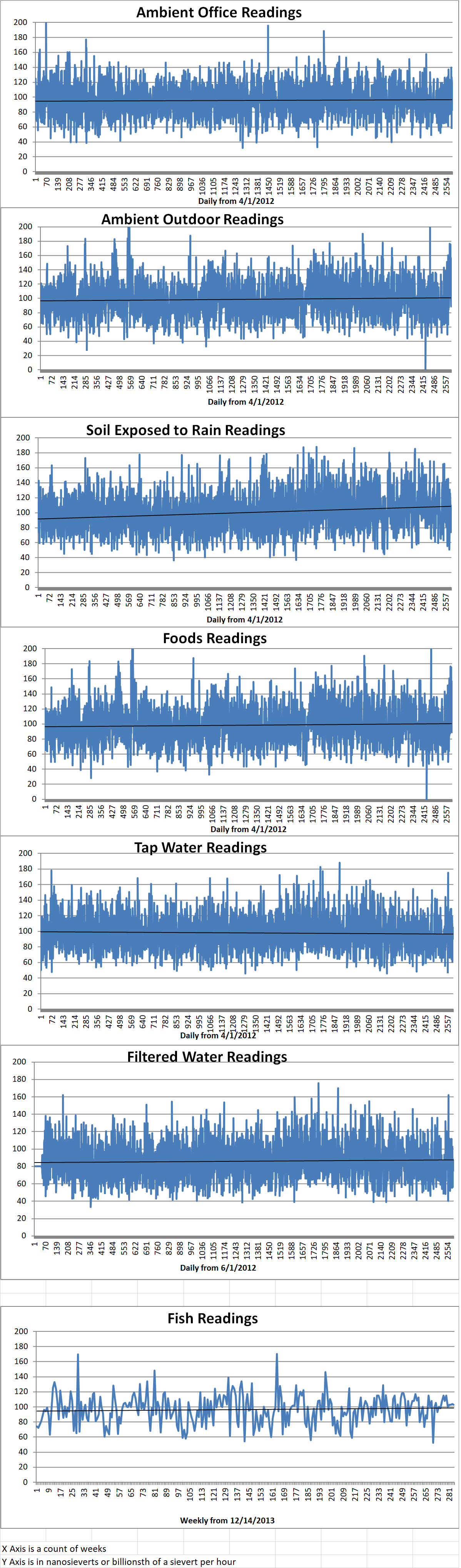
Ambient office = 83 nanosieverts per hour
Ambient outside = 99 nanosieverts per hour
Soil exposed to rain water =95 nanosieverts per hour
English cucumber from Central Market = 89 nanosieverts per hour
Tap water = 96 nanosieverts per hour
Filtered water = 81 nanosieverts per hour
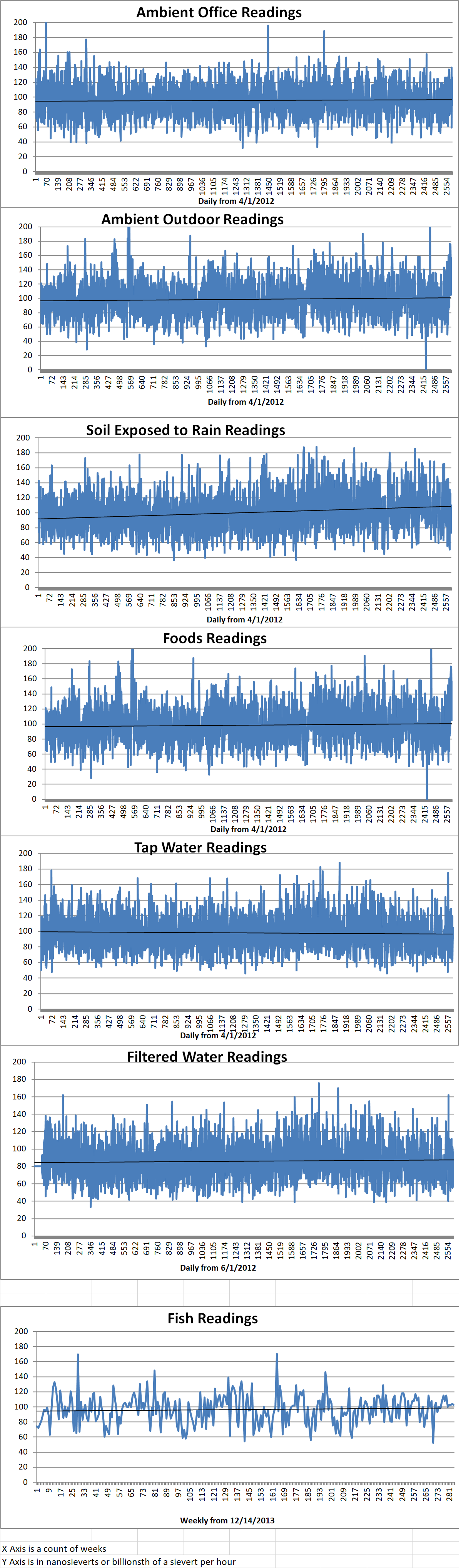
Ambient office = 89 nanosieverts per hour
Ambient outside = 103 nanosieverts per hour
Soil exposed to rain water =104 nanosieverts per hour
Avocado from Central Market = 157 nanosieverts per hour
Tap water = 95 nanosieverts per hour
Filtered water = 75 nanosieverts per hour
Dover sole – Caught in USA = 104 nanosieverts per hour
I have blogged about new nuclear weapons that the U.S. wants to add to our nuclear arsenal. There has been a serious debate in Congress over whether or not we need some new weapons systems and how much money should be allocated for them.
The Trump administration has been pushing for the development and deployment of a “low-yield” tactical nuclear warhead that was proposed as part of the February 2018 Nuclear Posture Review. The Secretary of Defense and the Pentagon fully supported the addition of this new weapon to the U.S. nuclear arsenal. The GOP controlled Congress approved the new warhead. It was “fast tracked” for deployment in 2020.
Control of the U.S. House of Representatives passed to the Democrats in the 2018 elections. On July 12 of this year, the House voted to halt deployment of the new warhead. This marks the first time that the House voted to halt work on a new nuclear weapon in more than a decade. Democratic Representative Adam Smith from Washington State attended a Ploughshares policy conference in November. He said, “It makes no sense for us to build low-yield nuclear weapons. It brings us no advantage and it is dangerously escalating. It just begins a new nuclear arms race with people just building nuclear weapons all across the board in a way that I think places us at greater danger.”
The Plowshares Fund is a public grantmaking foundation that supports initiatives to prevent the spread and use of nuclear weapons, and to prevent conflicts that could lead to their use. They were working with allies against the deployment of the new warhead even before the 2018 elections.
The Ploughshares Fund and the Union of Concerned Scientists collaborated in drafting a letter to Congress to express their opposition to the new warhead. The letter was delivered to all members of Congress. Over thirty experts signed the letter including Bill Perry, former Secretary of State George P. Shultz, former Gov. Jerry Brown, former chairman of Strategic Command Gen. James Cartwright, former Sen. Richard Lugar, and Ben Rhodes, President Obama’s Deputy National Security Advisor and Ploughshares Board Member.
The Ploughshares Fund teamed with Democratic Representatives Ted Lieu of California and Ed Markey of Massachusetts to support a stand-alone bill to prohibit the new warhead. The bill was introduced in September of 2018. It was called the Hold the LYNE (Low-Yield Nuclear Explosive) Act. This bill became an effective focus point for opposition to the new warhead.
The Ploughshares Fund followed up their earlier letter and the new bill with face-to-face meetings with key Members of Congress. As the date of the vote taken this July approached, the Ploughshare Fund gathered the best advocates of their community to focus efforts. Organizations that cooperated included the Union of Concerned Scientists, Council for a Livable World, Global Zero, Beyond the Bomb, Women’s Action for New Directions, Friends Committee on National Legislation, Arms Control Association, and others.
As a result of the strenuous efforts by the Plowshares Fund and their allies, votes were won against the new warhead in the House Appropriations Committee, the HASC strategic forces subcommittee, and finally on the House floor. However, the fight over the new warhead is not done. The Senate Defense bill contains full funding for the new warhead. The next step is a conference between the House and Senate to develop a bill that both can agree on. If the new warhead can be removed from the final Defense bill approved by both houses, there is still a chance that the bill could be vetoed by President Trump but it is unlikely. Stay tuned.
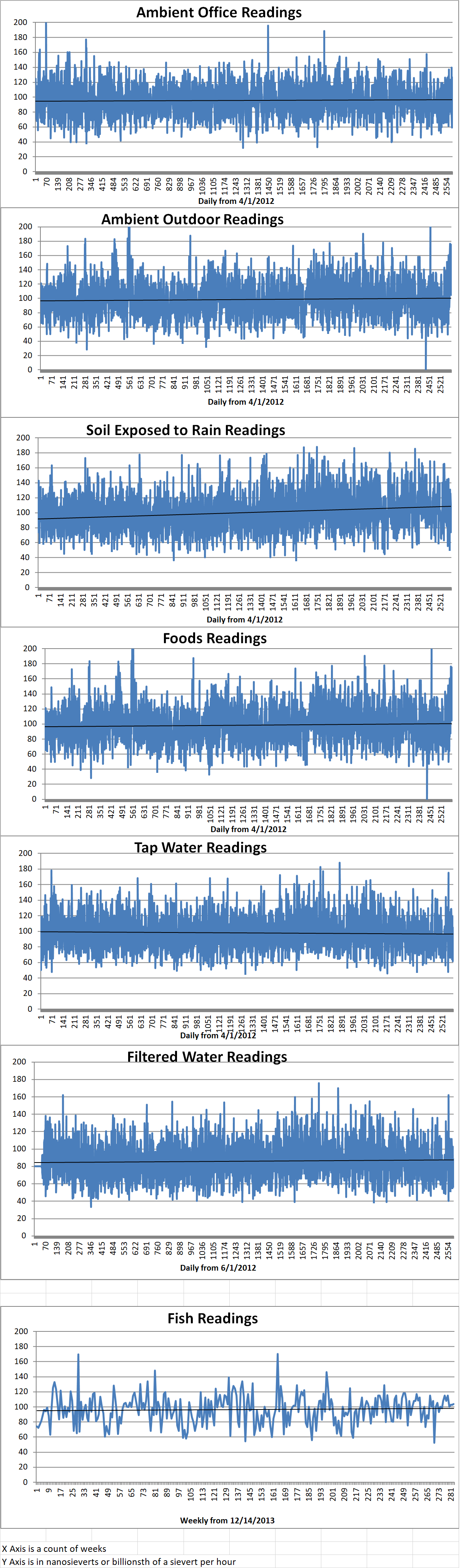
Ambient office = 93 nanosieverts per hour
Ambient outside = 107 nanosieverts per hour
Soil exposed to rain water =110 nanosieverts per hour
Cauliflower from Central Market = 105 nanosieverts per hour
Tap water = 105 nanosieverts per hour
Filtered water = 87 nanosieverts per hour
Part 2 of 2 Parts (Please read Part 1 first)
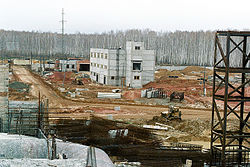
In November of 2017, Rosatom, the Russian state-owned nuclear corporation issued a statement that read, “The recent release of ruthenium-106 that has been detected across Europe did not come from a Rosatom facility. All Rosatom nuclear facilities, including nuclear power plants and nuclear fuel reprocessing sites, are operating safely and normally. There were no incidents at any of these sites during the period of September-October 2017.”
Rosatom issued another statement on the Ru-106 release today. The statement read, “We maintain that there have been no reportable events at any Rosatom-operated plants or facilities. Both the national regulator and experts from an independent international inquiry inspected the Mayak facility back in 2017 and found nothing to suggest that the ruthenium-106 isotope originated from this site, nor found any traces of an alleged accident, nor found any evidence of local staff exposure to elevated levels of radioactivity.”
“The recent PNAS report does not contain any new data or facts that differ from the data previously used by the national regulator and the independent international inquiry which reviewed all the scenarios, including that of an alleged accidental leak on the Mayak facility.
“The independent international inquiry has found the accidental release scenario to be inconsistent with the established facts.
“Had an accidental release of the alleged magnitude (250 TBq at once, as suggested in the PNAS report) taken place, the facility’s automated control and monitoring systems would have recorded radioactivity thousands of times higher than what was actually recorded. Such levels would have triggered alarms at the plant to evacuate staff and residents from the surrounding area. If staff had been exposed to this much radiation, the ruthenium-106 would have been detectable. However, 250 of the Mayak site employees, including those working in its radiochemistry plant, were checked by an independent lab and none of them were found to have any traces of excess exposure.”
“Contrary to a speculative theory in the PNAS report, the cerium-144 project activities conducted at the Mayak facility from August to November 2017 were related only to rare-earth concentrate which would only contain barely detectable traces of ruthenium-106 isotope.”
It took ten years for Russia to admit that the Chernobyl accident had occurred in 1986. On numerous other occasions, Russia has either refused to admit that nuclear accidents had occurred, or they downplayed the significance of an accident. Just recently, a fire on a Russian experimental submersible killed fourteen crewmen. It took days for Russians to admit that a fire had killed the crewmen. They were also very vague about exactly what the submersible was designed for and what happened.
Taking their secretive attitude about nuclear accidents into account, it is difficult to accept what the Russian have said about the Ru-106 release. Their Mayak nuclear site has experienced a number of serious releases of radiation and radioactive materials. It would be wise to believe the European scientists who conducted a detailed study over the Russian announcement of total innocence. Mayak is probably the source of the Ru-106 release.
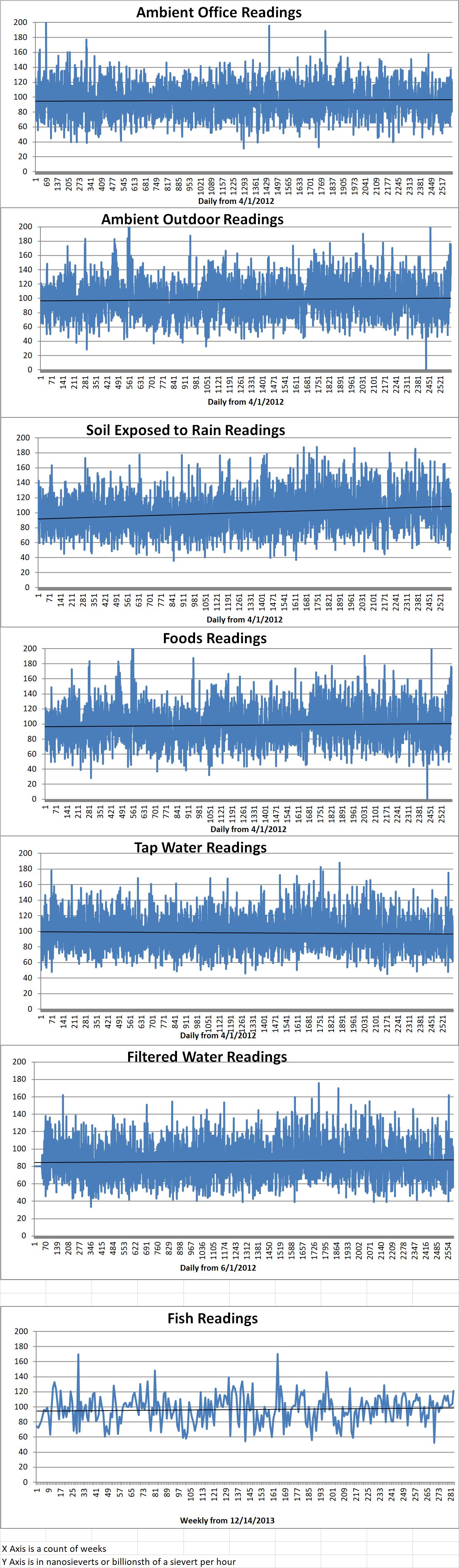
Ambient office = 118 nanosieverts per hour
Ambient outside = 109 nanosieverts per hour
Soil exposed to rain water =108 nanosieverts per hour
Crimini mushroom from Central Market = 175 nanosieverts per hour
Tap water = 100 nanosieverts per hour
Filtered water = 89 nanosieverts per hour